
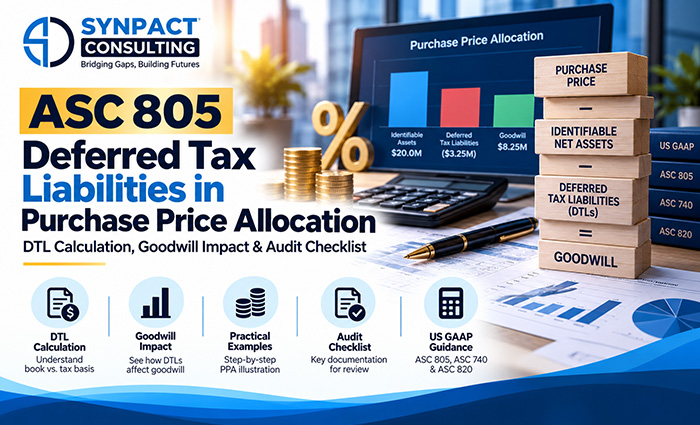
ASC 805 Deferred Tax Liabilities in Purchase Price Allocation: DTL Calculation, Goodwill Impact & Audit Checklist
A purchase price allocation can increase the fair value of acquired intangible assets—and unexpectedly increase goodwill at the same time.
For CFOs, controllers, private equity firms, and M&A accounting teams, this can seem counterintuitive.
If a company recognizes more identifiable assets in an acquisition, shouldn’t goodwill decrease?
Not always.
The answer often involves deferred tax liabilities (DTLs) arising from differences between the financial reporting basis and tax basis of acquired assets.
Under ASC 805, Business Combinations, identifiable acquired assets and assumed liabilities are generally recognized at acquisition-date fair value, subject to specific exceptions. Under ASC 740, Income Taxes, the acquirer must also evaluate the income tax consequences of temporary differences created or identified in the acquisition.
The interaction between these standards can materially affect:
- Acquisition-date deferred tax liabilities and assets.
- Recognized customer relationships and developed technology.
- Inventory and fixed asset fair value adjustments.
- Residual goodwill.
- Future income tax expense and deferred tax reversals.
- Financial statement disclosures and audit documentation.
This guide explains how deferred taxes work in a purchase price allocation, why the tax structure of an acquisition matters, and how finance teams can calculate and document DTLs using practical examples.
Preparing a business combination valuation? Explore Synpact Consulting’s ASC 805 Purchase Price Allocation Services for financial reporting valuation support.
What Are Deferred Tax Liabilities in an ASC 805 Purchase Price Allocation?
A deferred tax liability generally represents future income tax consequences arising from a taxable temporary difference between an asset’s or liability’s financial reporting carrying amount and its tax basis.
In a business combination, temporary differences may arise when acquired assets are recognized at amounts different from their tax bases.
For example, an acquirer may recognize a customer relationship intangible asset at $5 million for financial reporting purposes, while the asset has no corresponding tax basis.
If the relevant future tax consequences produce a taxable temporary difference, the acquirer generally recognizes a deferred tax liability under ASC 740, subject to applicable exceptions.
Basic DTL Calculation
For a straightforward taxable temporary difference:
Deferred Tax Liability = Taxable Temporary Difference × Applicable Enacted Tax Rate
Assume:
- Financial reporting carrying amount of an acquired intangible asset: $5,000,000
- Tax basis: $0
- Taxable temporary difference: $5,000,000
- Assumed enacted tax rate: 25%
The illustrative DTL is:
$5,000,000 × 25% = $1,250,000
The $1.25 million deferred tax liability represents the estimated future tax consequences of the temporary difference under the stated assumptions.
This calculation is simplified. Actual deferred tax measurement requires consideration of enacted tax rates expected to apply when differences reverse, relevant jurisdictions, tax character, and applicable ASC 740 guidance.
How ASC 805 and ASC 740 Work Together
ASC 805 and ASC 740 serve different but connected purposes.
ASC 805: Acquisition Accounting
ASC 805 establishes the framework for recognizing and measuring assets acquired, liabilities assumed, and goodwill in a qualifying business combination.
It generally requires the acquisition method, including identification of the acquirer, determination of the acquisition date, recognition and measurement of relevant assets and liabilities, and calculation of goodwill or a bargain purchase gain.
ASC 740: Income Tax Accounting
ASC 740 addresses the recognition and measurement of current and deferred income taxes.
In a business combination, the acquirer evaluates differences between the financial reporting amounts and tax bases of the acquired assets and assumed liabilities.
Deferred taxes arising from those differences are generally recognized and measured under ASC 740 rather than simply applying an ASC 820 fair value model to the tax balances.
ASC 820: Fair Value Measurement
ASC 820 provides the framework for measuring the fair value of many acquired assets and liabilities.
For example, ASC 820 principles may be relevant when estimating the acquisition-date fair value of customer relationships, developed technology, trade names, inventory, and equipment.
However, deferred tax assets and liabilities are subject to ASC 740 measurement requirements.
Key distinction: The acquired intangible asset may be measured using fair value principles, while the related deferred tax liability is calculated under income tax accounting guidance.
Why Deferred Tax Liabilities Affect Goodwill
Goodwill is generally the residual amount remaining after the applicable acquisition accounting components are considered.
In a simplified 100% acquisition:
Goodwill = Consideration Transferred − Recognized Identifiable Net Assets
Recognized identifiable net assets include acquired assets less assumed liabilities, including applicable deferred tax liabilities.
When a DTL is recognized, it reduces identifiable net assets.
Holding all other acquisition accounting amounts constant, that increases residual goodwill.
Simple Example: Intangible Asset and Goodwill
Assume an acquirer identifies an additional customer relationship asset with a fair value of $4 million.
The asset has no tax basis, and the relevant enacted tax rate is 25%.
The DTL is:
$4,000,000 × 25% = $1,000,000
The net effect on identifiable net assets is:
$4,000,000 − $1,000,000 = $3,000,000
Therefore, the recognition of the customer relationship asset reduces goodwill by $3 million rather than the full $4 million, compared with a simplified starting point that included neither the asset nor its associated DTL.
This is why a purchase price allocation should not be finalized without evaluating the related income tax consequences.
Practical Example: $25 Million Acquisition With Deferred Tax Liabilities
Consider a hypothetical US company acquiring 100% of a privately held operating business.
Assume the transaction qualifies as a business combination under ASC 805.
The purchase consideration is $25 million.
The transaction is structured as a stock acquisition for which the acquired assets generally retain their historical tax bases. For this illustration, assume there is no tax basis step-up election and no other transaction-specific tax adjustments.
Step 1: Identify Acquisition-Date Assets
The valuation team determines the following simplified financial reporting amounts:
| Asset or liability category | Acquisition-date amount |
|---|---|
| Net tangible assets | $6,000,000 |
| Customer relationships | $7,000,000 |
| Developed technology | $4,000,000 |
| Trade name | $2,000,000 |
| Other identifiable net assets | $1,000,000 |
| Identifiable net assets before deferred taxes | $20,000,000 |
Assume the net tangible and other identifiable net asset amounts do not create additional temporary differences in this illustration.
Step 2: Determine Tax Bases
Assume the newly recognized intangible assets have no corresponding tax bases.
| Intangible asset | Book basis | Tax basis | Taxable temporary difference |
|---|---|---|---|
| Customer relationships | $7,000,000 | $0 | $7,000,000 |
| Developed technology | $4,000,000 | $0 | $4,000,000 |
| Trade name | $2,000,000 | $0 | $2,000,000 |
| Total | $13,000,000 | $0 | $13,000,000 |
Step 3: Calculate Deferred Tax Liabilities
Assume an applicable enacted tax rate of 25%.
DTL = $13,000,000 × 25%
Total DTL = $3,250,000
The illustrative DTLs by asset are:
| Asset | Temporary difference | DTL at 25% |
|---|---|---|
| Customer relationships | $7,000,000 | $1,750,000 |
| Developed technology | $4,000,000 | $1,000,000 |
| Trade name | $2,000,000 | $500,000 |
| Total | $13,000,000 | $3,250,000 |
Step 4: Calculate Identifiable Net Assets After Deferred Taxes
Identifiable net assets before deferred taxes:
$20,000,000
Less deferred tax liabilities:
$3,250,000
Identifiable net assets after deferred taxes = $16,750,000
Step 5: Calculate Goodwill
Purchase consideration:
$25,000,000
Less identifiable net assets after deferred taxes:
$16,750,000
Goodwill = $8,250,000
Step 6: Compare Goodwill With and Without the DTL
| PPA component | Without DTL | With DTL |
|---|---|---|
| Purchase consideration | $25,000,000 | $25,000,000 |
| Identifiable net assets before DTL | $20,000,000 | $20,000,000 |
| Deferred tax liability | $0 | ($3,250,000) |
| Net identifiable assets | $20,000,000 | $16,750,000 |
| Residual goodwill | $5,000,000 | $8,250,000 |
Recognizing the $3.25 million DTL increases residual goodwill from $5 million to $8.25 million.
Key takeaway: Ignoring deferred tax liabilities can materially understate goodwill and overstate identifiable net assets in an acquisition.
Example assumptions: This is a simplified 100% acquisition with no noncontrolling interest, previously held equity interest, additional deferred tax assets, tax basis adjustments, or other acquisition accounting exceptions. All amounts are hypothetical.
Why Stock Acquisitions and Taxable Asset Acquisitions Can Produce Different DTLs
The legal and tax structure of an acquisition can materially affect deferred tax accounting.
A transaction’s legal form does not always determine its tax treatment. Relevant elections, jurisdictions, and tax rules must also be considered.
Stock Acquisition Without a Tax Basis Step-Up
In many stock acquisitions, the acquired company’s assets retain their historical tax bases.
For financial reporting purposes, the acquirer may recognize identifiable intangible assets at acquisition-date fair value.
This can create temporary differences.
Example:
- Customer relationship book basis: $6 million
- Customer relationship tax basis: $0
- Temporary difference: $6 million
- Assumed tax rate: 25%
Illustrative DTL:
$1.5 million
Taxable Asset Acquisition With a Corresponding Tax Basis
In some taxable transactions, the acquired assets receive new tax bases.
If an intangible asset has the same initial financial reporting basis and tax basis, no temporary difference arises from that asset at initial recognition.
Example:
- Customer relationship book basis: $6 million
- Customer relationship tax basis: $6 million
- Initial temporary difference: $0
Illustrative initial DTL from that asset:
$0
However, a taxable business combination does not guarantee that all financial reporting and tax bases will match.
Differences in allocation, recognition, or other applicable tax requirements can still produce deferred tax balances.
Transaction Structure Comparison
| Consideration | Stock acquisition without tax step-up | Taxable transaction with tax basis step-up |
|---|---|---|
| Financial reporting basis | Generally acquisition-date fair value for applicable assets | Generally acquisition-date fair value for applicable assets |
| Tax basis | Often carries over | May be adjusted under tax rules |
| New intangible book-tax differences | Common | Depends on tax allocation |
| Initial DTL | May be significant | May be lower or absent for matching bases |
| Goodwill impact | Reflects applicable deferred taxes | Reflects applicable deferred taxes |
A transaction-specific tax basis schedule is essential before finalizing the PPA.
Deferred Taxes on Customer Relationship Valuation
Customer relationships are frequently recognized in acquisitions involving SaaS businesses, professional services firms, manufacturers, distributors, and other companies with recurring customer revenue.
The multi-period excess earnings method (MPEEM) is commonly used to estimate the value of acquired customer relationships.
The method generally considers expected earnings attributable to the existing customer base after deducting appropriate contributory asset charges.
Relevant inputs may include:
- Customer retention and attrition.
- Revenue from existing customers.
- Operating margins.
- Contributory asset charges.
- Asset-specific discount rates.
- Remaining economic life.
Once the acquisition-date fair value is determined, the accounting team should compare the recognized amount with the applicable tax basis.
If the book basis exceeds the tax basis and creates a taxable temporary difference, a DTL may be required.
For additional valuation methodology guidance, read ASC 805 Customer Relationship Valuation Services: MPEEM, Attrition and Audit Support.
Deferred Taxes on Developed Technology and Software
Technology acquisitions frequently involve proprietary software, platforms, algorithms, intellectual property, and other technology-related assets.
An acquired company may have developed software internally without recognizing the full economic value of that technology as an asset in its historical financial statements.
Under ASC 805, qualifying developed technology may be recognized at acquisition-date fair value.
The tax basis may be different from the newly recognized book value.
Illustrative Technology Example
Assume:
- Developed technology fair value: $8 million
- Tax basis: $2 million
- Taxable temporary difference: $6 million
- Enacted tax rate: 25%
Illustrative DTL:
$6 million × 25% = $1.5 million
The tax basis is not assumed to be zero automatically.
It must be established using the relevant tax records and applicable tax rules.
Technology-related temporary differences can be particularly important when the asset’s book amortization period differs from its tax recovery period.
For a broader discussion of software acquisition accounting, explore ASC 805 Purchase Price Allocation for Software Acquisitions.
Deferred Tax Liabilities on Inventory Step-Up
Inventory fair value adjustments can create temporary differences in a business combination.
Suppose an acquired manufacturer reports inventory with a historical tax basis of $3 million.
The acquisition-date fair value is $3.8 million.
If the tax basis remains $3 million, the taxable temporary difference is:
$3.8 million − $3 million = $800,000
At an assumed enacted tax rate of 25%:
DTL = $800,000 × 25% = $200,000
The $200,000 DTL affects the acquisition-date identifiable net asset calculation.
As the acquired inventory is sold and the temporary difference reverses, the associated deferred tax balance is reassessed and reduced as appropriate.
The inventory step-up can also affect post-acquisition cost of goods sold and gross profit.
For detailed inventory valuation methodology, see ASC 805 Inventory Step-Up Valuation: Fair Value Methods and PPA Audit Checklist.
Deferred Tax Assets in a Business Combination
Not all acquisition-related temporary differences create deferred tax liabilities.
Some differences may create deferred tax assets (DTAs).
A deferred tax asset may arise from deductible temporary differences or qualifying tax attributes, subject to applicable recognition and measurement requirements.
Examples can include:
- Deductible temporary differences.
- Certain accrued obligations.
- Qualifying net operating loss carryforwards.
- Tax credit carryforwards.
- Other tax attributes that meet the relevant requirements.
Example: Acquired Deductible Temporary Difference
Assume an acquired business has a qualifying deductible temporary difference of $2 million.
At an assumed enacted tax rate of 25%:
Gross DTA = $500,000
However, recognizing a gross DTA does not necessarily mean the full amount will remain on the balance sheet.
Under ASC 740, a valuation allowance is required when, based on the weight of available evidence, it is more likely than not that some portion or all of a deferred tax asset will not be realized.
Why DTA Valuation Allowances Matter
The acquirer may need to evaluate:
- Future taxable income.
- Reversal of existing taxable temporary differences.
- Relevant tax planning strategies.
- Tax loss expiration periods.
- Jurisdiction-specific limitations.
- Restrictions on acquired tax attributes.
An acquisition may also affect the realizability assessment of existing deferred tax assets.
The accounting consequences depend on whether the relevant DTA belongs to the acquiree or acquirer and the nature and timing of the new information.
The Initial Recognition of Goodwill and Deferred Taxes
Goodwill requires special consideration under ASC 740.
A common mistake is to assume that every difference between book goodwill and tax goodwill automatically creates a deferred tax liability.
That is not correct.
ASC 740 includes a specific exception relating to the portion of goodwill for which amortization is not deductible for tax purposes.
Therefore, an acquirer should not simply multiply all book goodwill by the enacted tax rate and record an additional DTL.
Why This Matters
An unrestricted DTL calculation on nondeductible goodwill could create an artificial circular increase in goodwill.
The appropriate analysis should distinguish:
- Identifiable intangible assets with temporary differences.
- Tax-deductible goodwill.
- Nondeductible goodwill.
- Other relevant tax basis differences.
- Applicable recognition exceptions.
The tax treatment of goodwill can differ significantly between transactions.
A transaction-specific ASC 740 analysis is essential.
Illustrative Journal Entries for Deferred Taxes in a PPA
Journal entries depend on the structure of the acquisition, the accounting records being consolidated, and the applicable recognition requirements.
The following examples are simplified and illustrate only the relevant acquisition accounting effects.
Example 1: Recognizing an Acquired Intangible Asset and Related DTL
Assume a qualifying customer relationship intangible asset has:
- Fair value: $4 million
- Tax basis: $0
- DTL: $1 million
An illustrative acquisition accounting adjustment is:
| Account | Debit | Credit |
|---|---|---|
| Customer relationship intangible asset | $4,000,000 | — |
| Deferred tax liability | — | $1,000,000 |
| Acquisition accounting allocation / goodwill reconciliation | — | $3,000,000 |
The third line represents the simplified balancing effect within the overall acquisition accounting allocation, not a stand-alone operating gain or an entry to be posted without the complete business combination journal entries.
Example 2: Subsequent DTL Reversal
Assume an acquired intangible asset is amortized for book purposes, reducing a taxable temporary difference by $400,000 during a reporting period.
At an unchanged 25% tax rate, and assuming no corresponding tax basis change:
DTL reversal = $400,000 × 25% = $100,000
A simplified entry for the deferred tax effect is:
| Account | Debit | Credit |
|---|---|---|
| Deferred tax liability | $100,000 | — |
| Deferred income tax benefit | — | $100,000 |
This illustrates the deferred component only.
Actual income tax accounting must also consider current taxes, other temporary differences, tax rates, and relevant reporting requirements.
How DTLs Reverse After an Acquisition
A deferred tax liability is not necessarily permanent.
It generally reverses as the underlying taxable temporary difference reverses.
For example, an acquired finite-lived intangible asset may be amortized for financial reporting purposes over its estimated useful life.
If the asset has no tax basis, its book carrying amount may decline over time while the tax basis remains zero.
The taxable temporary difference therefore decreases as the asset is amortized, assuming no other changes.
Five-Year Simplified Example
Assume:
- Initial intangible asset book basis: $5 million
- Tax basis: $0
- Book amortization: $1 million annually
- Enacted tax rate: 25%
- No impairment, tax basis changes, or tax rate changes
| Year-end | Remaining book basis | Tax basis | DTL |
|---|---|---|---|
| Acquisition date | $5,000,000 | $0 | $1,250,000 |
| Year 1 | $4,000,000 | $0 | $1,000,000 |
| Year 2 | $3,000,000 | $0 | $750,000 |
| Year 3 | $2,000,000 | $0 | $500,000 |
| Year 4 | $1,000,000 | $0 | $250,000 |
| Year 5 | $0 | $0 | $0 |
Under these assumptions, the DTL decreases by $250,000 annually.
Real-world deferred tax schedules may be more complex because tax amortization, book amortization, impairment, enacted tax rates, and other temporary differences can change.
Common Deferred Tax Mistakes in Purchase Price Allocation
1. Ignoring the Tax Structure of the Acquisition
A stock acquisition and a taxable asset acquisition may produce different tax bases and deferred tax consequences.
2. Assuming Every Intangible Asset Has Zero Tax Basis
Tax basis must be supported by the relevant records and applicable tax rules.
3. Applying the Wrong Tax Rate
Deferred taxes generally use enacted tax rates expected to apply when temporary differences reverse, considering relevant jurisdictions and tax law.
4. Treating Deferred Taxes as Fair Value Measurements
DTAs and DTLs follow ASC 740 measurement requirements rather than being valued as ordinary ASC 820 fair value liabilities.
5. Discounting Deferred Tax Liabilities
Deferred tax liabilities arising from ordinary temporary differences are generally not discounted under ASC 740.
6. Ignoring the Goodwill Impact
Recognizing a DTL can reduce identifiable net assets and increase residual goodwill.
7. Recognizing DTLs on Nondeductible Goodwill Without Evaluating the Exception
Goodwill has specific deferred tax recognition considerations that must be assessed separately.
8. Overlooking Deferred Tax Assets
Acquired deductible temporary differences and qualifying tax attributes may require DTA recognition and valuation allowance analysis.
9. Failing to Reconcile Book and Tax Bases
A valuation report alone may not provide sufficient information to calculate deferred taxes.
10. Using One Tax Rate Without Considering Jurisdictions
Businesses operating across multiple jurisdictions may require separate temporary difference and tax rate analyses.
11. Misclassifying Measurement-Period Adjustments
Adjustments based on acquisition-date facts may receive different treatment from changes caused by subsequent events.
12. Failing to Maintain a DTL Reversal Schedule
Finance teams should track how temporary differences and deferred tax balances change after acquisition.
ASC 805 Deferred Tax Audit Checklist
A supportable PPA tax analysis should connect acquisition accounting, valuation, and tax records.
A. Transaction Documentation
- Executed purchase agreement.
- Transaction structure memorandum.
- Acquisition date.
- Tax elections and relevant legal documents.
- Consideration transferred.
- Closing balance sheet.
- Identification of relevant tax jurisdictions.
B. Asset Valuation Documentation
- Acquisition-date intangible asset valuations.
- Customer relationship valuation schedules.
- Developed technology valuation.
- Trade name and trademark valuation.
- Inventory step-up analysis.
- Fixed asset fair value adjustments.
- Supporting valuation assumptions.
C. Tax Basis Documentation
- Historical tax basis schedules.
- Tax depreciation and amortization records.
- Relevant tax returns.
- Tax allocation schedules.
- Tax basis step-up calculations, where applicable.
- Information about tax attributes and carryforwards.
D. Deferred Tax Calculations
- Book-to-tax basis reconciliation.
- Temporary difference schedules.
- Applicable enacted tax rates.
- DTL calculations.
- DTA calculations.
- Valuation allowance analysis.
- Relevant tax jurisdiction analysis.
E. Goodwill Reconciliation
- Acquisition consideration.
- Identifiable acquired assets and assumed liabilities.
- Deferred tax balances.
- Noncontrolling interest, if applicable.
- Previously held equity interest, if applicable.
- Residual goodwill calculation.
- Evaluation of goodwill-related tax exceptions.
F. Post-Acquisition Tracking
- Intangible asset amortization schedules.
- Tax amortization schedules.
- DTL reversal schedules.
- DTA utilization schedules.
- Tax rate change assessments.
- Financial statement disclosure support.
The required evidence depends on the transaction’s complexity, materiality, and applicable reporting requirements.
ASC 805 Measurement-Period Adjustments and Deferred Taxes
The ASC 805 measurement period allows certain provisional acquisition accounting amounts to be adjusted when additional information becomes available about facts and circumstances that existed at the acquisition date.
The measurement period ends when the necessary information is obtained or determined unavailable and cannot exceed one year from the acquisition date.
For example, an acquirer may initially recognize a provisional value for acquired customer relationships.
If additional acquisition-date information results in a valid measurement-period adjustment to that asset, the related deferred tax consequences may also need to be reassessed.
Changes to acquisition-date amounts and related goodwill should be evaluated under the applicable measurement-period requirements.
However, a change in tax law, a post-acquisition operating event, or newly developed expectations does not automatically qualify as a measurement-period adjustment.
The accounting team should distinguish new evidence about acquisition-date conditions from events that arose after the acquisition.
When Should a Company Engage a PPA Valuation Specialist?
Specialist support may be particularly useful when:
- The acquisition includes significant intangible assets.
- Book and tax bases differ materially.
- The transaction involves a complex tax structure.
- Customer relationship or technology valuations are significant.
- The company has material inventory or fixed asset step-ups.
- Deferred tax balances materially affect goodwill.
- Multiple tax jurisdictions are involved.
- A private equity portfolio company completes several acquisitions.
- Auditors request detailed valuation and tax basis support.
- Management needs a coordinated acquisition accounting timetable.
A valuation specialist can help establish supportable fair values and related documentation.
Tax basis determinations, tax elections, DTA realizability, and final income tax accounting should be coordinated with appropriately qualified tax and accounting advisers.
How Synpact Consulting Supports ASC 805 Purchase Price Allocation
A purchase price allocation is most useful when individual valuation analyses reconcile with the overall acquisition accounting.
Synpact Consulting provides valuation and financial modeling services relevant to business combinations and acquisition-date fair value measurement.
Our relevant service areas include:
- ASC 805 Purchase Price Allocation.
- Customer Relationship Valuation.
- Developed Technology Valuation.
- Trade Name and Intangible Asset Valuation.
- ASC 820 Fair Value Measurement.
- Financial Modeling and Sensitivity Analysis.
- Identifiable Net Asset and Goodwill Reconciliation.
- Valuation Documentation and Audit Support.
Our valuation work can support the financial reporting analysis used by management and its tax advisers when evaluating deferred tax consequences.
Need acquisition-related valuation support?
Explore Synpact Consulting’s Purchase Price Allocation Services.
Or use our Valuation Assistant to identify the valuation service that may fit your requirements.
Frequently Asked Questions About ASC 805 Deferred Tax Liabilities
What is a deferred tax liability in purchase price allocation?
A DTL generally represents future income tax consequences of taxable temporary differences between financial reporting carrying amounts and tax bases of acquired assets or assumed liabilities.
Why do deferred tax liabilities increase goodwill?
Recognizing a DTL reduces identifiable net assets. Holding other acquisition accounting components constant, this increases residual goodwill.
How do you calculate a DTL under ASC 805?
For a straightforward taxable temporary difference, multiply the difference between the financial reporting carrying amount and tax basis by the applicable enacted tax rate, subject to relevant ASC 740 requirements.
Does every intangible asset create a DTL?
No. A DTL depends on the asset’s book basis, tax basis, applicable tax law, and relevant recognition requirements.
Do stock acquisitions create deferred tax liabilities?
They can. When acquired assets retain historical tax bases but are recognized at higher fair values for financial reporting, taxable temporary differences may arise.
Do taxable asset acquisitions eliminate DTLs?
Not necessarily. If book and tax bases match, no initial temporary difference arises from that asset. Other differences may still create deferred taxes.
Does inventory step-up create a deferred tax liability?
It may. If the acquired inventory’s financial reporting basis exceeds its tax basis, a taxable temporary difference may arise.
Are deferred tax liabilities discounted?
Generally, no. ASC 740 prohibits discounting deferred tax liabilities arising from ordinary temporary differences, subject to specific exceptions.
Is a DTL recognized on nondeductible goodwill?
ASC 740 includes a specific exception for certain goodwill-related temporary differences when goodwill amortization is not deductible for tax purposes. The relevant facts must be evaluated.
What is the difference between a DTA and DTL?
A DTA generally represents future deductible tax consequences or qualifying tax benefits, while a DTL generally represents future taxable consequences.
Can deferred tax assets affect goodwill?
Yes. Acquisition-date recognition and measurement of qualifying acquired DTAs and related valuation allowances may affect the identifiable net assets and resulting goodwill, depending on the applicable guidance.
How do DTLs reverse after an acquisition?
DTLs generally reverse as the underlying taxable temporary differences reverse through amortization, depreciation, asset recovery, settlement, or other relevant events.
Does ASC 805 determine the deferred tax rate?
Deferred tax measurement follows ASC 740 and relevant enacted tax rates rather than a rate independently established by ASC 805.
What documentation is needed for an audit-ready DTL calculation?
Common documents include acquisition agreements, valuation reports, tax basis schedules, temporary difference calculations, enacted tax rate support, DTA and DTL schedules, and goodwill reconciliations.
Can Synpact Consulting help with PPA valuations involving deferred taxes?
Synpact Consulting provides purchase price allocation, intangible asset valuation, fair value measurement, and supporting financial modeling services. Transaction-specific tax conclusions should be coordinated with qualified tax advisers.
Final Thoughts: Deferred Taxes Are a Critical Part of ASC 805 Purchase Price Allocation
A purchase price allocation does not end when the acquired assets have been valued.
The financial reporting amounts must also be evaluated against the relevant tax bases.
The interaction between ASC 805 and ASC 740 can materially change the identifiable net assets and goodwill recognized in a business combination.
For CFOs, controllers, and M&A teams, the process should connect:
Acquisition Structure → Asset Fair Values → Tax Bases → Temporary Differences → Deferred Taxes → Goodwill Reconciliation → Audit Documentation
Ignoring any of these steps can lead to incomplete acquisition accounting and unsupported financial reporting conclusions.
A well-documented PPA should therefore bring together valuation specialists, financial reporting teams, and tax advisers early in the process.
Need ASC 805 Purchase Price Allocation Support?
Synpact Consulting helps businesses and financial professionals address complex valuation and financial reporting requirements.
Explore Our ASC 805 Purchase Price Allocation Services
Start With Our Valuation Assistant
Synpact Consulting — Bridging Gaps, Building Futures
Website: https://synpactconsulting.com/
Email: [email protected]