
The Role of Discounted Cash Flows in Business Valuation
Discounted Cash Flows (DCF) play a pivotal role in the realm of business valuation, serving as a fundamental methodology for assessing the worth of a company. Understanding DCF not only provides insights into the financial health of a business but also aids in strategic decision-making processes. When evaluating a business for investment, acquisition, or other financial decisions, one of the most fundamental techniques used to assess value is the Discounted Cash Flow (DCF) method. While there are multiple approaches to business valuation, the DCF method remains one of the most comprehensive and accurate ways to determine the present value of a company based on its expected future cash flows.
In this blog, we’ll explore the key components of the DCF method, its significance in business valuation, and how it helps investors, financial analysts, and business owners make more informed decisions.
Understanding Discounted Cash Flows (DCF)
Discounted Cash Flow (DCF) is a valuation method that calculates the present value of a business based on its projected future cash flows. The core concept of DCF is that the value of money decreases over time, a concept known as the time value of money. In simple terms, a dollar received today is worth more than a dollar received in the future due to its earning potential.
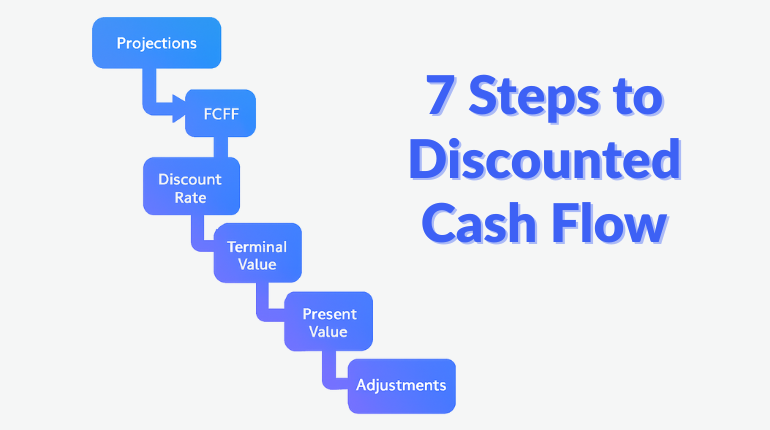
To estimate the value of a business using DCF, you first project the company’s future cash flows for a set number of years and then apply a discount rate to these future cash flows to account for the time value of money. The sum of these discounted future cash flows gives you the net present value (NPV), which is considered the business’s intrinsic value.
The Key Components of DCF
A Discounted Cash Flow analysis involves several components, each contributing to a thorough valuation:
Forecasted Cash Flows:
The first step in performing a DCF is forecasting the company’s future cash flows. These cash flows typically represent the company’s free cash flow (FCF), which is the cash a business generates after accounting for capital expenditures, taxes, and working capital needs. The more accurately these cash flows are projected, the more reliable the DCF analysis will be.
Free Cash Flow = Operating Cash Flow – Capital Expenditures
Discount Rate:
The discount rate is one of the most crucial factors in DCF analysis. It reflects the risk of investing in the business and accounts for the time value of money. The discount rate is often based on the company’s Weighted Average Cost of Capital (WACC), which is the average rate of return the company is expected to pay to its investors, weighted by the proportion of debt and equity in its capital structure.
WACC Formula:
WACC=(E/V×Re)+(D/V×Rd×(1−Tc))
Where:
E = Market value of equity
D = Market value of debt
V = Total market value of the company (equity + debt)
Re = Cost of equity
Rd = Cost of debt
Tc = Corporate tax rate
Terminal Value:
Since businesses typically don’t stop operating after a set period (like five years), a DCF model accounts for the value beyond the forecast period by calculating the terminal value (TV). The terminal value represents the business’s value at the end of the projection period, assuming a steady growth rate.
Two common methods to calculate terminal value include:
1. Perpetuity Growth Model
TV={FCFn×(1+g)}/(r-g)
Where:
FCFₙ = Final year’s projected free cash flow
g = Perpetuity growth rate
r = Discount rate
2. Exit Multiple Method:
TV is calculated by applying a multiple (such as EV/EBITDA) to the company’s projected financial metric at the end of the forecast period
Calculating Net Present Value (NPV):
Finally, after calculating the projected cash flows for each year and determining the terminal value, the present value of all future cash flows is summed up to give the net present value (NPV). This represents the intrinsic value of the business today.
Example: Using the projected free cash flows, the discount rate, and the terminal value, an investor can calculate the present value of the business. If the present value of the first five years of cash flows sums to $5 million, and the terminal value is $26.57 million, the total value of the business would be the sum of both, discounted at the appropriate rate.
Importance of DCF in Business Valuation
Provides a Detailed Financial Perspective:
DCF offers a highly detailed and forward-looking perspective on the value of a business, which is crucial for investors and financial analysts. It takes into account a company’s cash-generating ability, growth prospects, and financial structure, rather than relying on historical financial performance alone. This makes DCF an effective tool for valuing high-growth companies or those with a significant future outlook.
Helps Assess Long-Term Investment Viability:
Since the DCF model projects future cash flows, it can provide valuable insights into whether an investment in a company is likely to provide sufficient returns over time. It’s particularly useful when evaluating businesses that may not have high earnings today but are expected to grow substantially in the future.
Allows for Better Comparisons Across Companies:
The DCF method is not just useful for individual valuations; it also allows for a better comparison between companies in the same industry. Investors can use the DCF to compare businesses on a like-for-like basis, based on their future earnings potential, risk levels, and growth rates.
Assesses Sensitivity to Key Assumptions:
A DCF analysis involves several assumptions, such as projected growth rates, discount rates, and terminal values. Conducting sensitivity analysis on these assumptions helps investors understand how changes in critical variables can impact the valuation, providing a clearer picture of potential risks.
Best Practices for Using DCF in Valuation
Data Quality and Assumptions
When using DCF in valuation, it is crucial to ensure the quality of data inputs and assumptions. This includes reliable financial information, realistic growth projections, and appropriate discount rates. Maintaining transparency and documenting the rationale behind key assumptions can enhance the credibility and robustness of the DCF analysis.
Sensitivity Analysis and Scenario Planning
To mitigate the uncertainties associated with DCF analysis, conducting sensitivity analysis and scenario planning is essential. By exploring various scenarios based on different assumptions and variables, analysts can assess the potential impact on the valuation outcomes. This helps in understanding the range of possible values and identifying key drivers of value within the DCF model.
When DCF May Not Be the Best Choice for Valuation
The Discounted Cash Flow (DCF) method is a key valuation tool that estimates a business’s intrinsic value by forecasting its future cash flows and discounting them to their present value using a discount rate, typically based on the company’s cost of capital. It offers a forward-looking perspective, focusing on the company’s ability to generate future value. However, DCF has its challenges, including the difficulty of accurately forecasting long-term cash flows, selecting the right discount rate, and estimating terminal value. It is also highly sensitive to assumptions, meaning small changes in input values can significantly impact the final result.
DCF is not ideal for businesses with highly unpredictable cash flows, such as startups, speculative ventures, or companies in volatile industries. It also becomes less reliable when there is insufficient financial data, or when long-term forecasts are too speculative. In cases where market conditions or growth assumptions are uncertain, alternative valuation methods like comparable company analysis or precedent transactions may offer a more accurate assessment of value.
Conclusion
Discounted Cash Flow (DCF) is an essential tool in business valuation that provides a thorough, long-term perspective on a company’s intrinsic value. By accounting for future cash flows, growth prospects, and the time value of money, DCF helps investors make more informed, data-driven decisions. While it is an invaluable method for assessing business value, it requires careful consideration of the inputs and assumptions used in the model. Looking ahead, future trends in DCF methodology may involve the integration of advanced analytics, machine learning algorithms, and artificial intelligence to enhance the accuracy and efficiency of valuation models. Additionally, there may be developments in incorporating non-financial metrics, such as environmental, social, and governance factors, into DCF analysis to reflect a more holistic view of a company’s value. As technology and methodologies evolve, the landscape of DCF analysis is expected to continue progressing towards more sophisticated and comprehensive valuation approaches.
How Outsourcing Discounted Cash Flow (DCF) Valuation Can Benefit Your Business
- Cost Efficiency: Valuating a business using DCF requires not only expertise but also access to specialized tools and up-to-date market data. Developing and maintaining an in-house team to handle such intricate tasks can be expensive, especially for smaller businesses or those with fluctuating needs. By outsourcing DCF valuation, businesses can leverage the expertise of financial professionals without the high costs of hiring full-time staff or purchasing costly software. This results in substantial cost savings while still ensuring high-quality, reliable valuation results.
- Expert Support: Discounted Cash Flow analysis is complex, requiring a deep understanding of financial modeling, market conditions, and the time value of money. Outsourcing DCF analysis to a KPO firm provides access to a team of experts who are skilled in financial analysis and valuation methodologies. These professionals have the knowledge and tools to produce precise projections, calculate accurate discount rates, and assess the sensitivity of key assumptions. By relying on experts, businesses can ensure that their DCF valuations are based on sound assumptions and are reflective of the most current financial data.
- Scalability: As your business grows or your needs evolve, outsourcing offers the flexibility to scale services up or down according to your specific requirements. Whether you need a one-time valuation or ongoing support for multiple projects, a KPO firm can provide a tailored solution that adapts to your changing business environment. This scalability ensures that you get the necessary support without overburdening your internal resources, allowing you to focus on core business activities.
Outsourcing DCF valuation to a professional KPO firm ensures that your company benefits from cost-effective, expert-led, and scalable financial analysis. At our KPO Firm Synpact Consulting, we specialize in providing high-quality DCF analysis services that support strategic decision-making, helping you make informed and profitable choices. Let us help you unlock the true value of your business through precise and reliable valuation services.