
The Use of Comparable Company Analysis (CCA) in Valuation
In the world of business valuation, professionals often employ a variety of methods to estimate the value of a company. One of the most commonly used approaches is the Comparable Company Analysis (CCA). This method is especially popular for its simplicity, transparency, and relative ease of application. By leveraging the market data of similar publicly traded companies, the CCA allows for a grounded and comparative approach to determining a company’s value.
In this blog, we will explore how Comparable Company Analysis works, its application in valuation, and why it’s one of the go-to methods for many finance professionals.
Understanding Comparable Company Analysis (CCA)
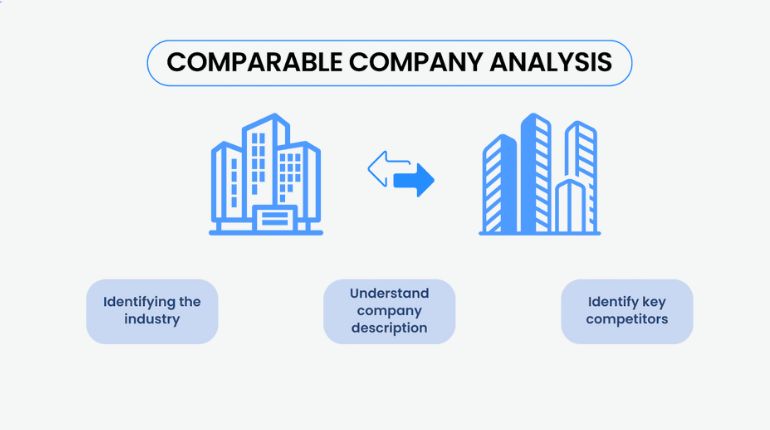
Comparable Company Analysis (CCA) is a valuation method used to determine the value of a company by comparing it to similar publicly traded companies in the same industry. The purpose of CCA is to assess the relative value of a company by analyzing its financial metrics in comparison to its peers. These “comparable companies” are typically in the same industry, with similar financial characteristics and operating models.
The basic premise of CCA is that companies within the same sector or industry are subject to similar market conditions, and thus their valuations can be used to assess the value of a target company. This comparative approach is useful for determining an appropriate valuation multiple, which is then applied to the company’s own financial metrics (such as revenue, EBITDA, or net income).
Key Steps in Performing Comparable Company Analysis
- Identify Comparable Companies: The first step in CCA is to identify a set of comparable companies that are in the same industry and share similar characteristics. These characteristics could include size, market segment, growth potential, and geographical presence.
- Select Valuation Multiples: After identifying the comparables, the next step is to select relevant valuation multiples. These multiples can vary depending on the company’s industry and the stage of development. Common multiples include:
Price-to-Earnings (P/E) Ratio: Useful for comparing profit generation.
Enterprise Value-to-EBITDA (EV/EBITDA): Commonly used for comparing companies in capital-intensive industries.
Price-to-Sales (P/S) Ratio: Often used for startups or companies with little to no profit.
- Apply the Valuation Multiple: Once the multiples have been selected, they are applied to the target company’s financial metrics. This is where the estimated value is derived.
- Adjustments for Differences: After applying the multiples, adjustments may be necessary. Factors such as the size, growth rate, profitability, and capital structure of the company may necessitate an upward or downward adjustment to the final valuation.
Why Use Comparable Company Analysis?
CCA is favored by many professionals due to its relative ease of use and the fact that it leverages real market data. Here are some of the reasons why it’s widely adopted:
- Market-Driven: Since CCA relies on publicly available market data, it is often considered an objective method of valuation.
- Simplicity: Compared to other complex valuation methods, such as Discounted Cash Flow (DCF) analysis, CCA is relatively straightforward, especially when the right set of comparable companies can be identified.
- Industry-Relevant: By focusing on companies within the same industry, it reflects the market sentiment specific to that sector.
- Quick Estimation: It provides a quick way to get a benchmark valuation, especially when detailed financial data is hard to come by.
Factors to Consider When Identifying Comparable Companies in Valuation
- Industry and Sector: The first and most important factor when selecting comparables is ensuring that the companies operate in the same industry or sector as the target company. Businesses within the same industry face similar market dynamics, regulatory environments, and consumer behaviors, making them the most relevant for comparison.
- Company Size and Market Capitalization: The size of the company, often measured by its market capitalization (for publicly traded companies), plays a critical role in determining comparability. Companies of similar size typically face similar operational challenges, access to capital, and growth prospects.
Smaller companies tend to have higher growth potential but also higher risk. In contrast, larger companies might offer more stability but slower growth. When selecting comparable companies, it’s important to ensure that the market capitalization (or revenue size) of the comparables is within a reasonable range of the target company to ensure the multiples are meaningful.
- Geographic Location and Market Exposure: Geography plays a key role in identifying comparable companies. The target company’s geographic market exposure—whether it operates domestically or internationally – will significantly affect its valuation. Companies operating in emerging markets, for instance, may face different risks and growth opportunities compared to companies in developed markets.
Key factors to consider here include:
Domestic vs. International: Are the companies primarily domestic players, or do they operate globally?
Regional Exposure: Are the comparables exposed to the same economic conditions, consumer preferences, and regulatory environments?
- Growth Rate and Financial Metrics: A company’s growth rate is a critical factor in identifying comparables, especially in industries where companies’ performance can vary widely based on growth potential. Growth can be assessed in terms of revenue, EBITDA, or net income over a given period.
If the target company has high growth rates in comparison to its peers, it may justify a higher valuation multiple. Conversely, a slower-growing company may warrant a lower multiple.
Limitations of Comparable Company Analysis
While CCA is a valuable tool, it is not without its drawbacks. Some of the key limitations include:
- Availability of Comparable Companies: Finding truly comparable companies can be challenging, especially in niche industries or for private companies with no publicly traded peers.
- Market Fluctuations: The approach is heavily influenced by market conditions. During times of market volatility, comparable company data may not accurately reflect the fundamental value of a company.
- Lack of Precision: Unlike DCF, which forecasts the future cash flows of a business, CCA doesn’t account for specific strategic initiatives or operational changes that could significantly impact a company’s value.
Real-World Example of Comparable Company Analysis
Imagine a private SaaS (Software as a Service) company, Tech Soft Solutions, is seeking to determine its value. Tech Soft is profitable and has demonstrated consistent revenue growth over the last few years. To perform a CCA, a finance professional would:
- Identify Comparable Companies: They might look at publicly traded companies in the SaaS space that are similar in size, growth trajectory, and geographic location. Potential comparable could include companies like Salesforce, HubSpot, and Fresh works.
- Select Valuation Multiples: Since Tech Soft is a SaaS company, revenue growth is a key indicator of value. Therefore, the finance professional may choose the Enterprise Value-to-Revenue (EV/Revenue) multiple. The typical EV/Revenue multiple for SaaS companies could range from 6x to 12x, depending on growth prospects and profitability.
- Apply the Multiple: Suppose Tech Soft Solutions generates $50 million in annual revenue, and the average EV/Revenue multiple for comparable SaaS companies is 8x. By applying this multiple to Tech Soft’s revenue, the estimated value of the company is $400 million (50 million x 8).
- Adjustments for Differences: If Tech Soft is growing faster than the comparable, or has unique intellectual property, an adjustment may be made to increase the multiple. Alternatively, if the company’s growth prospects are lower, the multiple may be reduced.
By using CCA, Tech Soft’s valuation has been quickly derived based on industry benchmarks. This approach provides a reasonable estimate that reflects the current market conditions and comparable companies.
Conclusion
Comparable Company Analysis (CCA) is a powerful and effective method for estimating the value of a company, particularly when market data is readily available. While it offers a quick and industry-relevant approach to valuation, it requires careful selection of comparable companies and an understanding of the broader market conditions.
For businesses undergoing valuation, whether for mergers, acquisitions, or investment purposes, CCA can provide a strong foundation for estimating company value. However, like any valuation method, it should be used in conjunction with other approaches (such as Discounted Cash Flow analysis or precedent transaction analysis) to ensure a more comprehensive and accurate assessment.
By mastering the nuances of CCA and understanding its strengths and limitations, financial professionals can provide valuable insights into a company’s market position, helping both buyers and sellers make informed decisions.
How Outsourcing Comparable Company Analysis (CCA) Can Benefit Your Business
- Cost Efficiency: Performing CCA requires significant expertise in financial analysis and access to up-to-date market data. For businesses with limited resources, maintaining an in-house team of experts to conduct this type of analysis can be costly. By outsourcing CCA, you can reduce overhead costs and avoid the expenses associated with hiring specialized talent or subscribing to expensive financial databases. Instead, you gain access to top-tier financial professionals who can deliver reliable valuation analysis at a fraction of the cost.
- Expert Support: CCA requires a thorough understanding of the industry, financial metrics, and valuation multiples. By outsourcing to a KPO firm, your business benefits from a team of experienced analysts who specialize in CCA and other financial valuation methods. These professionals have the expertise to identify truly comparable companies, select the appropriate valuation multiples, and ensure that all adjustments are accurately made. This expert support helps ensure that your valuation is both accurate and reflective of current market conditions.
- Scalability: As your business grows, the need for valuation support can fluctuate. Whether you’re expanding into new markets or engaging in complex transactions, outsourcing provides the scalability needed to meet your evolving needs. A KPO firm can quickly adjust its resources to handle increased demand, whether it’s performing CCA for multiple companies, during mergers and acquisitions, or for other business assessments. This flexibility ensures that you have the right support at every stage of your growth, without the need to hire additional staff or invest in new infrastructure.
By outsourcing CCA to a professional KPO firm, you can access cost-effective, expert-driven, and scalable valuation services that empower your business to make informed decisions with confidence. At our KPO Firm Synpact Consulting, we specialize in providing high-quality financial analysis and valuation services tailored to your unique needs, helping you unlock the true potential of your business. Let us support your growth with accurate and reliable CCA analysis.