
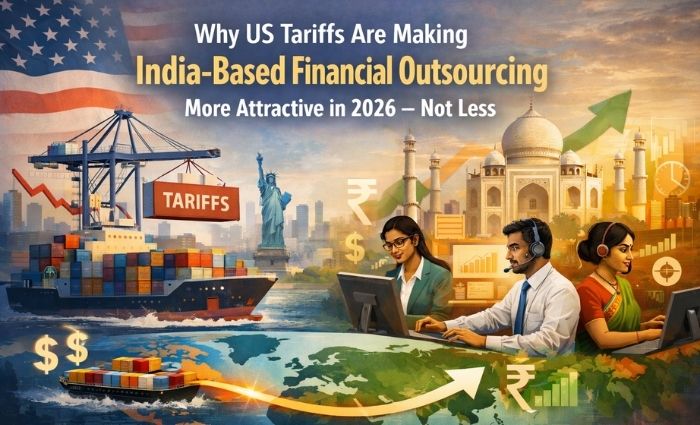
Why US Tariffs Are Making India-Based Financial Outsourcing More Attractive in 2026 — Not Less
The Instinct That Is Leading CFOs to the Wrong Conclusion
When US tariffs on Indian goods hit 50% in early 2026 — before the February bilateral trade deal brought them back to 18% — the instinct in many US finance teams was to pause or reconsider any India-based outsourcing relationship. The reasoning was intuitive, if imprecise: tariffs mean trade restrictions, trade restrictions apply to India, therefore anything coming from India is now riskier or more expensive.
This instinct is understandable. It is also wrong — in a specific, measurable way that matters for every CFO, advisory firm partner, and investment bank MD who makes outsourcing decisions.
This blog explains exactly why the tariff logic does not apply to financial services outsourcing, why the broader economic consequences of the 2026 tariff shock are actively increasing demand for India-based analytical services, and why firms that paused their India outsourcing relationships in Q1 2026 on tariff grounds are now reconsidering that decision with some urgency.
The Core Misunderstanding: Tariffs Apply to Goods, Not Services
The 2026 US tariff regime — which at its peak applied a combined 50% rate to most Indian goods exports before the February bilateral deal reduced this to 18% — is a tax on the physical import of merchandise across the US border. It applies to the container of auto parts arriving at the Port of Los Angeles. It applies to the textile shipment clearing customs in New Jersey. It does not apply to the valuation report delivered as a PDF through an encrypted portal, the LBO model emailed from Bengaluru at 6 AM EST, or the financial analysis produced by an India-based analyst and reviewed by a US partner before going to a client.
Financial services, knowledge work, and professional services are classified as service exports under World Trade Organization framework and US trade law. They are governed by the General Agreement on Trade in Services (GATS), not the tariff schedules that apply to goods. No US tariff — not the reciprocal tariffs, not the punitive duties, not the sector-specific levies — creates a cost increase on the delivery of a valuation report, a pitch book, a CFO dashboard, or a financial model from India to a US client.
This distinction is not a loophole or a technicality. It is a fundamental feature of how trade policy works. Manufacturing outsourcing to India — the production of physical goods in Indian factories for import to the US — is affected by tariffs. Financial and analytical outsourcing to India — the production of intellectual work product delivered digitally — is not.
The practical implication: a US advisory firm using Synpact for white-label valuation reports, 409A outsourcing, or investment banking support experienced zero cost increase from the 2026 tariff regime. The cost structure that made India-based financial outsourcing attractive in January 2026 is identical in April 2026. The tariff shock changed nothing for knowledge work.
What the February 2026 US-India Trade Deal Actually Means
On February 2, 2026, the Trump administration announced a bilateral trade deal with India that reduced tariffs on most Indian goods from 50% to 18%, effective immediately. The deal also removed the additional 25% punitive duty that had been linked to India’s Russian oil purchases, in exchange for India committing to shift crude oil sourcing away from Russia toward US suppliers.
For financial and knowledge services outsourcing, this deal was largely irrelevant — because services were never subject to the goods tariffs in the first place. But the deal’s existence carries an important signal: the US-India trade relationship in 2026 is moving toward closer alignment, not toward the decoupling that characterised US-China trade policy over the same period.
While China faces 125%+ tariff rates on goods imports — making US companies actively seek to diversify away from Chinese manufacturing and supply chain dependencies — India is positioned as a preferred trade partner under the February 2026 framework. The geopolitical direction of travel favours India as a strategic outsourcing destination, not just an economically attractive one.
For US firms evaluating long-term outsourcing relationships, this geopolitical dimension matters. An outsourcing relationship with an Indian firm sits within a trade framework that is structurally supportive and moving in the direction of further liberalisation. The same cannot be said of outsourcing relationships with firms in jurisdictions facing escalating tariff and trade pressure.
Five Ways the Tariff Shock Is Increasing Demand for India-Based Financial Services
Here is where the counter-intuitive argument becomes concrete. The 2026 tariff shock has not just left India-based financial outsourcing unaffected — it has actively generated new demand for the specific services that India-based analytical firms provide. Here are the five mechanisms.
1. The Supply Chain Restructuring Valuation Wave
The most immediate and direct effect of the 2026 tariff shock on US companies is a forced reconsideration of global supply chains. A manufacturer that sourced 60% of its components from China at 125% tariff rates faces an urgent decision: absorb the cost increase, find alternative sourcing, reshore to the US, or some combination of all three. Each of these decisions requires financial modelling, scenario analysis, and in many cases a formal valuation of the restructuring options.
The volume of supply chain restructuring advisory work generated by the tariff shock — DCF analysis of reshoring decisions, valuation of divested offshore operations, purchase price analysis for acquisitions of US manufacturing assets — is substantial and growing. This work lands in the laps of advisory firms, boutique investment banks, and CPA practices that are already resource-constrained. The analytical overflow from this restructuring wave goes to India-based outsourcing teams.
Synpact’s M&A valuation and financial modelling capabilities are directly relevant to this restructuring work. The tariff shock created the demand; India-based analytical capacity meets it.
2. WACC and DCF Model Updates Across Every Existing Valuation
Every company that carried a goodwill balance, an intangible asset, or a long-lived asset on its balance sheet as of January 1, 2026 now faces a potential impairment trigger. The tariff shock increased discount rates through its effect on risk premia, compressed revenue projections for trade-exposed businesses, and introduced scenario uncertainty that most pre-2026 DCF models did not contemplate.
The practical result: every advisory firm with corporate clients in manufacturing, retail, consumer goods, or export-dependent sectors is fielding requests to update existing valuation models for tariff impact. These are not full new engagements — but they are billable, time-consuming model updates that require a financial analyst’s time.
The firms that can deliver these updates quickly — because their analytical capacity is not capped by headcount — are the firms that win the engagement. India-based outsourcing is the fastest way to add analytical capacity without hiring. Our audit-ready valuation guide covers the documentation standard for these updated models, including how to document tariff assumptions in a defensible way.
3. US Firms Cutting Domestic Costs — and Outsourcing More
The tariff shock has compressed margins across tariff-exposed industries. Companies facing higher input costs, lower revenue projections, and increased capital expenditure requirements for reshoring are under pressure to reduce operating costs wherever they can. Professional services and back-office functions — including finance and accounting — are the first areas where cost reduction measures land.
This creates a direct demand driver for financial outsourcing. A CFO whose company faces a 15% EBITDA compression from tariff-driven input cost increases is simultaneously under pressure from the board to reduce SG&A. The virtual CFO, financial reporting, and management reporting functions that India-based teams can provide at 60–70% below US cost are directly responsive to this board pressure.
The tariff shock that created the margin compression is the same force driving the decision to outsource financial functions to India. The cause and the solution are connected.
4. PE Funds Requiring More Frequent Portfolio Valuations
Private equity funds with portfolio companies in tariff-exposed sectors — manufacturing, consumer goods, retail, automotive supply chain — face a specific obligation: their LPs and auditors expect quarterly portfolio valuations that reflect material changes in the economic environment. The tariff shock is, unambiguously, a material change.
Quarterly NAV calculations that were previously routine model refreshes now require substantive assumption updates: revised revenue projections, updated WACC inputs reflecting higher risk premia, and in some cases scenario-weighted valuations that explicitly model tariff outcomes. This is more analytical work per quarter than the pre-tariff environment required.
PE funds using Synpact for quarterly NAV calculations and ILPA reporting are getting this additional work absorbed within their existing outsourcing relationship. Funds that do this work in-house are finding that quarterly valuation cycles that previously took two weeks are now taking four — which creates pressure to add analytical capacity or outsource the function.
5. The Advisory Capacity Crunch — More Work, Same Headcount
The cumulative effect of the above four demand drivers — supply chain restructuring advisory, WACC and DCF model updates, corporate cost reduction outsourcing, and PE portfolio revaluation — is a significant increase in the volume of financial analytical work hitting US advisory firms simultaneously. This work arrives at firms whose headcount was sized for the pre-tariff environment and cannot be quickly expanded.
The talent market for financial analysts in the US has not become easier in Q1 2026. Associate and analyst hiring timelines are measured in months, not weeks. The analytical capacity crunch is real: more work, the same number of people to do it, and no fast path to headcount expansion.
India-based outsourcing is the fast path. A white-label engagement with Synpact can be live within one week of onboarding — providing analytical capacity that would take 3–6 months to hire for. The tariff-driven demand surge is the accelerant; the India-based outsourcing model is the release valve.
The Cost Advantage Is Unchanged — and Now Relatively Larger
Before the tariff shock, the cost advantage of India-based financial outsourcing over US domestic delivery was approximately 70–80% for analytical work. A 409A valuation that costs $1,500–$2,000 to produce through Synpact costs $6,000–$8,500 to produce with a US in-house analyst on a fully-loaded basis. A CIM financial section that costs $4,500–$6,500 from Synpact costs $25,000–$40,000 in US associate time.
The tariff shock has not changed this cost differential for financial services — because services are not subject to tariffs. But it has changed the comparative attractiveness of this differential in one specific way: US domestic costs are increasing.
US companies facing margin compression from tariff-driven input cost increases are under pressure to raise prices where they can and cut costs where they must. Labor cost inflation in professional services — already elevated — is not reversing. A firm that was paying a senior associate $130,000 fully loaded in 2025 is paying more in 2026, not less.
The India-based outsourcing cost advantage, always real, is now relatively larger in an environment where US domestic costs are rising while the outsourcing cost is unchanged. The 70–80% cost differential may be closer to 75–85% in the current environment, as US labor costs continue upward while India-based analytical costs remain stable.
The Objections — Addressed Directly
“India’s tariff situation is unstable — what if services get targeted next?”
The February 2026 US-India bilateral trade deal specifically reduced goods tariffs and included no provision affecting services trade. Services trade between the US and India is governed by GATS, which neither country has proposed to modify in a way that would affect professional services outsourcing. The political direction of the US-India relationship in 2026 — characterised by the February deal, defence cooperation deepening, and India’s commitments to reduce non-tariff barriers — is toward closer alignment, not toward trade restriction.
If services trade between the US and India were to be affected by future policy — which would require a fundamental reversal of current trade policy direction — the lead time on any such change would be measured in years, not weeks. An outsourcing relationship built today would have ample time to adapt to any policy change that was genuinely on the horizon. Deferring outsourcing decisions today based on a policy risk that does not currently exist and shows no signs of emerging is not risk management — it is missed opportunity.
“Our US clients are anxious about India generally — will they push back?”
The relevant question is not where the analytical work is produced — it is whether the work product meets the quality standard and carries the right professional credential. A white-label valuation report delivered under your firm’s brand, reviewed by your partner, and meeting the audit-ready standard described in our audit quality guide is indistinguishable to your end client from a report produced entirely in-house.
Your client does not see where the analytical work was produced. They see your firm’s logo, your firm’s methodology, and your firm’s professional responsibility on the report. The production geography is not visible to them — and in most cases, they would not regard it as material if it were. The Big Four have operated India delivery centres for decades. Your clients are accustomed to the model; they simply may not know it by that name.
“The data security risk with India is higher in a tariff-tension environment.”
Data security risk is a function of the security protocols of the specific firm you work with — not the geography. Synpact’s data security framework — documented in our technical security guide — includes encrypted portal transfer, named-analyst NDAs, role-based access controls, and AES-256 encryption at rest. These protocols are independent of the US-India tariff relationship and are unchanged by the 2026 trade environment.
The conflation of tariff risk (a trade policy question) with data security risk (a technology and operational question) is a category error. They are unrelated. A firm that has robust data security protocols in 2026 has the same protocols regardless of what the goods tariff rate between the US and India happens to be.
What This Means Practically — The Decision Framework
For a US advisory firm, CPA practice, or boutique investment bank evaluating India-based financial outsourcing in April 2026, here is the decision framework that the tariff context suggests.
If you paused India outsourcing on tariff grounds in Q1 2026: The pause was based on a misapplication of goods tariff logic to services outsourcing. The cost structure, the quality capability, and the delivery model you were evaluating in late 2025 are unchanged. Reopen the evaluation.
If you are new to India-based outsourcing and tariffs made you hesitate: The hesitation is understandable but misplaced for knowledge work. Services are not goods. The cost advantage is real and unchanged. The demand surge from the tariff shock is making outsourcing more necessary, not less. Start with a pilot engagement — one 409A, one comps screen, one CIM financial section — to verify quality before committing to a steady-state model.
If you are already using India-based outsourcing and wondering whether to expand: The tariff environment is an argument for expansion, not contraction. Your domestic analytical capacity is under more pressure than it was six months ago. The cost advantage is relatively larger. The demand from tariff-driven restructuring work is real and growing. Now is the time to onboard additional engagement types, not to wait.
If you are a PE fund or corporate CFO evaluating outsourced financial reporting: The tariff-driven margin compression that is making this conversation happen is the same force making India-based outsourced CFO services and finance and accounting outsourcing more economically compelling. The board pressure to reduce SG&A and the availability of high-quality India-based financial services are pointed at the same solution.
Conclusion: The Tariff Shock Is a Demand Driver, Not a Demand Suppressor
The 2026 tariff shock has created a specific set of conditions that make India-based financial and analytical outsourcing more attractive, not less:
It increased the volume of valuation, restructuring advisory, and financial modelling work hitting US advisory firms simultaneously. It increased cost pressure on US domestic operations, making the India cost advantage relatively larger. It left the services outsourcing model entirely unaffected by the tariff regime itself. And it reinforced India’s position as the preferred outsourcing destination within a US trade policy framework that is moving toward closer India alignment, not away from it.
The firms that understood this in Q1 2026 — while their peers were pausing on tariff anxiety — are now delivering more engagements, at higher margin, with faster turnaround than their in-house-only competitors. The tariff shock was a demand accelerant for their outsourcing model. It can be the same for yours.
The starting point is a single pilot engagement. Submit a brief, receive a sample in your format, verify the quality, and make the decision based on what you see — not on a tariff narrative that does not apply to the service you are evaluating.
→ Start a Pilot Engagement or Request a Sample Report — One Business Day Delivery
Related Reading on Synpact Blog:
- White-Label Valuation Reports From India: The Complete Process Guide
- White-Label 409A Valuation: The Complete Guide for Startups and CPA Firms
- White-Label Pitch Books, CIMs, and LBO Models for Boutique Investment Banks
- Data Security in Valuation Outsourcing — A Technical Checklist
- What “Audit-Ready” Actually Means in 2026
- PE-Backed Consolidation of India’s Outsourcing Firms: What US Advisory Firms Need to Know
- The GCC vs Outsourcing Dilemma for US CPA Firms
- Is AI Making India Valuation Analysts Obsolete — Or Making Them Better?
- Valuation Services — Synpact
- Investment Banking Support — Synpact
- Finance & Accounting Outsourcing — Synpact