
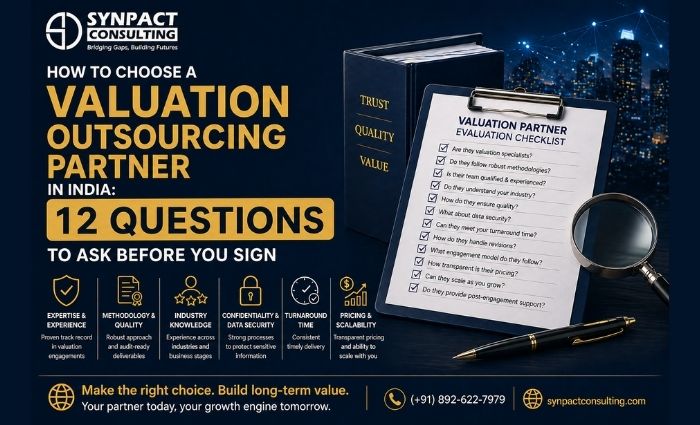
How to Choose a Valuation Outsourcing Partner in India: 12 Questions to Ask Before You Sign
You Have Already Made the Decision. Now Make It Right.
If you are reading this blog, you have almost certainly already decided to outsource valuation work to India. The cost case is clear — 70–85% below US boutique pricing for equivalent analytical quality. The talent case is clear — CFA-qualified analysts at India cost structures. The time-zone case is clear — briefs submitted at 6pm EST, models waiting at 9am.
What you have not decided is which provider to use.
This is the decision that most outsourcing guides ignore — because most guides are written by providers who want to skip the vendor evaluation and get to the engagement. This blog takes the opposite approach. It gives you 12 specific, technically grounded questions that separate the providers who are genuinely audit-ready from the ones who use the phrase as marketing language.
Every question in this guide has a correct answer. A provider who answers all 12 correctly — with documentation to back each answer — has earned the right to handle your deal data, your cap tables, and your client relationships. A provider who deflects, answers vaguely, or cannot produce documentation for any of these questions is telling you something important.
Apply every question to Synpact as well as to our competitors. The correct answers are documented throughout our published guides — and we will produce evidence for every one of them before your first engagement begins.
The 12 Questions — With the Correct Answers
Question 1: “What are your analyst credentials — and can you name the specific person who will work on my engagement?”
Why it matters: “CFA-qualified team” is easy marketing language. What matters is whether the specific analyst assigned to your 409A, PPA, or goodwill impairment test has the credentials and experience to handle the methodology your engagement requires.
The correct answer: Names a specific analyst or senior analyst who will own your engagement. Confirms their credential level — CFA charterholder, CFA Level 2 or 3 candidate, CA, or MBA with valuation specialisation. Describes their specific experience with your engagement type — not just “valuation work” but “Series B PWERM 409As” or “ASC 805 PPAs for mid-market technology acquisitions.”
The red flag answer: “Our team of CFA-qualified analysts will handle your work.” Anonymity in analyst assignment is a service model flag — it typically means engagement routing to whoever is available, not relationship-based specialist assignment.
At Synpact, every engagement has a named lead analyst and a named senior reviewer. You know who is working on your report before work begins.
Question 2: “Can you show me a sample report for the specific engagement type I need — before I commit?”
Why it matters: Every provider claims audit-ready quality. A sample report proves it — or disproves it — before you have invested time, money, or client trust in the relationship.
The correct answer: Produces an anonymised sample report for your specific engagement type within 24–48 hours. The sample should be a complete report — not a template, not a redacted skeleton — with all six elements of audit-ready documentation present: methodology narrative, WACC with sourced inputs, comparable selection with exclusion rationale, sensitivity analysis, assumption sourcing, and reviewer credentials.
The red flag answer: “We can share a template” or “our reports are confidential so we can’t share samples.” A provider who cannot produce a sample anonymised report has either not done the engagement type before or does not have the quality to show.
Apply the audit-ready 20-question checklist to any sample you receive. If the sample does not pass the checklist, the provider is not operating at the 2026 audit standard.
Question 3: “What is your WACC documentation standard — specifically how do you source the risk-free rate, ERP, and beta?”
Why it matters: WACC documentation is the most commonly inadequate element in India-based valuation reports — and the most frequently challenged by Big Four auditors in 2026. A provider who cannot describe their WACC sourcing protocol in detail is not operating at the current audit documentation standard.
The correct answer: Describes sourcing the risk-free rate from the current government bond yield published on the valuation date (Federal Reserve, Bank of England, RBA — specific source named). Describes using a named ERP study (Damodaran, Kroll/Duff & Phelps — specific study and year). Describes beta peer group construction with unlevering methodology. References current market conditions — the provider should acknowledge that 2026 WACCs are materially different from 2021 or 2022 WACCs as documented in our WACC rebuild guide.
The red flag answer: “We use standard industry WACC inputs” or “our WACC is based on market data.” No specificity = no documentation standard = audit challenge risk.
Question 4: “How do you handle comparable company selection — and how do you document exclusions?”
Why it matters: A comparable set without documented exclusion rationale is not audit-ready. Auditors reviewing a 409A or PPA will ask why specific companies were excluded — and a provider who cannot answer has a methodology gap, not a documentation gap.
The correct answer: Describes a specific screening process — initial screen criteria applied in Capital IQ or PitchBook, followed by qualitative review, followed by documented exclusion of companies that do not meet comparability standards (wrong revenue size, wrong business model, wrong geopolitical exposure in 2026). Confirms that exclusion rationale is documented in the report itself.
The red flag answer: “We screen for the most relevant comparables.” Describing the outcome without describing the process means there is no documented process — only a result.
Question 5: “What is your file transfer method for sensitive client data?”
Why it matters: This is the data security question that most clients forget to ask — and the most important one. As we documented in detail in our data security guide, NDA language does not protect cap tables and deal financials. Technical controls do.
The correct answer: “All file transfer occurs through an encrypted client portal. We do not accept or send sensitive financial data via email attachment.” Names a specific portal or platform. Confirms audit logs, MFA, and per-engagement access control.
The red flag answer: “We use secure email” or “you can send files via Google Drive.” Email and consumer cloud storage are not adequate security controls for M&A deal data and cap tables.
If a provider’s primary file transfer method is email, disqualify them regardless of their other answers.
Question 6: “What happens to my data after the engagement is complete?”
Why it matters: Data retention after engagement completion is one of the most overlooked security risks in outsourcing — and the one that creates the longest-tail exposure.
The correct answer: Describes a specific deletion timeline (Synpact’s standard is 30 days post-delivery), confirms deletion of all files including working documents and analyst device copies, and provides written confirmation of deletion on request.
The red flag answer: “We keep client files for reference in case you need them later.” Indefinite retention of your deal data on an external provider’s systems is an unacceptable security posture for any engagement involving M&A data, fund LP economics, or cap table information.
Question 7: “Are you currently PE-backed or in discussions with PE investors?”
Why it matters: PE-backed outsourcing firms experience predictable post-acquisition dynamics — talent attrition, service standardisation, pricing pressure upward, and data systems integration — as we documented in detail in our PE consolidation blog. Knowing your provider’s ownership structure before you sign protects you from building a relationship on a foundation that may shift significantly within 24 months.
The correct answer: Clear, specific answer about current ownership structure. Independent firms should confirm founder or employee ownership with no institutional equity. If the provider is PE-backed, they should confirm it — and you should ask the follow-up questions about what has changed post-acquisition.
The red flag answer: Deflection, vagueness, or “we don’t discuss our ownership structure.” A provider who will not confirm their ownership structure is not providing the transparency a long-term outsourcing relationship requires.
Question 8: “What is your turnaround time — and what happens if you miss it?”
Why it matters: Turnaround commitments without consequences are not commitments — they are aspirations. Advisory firms and PE funds operating with audit deadlines, option grant windows, and deal timelines need turnaround reliability, not best-effort estimates.
The correct answer: States a specific standard turnaround (Synpact: 7–10 business days) and a specific rush turnaround (3–5 business days with premium). Describes what happens if a deadline is missed — proactive communication, no additional charge for the delay, escalation process. Confirms that rush premiums are quoted upfront, not applied post-delivery.
The red flag answer: “We typically deliver within 1–2 weeks.” Vague timelines with no accountability structure are a service quality flag.
Question 9: “Is your pricing fixed-fee or hourly — and what is included?”
Why it matters: Hourly billing for valuation work creates misaligned incentives and unpredictable final costs. A provider who quotes hourly without a cap is transferring cost risk to you — and providing no certainty on the final invoice. As we documented in our 409A cost guide, revision charges, auditor liaison fees, and database surcharges can add 30–50% to an hourly-billed headline price.
The correct answer: Fixed fee, quoted before work begins, with revisions within scope included at no additional charge. Database costs (Capital IQ, PitchBook) included. Auditor liaison support included. The price you see in the quote is the price on the invoice.
The red flag answer: “We price based on hours” or “our base fee is X plus additional charges for revisions.” Walk away from any provider who cannot commit to a fixed fee before work begins.
Question 10: “How do you handle the current macro environment in your valuations — specifically the post-Iran ceasefire oil price shift and current WACC inputs?”
Why it matters: This question separates providers who are analytically current from those using 2022 or 2023 assumptions in 2026 valuations. As we documented in our Iran ceasefire valuation blog and WACC rebuild guide, outdated WACC inputs are the most common basis for Big Four audit challenge in 2026.
The correct answer: Demonstrates awareness of current market conditions — current risk-free rates (~4.3% for USD), current ERP estimates (~5.0–5.5%), and the specific post-ceasefire oil price scenario analysis required for energy sector engagements. Describes a process for updating WACC inputs to the valuation date on every engagement — not using prior-period assumptions.
The red flag answer: “We use standard industry discount rates.” Any answer that does not reference current market data is a strong indicator that the provider is applying stale inputs to current engagements.
Question 11: “Do you have experience with my specific jurisdiction’s accounting standards — AASB for Australia, IFRS for UK/Europe, ASC for US?”
Why it matters: A provider with deep US GAAP expertise but limited IFRS or AASB knowledge will produce reports that require significant rework before they are suitable for Australian auditor review or UK financial reporting. Standard selection — not just general valuation capability — is a prerequisite for jurisdiction-specific engagements.
The correct answer: Confirms specific experience with your jurisdiction’s standards. For Australian firms: AASB 3, AASB 136, AASB 13, and familiarity with ASIC’s financial reporting surveillance program focus areas as documented in our Australian advisory firm guide. For UK firms: IFRS 3, IAS 36, IFRS 13, and FRC documentation expectations. For US firms: ASC 805, ASC 350, ASC 820.
The red flag answer: “We follow international standards.” Confirming IFRS awareness without specific AASB or US GAAP application experience is not sufficient for jurisdiction-specific engagements.
Question 12: “Can you provide a reference from a client whose engagement was reviewed by a Big Four auditor — and what was the outcome?”
Why it matters: The ultimate proof of audit-ready quality is not a provider’s self-assessment — it is what happened when a Big Four auditor reviewed their work. A provider with genuine audit-defensible track record will be able to reference specific engagement types that passed Big Four review. A provider without this track record will deflect.
The correct answer: Confirms that their reports are routinely reviewed by Big Four audit teams across PwC, KPMG, Deloitte, and EY engagements. Offers to provide a client reference — with the client’s permission — who can speak specifically to the audit review outcome. Cannot share the specific audit communication (confidential) but can confirm the outcome.
The red flag answer: “Our work has never been challenged.” That answer is either untrue or means the provider has never worked with clients whose reports face Big Four scrutiny — which is a service gap, not a quality indicator.
How to Use This Checklist — The Evaluation Process
Step 1: Send the Questions in Writing Before Any Call
Email the 12 questions to every provider you are evaluating. Responses in writing are more useful than verbal answers on a call — they are documentable, comparable, and they force the provider to commit to specifics rather than improvise.
Step 2: Request a Sample Report With Your Questions
When you send the questions, also request a sample anonymised report for your specific engagement type. The sample and the written answers together give you everything you need to evaluate without a sales call.
Step 3: Apply the Audit-Ready Checklist to the Sample
Use the 20-question audit-ready checklist to evaluate the sample report. A provider whose sample passes all 20 checklist items and who answers all 12 evaluation questions with documented specifics has earned consideration for your first engagement.
Step 4: Run a Pilot Engagement Before Volume Commitment
Before committing to a long-term outsourcing relationship, run a pilot engagement — one real, current engagement with manageable timeline pressure. Evaluate the output against your quality standard and your auditor’s expectations. The pilot is your real-world verification of every answer the provider gave in the evaluation process.
As we documented in our onboarding playbook, the pilot is the most important step in the onboarding process — not because it tests the provider’s capability, but because it calibrates the relationship before steady-state volume is at stake.
The Scoring Framework — How to Compare Multiple Providers
If you are evaluating more than one India-based provider simultaneously, use this scoring framework to compare responses objectively:
| Question | Maximum Score | Synpact Score |
|---|---|---|
| 1. Named analyst credentials | 10 | Documented |
| 2. Sample report available | 10 | 1 business day |
| 3. WACC sourcing specificity | 10 | Full documentation |
| 4. Comparable exclusion process | 10 | Documented rationale |
| 5. File transfer method | 10 | Encrypted portal only |
| 6. Data deletion protocol | 10 | 30 days + written confirmation |
| 7. Ownership structure clarity | 10 | Founder-owned, confirmed |
| 8. Turnaround commitment | 10 | Fixed: 7–10 days |
| 9. Fixed-fee pricing | 10 | Fixed, revisions included |
| 10. Current macro awareness | 10 | Post-ceasefire WACC current |
| 11. Jurisdiction standards | 10 | ASC, IFRS, AASB confirmed |
| 12. Big Four audit track record | 10 | PwC, KPMG, Deloitte, EY |
| Maximum Total | 120 |
Score each provider on each question from 0 (cannot answer) to 10 (fully documented specific answer). The provider with the highest score across all 12 questions is the one who has demonstrated the most comprehensive capability — not just the one who sounded most confident on the phone.
Frequently Asked Questions
How many India-based valuation providers should I evaluate before choosing?
Two to three is the right number for most firms. Fewer than two means no comparison basis. More than three means evaluation overhead that is disproportionate to the decision. Request written answers and sample reports from two or three providers simultaneously — the comparison typically becomes clear within 48 hours of receiving responses.
What if a provider answers all 12 questions correctly but the sample report is not up to standard?
The sample report takes precedence over the written answers. Verbal or written commitments about quality are marketing. A sample report is evidence. If the sample does not pass the audit-ready checklist, do not engage regardless of how well the questions were answered.
Can we negotiate on price if we commit to a certain volume?
Yes. Clients with 8+ engagements per year typically benefit from a monthly retainer arrangement that reduces per-engagement cost by 15–20% compared to ad-hoc pricing. See our pricing guide for retainer structure benchmarks. Volume pricing is negotiated before the first engagement — not applied retroactively.
What if we are an Australian firm — do the same 12 questions apply?
Yes, with the addition of Question 11 being specifically tested for AASB standards. For Australian firms, also ask specifically whether the provider has access to ASX-listed comparable company data and whether they invoice in AUD. Our Australian advisory firm guide covers the full Australian-specific evaluation criteria.
We are a CPA firm evaluating white-label providers — are there additional questions?
Three additional questions for white-label evaluation: (a) “Can you match our exact report template, font, colour scheme, and disclaimer language?” — the answer should be yes, demonstrated in the sample. (b) “Will your name appear anywhere in the deliverable?” — the answer must be no. (c) “How do you handle auditor queries that come to us about your methodology?” — the answer should describe a documented audit defence support process. Our white-label valuation guide covers the full white-label evaluation criteria.
How do we apply the checklist to Synpact specifically?
Contact us with your engagement type and we will provide written answers to all 12 questions, a sample report in your format, and documentation for each answer — within one business day. No sales call required. The evaluation should take you less than 30 minutes once you have the sample and the written responses.
The Right Provider Answers All 12. Every Time.
Choosing a valuation outsourcing partner is a professional decision with professional consequences. The provider whose name — directly or indirectly through your white-label brand — appears on reports reviewed by Big Four auditors, LP audit committees, and SEC reviewers must meet a specific, verifiable standard.
The 12 questions in this guide are that standard. They are not trick questions. They are not designed to be difficult. They are the questions that any genuinely audit-ready, genuinely secure, genuinely independent specialist provider should be able to answer without hesitation and with documentation.
The provider who welcomes this checklist is the one who has built their practice around meeting it. The provider who deflects is the one who has not.
→ Get Synpact’s Written Answers to All 12 Questions — Plus a Sample Report in Your Format
Related Reading on Synpact Blog:
- What “Audit-Ready” Actually Means in 2026 — A CFO’s Checklist
- Data Security in Valuation Outsourcing — A Technical Checklist for CFOs
- How Much Does a 409A Valuation Cost in 2026?
- PE-Backed Consolidation of India Outsourcing Firms: What You Need to Know
- How to Onboard a Valuation Outsourcing Team Without Disrupting Your Workflow
- The True Cost of Valuation Outsourcing to India in 2026