
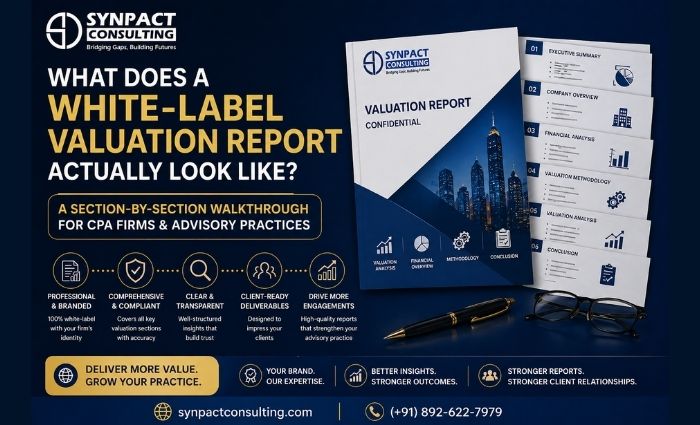
What Does a White-Label Valuation Report Actually Look Like? A Section-by-Section Walkthrough for CPA Firms and Advisory Practices
“Show Me Before I Commit”
It is the most reasonable request in professional services — and the one that most valuation outsourcing providers handle worst.
You want to outsource your valuation work to India. You have read about the cost savings, the turnaround times, and the CFA-qualified analyst teams. But before you put your firm’s name on a report produced by an external team — before you deliver it to your client, submit it to your auditor, or present it to a PE fund’s LP committee — you want to see exactly what that report looks like.
Not a template. Not a redacted skeleton. A real, complete, professionally formatted report that shows you every section, every table, every piece of documentation that goes between the cover page and the conclusion.
This blog is that walkthrough. It takes you through every section of two core report types — a 409A valuation report and a purchase price allocation — explaining what is in each section, why it is there, what audit-ready documentation looks like versus inadequate documentation, and what you should verify before putting your firm’s brand on any report from any provider.
The companion to this walkthrough is a real sample — which you can request in your firm’s exact format, with your logo and branding, within one business day. The walkthrough tells you what to look for. The sample shows you whether a specific provider meets that standard.
For the technical quality standard underlying every section described here, read our audit-ready valuation guide. For the white-label delivery process that produces these reports under your brand, read our white-label valuation reports guide.
Part 1: The 409A Valuation Report — Section by Section
A complete, audit-ready 409A report for a Series B company typically runs 35–55 pages including exhibits. Here is every section and what it must contain.
Section 1: Cover Page
What it contains: Report title (“Independent Business Valuation — Section 409A Compliance”), company name, valuation date, purpose statement (“This report has been prepared for the purpose of determining the fair market value of the common stock of [Company] as of [Date] for use in connection with stock option grants under IRC Section 409A”), the firm’s name and logo, and date of report delivery.
In a white-label report: Your firm’s name, logo, address, phone number, and email replace Synpact’s. The cover page is indistinguishable from a report produced entirely within your firm. See our white-label delivery guide for the full branding customisation options.
What audit-ready looks like: Clean, professional, specific purpose statement that cites IRC Section 409A explicitly, specific valuation date (not a range), and the report preparer identified by firm name.
What inadequate looks like: Generic title without purpose citation, missing valuation date, or a template placeholder that was not updated for the specific engagement.
Section 2: Table of Contents and Scope of Engagement
What it contains: A complete table of contents with page numbers, followed by a scope section that describes: what was valued (common stock, specific share class), the standard of value (fair market value), the premise of value (going concern), what information was relied upon (financial statements, cap table, management projections), and any limiting conditions or assumptions.
Why it matters for audit: The scope section is where the report defines its own boundaries. An auditor reviewing a 409A will look at the scope section to understand what the analyst was asked to do and what data they relied upon. A scope section that does not identify the specific data sources relied upon — or that contains boilerplate limiting conditions copied from a template — signals a documentation gap.
What audit-ready looks like: Specific data sources named by document and date — “audited financial statements for the fiscal year ended December 31, 2025, provided by management on March 15, 2026” — not “financial information provided by the company.” Specific cap table version cited. Management projection document version cited.
Section 3: Company Overview and Industry Analysis
What it contains: A factual description of the company — business model, products or services, revenue model, customer base, competitive position, management team, and ownership structure. Followed by an industry analysis covering the sector the company operates in, key industry growth drivers, competitive dynamics, and any specific macro or regulatory factors affecting the sector.
Why it matters for audit: This section establishes the business context that justifies the comparable company selection in Section 6. An auditor who questions why a specific set of comparables was chosen will look back at this section to understand what type of business the subject is — and whether the comparable set is genuinely appropriate.
What audit-ready looks like: Specific, current industry data — citing named sources (IBISWorld, PitchBook, Capital IQ market data) with publication dates. A company overview that is specific to this company, not a generic SaaS or fintech boilerplate. The 2026 context matters: any sector affected by US tariffs, geopolitical disruption, or the post-ceasefire energy environment should be acknowledged here.
What inadequate looks like: A three-paragraph company description that reads identically across all engagements, industry data with no sources cited, or an industry section that does not acknowledge macro conditions materially affecting the sector.
Section 4: Financial Analysis
What it contains: Spread historical financial statements — typically 3 years of income statements, balance sheets, and cash flow statements — with normalisation adjustments for non-recurring items. A review of revenue growth, gross margin trajectory, EBITDA margin evolution, and key balance sheet metrics. For pre-revenue or early-stage companies, a qualitative assessment of financial milestones achieved.
Why it matters for audit: The financial analysis section is where the analyst demonstrates that they understand the business’s financial trajectory — not just that they have downloaded a spreadsheet. Normalisation adjustments require judgment: what is truly non-recurring, what represents ongoing operational costs that should be capitalised or excluded.
What audit-ready looks like: Year-over-year growth rates calculated and commented upon, EBITDA normalisation adjustments identified and quantified with specific justification for each, revenue recognition policy noted, and any unusual items flagged with explanation. Numbers tied back to the specific financial statements cited in the scope section.
What inadequate looks like: Raw financial data with no commentary, normalisation adjustments applied without justification, or financial analysis that does not reconcile to the financial statements cited.
Section 5: Valuation Methodology Selection
What it contains: A discussion of the three standard valuation approaches — Income Approach (DCF), Market Approach (comparable companies and transactions), and Cost Approach (asset-based) — with explicit reasoning for which approach or approaches were selected for this engagement and why the others were not used or were used only as cross-checks.
Why it matters for audit: This is one of the most commonly inadequate sections in India-produced 409A reports — and one of the most commonly challenged by Big Four auditors. “We selected the income approach because it best reflects the company’s future earnings potential” is not adequate methodology justification. The selection must be grounded in the specific characteristics of the subject company.
What audit-ready looks like for a Series B SaaS company: “The Market Approach — Guideline Public Company Method — was selected as the primary approach because the subject company operates in a sector with a sufficient number of publicly traded comparable companies to provide meaningful market-derived multiples. The Income Approach — DCF — was used as a secondary cross-check. The Cost Approach was not used as it does not capture the going-concern value of a high-growth software business where intangible assets represent the primary value drivers.”
What inadequate looks like: Boilerplate methodology selection language that could apply to any company, or methodology selection that does not explain why specific approaches were excluded.
Section 6: Comparable Company Analysis — The Most Important Section
What it contains: The universe of comparable public companies used in the market approach — with full disclosure of the screening criteria applied, the companies initially identified, the companies excluded and the specific reason for each exclusion, the final comparable set selected, and the financial and valuation metrics for each comparable (revenue, EBITDA, growth rate, gross margin, EV/Revenue, EV/EBITDA multiples).
Why it matters for audit: This is the section that Big Four auditors challenge most frequently — and where the quality gap between adequate and inadequate providers is most visible. As we documented in our audit-ready guide, a comparable set without documented exclusion rationale is not audit-ready regardless of how appropriate the final selection is.
What audit-ready looks like: A screening criteria table showing initial universe size (e.g., “43 companies identified in Capital IQ screen”), followed by a step-by-step exclusion table showing how the universe was narrowed — “12 excluded: revenue above $1B (too large), 8 excluded: different business model (hardware vs software), 5 excluded: insufficient trading history” — down to the final comparable set of 8–12 companies. For each comparable in the final set, a brief narrative explaining why it is genuinely comparable to the subject.
The 2026 context: In April 2026, comparable sets must acknowledge sector bifurcation created by the war economy — AI infrastructure vs legacy software, tariff-exposed vs domestically-insulated manufacturing, energy sector war-beneficiaries vs war-impaired logistics. A comparable set that does not address this bifurcation will be challenged by any auditor who understands current market conditions.
What inadequate looks like: A table of 8–10 companies with no screening criteria disclosed, no exclusion rationale, and no explanation of why each comparable is appropriate for the subject company. This is the most common failure in India-produced valuation reports — and the most preventable.
Section 7: WACC Build — The Documentation Standard That Separates Providers
What it contains: A complete, component-by-component build of the weighted average cost of capital — with every input sourced, dated, and justified.
The complete WACC documentation standard for a 2026 409A:
Risk-Free Rate: “The risk-free rate of 4.32% represents the yield on the 10-year US Treasury Note as published by the Federal Reserve on [valuation date], consistent with the duration of the subject company’s projected cash flows.”
Equity Risk Premium: “The equity risk premium of 5.5% is based on the Kroll Cost of Capital Navigator recommended ERP as of January 2026, representing the long-horizon expected equity risk premium for the US market.”
Beta: “An unlevered beta of 0.92 was estimated based on a peer group of [X] publicly traded companies in the [sector] industry, using a 5-year monthly regression against the S&P 500. Betas were unlevered using the Hamada equation and relevered using the subject company’s target capital structure of [X]% equity / [X]% debt.”
Size Premium: “A size premium of 3.82% was applied based on the Kroll CRSP Decile [X] size premium, reflecting the subject company’s equity market capitalisation equivalent.”
DLOM: “A discount for lack of marketability of [X]% was applied based on [specific methodology — Finnerty Put Option Model / Longstaff LEAPS study / Mandelbaum factors], reflecting the subject company’s expected time to liquidity of [X] years, stock price volatility of [X]%, and the specific restrictions on transfer applicable to the shares being valued.”
Why it matters: Every one of these components requires a specific current source. A WACC that presents a single percentage without this supporting documentation will be immediately challenged by any Big Four auditor in 2026. See our WACC rebuild guide for the full current-market input context.
What inadequate looks like: “WACC of 18% was applied based on industry standards.” No source, no component breakdown, no DLOM justification. This is automatic audit challenge territory.
Section 8: Equity Allocation — OPM or PWERM
What it contains: The equity allocation model that determines the value of common stock relative to the various classes of preferred stock. For early-stage companies — OPM (Option Pricing Model). For later-stage or pre-liquidity-event companies — PWERM (Probability-Weighted Expected Return Method) or hybrid.
What audit-ready looks like for OPM: Full disclosure of the breakpoints in the waterfall (liquidation preference amounts for each preferred class, participation provisions, conversion thresholds), the option pricing inputs (risk-free rate, volatility, time to exit), and the resulting allocation of enterprise value to each equity class.
What audit-ready looks like for PWERM: Explicit liquidity scenarios identified (IPO, M&A, continued private operation), probability assigned to each scenario with justification for the probability estimate, exit value modelled under each scenario, timing assumption for each scenario, and probability-weighted value calculated for each share class.
The DLOM application: After the equity allocation, the DLOM is applied to the common stock value to arrive at the fair market value of a single share of common stock. The DLOM methodology must be explicitly justified — not just applied as a flat percentage. As we noted in our AI valuation blog, flat-percentage DLOMs without specific methodology justification are one of the most common AI-native platform failures and one of the most common audit challenge bases.
Section 9: Sensitivity Analysis
What it contains: A sensitivity table showing the common stock fair market value under variations in the key assumptions — WACC ± 1–2%, exit multiple ± 1–2 turns, time to exit ± 1 year, DLOM ± 5 percentage points.
Why it matters: In 2026, with WACCs uncertain by 2–3 percentage points depending on geopolitical and macro outcomes, sensitivity analysis is not a stylistic addition — it is an audit expectation. An auditor reviewing a 409A in a period of genuine macro uncertainty will ask: “What is the common stock value if WACC is 2% higher?” If the report does not show this, the auditor will ask for supplementary analysis.
What audit-ready looks like: A two-dimensional sensitivity table with clearly labelled axes, showing the range of common stock values across the sensitivity inputs. A brief narrative noting which inputs have the most significant impact on the conclusion and why.
Section 10: Conclusion and Appraiser’s Certification
What it contains: A single-sentence conclusion stating the fair market value per share of common stock as of the valuation date. Followed by the appraiser’s certification — confirming that the analyst has no financial interest in the subject company, that the analysis was performed in accordance with applicable professional standards, and that the conclusions are the independent opinion of the analyst.
In a white-label report: The certification is signed under your firm’s name. If your partner or senior associate has reviewed the report and is taking professional responsibility for the conclusion, their name appears here. If you prefer not to name an individual reviewer, the certification can be framed at the firm level.
Part 2: The PPA Report — Key Differences From a 409A
A purchase price allocation (PPA) under ASC 805 is structurally similar to a 409A but with five key additional elements that make it more complex and more documentation-intensive.
PPA Section 1: Transaction Summary
What it contains: Deal structure, purchase price components (cash, stock, earnout, contingent consideration), closing date, and a summary of the assets acquired and liabilities assumed at carrying value.
Why it differs from 409A: The PPA requires the analyst to account for every element of the purchase price — including contingent consideration like earnouts, which must be fair-valued at the acquisition date under ASC 805. A PPA that does not address earnout fair value is incomplete.
PPA Section 2: Identified Intangible Assets
What it contains: Identification and valuation of each separately identifiable intangible asset acquired — customer relationships, developed technology, trade names, non-compete agreements, backlog, and in-process R&D. Each asset valued using the appropriate methodology: Relief from Royalty for trade names and technology, Multi-Period Excess Earnings Method (MPEEM) for customer relationships and backlog, Cost Approach for assembled workforce.
Why it is the most challenging section: Intangible asset identification and valuation requires both technical methodology expertise and deep understanding of the acquired business. A PPA that identifies only obvious intangibles (trade name, technology) and misses less obvious ones (customer lists, favourable contracts, regulatory approvals) is incomplete — and an auditor who identifies a missing intangible will require a restatement.
What audit-ready looks like: A complete intangible asset inventory with explicit consideration of every category in ASC 805 paragraph 55-11 through 55-45, a fair value estimate for each identified asset using the most appropriate methodology, and explicit documentation of why any category of intangible was determined to not exist or to not be separately identifiable.
PPA Section 3: Fair Value of Property, Plant and Equipment
What it contains: For acquisitions involving significant tangible assets, a fair value assessment of PP&E — typically using a cost approach (replacement cost new less depreciation) rather than carrying value.
Why it matters: Many mid-market acquisitions involve PP&E that is carried on the seller’s books at historical cost net of accumulated depreciation — which may be materially different from current fair value. A PPA that does not revalue PP&E to current fair value is technically incomplete under ASC 805.
PPA Section 4: Goodwill Calculation and Allocation
What it contains: The residual goodwill calculation — purchase price minus the net fair value of all identified assets and assumed liabilities — and the allocation of that goodwill to reporting units for future impairment testing.
Why the reporting unit allocation matters: Goodwill must be allocated at acquisition to the reporting units that are expected to benefit from the synergies of the combination. This allocation determines which reporting units will carry goodwill for future ASC 350 impairment testing — and incorrect allocation at the PPA stage creates impairment testing complexity for years after the deal closes. See our goodwill impairment surge blog for why this allocation is especially important in the current rising-WACC environment.
PPA Section 5: Deferred Revenue and Working Capital Adjustments
What it contains: Fair value of assumed deferred revenue (which must be marked to its fair value — typically lower than face value — at acquisition), purchase price adjustments for working capital pegs, and fair value of any assumed contingent liabilities.
Why it is commonly missed: Deferred revenue fair value adjustment is one of the most frequently incomplete elements in mid-market PPAs. The acquired company’s deferred revenue is carried at cost of remaining performance obligation, not at the price that would be received to transfer the obligation — the difference can be material for SaaS businesses with large deferred revenue balances.
What to Request From Any Provider Before Committing
Based on this walkthrough, here is exactly what to ask any valuation provider to send before your first engagement:
For a 409A: Request a complete anonymised sample for a Series A or Series B company — same stage as your typical client. Review the WACC section against Question 3 from our vendor selection guide. Review the comparable section for documented exclusion rationale. Review the DLOM methodology for specific justification. Review the sensitivity table for completeness.
For a PPA: Request a sample for a mid-market technology or services acquisition — the most common PPA engagement type. Review the intangible asset identification for completeness against ASC 805 paragraph 55-11 through 55-45. Review the MPEEM model for customer relationships — this is the most technically demanding methodology in a standard PPA and the most revealing test of a provider’s capability.
For white-label delivery: Request the sample in your firm’s format — with your logo, your colour scheme, your disclaimer language. This is the deliverable your client will actually receive. Review it as you would review any work product before it goes to a client under your name.
Frequently Asked Questions
How long is a typical 409A report from Synpact?
A standard 409A report for a Series A–B company is 35–50 pages including exhibits. A Series C or pre-IPO 409A using PWERM is typically 50–70 pages. The length reflects the documentation depth required for audit-ready quality — not padding. Every section described in this walkthrough is present in every report.
Can I request a sample in my exact firm format before committing to any engagement?
Yes. Send us your logo, your colour scheme, your preferred disclaimer language, and the engagement type you want to test. We produce a sample white-label report in your format within one business day. Contact us with these details and we will confirm receipt and delivery timeline within 2 hours during IST business hours.
What if the sample report does not match my firm’s quality standard?
That is the correct outcome of a sample request — you learn before committing, not after. If the sample does not meet your standard, you have invested nothing. If it does meet your standard, you have a reliable quality baseline before your first live engagement. We would rather lose a potential client at the sample stage than deliver a report that does not meet your standard on a live engagement.
Does the report structure differ for IFRS vs ASC standards?
Yes — materially for PPA reports. An IFRS 3 PPA differs from an ASC 805 PPA in the treatment of contingent consideration (IFRS 3 requires fair value only for obligations, not assets), the deferred tax treatment of intangible assets, and the specific disclosure requirements. A 409A equivalent under IFRS is a stock-based compensation valuation under IFRS 2 — structurally similar but with different standard references. Our Australian advisory firm guide covers the AASB 3 / AASB 2 specific differences in detail.
How do you handle reports for companies in sectors affected by the current geopolitical environment — energy, defence, logistics?
Sector-specific context is incorporated in both the company overview / industry analysis section and the comparable company analysis. For energy sector 409As, the post-ceasefire oil price scenario analysis described in our Iran ceasefire valuation blog is incorporated into the sensitivity analysis. For defence sector PPAs, the tier-specific comparable selection methodology from our defence sector M&A blog is applied. The sector context is not a boilerplate addition — it is integrated throughout the report.
Can I see a PPA sample as well as a 409A sample?
Yes. Request both by engagement type when you contact us. PPA samples are available for technology, healthcare, and services sector acquisitions — the three most common mid-market PPA types. Contact us with your preferred sector and deal size range and we will provide the most relevant sample.
See It Before You Sign It
Every section described in this walkthrough exists in every Synpact report. The WACC documentation. The comparable exclusion rationale. The DLOM methodology justification. The sensitivity analysis. The appraiser’s certification. These are not optional elements that vary by engagement — they are the baseline documentation standard for every report that carries your firm’s brand.
The most efficient way to verify this is to request the sample. One business day. Your format. Your logo. The exact engagement type you need. Review every section against this walkthrough and against the audit-ready checklist. Make the decision with evidence rather than trust.
→ Request Your Sample Report in Your Firm’s Format — Delivered in 1 Business Day
Related Reading on Synpact Blog:
- What “Audit-Ready” Actually Means in 2026 — A CFO’s Checklist
- How to Choose a Valuation Outsourcing Partner in India: 12 Questions
- How Much Does a 409A Valuation Cost in 2026?
- How to Onboard a Valuation Outsourcing Team Without Disrupting Your Workflow
- Is AI Making India Valuation Analysts Obsolete — Or Making Them Better?