
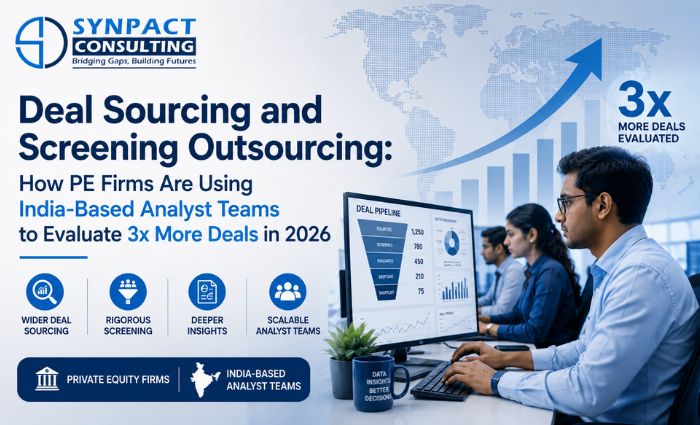
Deal Sourcing and Screening Outsourcing: How PE Firms Are Using India-Based Analyst Teams to Evaluate 3x More Deals in 2026
The Sourcing Problem That Every PE Fund Manager Knows But Few Discuss Openly
There is a number that haunts every private equity investment professional: the ratio of deals evaluated to deals closed. For most mid-market PE firms, that ratio is somewhere between 50:1 and 100:1. For every deal that closes, the team has evaluated — at varying levels of depth — fifty to one hundred others. The screening work, the initial financial analysis, the sector mapping, the comparable transaction research — most of it produces no return. It is the cost of finding the one deal that does.
A sample of the top 10% of equity firms reveals that they pay special attention to outbound deal origination. They do this by hiring at least 0.75 to 1.25 dedicated deal sourcers for every investment professional on the team.
The economics of this model are brutal for smaller and mid-market funds. A dedicated deal sourcing analyst in New York — junior enough to do the screening work, senior enough to communicate credibly with targets — costs $110,000–$140,000 per year fully loaded. That analyst can realistically evaluate 150–200 companies per year at a meaningful screening level: enough financial analysis to determine whether the target meets the fund’s investment criteria, enough sector research to understand the competitive position, enough management information to assess whether the business is genuinely investable.
At 200 companies per year, the cost per screened company is $550–$700. Multiply by the 50–100 companies that must be screened to find one that advances to full diligence, and the sourcing cost per deal that reaches diligence is $27,500–$70,000 — before a single dollar of diligence has been spent.
This is the PE sourcing economics problem. It is not a secret in the industry. What is less widely discussed is the structural solution that a growing number of mid-market and upper-mid-market PE funds have quietly implemented: outsourcing the analytical screening layer of their deal sourcing process to India-based analyst teams, while retaining the relationship, origination, and investment decision functions entirely in-house.
This blog explains exactly how that model works, what it produces, what it costs, where it fits in the deal sourcing workflow, and what the 2026 deal environment means for funds that are still running their screening process entirely in-house.
What “Deal Sourcing and Screening Outsourcing” Actually Means — and What It Does Not
Before explaining the model, it is important to be precise about what is being outsourced and what is not — because the most common objection to PE deal sourcing outsourcing is based on a misunderstanding of the division of labour.
What Is Being Outsourced — The Analytical Layer
The deal sourcing and screening process has two distinct layers. The first is the origination layer: identifying potential targets, making initial contact, building relationships with founders and management teams, attending industry conferences, cultivating intermediary networks. This layer requires US presence, sector credibility, and relationship capital. It cannot be meaningfully outsourced to an India-based team — and no serious outsourcing model attempts to do so.
The second is the analytical screening layer: once a target company has been identified — through the fund’s own origination, through an intermediary introduction, or through a proactive market mapping exercise — the analytical work of evaluating whether that company meets the fund’s investment criteria. This is the layer that is outsourced. It includes:
Initial financial screening: Spreading the target’s historical financial statements, calculating key metrics (revenue CAGR, EBITDA margin, EBITDA conversion, working capital dynamics, capex intensity), and comparing them against the fund’s investment criteria. Does this company meet the minimum EBITDA threshold? Is the revenue growth consistent with the fund’s sector thesis? Is the margin profile indicative of a business with defensible competitive position?
Sector and competitive landscape research: Mapping the target’s competitive environment, identifying the top competitors, assessing the target’s market share position, and summarising the sector’s growth dynamics and key risk factors. This is desk research — sourced from Capital IQ, PitchBook, industry databases, and publicly available information — not primary research requiring market access.
Comparable company and precedent transaction analysis: Identifying the set of comparable public companies and relevant M&A transactions, pulling the trading and transaction multiples, and producing a preliminary valuation range based on the available financial data. This gives the investment team an initial sense of whether the target’s implied valuation is consistent with the fund’s return requirements.
Investment summary or screening memo: A structured one-page or two-page summary of the target — business description, financial metrics, competitive position, preliminary valuation, key diligence questions, and a recommendation on whether the company warrants further engagement. This is the document the investment team uses to decide whether to advance the target to the next stage.
All of this analytical work is what Synpact’s India-based analyst team produces for PE fund clients. It is the same work that a US-based sourcing analyst would produce — with the same data sources, the same financial methodology, and the same output format — delivered at 70% lower cost and with overnight turnaround on most deliverables.
What Is Not Being Outsourced — The Relationship and Decision Layer
The fund’s investment professionals retain full ownership of the origination relationship, the investment thesis development, the management meeting, the IC presentation, and the investment decision. The India-based team is not making investment recommendations — it is producing the analytical infrastructure that allows the investment team to make better, faster, more informed decisions about which companies to pursue.
By outsourcing deal sourcing analytical work, private equity firms gain access to high-quality screening output, increased efficiency, and the ability to focus their in-house team on relationship development and strategic decision-making — the activities that actually create investment alpha.
This distinction matters for the LP conversation. LPs are not evaluating whether the screening memo was produced in New York or Bengaluru — they are evaluating whether the fund’s investment thesis is sound, whether the diligence process is rigorous, and whether the investment team has the judgment to make good decisions. The analytical screening layer supports the investment team’s judgment; it does not replace it.
The 2026 Deal Environment — Why This Model Matters More Now Than Ever
The 2026 private equity deal environment has created specific conditions that make analytical screening outsourcing more valuable — and more necessary — than it was in prior years.
Dry Powder Pressure Is Real and Growing
The increase in deal volumes, with 4,828 buyouts recorded in Q1 2025 alone, puts the sourcing of differentiated assets as the primary hurdle in the investment process. This is especially beneficial for GPs whose presence is widespread across different sectors and regions but have only a small number of internal staff.
PE funds that raised in 2022 and 2023 are now facing meaningful LP pressure to deploy capital. The deployment timeline pressure — combined with a deal market that has become more competitive as activity recovers from the 2023–2024 slowdown — means that funds are evaluating more companies to find the same number of investable opportunities. Volume of screening has increased; in-house analyst capacity has not.
The Geopolitical Disruption Is Creating New Sector Opportunities
The Iran war, US tariffs, and supply chain restructuring described in our earlier blog on geopolitical risk premiums are creating specific investment opportunities that require sector-by-sector analytical coverage: reshoring plays in US manufacturing, energy infrastructure beneficiaries, logistics companies with domestic-only exposure, and businesses with supply chain insulation from Gulf-transit disruption. A fund that wants to systematically screen the manufacturing, logistics, and energy sectors for these themes needs analytical coverage across a much broader universe of companies than its in-house team can realistically evaluate.
PE firms that actively track and respond to external forces like geopolitical disruption are better equipped to adapt their strategies and sustain strong deal flow. Investors who consistently win the best opportunities take a proactive, informed approach to sourcing by tapping into networks, leveraging technology, and analytical resources.
The analytical screening outsourcing model is the practical implementation of this proactive approach — systematic coverage of a broad target universe, evaluated against the fund’s investment thesis, with overnight delivery of screening memos that allow the investment team to triage and prioritise before the market moves.
AI Is Changing the Data Layer But Not the Analytical Layer
Nearly half of dealmakers (49%) use AI tools nearly every day, according to a recent Sourcescrub survey. Generative and agentic AI for deal sourcing, screening, and diligence will have a massive impact on the M&A world in 2026 and beyond.
AI platforms like Grata, SourceScrub, and PitchBook are becoming more capable at the data identification layer — surfacing target companies, enriching contact data, and providing initial signals. But they are not replacing the analytical judgement required to produce a credible screening memo: the financial analysis, the competitive position assessment, the comparable valuation analysis, the identification of key diligence questions.
Platforms now use a Data × Technology multiplied by Analysts model, where human intelligence validates machine-driven results. The goal is to identify companies that are not only a fit but also open to a conversation.
The India-based analyst team is the human intelligence layer that makes the data valuable. AI surfaces the universe; the analyst produces the screening analysis that allows the investment team to make a decision. The two are complementary, not substitutes.
The Deal Sourcing and Screening Workflow — Where Synpact Fits
Here is the end-to-end deal sourcing workflow for a PE fund using Synpact’s India-based team as the analytical screening layer — and exactly where each step happens.
Step 1: Universe Identification (In-House or Platform-Assisted)
The investment team defines the target universe — sector, geography, revenue range, EBITDA minimum, ownership type (family-owned, founder-led, corporate carve-out), and any thesis-specific criteria (supply chain domestic exposure, recurring revenue model, defensible market position). This definition comes from the fund’s investment thesis — it is not outsourceable.
The target universe is populated using the fund’s preferred data platform — Capital IQ, PitchBook, SourceScrub, Grata — filtered against the defined criteria. For a focused sector thesis, this might produce 200–500 target companies. For a broader mandate, the universe may be 1,000+.
Step 2: Tier 1 Screen — Financial Metrics Filter (Synpact)
The first analytical step is a rapid financial metrics screen across the full target universe. For each company, Synpact pulls the available financial data — revenue, EBITDA, growth rates, margin — from Capital IQ, PitchBook, or any supplementary databases the fund subscribes to, and compares them against the fund’s minimum financial criteria.
This screen reduces a universe of 500 companies to the 80–120 that meet the minimum financial threshold. The output is a structured spreadsheet — one row per company, columns for each financial metric, a pass/fail flag against the fund’s criteria, and a brief note on any companies that are borderline. Delivered overnight after the brief is submitted.
Step 3: Tier 2 Screen — Competitive and Business Quality Assessment (Synpact)
The 80–120 companies that passed the financial screen are now assessed at the next level of depth. For each company, Synpact produces a structured one-page profile covering:
Business description — what the company does, who it serves, how it generates revenue.
Competitive position — who the main competitors are, what the company’s differentiation appears to be based on available information, and any visible indicators of competitive moat (customer concentration, proprietary technology, switching costs, regulatory barriers).
Growth drivers and risks — what is driving revenue growth (or what has caused revenue to be flat or declining), and what the primary operational or market risks appear to be.
Preliminary financial assessment — whether the financial performance is consistent, whether the margins are defensible, whether the capex intensity is appropriate for the sector, and whether there are any visible red flags in the available data.
The output for Tier 2 is a standardised screening brief for each of the 80–120 companies — delivered in the fund’s template, in batches as they are completed, over 5–10 business days depending on the volume.
Step 4: Investment Team Triage (In-House)
The investment team reviews the Tier 2 screening briefs and makes the triage decision: which companies warrant direct outreach and management engagement. This is the investment judgement step — the team applies its sector knowledge, its relationship intelligence, and its thesis conviction to decide which of the screened companies are genuinely worth pursuing.
Typically, 15–30 companies from the Tier 2 screen advance to direct outreach. The rest are filed in the CRM for monitoring — some will become relevant in future periods as their financial performance evolves or their ownership situation changes.
Step 5: Preliminary Valuation and IC Screening Memo (Synpact)
For the 15–30 companies that the investment team decides to pursue, Synpact produces a fuller screening memo — the document that supports the investment committee’s decision on whether to allocate time to a management meeting and preliminary diligence.
The IC screening memo includes:
Financial summary: Three-year revenue and EBITDA history with growth rates, margin analysis, and working capital assessment. For companies where public financial information is limited, the memo uses available data with clear disclosure of data gaps.
Comparable company valuation: A screen of comparable public companies with relevant trading multiples (EV/Revenue, EV/EBITDA) applied to the target’s financial metrics to produce a preliminary enterprise value range. This gives the investment team a preliminary sense of whether the implied valuation is consistent with the fund’s return model.
Precedent transaction analysis: Relevant M&A transactions in the same sector with deal multiples, providing a transaction-based valuation cross-reference.
Preliminary LBO indication: A high-level LBO sketch — not a full model — showing the implied entry multiple, assumed leverage, and the IRR range at different exit multiple assumptions. This is the first-order check on whether the deal economics work before a management meeting is scheduled.
Key diligence questions: The three to five most important questions that the management meeting should answer — the issues where the available data is insufficient to assess the investment quality.
Recommendation: A clear statement — advance to management meeting, monitor for 12 months, or pass — with a brief rationale.
This memo is produced in the fund’s standard IC screening template, formatted to the partner’s preference, delivered within 5–7 business days of the brief submission.
Step 6: Full Diligence Support (Synpact as Required)
For companies that advance past the management meeting to full diligence, Synpact’s team is available for deeper analytical support: the full LBO model, the detailed comparable company and precedent transaction analysis, the quality of earnings support, and the sector research deep-dives. This is where the analytical work connects to the deal execution support described in our white-label IB support guide.
The Economics — What the Numbers Look Like for a Specific Fund
To make the economic case concrete, here is a specific calculation for a mid-market PE fund with a $300M fund size and a four-year investment period.
In-House Screening Model — Current State
Deal sourcing analyst: 1 dedicated analyst, fully loaded cost $130,000 per year.
Annual screening capacity: 180 companies per year at meaningful depth.
Deal flow target: 8–10 new investments over the 4-year investment period, requiring approximately 500–700 companies screened.
Total in-house screening cost over investment period: $520,000.
Cost per company screened: $720–$1,040.
Cost per deal reaching full diligence: $52,000–$65,000 (at 10 companies reaching diligence per deal closed).
The hidden cost: The sourcing analyst’s 180-company annual capacity is a hard ceiling. When deal flow accelerates — as it is doing in 2026 — the team’s screening capacity does not scale. Deals that cannot be evaluated quickly are passed on. Market opportunities from the geopolitical restructuring wave are missed because the in-house team cannot evaluate them at speed.
Synpact Outsourcing Model — What Changes
Synpact cost per Tier 1 screen (financial metrics filter): $15–$25 per company for a batch screen of 200+ companies.
Synpact cost per Tier 2 screen (competitive and business quality profile): $150–$250 per company. Synpact cost per IC screening memo (full preliminary analysis): $800–$1,400 per company.
Synpact cost per full LBO model and diligence support: $2,800–$4,500 per engagement.
Annual screening economics at scale: Tier 1 screen of 500 companies: $7,500–$12,500. Tier 2 screen of 120 companies: $18,000–$30,000. IC screening memos for 30 companies: $24,000–$42,000. Full diligence support for 10 companies: $28,000–$45,000.
Total annual outsourcing cost: $77,500–$129,500.
Versus in-house cost: $130,000 per year for a single analyst who covers 180 companies at lower depth than the Synpact model covers 500.
The capacity difference: The Synpact model evaluates 500 companies per year — nearly 3x the in-house analyst’s capacity — at 40–60% lower annual cost. The investment team’s time is freed from the analytical screening work entirely, available for the relationship and decision work that only they can do.
The ROI question: If the increased screening coverage allows the fund to identify and close one additional deal per fund cycle that the in-house model would have missed — at an average investment of $25M and a 2.5x MOIC — the incremental return is $37.5M on a cost difference of $200,000–$400,000 over the investment period. The economics of the outsourcing decision are not marginal.
The Template Infrastructure — What “In Your Format” Actually Means
A PE fund that has been operating for several years has established templates — for the IC screening memo, the management presentation summary, the sector overview brief, the comparable company table. These templates reflect the partners’ preferences, the IC’s expectations, and the fund’s brand standards.
When Synpact delivers screening memos and analytical outputs, they are delivered in the fund’s existing templates — not in Synpact’s standard format. This requires a one-time template onboarding at the start of the engagement, during which:
The fund provides its standard IC screening memo template, its comparable company table format, its sector research brief structure, and any other analytical output formats used in the sourcing process.
Synpact maps each deliverable type to the appropriate template and confirms the data sources, metric definitions, and formatting conventions the fund uses.
The first two or three screening memos are produced as pilot deliverables — the fund reviews them against its internal quality standard and provides feedback. Revisions are incorporated, and the template is finalized.
From the fourth engagement onward, the deliverables require minimal formatting review — the output is already in the fund’s format, at the fund’s quality standard, ready for direct use in the IC process.
This onboarding process typically takes 10–14 business days from the first template submission to the first production-ready deliverable. The onboarding process for PE deal sourcing support is the same model described in our valuation outsourcing onboarding guide.
The Confidentiality Framework — What PE Funds Need to Know
Deal information is among the most sensitive information a PE fund handles. Target companies, investment theses, acquisition strategies, and financial analyses are information that, if disclosed, could damage the fund’s competitive position, alert targets to unwanted acquisition interest, or violate confidentiality obligations to management teams.
The confidentiality framework for Synpact’s PE deal sourcing support is structured at the engagement level, not at the firm level:
Deal-specific NDAs: Every analyst working on a specific fund’s screening engagement signs a deal-specific NDA before accessing any target information. The NDA identifies the specific fund, the specific analyst, and the specific engagement — not a blanket firm-level confidentiality agreement.
Information barrier: Synpact operates strict information barriers between client engagements. The analyst team working on Fund A’s deal flow has no access to Fund B’s target universe. Assignment is managed by engagement, not by analyst self-selection.
Secure transfer: All deal materials — target lists, financial data, draft screening memos — are transferred through Synpact’s encrypted portal. No email attachments, no shared consumer file services, no unencrypted transfer of any kind.
Output controls: Every deliverable is produced in the fund’s template, with the fund’s formatting. Synpact’s name does not appear in any deliverable. The screening memo the investment team presents at IC looks exactly as if it was produced internally.
The full data security framework — including encryption standards, access controls, and breach response protocols — is documented in our data security guide.
The Pilot Engagement — How to Test the Model
The lowest-risk way to evaluate Synpact’s deal sourcing and screening outsourcing model is a single pilot engagement — one batch of companies, one deliverable type, one fund cycle.
The recommended pilot structure:
Submit a list of 20–30 target companies from your current pipeline — companies that are in the early screening stage, where you have not yet produced a formal screening analysis. Provide your financial criteria, your IC screening memo template, and any sector-specific context that is relevant to the investment thesis.
Synpact delivers Tier 2 screening profiles for each company within 7–10 business days. You review them against the quality standard your internal team would apply — completeness of financial analysis, accuracy of competitive positioning, quality of the preliminary valuation, usefulness of the diligence questions.
If the output meets your standard — and most funds find it does after the first revision cycle — you have your quality verification. If it requires significant adjustment, you have learned something specific about the gap between the initial output and your fund’s standard, and that feedback is incorporated before the next batch.
Most PE fund investment teams that run a 20–30 company pilot with Synpact move to steady-state outsourcing of their analytical screening layer within 60 days. The pilot is the proof of concept. The quality of the first batch of screening memos is the answer to the question of whether this model works for your fund.
→ Submit a Pilot Brief or Book a 20-Minute Deal Sourcing Consultation — No Commitment Required
The Objections — Addressed Directly
“My investment thesis is proprietary. I cannot share target lists with an outside team.”
The confidentiality framework described above specifically addresses this concern. The deal-specific NDA, the information barrier between client engagements, and the secure transfer protocol are designed for exactly this situation. The fund’s target list and investment thesis are treated with the same confidentiality as the most sensitive deal materials — because they are.
The more relevant question is whether the risk of a confidentiality breach from a professionally managed outsourcing engagement is higher or lower than the risk of the same information being discussed at a conference, shared in a group email, or seen by a junior analyst who subsequently joins a competing fund. The risks are real in both cases; the mitigation in the outsourcing engagement is more explicitly managed.
“The quality of India-based financial analysis is not at the level our IC expects.”
This objection is addressed directly by the pilot engagement. The quality of the output is verifiable within 10 business days at the cost of a single pilot brief. If the output does not meet the IC standard after one revision cycle, the cost is one brief and one feedback conversation. If it does meet the standard — which it does for the vast majority of funds that run a pilot — the objection is empirically resolved.
Private equity outsourcing relationships are increasingly becoming more strategic, not just tactical cost-cutting exercises. 75% of firms use providers to access new business models, AI innovation, and specialized expertise — not simply to reduce headcount costs.
The CFA-qualified analysts on Synpact’s deal sourcing team are trained on the same financial methodology — DCF, LBO modelling, comparable company analysis, precedent transaction screening — that US investment banking analysts use. The analytical product is the same; the cost structure is different.
“Our investment professionals need to do the screening themselves to develop investment judgment.”
This is a legitimate concern for funds whose primary development objective is building the next generation of investment professionals. For junior analysts who are learning the craft, doing the screening work themselves has genuine educational value.
For funds where the constraint is not analyst development but deal throughput — where the senior investment professionals are the bottleneck, not the junior analysts — the outsourcing model does not impair judgment development. The junior analysts still review, question, and present the screening output. They simply have 3x the volume of companies to develop judgment about, rather than 1x.
The Analytical Screening Layer Is Not Your Competitive Advantage — Your Investment Judgment Is
The competitive advantage of a PE fund is not the ability to build financial models faster than other funds. It is the investment thesis, the sector expertise, the management relationships, the portfolio company operational support, and the IC judgment that makes the difference between a 2.0x MOIC fund and a 3.5x MOIC fund.
The analytical screening layer — the financial model, the competitive brief, the comparable company table, the preliminary LBO sketch — is the infrastructure that enables the investment judgment to be applied efficiently. It is necessary, but it is not differentiated.
Hiring a full-time analyst or sourcing associate can cost $100K+ per year, and they can only do so much. In a market where speed and volume matter, the ROI on old-school methods just is not there anymore. Outsourcing deal origination analytics is no longer just about saving time — it is a strategic decision that unlocks proprietary, qualified deal flow at a fraction of the cost and time.
Outsourcing that infrastructure to Synpact’s India-based team — at 70% lower cost, with 3x the screening volume, in your format, with overnight delivery — frees your investment professionals to do the work that actually generates alpha. That is the case for the model, and it is testable in 10 business days.
→ Submit a Pilot Deal Sourcing Brief or Book a 20-Minute Consultation — No Commitment
Related Reading on Synpact Blog:
- White-Label Pitch Books, CIMs, and LBO Models for Boutique Investment Banks
- Why Geopolitical Uncertainty Is Creating a Corporate Carve-Out Wave
- Data Security in Valuation Outsourcing — A Technical Checklist
- What “Audit-Ready” Actually Means in 2026 — A CFO’s Checklist
- Deal Sourcing & Screening — Synpact
- Due Diligence & Valuation — Synpact
- Exit & Realisation Support — Synpact
- Private Equity & VC Support — Synpact
- Valuation Services — Synpact