
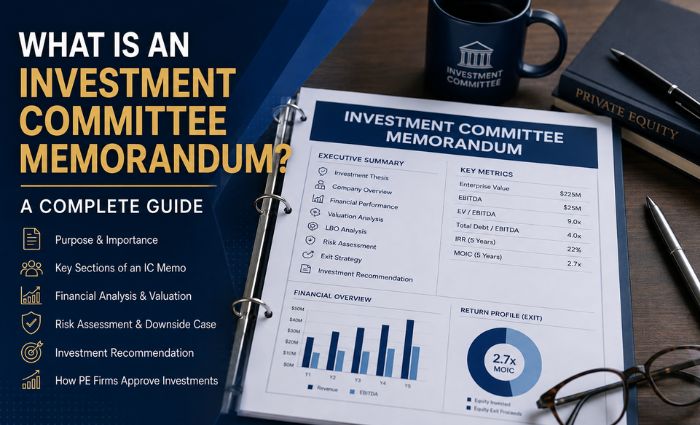
What Is an Investment Committee Memorandum? A Complete Guide
An Investment Committee Memorandum, often called an IC Memo, is one of the most important documents used by private equity firms, venture capital firms, investment funds, family offices, and corporate investment teams when evaluating a potential investment.
The document summarizes the investment opportunity, financial analysis, valuation, due diligence findings, risks, expected returns, and recommendation for the decision-makers responsible for approving or rejecting the transaction.
In many investment organizations, a deal cannot proceed until the Investment Committee has reviewed the memorandum and formally approved the investment.
For this reason, a well-prepared IC Memo needs to be clear, objective, financially rigorous, and focused on the factors that matter most to the investment decision.
What Is an Investment Committee Memorandum?
An Investment Committee Memorandum is a structured document prepared by the investment team to present a potential transaction to the firm’s Investment Committee.
The memo typically explains:
- What company is being acquired or invested in
- Why the opportunity is attractive
- How the business generates revenue
- Historical financial performance
- Expected future performance
- Purchase price and valuation
- Financing structure
- Expected IRR and MOIC
- Key due diligence findings
- Major risks and mitigants
- Potential exit strategies
The objective is to give the Investment Committee enough information to make an informed capital allocation decision.
What Is an Investment Committee?
The Investment Committee is the group responsible for approving major investments within an investment organization.
Depending on the firm, the committee may include:
- Managing partners
- Senior investment professionals
- Portfolio managers
- Operating partners
- Risk professionals
- Other senior decision-makers
The committee reviews the proposed transaction independently from the deal team’s day-to-day work.
This structure is intended to introduce additional discipline and challenge before capital is committed.
Why Investment Committees Are Important
Investment teams can spend months evaluating a transaction.
During that process, deal professionals may become increasingly committed to completing the investment.
This can create risks such as:
- Confirmation bias
- Overly optimistic forecasting
- Underestimating downside risks
- Justifying a high purchase price
- Overestimating synergies or operational improvements
The Investment Committee provides an additional level of scrutiny by asking whether the investment still makes sense when evaluated from an independent decision-making perspective.
What Is the Purpose of an IC Memo?
An Investment Committee Memorandum serves several important purposes.
1. Summarize the Investment Opportunity
The memo gives senior decision-makers a concise but comprehensive overview of the proposed transaction.
2. Document the Investment Thesis
It explains why the investment team believes the target can create attractive returns.
3. Present Financial Analysis
The memo summarizes historical performance, forecasts, valuation, financing, and expected returns.
4. Highlight Risks
A credible IC Memo should clearly identify the reasons the investment could fail.
5. Support Decision-Making
The memo provides the analytical foundation for approving, rejecting, or modifying the proposed transaction.
6. Create an Investment Record
The memorandum can later provide a record of the assumptions, risks, and expectations that existed when the investment was approved.
Who Prepares the Investment Committee Memorandum?
The IC Memo is usually prepared by the deal team responsible for evaluating the opportunity.
Depending on the organization, contributors may include:
- Associates
- Senior associates
- Vice presidents
- Principals
- Partners
- Operating professionals
Specialist advisors may also contribute analysis related to:
- Financial due diligence
- Quality of Earnings
- Commercial due diligence
- Legal matters
- Tax
- Technology
- Industry analysis
When Is an IC Memo Prepared?
Investment Committee materials may be prepared at several stages of the investment process.
Some firms use multiple committee reviews.
For example:
| Investment Stage | Typical Decision |
|---|---|
| Initial Screening | Should the firm spend additional resources on the opportunity? |
| Preliminary IC | Should the team submit an indication of interest or preliminary bid? |
| Due Diligence IC | Should the firm continue after reviewing diligence findings? |
| Final IC | Should the firm approve the investment and commit capital? |
The level of detail typically increases as the transaction progresses.
What Makes a Good Investment Committee Memo?
A strong IC Memo is not simply a document that explains why the deal is attractive.
It should present a balanced investment case.
A high-quality memorandum generally demonstrates:
- Clear investment logic
- Reliable financial analysis
- Realistic forecasts
- Transparent valuation assumptions
- Detailed downside analysis
- Well-understood risks
- Credible value creation opportunities
- Multiple potential exit paths
The Investment Committee should be able to understand not only how the investment could succeed, but also what could cause the investment to underperform.
Typical Structure of an Investment Committee Memorandum
Although formats vary between firms, an IC Memo commonly includes:
- Executive Summary
- Investment Recommendation
- Investment Thesis
- Company Overview
- Industry and Market Analysis
- Historical Financial Performance
- Quality of Earnings
- Financial Forecast
- Valuation
- Transaction Structure
- Debt Financing
- LBO Analysis
- IRR and MOIC
- Value Creation Plan
- Due Diligence Findings
- Key Risks and Mitigants
- Downside Analysis
- Exit Strategy
Executive Summary
The Executive Summary is often the most important section of the IC Memo because senior decision-makers may form their initial view of the investment from these first pages.
The summary should quickly explain:
- Target company
- Industry
- Transaction type
- Purchase price
- Entry valuation multiple
- Financing structure
- Expected returns
- Investment thesis
- Major risks
Illustrative Executive Summary
| Transaction Metric | Illustrative Value |
|---|---|
| Target Revenue | $150 million |
| Normalized EBITDA | $25 million |
| Enterprise Value | $225 million |
| Entry EV / EBITDA | 9.0x |
| Debt Financing | $100 million |
| Equity Investment | $125 million |
| Illustrative 5-Year MOIC | 2.5x |
| Illustrative 5-Year IRR | 20%+ |
This gives the committee an immediate overview of the transaction economics.
Investment Recommendation
The investment recommendation should clearly state what approval the deal team is requesting.
For example, the team may request approval to:
- Submit a final bid
- Sign a definitive purchase agreement
- Commit a specified amount of equity
- Proceed under specified financing terms
The recommendation should be direct rather than leaving decision-makers uncertain about the requested action.
Investment Thesis
The investment thesis explains why the deal team believes the opportunity can generate attractive risk-adjusted returns.
A strong investment thesis usually consists of several clearly defined points.
Illustrative Investment Thesis
- Attractive industry with durable long-term growth
- Recurring and diversified customer revenue
- Strong historical organic growth
- Opportunity to expand EBITDA margins
- High Free Cash Flow conversion
- Experienced management team
- Multiple strategic exit opportunities
Each point should be supported by evidence rather than presented as a marketing statement.
Investment Thesis vs Investment Story
An effective IC Memo should distinguish between an attractive story and a financially supportable investment thesis.
For example:
Weak: “The company operates in an exciting market with significant growth potential.”
Stronger: “The company’s target market has grown approximately 8% annually, while the company has achieved 13% organic growth and increased market share during the last three years.”
The second statement provides measurable evidence supporting the investment case.
Company Overview
The Company Overview explains what the target does and how it generates economic value.
The section may include:
- Company history
- Products and services
- Revenue model
- Customer base
- Geographies
- Key management
- Employee base
- Ownership structure
Explain the Business Model Clearly
Investment Committee members should be able to understand how the company makes money without needing deep industry expertise.
The memo should explain:
- What customers buy
- Why customers buy it
- How the company prices its offering
- How often customers purchase
- What drives margins
Revenue Breakdown
A strong IC Memo often includes a detailed revenue analysis.
Revenue may be presented by:
- Customer
- Product
- Service line
- Geography
- Recurring vs non-recurring
Illustrative Revenue Mix
| Revenue Category | Percentage |
|---|---|
| Recurring Contracts | 65% |
| Repeat Customer Orders | 25% |
| One-Time Projects | 10% |
This type of analysis helps the committee evaluate the predictability of future revenue.
Customer Concentration
Customer concentration should be clearly disclosed because it can materially affect investment risk.
| Customer Group | Percentage of Revenue |
|---|---|
| Largest Customer | 17% |
| Top 3 Customers | 35% |
| Top 10 Customers | 58% |
If customer concentration is high, the memo should discuss:
- Contract terms
- Renewal history
- Customer satisfaction
- Switching costs
- Relationship strength
Industry and Market Overview
The Investment Committee needs to understand the market environment in which the company operates.
This section may address:
- Market size
- Market growth
- Competitive structure
- Industry trends
- Regulatory considerations
- Technology changes
- Barriers to entry
Market Growth vs Company Growth
The memo should distinguish between company-specific growth and general market growth.
For example:
| Metric | Growth Rate |
|---|---|
| Industry Growth | 6% |
| Target Company Growth | 12% |
The difference may indicate market share gains, but the investment team should explain what is driving that outperformance.
Competitive Position
The memorandum should explain why the company is positioned to compete successfully.
Potential competitive advantages may include:
- Brand
- Customer relationships
- Technology
- Distribution
- Switching costs
- Scale
- Cost advantages
The deal team should also identify areas where competitors may have advantages over the target.
Historical Financial Performance
The Investment Committee generally reviews several years of historical financial information.
Core metrics may include:
- Revenue
- Gross profit
- EBITDA
- EBITDA margin
- Capital expenditures
- Free Cash Flow
Illustrative Historical Financials
| Metric | Year 1 | Year 2 | Year 3 |
|---|---|---|---|
| Revenue | $110M | $130M | $150M |
| EBITDA | $17M | $21M | $25M |
| EBITDA Margin | 15.5% | 16.2% | 16.7% |
The memo should explain the drivers behind the historical performance rather than simply presenting the numbers.
Quality of Earnings
If a Quality of Earnings analysis has been performed, its findings are generally important to the Investment Committee.
The memo may show:
- Reported EBITDA
- Seller adjustments
- Buyer-supported adjustments
- Normalized EBITDA
Illustrative EBITDA Bridge
| Item | Amount |
|---|---|
| Reported EBITDA | $24.0M |
| Valid One-Time Add-Backs | +$1.5M |
| Unsupported Adjustments | ($0.5M) |
| Normalized EBITDA | $25.0M |
The normalized EBITDA figure often becomes the basis for both entry valuation and debt underwriting.
Related Reading: What Buyers Examine During Financial Due Diligence: A Complete Guide
Financial Forecast
The IC Memo should summarize the financial forecast supporting the investment thesis.
Key projections may include:
- Revenue growth
- EBITDA growth
- Margin expansion
- Capital expenditures
- Working capital
- Free Cash Flow
Illustrative Five-Year Forecast
| Metric | Entry | Year 3 | Year 5 |
|---|---|---|---|
| Revenue | $150M | $185M | $220M |
| EBITDA | $25M | $32M | $42M |
| EBITDA Margin | 16.7% | 17.3% | 19.1% |
Forecasts Should Be Evidence-Based
The committee will generally challenge assumptions that appear aggressive.
The deal team should support forecasts using:
- Historical performance
- Market growth
- Current backlog
- Sales pipeline
- Customer contracts
- Operational initiatives
Investment Committee Questions
At this stage, committee members may ask:
- What is the most important reason to make this investment?
- What is the biggest reason not to invest?
- How reliable is normalized EBITDA?
- How much revenue is recurring?
- What happens if the largest customer leaves?
- Why is the company growing faster than its market?
- What assumptions drive the forecast?
A well-prepared IC Memo should anticipate these questions rather than leaving them unanswered.
Key Takeaway
An Investment Committee Memorandum is the central decision document used to present a potential investment for approval. Part 1 of the memorandum typically establishes the foundation of the investment case through the Executive Summary, recommendation, investment thesis, company overview, revenue quality, customer concentration, industry analysis, historical financial performance, Quality of Earnings, and financial forecast. The strongest IC Memos are balanced and evidence-based: they explain why the opportunity is attractive while clearly identifying the assumptions and risks that could cause the investment to underperform.
Valuation Analysis
Valuation is one of the most important sections of an Investment Committee Memorandum because it explains how the proposed purchase price compares with market evidence and the target company’s expected financial performance.
The deal team should clearly show:
- Proposed Enterprise Value
- Equity Value
- Entry EV / EBITDA multiple
- Entry EV / Revenue multiple
- Comparable Company Analysis
- Precedent Transaction Analysis
- Discounted Cash Flow analysis, where relevant
The objective is to help the Investment Committee determine whether the acquisition price is reasonable and whether sufficient upside remains for investors.
Entry Valuation Multiple
Assume the target generates normalized EBITDA of $25 million and the proposed Enterprise Value is $225 million.
The implied entry multiple is:
$225 million ÷ $25 million = 9.0x EV/EBITDA
The memo should then explain why 9.0x is appropriate relative to comparable companies, precedent transactions, growth, profitability, and business quality.
Illustrative Valuation Comparison
| Valuation Reference | EV / EBITDA |
|---|---|
| Comparable Company Median | 8.2x |
| Comparable Company High | 9.1x |
| Precedent Transaction Median | 9.4x |
| Proposed Entry Multiple | 9.0x |
In this example, the proposed valuation is above the comparable company median but below the precedent transaction median.
The memo should explain whether the target’s growth, margins, recurring revenue, or strategic position justify this valuation.
Related Reading: How to Evaluate Whether an Acquisition Price Is Reasonable: A Complete Guide
Transaction Structure
The IC Memo should clearly explain how the transaction is structured.
Important details may include:
- Purchase price
- Cash paid at closing
- Seller financing
- Earnouts
- Rollover equity
- Management ownership
- Escrow or holdback
Illustrative Transaction Structure
| Consideration | Amount |
|---|---|
| Cash at Closing | $180 million |
| Seller Rollover Equity | $25 million |
| Earnout | $20 million |
| Total Potential Consideration | $225 million |
This section helps the committee understand how much capital is required upfront and how much consideration remains contingent or deferred.
Sources and Uses
Private equity IC Memos commonly include a Sources and Uses table.
This shows how the transaction will be funded and where the capital will be used.
Illustrative Sources and Uses
| Uses | Amount |
|---|---|
| Purchase of Equity | $200 million |
| Refinancing Existing Debt | $20 million |
| Transaction Fees | $5 million |
| Total Uses | $225 million |
| Sources | Amount |
|---|---|
| Senior Debt | $100 million |
| Private Equity Capital | $125 million |
| Total Sources | $225 million |
Debt Financing
The memorandum should explain the proposed debt structure because leverage materially affects both returns and downside risk.
Important financing terms may include:
- Senior debt amount
- Debt / EBITDA
- Interest rate
- Amortization schedule
- Maturity
- Financial covenants
- Cash sweep provisions
Illustrative Debt Profile
| Financing Metric | Illustrative Value |
|---|---|
| Total Debt | $100 million |
| Normalized EBITDA | $25 million |
| Total Debt / EBITDA | 4.0x |
| Interest Rate | 8% |
| Annual Cash Interest | $8 million |
Debt Service Capacity
The committee should understand whether the company can safely service the proposed debt.
The memo may summarize:
- Free Cash Flow
- Interest coverage
- Principal repayment
- Liquidity
- Minimum cash requirements
High leverage may improve equity returns in the base case but also increase the probability of financial stress in a downside scenario.
Leveraged Buyout Analysis
The LBO analysis is one of the central components of a private equity IC Memo.
It shows how the investment is expected to generate equity returns over the holding period.
The model usually incorporates:
- Entry Enterprise Value
- Initial debt
- Equity investment
- Revenue and EBITDA growth
- Free Cash Flow
- Debt paydown
- Exit multiple
- Exit Enterprise Value
- Exit Equity Value
Illustrative LBO Summary
| Metric | Entry | Year 5 |
|---|---|---|
| Revenue | $150 million | $220 million |
| EBITDA | $25 million | $42 million |
| Debt | $100 million | $40 million |
| EV / EBITDA Multiple | 9.0x | 9.0x |
IRR and MOIC
Private equity Investment Committees usually evaluate both IRR and MOIC.
These metrics answer different questions.
| Metric | What It Measures |
|---|---|
| IRR | Annualized rate of return |
| MOIC | Total multiple of invested equity |
Illustrative Return Profile
Assume:
- Initial Equity Investment: $125 million
- Exit Equity Value: $338 million
- Holding Period: 5 years
The investment generates approximately:
2.7x MOIC
The corresponding IRR would then be calculated based on the timing of cash flows.
Return Sensitivity
A high-quality IC Memo should not present only one return scenario.
It should show how returns change if operating performance or exit assumptions differ.
Illustrative Return Sensitivity
| Scenario | Exit Multiple | MOIC | IRR |
|---|---|---|---|
| Downside | 7.5x | 1.6x | 10% |
| Base Case | 9.0x | 2.7x | 22% |
| Upside | 9.5x | 3.2x | 27% |
The committee can then determine whether the expected return adequately compensates for the downside risk.
Value Creation Plan
The IC Memo should explain specifically how the investment team expects to increase the value of the business during ownership.
Common value creation initiatives include:
- Organic revenue growth
- Pricing optimization
- Margin expansion
- Procurement savings
- Sales force expansion
- Add-on acquisitions
- Geographic expansion
- Debt repayment
Illustrative Value Creation Plan
| Initiative | Expected Impact |
|---|---|
| Pricing Improvements | Revenue and Margin Growth |
| Sales Expansion | Organic Revenue Growth |
| Procurement Savings | EBITDA Margin Expansion |
| Add-On Acquisitions | Scale and Market Share |
| Debt Paydown | Higher Equity Value |
Value Creation Must Be Actionable
A weak value creation plan may say:
“Grow revenue and improve margins.”
A stronger plan identifies:
- Specific initiatives
- Responsible executives
- Implementation timeline
- Financial impact
- Required investment
The committee should be able to understand exactly how the deal team expects to move from entry performance to exit performance.
Management Assessment
The IC Memo should evaluate whether the existing management team can execute the investment plan.
Areas may include:
- CEO capabilities
- CFO quality
- Sales leadership
- Operations leadership
- Management depth
- Succession planning
Management Gaps
If the team identifies management gaps, the memorandum should state them clearly.
For example:
- Need to recruit a CFO
- Need stronger sales leadership
- Need a dedicated integration executive
The cost and timing of these hires should be incorporated into the investment model.
Management Incentive Plan
Private equity firms generally want management to participate economically in future value creation.
The memo may describe:
- Management rollover equity
- New management investment
- Stock options
- Performance-based equity
- Management incentive pool
Proper incentive alignment can be an important component of investment execution.
Due Diligence Summary
The memorandum should summarize the major findings from all completed diligence workstreams.
This may include:
- Financial due diligence
- Commercial due diligence
- Operational due diligence
- Legal diligence
- Tax diligence
- Technology diligence
- Human capital diligence
Illustrative Diligence Summary
| Diligence Area | Key Finding |
|---|---|
| Financial | Normalized EBITDA confirmed at $25M |
| Commercial | Market growth supportive |
| Operational | Margin improvement opportunity identified |
| Technology | $3M system investment required |
| Management | CFO upgrade recommended |
Key Risks
A credible IC Memo should clearly identify the major reasons the investment could fail.
Common risks may include:
- High customer concentration
- Slower industry growth
- Margin compression
- Management dependence
- High leverage
- Technology investment requirements
- Competitive pressure
- Regulatory risk
Risk Disclosure Should Be Specific
A generic statement such as:
“The company faces competitive risk.”
is less useful than:
“The company’s two largest competitors have recently expanded capacity, which may limit the target’s ability to achieve the 4% annual pricing increases assumed in the base-case forecast.”
The second statement allows the committee to understand the financial implication of the risk.
Risk Mitigants
The memorandum should also explain why management or the investment team believes major risks are manageable.
Potential mitigants may include:
- Long-term customer contracts
- High switching costs
- Low leverage
- Diversified end markets
- Strong recurring revenue
- Multiple suppliers
- Conservative entry valuation
Key Takeaway
The middle sections of an Investment Committee Memorandum translate the investment thesis into transaction economics. Valuation analysis explains whether the entry price is reasonable, Sources and Uses shows how the deal will be funded, debt analysis evaluates leverage risk, and the LBO model estimates expected IRR and MOIC. The memo should also provide an actionable value creation plan, evaluate management capabilities, summarize due diligence findings, and clearly identify major risks and mitigants. A strong IC Memo does not hide weaknesses—it gives the Investment Committee enough information to determine whether the expected return adequately compensates for the risks being assumed.
Downside Case Analysis
A strong Investment Committee Memorandum should not rely only on the base-case investment scenario.
The Investment Committee generally wants to understand what happens if the company performs below expectations.
Downside analysis helps answer questions such as:
- Can the business continue servicing debt?
- How much equity value could be lost?
- What happens if revenue growth slows?
- What happens if margins decline?
- What happens if the exit multiple contracts?
Build a Realistic Downside Case
The downside scenario should be plausible rather than artificially extreme.
Typical downside assumptions may include:
- Lower revenue growth
- Reduced pricing
- Lower customer retention
- Higher labor costs
- Lower EBITDA margins
- Higher capital expenditures
- Greater working capital needs
- Lower exit multiple
Illustrative Downside Scenario
| Metric | Base Case | Downside Case |
|---|---|---|
| Year 5 Revenue | $220M | $180M |
| Year 5 EBITDA Margin | 19% | 15% |
| Year 5 EBITDA | $42M | $27M |
| Exit Multiple | 9.0x | 7.5x |
This scenario allows the committee to see how sensitive investor returns are to weaker operating performance.
Debt Service Under Downside Conditions
For leveraged investments, one of the most important downside questions is whether the company can continue paying interest and principal.
Assume:
- Base-Case Pre-Debt Cash Flow: $15 million
- Downside Pre-Debt Cash Flow: $9 million
- Annual Debt Service: $8 million
| Scenario | Pre-Debt Cash Flow | Debt Service | Cash Remaining |
|---|---|---|---|
| Base Case | $15M | $8M | $7M |
| Downside Case | $9M | $8M | $1M |
The company may still remain solvent in the downside case, but its financial flexibility is materially reduced.
IRR and MOIC Downside Analysis
The Investment Committee will usually want to understand how investor returns change under different scenarios.
| Scenario | MOIC | IRR |
|---|---|---|
| Downside | 1.5x | 8% |
| Base Case | 2.7x | 22% |
| Upside | 3.3x | 27% |
The committee can then evaluate whether the downside return and capital preservation characteristics are acceptable.
Sensitivity Analysis
Sensitivity analysis allows the committee to understand which assumptions have the greatest impact on returns.
Common sensitivities include:
- Entry multiple
- Exit multiple
- Revenue growth
- EBITDA margin
- Debt level
- Interest rates
Exit Multiple Sensitivity
Assume Year 5 EBITDA is $40 million.
| Exit Multiple | Exit Enterprise Value |
|---|---|
| 7.0x | $280M |
| 8.0x | $320M |
| 9.0x | $360M |
| 10.0x | $400M |
A relatively small change in the exit multiple can materially change investor returns.
Exit Strategy
The Investment Committee Memorandum should explain how the firm expects to eventually realize its investment.
Potential exit routes may include:
- Sale to a strategic buyer
- Sale to another private equity sponsor
- Initial Public Offering
- Recapitalization
A strong investment opportunity generally has more than one credible exit option.
Strategic Buyer Exit
A strategic buyer may be willing to pay a premium if the portfolio company creates meaningful synergies.
Potential strategic value drivers may include:
- Customer access
- Cost savings
- Technology
- Geographic expansion
- Product capabilities
Secondary Buyout
A secondary buyout occurs when the current private equity owner sells the business to another private equity sponsor.
The IC Memo should consider whether a future financial buyer would have a credible new value creation thesis.
Exit Multiple Assumption
The exit multiple should be supported rather than selected simply to achieve the target IRR.
The investment team should consider:
- Current trading multiples
- Precedent transaction multiples
- Expected company size at exit
- Future growth profile
- Margin profile
- Market conditions
A disciplined model may assume a flat or lower exit multiple rather than relying on multiple expansion.
Investment Committee Decision Criteria
Investment Committees usually consider the opportunity from several perspectives simultaneously.
| Decision Area | Key Question |
|---|---|
| Business Quality | Is this a high-quality company? |
| Industry | Is the market structurally attractive? |
| Valuation | Are we paying a reasonable price? |
| Returns | Does the investment meet required IRR and MOIC? |
| Downside | Can we protect capital if performance weakens? |
| Execution | Can management deliver the value creation plan? |
| Exit | Are multiple realistic exit routes available? |
The Investment Recommendation
After presenting the full analysis, the IC Memo should conclude with a clear recommendation.
The recommendation may be:
- Approve the investment
- Approve subject to specific conditions
- Continue diligence before approval
- Renegotiate transaction terms
- Reject the opportunity
The recommendation should directly reflect the financial analysis and due diligence findings presented throughout the memorandum.
Conditional Investment Approval
Sometimes the committee may approve a transaction subject to specific conditions.
Examples include:
- Lower purchase price
- Additional debt financing commitments
- Completion of legal diligence
- Customer contract renewal
- Management retention agreements
- Resolution of a tax issue
Investment Committee Questions
The deal team should prepare for difficult questions during the committee meeting.
Common questions may include:
- Why should we own this company?
- Why is now the right time to invest?
- Why is the purchase price reasonable?
- What is the biggest risk?
- What happens if EBITDA is 20% below plan?
- What happens if the exit multiple contracts?
- How much of the return comes from leverage?
- How much comes from operational improvement?
- What would cause us to lose money?
- What is our most realistic exit?
The Memo Should Answer the Hard Questions Before the Meeting
A strong IC Memo reduces the number of unanswered questions during the Investment Committee discussion.
The document should proactively explain:
- What could go wrong
- How management plans to respond
- Which assumptions are most sensitive
- What downside protection exists
Common Investment Committee Memo Mistakes
Even detailed IC Memos can become ineffective if the analysis is poorly structured or overly promotional.
Mistake #1: Writing a Sales Document Instead of an Investment Analysis
The memo should not read like a marketing presentation from the seller.
It should challenge the investment thesis and disclose material weaknesses.
Mistake #2: Too Much Information Without Prioritization
A very long memorandum is not necessarily a useful memorandum.
Critical decision points should be clearly highlighted so senior reviewers can quickly understand what matters most.
Mistake #3: Hiding Risks
Attempting to minimize significant risks can reduce confidence in the entire analysis.
Material risks should be stated clearly and accompanied by realistic mitigants where available.
Mistake #4: Unsupported Forecasts
Forecast assumptions should be tied to specific commercial and operational evidence.
High revenue growth or margin expansion without a clear explanation can weaken the investment case.
Mistake #5: Optimistic Exit Multiples
Using multiple expansion simply to reach the required IRR can make an otherwise weak investment appear attractive.
Mistake #6: Ignoring Quality of Earnings Findings
If diligence identifies lower normalized EBITDA, the valuation and LBO model should be updated accordingly.
Mistake #7: Inconsistent Numbers
Revenue, EBITDA, debt, valuation, and returns should reconcile across all sections of the memorandum.
Inconsistent financial data can undermine confidence in the analysis.
Mistake #8: Weak Downside Analysis
A downside case that is only slightly below the base case may not provide useful insight into investment risk.
Use a Clear Risk Matrix
A risk matrix can help the Investment Committee understand the probability and potential impact of key issues.
| Risk | Probability | Potential Impact | Mitigant |
|---|---|---|---|
| Customer Concentration | Medium | High | Multi-year contracts |
| Margin Compression | Medium | Medium | Pricing initiatives |
| Management Gap | High | Medium | CFO recruitment plan |
| Exit Multiple Contraction | Medium | High | Returns supported by EBITDA growth and debt paydown |
Investment Committee Memorandum Checklist
Before submitting the final IC Memo, the deal team should confirm that the document clearly addresses:
- Executive Summary
- Investment Recommendation
- Investment Thesis
- Company Overview
- Industry Analysis
- Customer Concentration
- Historical Financial Performance
- Quality of Earnings
- Financial Forecast
- Valuation
- Transaction Structure
- Sources and Uses
- Debt Structure
- LBO Returns
- IRR and MOIC
- Value Creation Plan
- Management Assessment
- Due Diligence Findings
- Risks and Mitigants
- Downside Case
- Exit Strategy
- Final Recommendation
Key Takeaway
The later sections of an Investment Committee Memorandum should focus heavily on risk, downside protection, exit assumptions, and the final investment decision. A credible memo shows how the investment performs under weaker revenue, margin, leverage, and exit scenarios rather than presenting only the base case. The Investment Committee should understand how much capital could be at risk, whether debt remains sustainable, what drives projected IRR and MOIC, and which exit routes are realistic. The strongest IC Memos anticipate difficult questions, disclose material risks clearly, and connect the final recommendation directly to the underlying financial and due diligence evidence.
How to Improve the Quality of an Investment Committee Memorandum
A high-quality Investment Committee Memorandum should do more than summarize the deal.
It should help senior decision-makers understand the investment quickly, challenge the key assumptions, and determine whether the expected return is sufficient for the risks being assumed.
The strongest IC Memos are usually structured around decision relevance rather than the amount of information available.
Prioritize the Most Important Decision Drivers
Investment teams often collect hundreds of pages of diligence materials.
The IC Memo should not attempt to reproduce all of that information.
Instead, it should identify the factors that matter most to the investment decision.
These typically include:
- Business quality
- Entry valuation
- Normalized EBITDA
- Growth assumptions
- Debt capacity
- Cash flow conversion
- Downside protection
- Management quality
- Exit opportunities
Use a Clear Investment Scorecard
A scorecard can help the Investment Committee quickly understand the strengths and weaknesses of the opportunity.
| Investment Factor | Assessment | Comment |
|---|---|---|
| Industry Attractiveness | Strong | Growing market with favorable structural trends |
| Revenue Quality | Strong | High recurring revenue and retention |
| Customer Concentration | Moderate Risk | Largest customer represents 17% of revenue |
| Entry Valuation | Fair | Within precedent transaction range |
| Leverage | Manageable | 4.0x Debt / EBITDA at closing |
| Management | Strong | Experienced CEO; CFO upgrade recommended |
| Downside Protection | Moderate | Debt service remains covered under moderate downside |
| Exit Options | Strong | Multiple strategic and financial buyers |
Show What Has Changed During Due Diligence
The final Investment Committee should understand how the deal has evolved since the initial review.
The memo may therefore compare the original underwriting case with the final diligence case.
Illustrative Underwriting Changes
| Metric | Initial Case | Final IC Case |
|---|---|---|
| Normalized EBITDA | $26.0M | $25.0M |
| Entry Enterprise Value | $230M | $225M |
| Initial Debt | $110M | $100M |
| Year 5 EBITDA | $45M | $42M |
| Exit Multiple | 9.5x | 9.0x |
| Illustrative MOIC | 3.0x | 2.7x |
This comparison helps demonstrate whether the investment case has become more conservative or more aggressive as additional information has been obtained.
Separate Facts from Assumptions
A strong IC Memo distinguishes clearly between:
- Historical facts
- Contracted future performance
- Management forecasts
- Deal team assumptions
- Upside opportunities
This distinction helps the Investment Committee understand which parts of the investment thesis are supported by evidence and which depend on future execution.
Clearly Identify the Key Underwriting Assumptions
The memo should explicitly state the assumptions that have the greatest impact on returns.
Examples include:
- Revenue growth of 9% annually
- EBITDA margin expansion from 16.7% to 19.1%
- Debt paydown of $60 million over five years
- 9.0x exit multiple
- No major customer loss
These assumptions should be easy for the committee to identify and challenge.
Explain Return Attribution
The Investment Committee should understand exactly where projected equity returns come from.
Private equity returns are commonly driven by:
- EBITDA growth
- Debt paydown
- Multiple expansion or contraction
Illustrative Return Attribution
| Return Driver | Contribution |
|---|---|
| EBITDA Growth | Major |
| Debt Paydown | Major |
| Multiple Expansion | None |
An investment case relying primarily on EBITDA growth and debt repayment may be considered more defensible than one requiring significant multiple expansion.
Show the Break-Even Case
In addition to upside and downside cases, the IC Memo can show the level of performance required merely to protect invested capital or meet the fund’s minimum return threshold.
For example, the committee may ask:
- What Year 5 EBITDA is required to achieve a 2.0x MOIC?
- What exit multiple produces a 15% IRR?
- How much can revenue underperform before debt service becomes stressed?
This analysis provides another way to evaluate the investment’s margin of safety.
Illustrative Break-Even Analysis
| Investment Outcome | Illustrative Requirement |
|---|---|
| 1.0x MOIC | $125M Exit Equity Value |
| 2.0x MOIC | $250M Exit Equity Value |
| 2.5x MOIC | $312.5M Exit Equity Value |
Discuss What the Deal Team Has Not Proven
One sign of a mature investment process is acknowledging unresolved uncertainties.
Examples may include:
- Unproven international expansion
- Limited evidence supporting price increases
- New product growth not yet demonstrated
- Management hires not yet completed
- Add-on acquisition pipeline not guaranteed
These opportunities can still be part of the upside case, but they should not necessarily be treated as committed base-case performance.
Use a Clear Diligence Issue Tracker
The IC Memo may summarize open diligence matters and their status.
| Issue | Status | Potential Impact |
|---|---|---|
| Largest Customer Renewal | In Progress | High |
| Technology Upgrade Cost | Confirmed | $3M Investment |
| Tax Exposure | Resolved | Low |
| CFO Recruitment | Candidate Identified | Medium |
Material open issues should generally be resolved or incorporated into the investment approval conditions before closing.
How to Present Risks Effectively
Risks should be prioritized based on both probability and financial impact.
A useful risk discussion should answer three questions:
- What could happen?
- What would the financial impact be?
- What can the investor do about it?
Illustrative Risk Analysis
| Risk | Potential Financial Impact | Mitigation |
|---|---|---|
| Largest Customer Loss | Potential 10%+ EBITDA Reduction | Long-term relationship and diversified sales pipeline |
| Higher Labor Costs | 100–200 bps Margin Pressure | Pricing initiatives and automation |
| Technology Investment | $3M Additional CapEx | Included in underwriting case |
Do Not Overstate Risk Mitigants
A mitigant does not eliminate a risk.
For example, a long customer relationship may reduce the probability of churn, but it does not guarantee customer retention.
The IC Memo should avoid presenting mitigants as though they completely remove downside exposure.
Present Valuation as a Range
Instead of presenting a single precise value, the memo may show several valuation perspectives.
| Valuation Method | Enterprise Value Range |
|---|---|
| Comparable Companies | $205M–$225M |
| Precedent Transactions | $215M–$240M |
| Standalone DCF | $200M–$230M |
| Proposed Enterprise Value | $225M |
This helps the Investment Committee understand where the proposed purchase price sits relative to different valuation frameworks.
Show Enterprise Value to Equity Value Clearly
The IC Memo should reconcile Enterprise Value to the actual equity purchase consideration.
Assume:
- Enterprise Value: $225 million
- Existing Debt: $30 million
- Excess Cash: $8 million
- Debt-Like Items: $4 million
| Item | Amount |
|---|---|
| Enterprise Value | $225M |
| Less: Debt | ($30M) |
| Less: Debt-Like Items | ($4M) |
| Add: Excess Cash | $8M |
| Indicative Equity Value | $199M |
This avoids confusion between headline transaction value and proceeds ultimately attributable to shareholders.
Related Reading: Enterprise Value vs Equity Value: Understanding the Difference
Include Working Capital Mechanics
The final purchase price may also depend on the level of working capital delivered at closing.
The IC Memo should summarize:
- Normalized working capital target
- Expected closing working capital
- Purchase price adjustment mechanics
This can be particularly important when working capital is seasonal or has changed materially during the diligence period.
Investment Committee Approval Conditions
The committee may approve the investment subject to specific conditions.
For example:
- Purchase price not exceeding $225 million
- Total debt not exceeding 4.0x EBITDA
- Execution of largest customer renewal
- Completion of final legal diligence
- Management retention arrangements
Clearly documenting these conditions can help maintain discipline if transaction terms change before closing.
When the Deal Team Should Return to the Investment Committee
Material changes after approval may require renewed review.
Examples include:
- Purchase price increase
- Lower normalized EBITDA
- Higher leverage
- Major customer loss
- Material legal issue
- Significant change in financing terms
The final transaction should remain consistent with the economics originally approved by the committee.
Keep the IC Memo Consistent with the Financial Model
All financial information presented in the memorandum should reconcile with the underlying model.
This includes:
- Revenue
- EBITDA
- Debt
- Purchase price
- Exit value
- IRR
- MOIC
Even small inconsistencies can reduce confidence in the overall underwriting process.
Final Investment Committee Review Checklist
Before final approval, the deal team should confirm:
- The investment thesis is clearly supported.
- Normalized EBITDA is finalized.
- Valuation assumptions are consistent with market evidence.
- Sources and Uses reconcile.
- Debt commitments are clear.
- IRR and MOIC are updated.
- Downside scenarios are realistic.
- Major diligence issues are resolved or disclosed.
- Management incentives are defined.
- Exit assumptions are supportable.
- The final recommendation is unambiguous.
Key Takeaway
A high-quality Investment Committee Memorandum should make the investment decision easier rather than merely make the document longer. The most useful IC Memos prioritize the critical underwriting assumptions, clearly separate facts from forecasts, explain where returns come from, identify unresolved diligence issues, quantify material risks, and show the performance required to achieve target returns. The document should reconcile completely with the financial model and clearly state any conditions attached to investment approval. The purpose of the IC Memo is not to persuade the committee at all costs, but to provide a disciplined and transparent basis for deciding whether the investment offers an attractive risk-adjusted return.
Frequently Asked Questions About Investment Committee Memorandums
What is an Investment Committee Memorandum?
An Investment Committee Memorandum, or IC Memo, is a structured decision document used to present a potential investment to the senior committee responsible for approving or rejecting the transaction. It typically includes the investment thesis, company overview, financial performance, valuation, due diligence findings, expected returns, risks, downside analysis, and exit strategy.
Who prepares an IC Memo?
The investment deal team usually prepares the memorandum. Depending on the organization, associates, vice presidents, principals, partners, operating professionals, and specialist advisors may contribute to different sections of the analysis.
What is the main purpose of an Investment Committee Memo?
The primary purpose is to provide decision-makers with a clear, balanced, and evidence-based analysis of the proposed investment so they can determine whether expected returns adequately compensate for the risks being assumed.
What should be included in an IC Memo?
A typical IC Memo includes an Executive Summary, investment recommendation, investment thesis, company overview, industry analysis, financial performance, Quality of Earnings, valuation, transaction structure, debt financing, LBO analysis, IRR and MOIC, value creation plan, due diligence findings, risks, downside scenarios, and exit strategy.
How long should an Investment Committee Memorandum be?
There is no universal length. The appropriate level of detail depends on the size, complexity, and risk of the investment. The document should be comprehensive enough to support the decision without overwhelming reviewers with information that does not materially affect the investment case.
What is an investment thesis?
An investment thesis explains why the investment team believes a target business can generate attractive risk-adjusted returns. It should identify the primary value drivers and support them with financial, commercial, and operational evidence.
Why is Quality of Earnings included in an IC Memo?
Quality of Earnings analysis helps determine whether reported EBITDA reflects sustainable operating performance. Because valuation, leverage, and projected returns may depend on normalized EBITDA, QoE findings can materially affect the investment decision.
Why does an IC Memo include a downside case?
A downside case helps the Investment Committee understand what happens if revenue, margins, customer retention, debt repayment, or exit conditions are weaker than expected. It provides insight into capital protection and financial resilience.
What is the difference between IRR and MOIC?
IRR measures the annualized return generated over the investment holding period, while MOIC measures the total multiple of invested capital returned to investors. Investment Committees commonly consider both metrics.
Why is exit multiple sensitivity important?
Exit valuation can materially affect projected investor returns. Sensitivity analysis helps determine whether the investment remains attractive if future market multiples are lower than expected.
Should the IC Memo include risks that could cause the deal to fail?
Yes. A credible memorandum should clearly identify material risks rather than focusing only on positive aspects. The purpose is to support an informed decision, not to function as a sales document.
What are risk mitigants?
Risk mitigants are factors or actions that may reduce the probability or financial impact of an identified risk. Examples may include long-term customer contracts, diversified revenue, lower leverage, management improvements, or contractual transaction protections.
What is a Sources and Uses table?
A Sources and Uses table summarizes where acquisition capital comes from and how it will be spent. Sources may include debt and sponsor equity, while uses may include purchase consideration, debt refinancing, and transaction fees.
Can the Investment Committee approve a transaction subject to conditions?
Yes. Approval may be conditional on matters such as maximum purchase price, financing terms, completion of diligence, customer contract renewals, management retention, or resolution of legal and tax issues.
When should a deal return to the Investment Committee after approval?
A renewed review may be appropriate if material transaction terms change after approval, such as an increase in purchase price, lower normalized EBITDA, higher leverage, a major customer loss, or significantly different financing terms.
Detailed Investment Committee Memorandum Example
To understand how the different sections work together, consider the following simplified private equity investment opportunity.
The target company has:
- Revenue: $150 million
- Normalized EBITDA: $25 million
- EBITDA Margin: 16.7%
- Proposed Enterprise Value: $225 million
- Entry Multiple: 9.0x EBITDA
- Initial Debt: $100 million
- Sponsor Equity: $125 million
Illustrative Investment Thesis
The deal team may summarize the investment thesis as follows:
- Attractive industry with durable underlying growth
- High proportion of recurring revenue
- Strong historical organic growth
- Opportunity for EBITDA margin expansion
- High Free Cash Flow conversion
- Experienced management team
- Multiple credible exit paths
Illustrative Five-Year Operating Case
| Metric | Entry | Year 5 |
|---|---|---|
| Revenue | $150M | $220M |
| EBITDA | $25M | $42M |
| EBITDA Margin | 16.7% | 19.1% |
| Debt | $100M | $40M |
The base case therefore assumes both operating improvement and meaningful debt repayment.
Illustrative Exit Value
If the business is sold at the same 9.0x EBITDA multiple:
$42 million × 9.0 = $378 million Exit Enterprise Value
After subtracting $40 million of remaining debt:
$378 million − $40 million = $338 million Exit Equity Value
Illustrative Investor Return
The sponsor initially contributes $125 million of equity.
If the investment generates $338 million of exit equity value:
$338 million ÷ $125 million = approximately 2.7x MOIC
The corresponding IRR depends on the exact timing of the investment and exit cash flows.
Illustrative Downside Case
The IC Memo should then evaluate a weaker scenario.
Assume:
- Year 5 EBITDA: $30 million
- Exit Multiple: 7.5x
- Remaining Debt: $55 million
Exit Enterprise Value:
$30 million × 7.5 = $225 million
Exit Equity Value:
$225 million − $55 million = $170 million
Compared with the original $125 million investment:
$170 million ÷ $125 million = approximately 1.36x MOIC
This is significantly below the base-case outcome and demonstrates why downside analysis is essential.
Illustrative IC Decision Summary
| Decision Factor | Assessment |
|---|---|
| Business Quality | Strong |
| Industry | Attractive |
| Entry Valuation | Reasonable but not inexpensive |
| Base-Case Returns | Attractive |
| Downside Protection | Moderate |
| Leverage | Manageable |
| Management | Strong with one identified gap |
| Exit Options | Multiple |
The Investment Committee can then decide whether the overall risk-return profile justifies committing capital.
Conclusion
An Investment Committee Memorandum is much more than a summary of a potential acquisition.
It is the central document that brings together the investment thesis, financial analysis, due diligence, valuation, financing, risks, and expected returns into one structured decision framework.
A strong IC Memo should help decision-makers understand:
- Why the investment may create value
- What assumptions support that value
- How much capital is required
- How leverage affects returns
- What could cause the investment to underperform
- How much downside protection exists
- What exit paths are realistic
The document should not be designed merely to obtain approval.
Its purpose is to improve the quality of the investment decision.
Balance Opportunity and Risk
The strongest IC Memos are balanced.
They explain the investment opportunity clearly while also identifying weaknesses, uncertainties, and unresolved issues.
Investment Committees generally benefit more from an honest assessment of risk than from a memorandum that attempts to make every aspect of the transaction appear attractive.
Focus on the Key Underwriting Assumptions
Every investment depends on assumptions.
The memorandum should make the most important assumptions transparent, including:
- Revenue growth
- Margin expansion
- Capital expenditures
- Working capital
- Debt repayment
- Exit valuation
These assumptions should be supported with evidence and tested under realistic downside scenarios.
The IC Memo as a Post-Investment Reference
The memorandum can also remain useful after the transaction closes.
Investors can compare actual portfolio company performance with the assumptions originally approved by the Investment Committee.
This may include:
- Revenue growth
- EBITDA margins
- Value creation initiatives
- Debt repayment
- Management changes
- Exit expectations
This creates a useful link between investment underwriting and post-acquisition performance monitoring.
How Synpact Consulting Can Help
Synpact Consulting provides valuation, financial modeling, due diligence support, and transaction advisory services for private equity firms, investment teams, corporate finance professionals, business owners, and financial advisors.
Our services include:
- Investment Committee Financial Analysis
- Business Valuation
- Acquisition Valuation
- Private Equity Investment Analysis
- Leveraged Buyout Modeling
- Quality of Earnings Analysis
- Financial Due Diligence Support
- Normalized EBITDA Analysis
- Comparable Company Analysis
- Precedent Transaction Analysis
- Debt Capacity Analysis
- Scenario and Sensitivity Analysis
- Enterprise Value and Equity Value Analysis
- Purchase Price Allocation
- M&A Transaction Advisory
Our team can help investment professionals analyze transaction economics, test key underwriting assumptions, evaluate downside scenarios, and develop financial analyses that support informed investment decisions.
Preparing an Investment Committee Analysis?
If you are evaluating an acquisition, preparing an Investment Committee Memorandum, building an LBO model, conducting financial due diligence, or reviewing a transaction valuation, Synpact Consulting can provide independent analytical support.
Contact Synpact Consulting to discuss your investment committee analysis, valuation, LBO modeling, Quality of Earnings, or transaction advisory requirements.