
Business Valuation for a U.S. Company Before a Founder Exit
Representative Case Study
When a founder begins planning an exit from a privately held company, one of the most important questions is:
“What is the business worth today, and what is my ownership interest worth before I step away?”
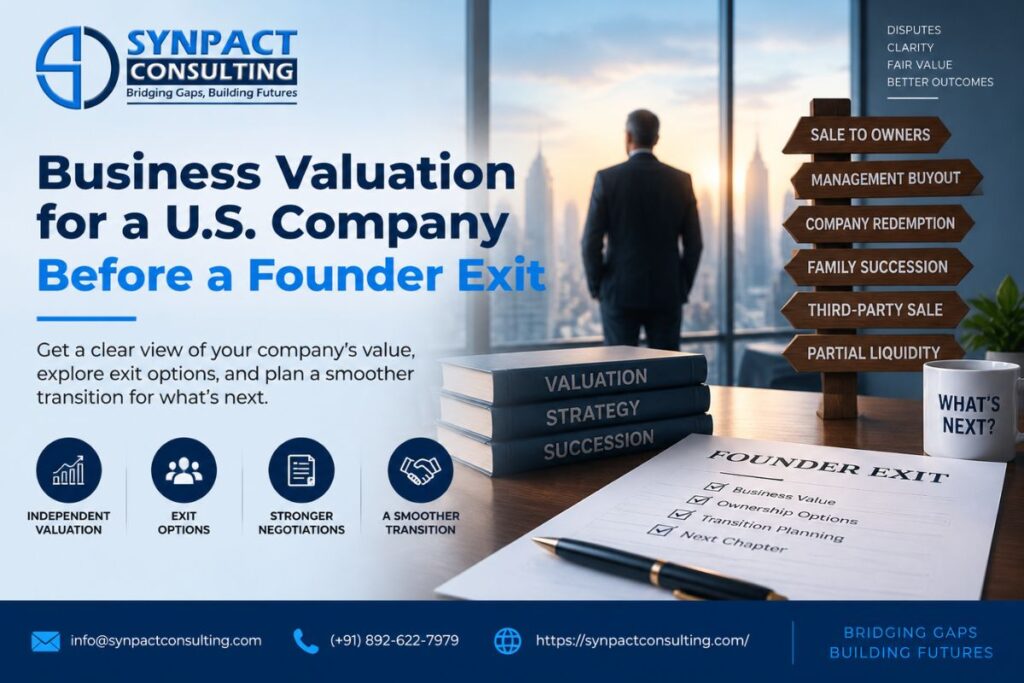
A founder exit can involve much more than simply selling shares. Depending on the situation, the transition may include:
- Sale to co-founders
- Management buyout
- Company share redemption
- Family succession
- Partial liquidity
- Third-party sale
- Gradual reduction in ownership
This representative case study illustrates how Synpact Consulting can approach a business valuation before founder exit for a privately held U.S. company preparing for a significant ownership and leadership transition.
Engagement Snapshot
- Company Type: Privately held U.S. operating company
- Valuation Purpose: Founder exit / ownership transition
- Primary Users: Founder, co-owners, management, and advisers
- Primary Need: Establish company and founder-interest value before evaluating exit options
- Key Considerations: Normalized earnings, founder dependence, management depth, customer concentration, debt, cash, ownership rights, and transition risk
The Situation
The founder had built the company over many years and remained actively involved in day-to-day operations.
The founder was now considering stepping away from the business and wanted to understand the available options before making a final decision.
Potential paths included:
- Selling shares to existing co-owners
- Transitioning ownership to management
- Having the company redeem part or all of the founder’s interest
- Transferring ownership to family members
- Preparing the entire company for a third-party sale
Before choosing a path, the founder wanted an independent view of both:
- The value of the overall business
- The value of the founder’s ownership interest
The Core Valuation Challenge
The founder’s exit created several related valuation questions.
- What is the current value of the operating business?
- What is the current equity value?
- What is the value of the founder’s ownership interest?
- How could the founder’s departure affect future business performance?
- Which exit structure may be financially practical?
The challenge was particularly important because the founder remained closely connected to customers, employees, strategic decisions, and business development.
Why Founder Dependence Can Affect Value
A founder can be one of the company’s greatest strengths, but significant reliance on one individual can also create risk during an ownership transition.
The founder may personally manage:
- Major customer relationships
- Sales
- Supplier relationships
- Pricing decisions
- Strategic direction
- Key employee relationships
If those responsibilities are not transferable to the remaining management team, a buyer or successor may view the company as having greater transition risk.
The valuation therefore needs to consider both historical financial performance and the company’s ability to operate successfully after the founder steps away.
Planning to Step Away From Your Business?
Understanding company value before deciding how to exit can help you evaluate buyout, succession, redemption, and sale options more clearly.
Discuss Your Founder Exit Valuation →
Step 1: Define the Founder’s Exit Objective
The first step is understanding what the founder wants to achieve.
Possible objectives may include:
- Full liquidity
- Partial liquidity
- Retaining a minority ownership position
- Transferring control to management
- Moving ownership to family
- Preparing for a future third-party sale
- Reducing day-to-day involvement while retaining economic ownership
The founder’s objective can materially affect the appropriate valuation and transaction analysis.
Step 2: Review the Current Ownership Structure
The next step is understanding the company’s capitalization and ownership rights.
Relevant information may include:
- Founder ownership percentage
- Co-founder ownership
- Employee equity
- Investor ownership
- Voting rights
- Different classes of shares
- Options or warrants
The analysis should also review shareholder or operating agreements that may affect the founder’s ability to transfer or redeem shares.
Step 3: Review Shareholder and Buy-Sell Agreements
Ownership agreements may contain provisions that directly affect the founder’s exit.
Relevant provisions may include:
- Rights of first refusal
- Buy-sell provisions
- Redemption rights
- Transfer restrictions
- Tag-along rights
- Drag-along rights
- Voting rights
- Valuation procedures
Legal interpretation should be addressed by qualified counsel, while the valuation analysis focuses on the economic implications of these provisions.
Step 4: Analyze Historical Financial Performance
The valuation process typically begins with a review of historical financial results.
Relevant information may include:
- Revenue
- Gross profit
- Operating expenses
- EBITDA
- Net income
- Cash flow
- Working capital
- Debt
- Cash balances
Several years of financial information can help identify trends and determine whether recent performance reflects normal ongoing operations.
Step 5: Normalize Earnings
Founder-led private companies often include expenses or compensation structures that may not reflect market-level ongoing operations.
Potential adjustments may include:
- Founder compensation above or below market levels
- Personal expenses paid through the business
- Related-party expenses
- One-time legal or professional fees
- Non-recurring bonuses
- Unusual gains or losses
The objective is to estimate normalized earnings that a market participant or successor may expect after the transition.
Illustrative EBITDA Normalization
| Item | Illustrative Amount |
|---|---|
| Reported EBITDA | $2.60M |
| Add: One-Time Professional Fees | $0.15M |
| Add: Non-Recurring Expense | $0.10M |
| Less: Market Replacement Compensation | ($0.20M) |
| Illustrative Normalized EBITDA | $2.65M |
This normalized figure may provide a more useful basis for applying valuation methodologies.
Why Replacement Compensation Matters
If the founder performs a significant operating role, the business may need to hire one or more people to replace those responsibilities after the exit.
The valuation may therefore consider the market cost of replacing functions such as:
- CEO leadership
- Sales management
- Customer relationship management
- Operations oversight
- Strategic planning
This helps distinguish the value of the business from the economic contribution of the founder’s ongoing labor.
Step 6: Evaluate Management Depth
A strong management team can reduce founder-transition risk.
The analysis may consider:
- Strength of second-level management
- Decision-making authority
- Customer relationship ownership
- Operational documentation
- Employee retention
- Succession readiness
A business that can operate independently of the founder may present a different risk profile from a company where nearly every major decision depends on one individual.
Step 7: Review Customer Concentration
Customer concentration can become especially important during a founder exit.
If a major customer relationship depends primarily on the founder, the company may face additional transition risk.
The analysis may consider:
- Largest customer concentration
- Top five customer concentration
- Contract terms
- Customer retention history
- Relationship ownership within the company
Step 8: Assess Revenue Quality
The valuation may also distinguish between different types of revenue.
Relevant factors may include:
- Recurring revenue
- Contracted revenue
- Project-based revenue
- Customer retention
- Revenue visibility
Predictable and diversified revenue can help reduce transition uncertainty.
Step 9: Review the Company’s Future Outlook
A founder exit may coincide with changes in strategy, management, or growth expectations.
The valuation may therefore review:
- Revenue growth
- Margins
- Sales pipeline
- New products or services
- Customer retention
- Capital expenditures
- Working capital requirements
Management forecasts should reflect a realistic post-founder operating structure.
Step 10: Apply the Market Approach
The Market Approach may estimate company value using evidence from comparable companies or transactions.
Potential valuation metrics may include:
- Enterprise Value / Revenue
- Enterprise Value / EBITDA
- Industry-specific measures
The selected market evidence should be evaluated based on differences in:
- Company size
- Growth
- Profitability
- Management depth
- Customer concentration
- Founder dependence
For additional background, see Synpact’s guide to common business valuation methods.
Illustrative Market Approach
Assume normalized EBITDA is:
$2.65 million
and relevant market evidence suggests an illustrative range of:
4.5x to 6.0x EBITDA
| Illustrative Multiple | Implied Enterprise Value |
|---|---|
| 4.5x | $11.93M |
| 5.25x | $13.91M |
| 6.0x | $15.90M |
These amounts are illustrative only. Actual valuation conclusions require company-specific analysis and relevant market evidence as of the valuation date.
Step 11: Apply the Income Approach
The Income Approach may provide another perspective by estimating the present value of expected future cash flows.
A discounted cash flow analysis may consider:
- Projected revenue
- Operating margins
- Replacement management costs
- Taxes
- Capital expenditures
- Working capital
- Free cash flow
- Discount rate
- Terminal value
The projections should reflect the expected economics of the business after the founder’s transition.
Step 12: Reconcile the Valuation Approaches
The valuation professional may compare the results from the Market Approach and Income Approach.
The reconciliation may consider:
- Historical financial performance
- Quality of management forecasts
- Availability of comparable market evidence
- Founder dependence
- Management depth
- Company-specific risk
The objective is to develop a supportable company valuation conclusion or range.
Step 13: Convert Enterprise Value Into Equity Value
The value of the operating business is not necessarily the same as the value attributable to shareholders.
A simplified relationship is:
Equity Value = Enterprise Value + Cash − Debt ± Other Relevant Adjustments
For illustration, assume:
- Enterprise Value: $13.91M
- Cash: $1.75M
- Debt: $2.25M
Illustrative Equity Value:
$13.91M + $1.75M − $2.25M = $13.41M
This equity value can then provide a starting point for analyzing the founder’s specific ownership interest.
Step 14: Determine the Founder’s Ownership Interest
Assume the founder owns:
60% of the company
Using the illustrative equity value of:
$13.41 million
a simple pro-rata indication would be:
$8.05 million
However, the final analysis may also need to consider:
- Voting rights
- Control
- Transfer restrictions
- Shareholder agreement provisions
- Transaction structure
The founder’s actual economic outcome may also differ depending on whether the exit involves a third-party sale, internal buyout, redemption, family transfer, or partial liquidity transaction.
Step 15: Compare Founder Exit Paths
Once company and ownership value are understood, the founder can begin comparing potential exit alternatives.
| Exit Path | Key Consideration |
|---|---|
| Sale to Co-Owners | Buyer funding capacity and agreed share value |
| Management Buyout | Management financing and transition readiness |
| Company Redemption | Company liquidity and debt capacity |
| Family Succession | Valuation, succession, gift/estate and governance planning |
| Third-Party Sale | Buyer market, transaction structure and sale readiness |
| Partial Liquidity | Founder retains some ownership while reducing exposure |
Each route can produce different financial, ownership, tax, and transition implications.
Not Sure Which Valuation Service Fits Your Founder Exit?
Use the Synpact Valuation Assistant to answer a few quick questions about your company, ownership situation, and timeline.
Start Your 60-Second Valuation Assessment →
Step 16: Evaluate a Sale to Co-Founders or Existing Owners
One common founder-exit path is a sale of the founder’s ownership interest to existing co-founders or shareholders.
This can preserve continuity because the remaining owners already understand:
- The company’s operations
- Customers
- Employees
- Strategy
- Industry position
However, internal buyers may not have enough liquidity to fund the entire purchase price at closing.
The analysis may therefore consider:
- Available buyer cash
- Bank financing
- Seller financing
- Installment payments
- Partial buyout structures
Illustrative Co-Founder Buyout Structure
Assume the founder’s ownership interest has an illustrative value of:
$8.0 million
The transaction might be structured as:
- $3.0M paid at closing
- $3.0M financed through a seller note
- $2.0M paid over time based on agreed terms
The economic value of deferred consideration can depend on:
- Payment timing
- Interest rate
- Credit risk
- Collateral
- Default provisions
These transaction terms should be evaluated separately with legal, tax, and financial advisers.
Step 17: Consider a Management Buyout
A management buyout may allow the founder to transfer ownership to the existing leadership team.
This can be attractive when management already has:
- Strong operational experience
- Customer relationships
- Leadership credibility
- A clear strategic plan
However, management teams may face financing constraints.
The transaction may involve a combination of:
- Management equity
- Third-party debt
- Seller financing
- Outside investors
The valuation provides a financial reference point, while transaction modeling can help determine whether the structure is economically feasible.
Step 18: Evaluate a Company Redemption
Another option is for the company itself to repurchase the founder’s shares.
This may allow the remaining shareholders to increase their ownership without directly funding the entire purchase.
However, a redemption can affect:
- Company cash reserves
- Debt capacity
- Working capital
- Capital expenditures
- Future growth investments
The company should evaluate whether the buyout can be funded without creating excessive financial strain.
Illustrative Redemption Analysis
Assume the founder’s interest is valued at:
$8.0 million
and the company has:
- $2.5M available cash
- Existing debt obligations
- Ongoing working capital requirements
Using all available cash to fund the redemption could weaken the company’s operating flexibility.
A staged redemption or combination of cash and financing may therefore be considered.
Step 19: Consider Family Succession
Some founders prefer to transition ownership to children or other family members rather than sell the company.
In that situation, the valuation may support:
- Ownership transfers
- Gift planning
- Estate planning
- Internal family buyouts
- Succession discussions
The valuation may need to consider both the overall company value and the specific ownership interests being transferred.
For family-transfer situations, legal and tax advisers should address the applicable estate, gift, and ownership-planning requirements.
Step 20: Evaluate a Third-Party Sale
A founder may decide that selling the entire company to an outside buyer provides the best liquidity option.
Potential buyers may include:
- Strategic acquirers
- Private equity firms
- Family offices
- Industry consolidators
A third-party buyer may evaluate the company based on:
- Normalized EBITDA
- Growth
- Customer concentration
- Management depth
- Founder dependence
- Recurring revenue
- Strategic fit
Founder transition planning can become especially important because a buyer may require the founder to remain involved for a period after closing.
Founder Transition Period
Some transactions include a structured transition period.
The founder may continue working for:
- Several months
- One year
- Multiple years
The founder’s role may include:
- Customer introductions
- Management transition
- Strategic advisory support
- Employee communication
A well-planned transition can help reduce the perceived risk associated with founder dependence.
Step 21: Consider Partial Liquidity
A founder does not always need to sell 100% of the ownership interest.
Partial liquidity may allow the founder to:
- Receive some cash today
- Reduce personal concentration risk
- Remain invested in future growth
- Transition gradually out of management
For example, a founder owning 60% of the company might sell 30% and retain 30%.
This can create a balance between current liquidity and participation in future upside.
Illustrative Partial Liquidity Scenario
Assume the founder owns:
60%
and the company’s illustrative equity value is:
$13.4 million
The founder’s simple pro-rata interest is approximately:
$8.0 million
If the founder sells half of that interest, the transaction could involve approximately:
$4.0 million of ownership value
while the founder retains approximately:
30% of the company
This simplified illustration does not reflect transaction-specific rights, restrictions, taxes, or negotiated adjustments.
Considering a Full or Partial Founder Exit?
An independent valuation can help compare internal buyout, redemption, succession, third-party sale, and partial-liquidity alternatives before you commit to a structure.
Discuss Your Founder Exit Options →
How to Reduce Founder Dependence Before an Exit
Founder dependence can often be reduced through preparation.
Potential steps may include:
- Transfer key customer relationships to management
- Document important processes
- Strengthen the leadership team
- Delegate pricing authority
- Develop succession plans
- Create recurring management reporting
- Reduce reliance on founder-only knowledge
These changes may improve transition readiness and make the business easier for a successor or buyer to operate.
Why Exit Timing Matters
Company value can change depending on when the founder exits.
Relevant factors may include:
- Recent financial performance
- Industry conditions
- Customer wins or losses
- Market valuation multiples
- Management readiness
- Company growth
A valuation can help the founder compare the economics of exiting now versus continuing to operate the business for a period before transitioning.
Founder Exit Readiness Checklist
| Item | Ready? |
|---|---|
| Current financial statements | ☐ |
| Normalized EBITDA analysis | ☐ |
| Current cap table | ☐ |
| Shareholder / buy-sell agreements | ☐ |
| Customer concentration analysis | ☐ |
| Management succession plan | ☐ |
| Founder responsibilities documented | ☐ |
| Debt and cash balances | ☐ |
| Exit alternatives reviewed | ☐ |
| Independent valuation prepared | ☐ |
Common Founder Exit Mistakes
1. Waiting Until the Founder Is Ready to Leave Immediately
A rushed transition can limit the founder’s ability to strengthen management, reduce key-person dependence, and evaluate multiple exit options.
2. Relying on a Rule-of-Thumb Valuation
A generic revenue or EBITDA multiple may not reflect the company’s actual growth, risk, margins, customer concentration, and transition profile.
3. Ignoring Founder Replacement Costs
If the founder performs multiple operating roles, a successor may need to incur additional compensation costs after the founder exits.
4. Assuming the Founder’s Percentage Equals the Final Buyout Price
The specific ownership interest may have voting, control, transfer, or contractual characteristics that require additional analysis.
5. Focusing Only on the Headline Price
Deferred payments, earnouts, seller notes, rollover equity, and transaction terms can affect the actual economics of an exit.
6. Ignoring Management Readiness
A weak transition plan can increase perceived risk for internal successors or outside buyers.
7. Failing to Compare Exit Paths
An internal buyout, redemption, family transfer, and third-party sale can produce very different liquidity, control, and future-participation outcomes.
Information Typically Required for a Founder Exit Valuation
Financial Information
- Historical financial statements
- Current management accounts
- Financial forecasts
- Debt schedules
- Cash balances
- Working capital information
Ownership Information
- Current capitalization table
- Founder ownership percentage
- Other shareholder interests
- Shareholder agreements
- Buy-sell agreements
- Share-class rights
Operating Information
- Founder responsibilities
- Management structure
- Key employees
- Major customers
- Customer concentration
- Supplier relationships
- Recent company developments
Exit Planning Information
- Preferred exit timeline
- Potential buyers or successors
- Desired level of liquidity
- Whether the founder plans to retain ownership
- Expected transition period
What the Valuation Deliverable May Include
Depending on the engagement scope, the analysis may include:
- Company background
- Historical financial analysis
- Normalized earnings analysis
- Founder replacement-cost analysis
- Industry and market considerations
- Market Approach
- Income Approach
- Enterprise value
- Equity value
- Founder ownership-interest analysis
- Exit-scenario modeling
- Key risks and value drivers
- Valuation conclusion or range
How the Valuation Can Support Founder Exit Planning
A founder-exit valuation is not only about producing a number.
It can help the founder understand:
- Current company value
- Potential ownership value
- How founder dependence affects the business
- Whether management is ready for succession
- How internal and external exit paths compare
- How much liquidity different structures may provide
This creates a clearer financial framework before ownership or leadership changes are finalized.
Questions Founders Should Ask Before Exiting
- What is my business worth today?
- What is my ownership interest worth?
- How dependent is the company on me?
- Who can take over my responsibilities?
- Can existing owners or management fund a buyout?
- Could the company fund a share redemption?
- Would a third-party sale produce a different outcome?
- Do I want full liquidity or partial liquidity?
- How long am I willing to remain during a transition?
- What legal and tax issues should I review with my advisers?
Frequently Asked Questions About Founder Exit Valuation
When should a founder start planning an exit?
Starting before the desired exit date can provide time to strengthen management, reduce founder dependence, improve financial reporting, and evaluate different transaction structures.
How is a founder’s ownership interest valued?
The analysis generally begins with company value and equity value, then considers the founder’s ownership percentage, rights, restrictions, and the transaction structure.
Can the company buy back the founder’s shares?
A company redemption may be possible depending on available cash, financing capacity, legal requirements, and transaction terms.
Does founder dependence reduce business value?
Significant reliance on a founder may increase perceived transition risk. The specific valuation impact depends on the company’s management depth, customer relationships, and succession readiness.
What if I want to retain some ownership after I leave?
A partial-liquidity structure may allow a founder to sell part of the ownership interest while retaining equity participation in the company.
Is a founder exit valuation the same as a business sale valuation?
Not always. A founder exit may involve an internal buyout, redemption, succession, partial liquidity, or third-party sale. The appropriate valuation and analysis depend on the specific transaction.
Can Synpact help determine which exit structure is best?
Synpact can provide valuation and financial analysis to help compare economic outcomes. Legal, tax, and transaction-structure decisions should be coordinated with the appropriate professional advisers.
How Synpact Consulting Can Help
Synpact Consulting provides valuation support for business owners, founders, shareholders, and privately held companies preparing for ownership and leadership transitions.
Depending on the engagement, support may include:
- Independent business valuation
- Normalized earnings analysis
- Founder replacement-cost analysis
- Enterprise-to-equity value analysis
- Ownership-interest valuation
- Internal buyout modeling
- Redemption analysis
- Partial-liquidity modeling
- Pre-sale valuation
- Transition scenario analysis
Not Sure Which Valuation Service Fits Your Exit?
If you are planning to step away from your company but are not sure whether you need a business valuation, shareholder valuation, pre-sale valuation, or another type of analysis, start with the Synpact Valuation Assistant.
Use the Synpact Valuation Assistant
Answer a few quick questions about your business, ownership situation, and timeline to receive personalized guidance.
Start Your Valuation Assessment →
Planning Your Founder Exit?
Understanding business value before choosing an exit structure can help you compare liquidity, ownership, succession, and transaction alternatives more clearly.
Discuss Your Founder Exit Valuation
Tell us about your company, approximate revenue or EBITDA, ownership percentage, expected exit timeline, and the transition alternatives you are considering.
Synpact Consulting can review the requirement and discuss an appropriate valuation scope.
Email: [email protected]
Phone: (+91) 892-622-7979