
How Valuation Firms Can Minimize Operating Expenses by Outsourcing
Running a valuation firm in today’s environment is expensive. Salary inflation, rising office overheads, escalating software licensing costs, and the pressure to deliver faster turnarounds with fewer errors have made cost control one of the defining strategic challenges for valuation practices in the United States, United Kingdom, and Australia.
Yet many mid-size and boutique valuation firms continue to operate with fully in-house teams — paying premium salaries for analysts who spend a large portion of their time on repetitive, process-driven work that could be executed at a fraction of the cost through a qualified outsourcing partner.
This blog explores exactly how valuation firms can strategically outsource key functions to minimize operating expenses, improve margins, and scale their practices — without compromising quality or client relationships.
The Cost Reality Facing Valuation Firms in 2025–2026
Before discussing solutions, it is important to understand the scale of the cost problem.
Analyst Salary Inflation in the USA, UK & Australia
The post-pandemic labor market permanently reset compensation benchmarks across financial services. In the United States, a junior valuation analyst with 1–3 years of experience now commands a base salary of $70,000–$95,000 per year. A senior analyst or manager-level professional with CFA or ASA credentials earns $120,000–$175,000 or more — before bonuses, benefits, payroll taxes, and overhead.
In the United Kingdom, equivalent roles cost £45,000–£85,000. In Australia, AUD $80,000–$140,000.
For a 10-person valuation firm, total compensation and overhead can easily exceed $1.5–2 million per year — representing 55–70% of total operating costs. This leaves very little room for profitability, especially during slower deal cycles or when inflation has already compressed client fee budgets.
Overhead, Technology, and Software Costs
Beyond salaries, valuation firms carry significant fixed costs:
- Bloomberg Terminal or FactSet subscriptions: $20,000–$25,000 per user per year
- Valuation software (BVR, ValuSource, Kroll/Duff & Phelps data): $5,000–$15,000 per year
- Office space in major financial centers: $15,000–$50,000 per year per employee equivalent
- HR, IT support, compliance, and professional liability insurance: typically 10–15% of revenues
The Margin Pressure Problem
When revenues dip — as they do during market downturns, rising rate environments, or geopolitical uncertainty (as explored in our companion piece on how war and inflation are reshaping business valuations) — a high fixed-cost base becomes an existential threat to smaller valuation firms.
The solution is not simply cutting staff. It is restructuring the cost base so that a larger proportion of expenses are variable, scalable, and tied directly to revenue.
What Is Valuation Outsourcing — and What Can Be Outsourced?
Outsourcing in the context of valuation firms does not mean offloading client relationships or professional judgment. It means delegating the execution of structured, process-driven analytical work to a qualified external team — typically one based in a lower-cost geography such as India — while the onshore partner retains client management, quality review, and final sign-off.
Here is a breakdown of the functions that can be effectively outsourced:
1. Financial Modeling and DCF Analysis
Building three-statement financial models, DCF frameworks, LBO models, and scenario analyses is highly structured, time-intensive work. A skilled analyst in India can build the same quality model at 30–40% of the cost of a US-based analyst, with the same — or faster — turnaround time.
At Synpact, we support valuation firms with complete valuation and financial modeling services, including forecasting and three-statement modeling, that can be white-labeled and delivered under your firm’s brand.
2. Comparable Company and Precedent Transaction Research
Identifying and screening public comps, pulling transaction multiples, and building comparable company tables is research-intensive but highly templatable. This is one of the highest-value outsourcing opportunities for valuation firms because it consumes significant analyst hours but does not require local market knowledge.
Our comparable company analysis and precedent transaction analysis teams handle these tasks daily for US, UK, and Australian clients.
3. Purchase Price Allocation (PPA) Work
Post-acquisition purchase price allocation involves identifying and valuing acquired intangible assets — customer relationships, trade names, technology, non-competes — and allocating the acquisition price accordingly. The underlying modeling work (excess earnings method, relief from royalty, with-and-without method) is highly structured and outsourceable. The client-facing interpretation and audit defense remain onshore.
4. Goodwill and Intangible Impairment Testing
Annual goodwill impairment testing under ASC 350 and IAS 36 requires DCF modeling, market approach benchmarking, and thorough documentation. The volume of impairment engagements tends to spike during high-rate, high-inflation environments — exactly when in-house teams are most stretched. Outsourcing the modeling component allows onshore managers to handle more engagements simultaneously without adding headcount.
5. 409A and Tax Valuation Support
The 409A valuation market is high-volume, deadline-driven, and relatively standardized in its methodology. Outsourcing the analytical build — OPM backsolve, PWERM, DLOM calculations — while retaining the final opinion sign-off onshore is a well-established model used by some of the largest 409A providers in the US market. The cost savings are substantial given the volume of engagements these firms handle.
6. Equity Research and Sector Analysis
Many valuation firms provide equity research, sector reports, or investor presentations as part of their service offering. Equity coverage and sector research, including model maintenance and roll-forwards, can be entirely offshored to qualified analysts — freeing senior onshore professionals to focus on client relationships and business development.
7. Finance and Accounting Back-Office Functions
Beyond pure valuation work, many boutique valuation firms also carry significant internal finance and accounting costs — bookkeeping, accounts payable and receivable, payroll processing, month-end close, and financial statement drafting. All of these are prime outsourcing candidates.
Our finance and accounting outsourcing practice handles exactly these functions for financial services firms, including bookkeeping, accounts payable, accounts receivable, month-end close and management reporting, and financial statement drafting.
8. Pitch Books, CIMs, and Client Presentation Materials
Preparing pitch books, teasers, confidential information memoranda, and management and investor presentations is time-consuming creative and analytical work. Outsourcing the production of these materials — while providing clear templates and brand guidelines — can save 15–20 analyst hours per engagement.
The Financial Case: How Much Can Valuation Firms Actually Save?
Let us put concrete numbers on the opportunity.
Scenario: A 5-Person US Valuation Firm
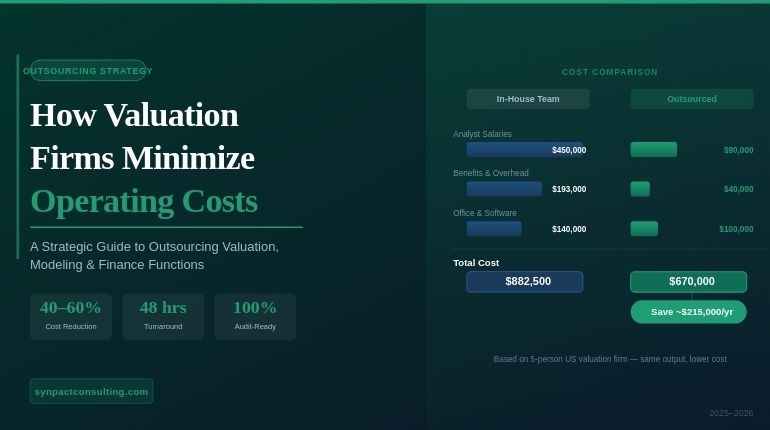
A boutique US valuation firm with 5 analysts generating $1.8 million in annual revenues might currently have the following cost structure:
- Analyst salaries (5 × avg $90,000): $450,000
- Benefits and payroll taxes (25%): $112,500
- Office and overhead: $80,000
- Software and data subscriptions: $60,000
- Management and BD (1 principal): $180,000
- Total operating costs: ~$882,500
- Operating margin: ~51%
Now consider a hybrid model where 60% of analyst-level work (modeling, research, documentation) is outsourced to a qualified India-based team at an equivalent blended cost of $25,000–$35,000 per analyst equivalent per year:
- Onshore team reduced to 2 senior reviewers: $240,000 in salaries
- Benefits and payroll taxes: $60,000
- Outsourced team (3 analyst equivalents × $30,000): $90,000
- Office and overhead (reduced footprint): $40,000
- Software and data: $60,000
- Management and BD: $180,000
- Total operating costs: ~$670,000
- Operating margin: ~63%
That is a 12-point improvement in operating margin — approximately $215,000 in additional profit on the same revenue base — without any reduction in capacity or output quality. In fact, with the right outsourcing partner, capacity and turnaround speed typically improve.
How to Choose the Right Valuation Outsourcing Partner
Not all outsourcing is created equal. Valuation work is technically complex, deadline-sensitive, and audit-facing. Choosing the wrong partner can create reputational and liability risks that outweigh the cost savings. Our blog on how to choose a valuation outsourcing agency in India covers this in depth, but here are the core criteria:
1. Credentials and Technical Expertise
Your outsourcing partner must employ analysts who are qualified in the relevant valuation methodologies — CFA charterholders, ACCA or CA-qualified professionals, and analysts with hands-on experience in ASC 805, ASC 820, IAS 36, IFRS 3, and IRS Section 409A. Generic financial analysts without valuation-specific training are not suitable for this work.
2. Audit-Ready Output Quality
The work product must be defensible in front of auditors — Big Four, regional, and independent. This means proper documentation of key assumptions, sensitivity tables, transparent methodology write-ups, and clear source citation for market data. Ask for sample deliverables before engaging any outsourcing provider.
3. Data Security and Confidentiality Protocols
Valuation engagements involve highly sensitive client financial data, transaction details, and non-public information. Your outsourcing partner must have robust NDAs, data security protocols, access controls, and GDPR/CCPA-compliant data handling practices.
4. Turnaround Time and Communication Standards
The value of outsourcing is destroyed if the turnaround is slow or communication is unreliable. Look for partners who can commit to specific SLAs — for example, 48-hour delivery for standard 409A or impairment testing engagements — and who maintain a clear communication protocol with your onshore team.
5. Scalability
One of the primary benefits of outsourcing is the ability to scale capacity up and down based on deal flow. A good outsourcing partner should be able to absorb 2x or 3x your normal volume during peak periods — M&A surge, year-end impairment testing season — without compromising turnaround or quality.
Common Objections — and Why They Do Not Hold Up
“Our clients won’t accept offshore work.”
In practice, your clients never need to know where the analytical work is executed — just as they do not need to know which associate in your office built the model. What matters to clients is the quality of the final deliverable and the professional judgment of the signing partner. This is no different from how the largest accounting and consulting firms in the world have operated for decades.
“The quality won’t be good enough.”
This objection applies to the wrong outsourcing partners, not to qualified ones. India has produced some of the world’s most sophisticated financial analysts — many of whom have trained at or worked for Big Four firms, global investment banks, and top-tier valuation boutiques. Outsourcing financial modeling to India at the right firm delivers output that is indistinguishable from US-based work — and often faster.
“It’s too risky to share client data.”
This is a legitimate concern that a reputable partner addresses through proper legal frameworks — NDA, data processing agreements, SOC 2 compliance, and access controls. It is not a reason to avoid outsourcing; it is a reason to choose your partner carefully.
“We tried it before and it didn’t work.”
Failed outsourcing experiments almost always trace back to one of two root causes: choosing the wrong partner (insufficient technical expertise) or insufficient onboarding and knowledge transfer. A structured onboarding process — clear templates, style guides, review checkpoints, and regular feedback loops — makes the difference between a failed experiment and a transformational cost reduction.
A Phased Approach to Outsourcing for Valuation Firms
Rather than attempting to outsource everything at once, we recommend a phased approach:
Phase 1 (Months 1–3): Pilot with Low-Risk, High-Volume Work Begin with comparable company research, precedent transaction screening, and data gathering. These tasks have clear, templatable outputs and low audit risk. Build confidence and establish the communication rhythm before moving to more complex work.
Phase 2 (Months 4–6): Expand to Financial Modeling Once the relationship is established and quality benchmarks are confirmed, transition the build phase of DCF models, LBO models, and three-statement models to the outsourced team. The onshore senior analyst reviews, refines, and signs off.
Phase 3 (Months 7–12): Full Engagement Delivery At maturity, the outsourced team handles end-to-end analytical production — from initial model build through final deliverable draft — with onshore review, client communication, and professional opinion sign-off remaining in-house.
Phase 4 (Ongoing): Back-Office Outsourcing Layer in finance and accounting outsourcing — bookkeeping, payroll, AP/AR — to complete the cost optimization picture and further reduce the non-billable overhead that drags down firm profitability.
The Strategic Advantage Beyond Cost Savings
Outsourcing is not just about cutting costs. For valuation firms with growth ambitions, it is also a scalability engine:
- Win more work without hiring: With a scalable outsourced production capability, you can take on larger deal volumes and faster turnarounds — competitive advantages that win mandates.
- Free senior talent for business development: When your senior analysts are not buried in model builds, they can spend more time winning new clients, deepening existing relationships, and developing new service lines.
- Enter new geographies: With an India-based team already covering Australian M&A valuation work or UK transfer pricing valuations, you have a natural bridge to expand your client base internationally.
- Upgrade your technology: The cost savings from outsourcing can be reinvested into premium data subscriptions, AI-powered financial modeling tools, or improved workflow systems — further widening your competitive moat.
Why Synpact Consulting Is the Right Outsourcing Partner for Valuation Firms
Synpact Consulting was built specifically to serve valuation firms, investment banks, private equity funds, and CFO offices in the US, UK, and Australia that need institutional-quality financial work delivered at offshore economics.
Our team includes CFA charterholders, ACCA-qualified analysts, and professionals with experience at Big Four firms and top-tier valuation boutiques. We deliver across the full range of valuation services, investment banking support, equity research and financial modeling, private equity and VC support, and finance and accounting outsourcing.
Our model is simple: you retain the client relationship, the professional judgment, and the final sign-off. We handle the analytical heavy lifting — to your standards, on your timelines, under your brand.
Typical client outcomes include:
- 40–60% reduction in per-engagement analytical costs
- 48-hour standard turnaround on most valuation and modeling engagements
- Zero compromise on audit-readiness or deliverable quality
- Scalable capacity that expands with your deal flow — no hiring lag, no severance risk
Whether you need an outsourced CFO function, support for a 409A valuation pipeline, or a white-label financial modeling team for your M&A practice, Synpact is built for exactly this work.
Schedule a free strategy call with our team today.
Conclusion
The valuation industry is under structural cost pressure — from salary inflation, technology costs, rising client expectations for speed, and the uncertainty created by geopolitical conflict and macroeconomic volatility. Firms that continue to operate with fully loaded in-house teams for every function will find their margins shrinking and their ability to scale constrained.
Strategic outsourcing — done with the right partner, with proper onboarding and quality controls — is not a compromise. It is a competitive strategy. The firms that embrace it in 2025 and 2026 will enter the next cycle leaner, more scalable, and more profitable than those that do not.
The question is no longer whether to outsource. It is how fast to start — and who to trust with the work.
Related Reading:
- How War and Rising Inflation Are Reshaping Business Valuations Globally
- How to Choose a Valuation Outsourcing Agency in India
- Outsourcing Financial Modeling to India: Cost, Quality & Turnaround Time
- Outsourced CFO Services for US Startups: Fractional vs Full-Time
- How AI & Automation Are Reshaping Finance Functions in 2026