
ASC 820 Level 3 Valuation: A Practical Guide for Private Equity & Venture Capital Funds
Private equity and venture capital funds face a valuation problem that public-market investors rarely encounter: how do you determine fair value when there is no active market price?
A public security may have a readily observable quoted price. A private portfolio company usually does not.
Instead, fund managers may need to assess recent financing rounds, financial forecasts, comparable-company multiples, capital structure rights, market conditions, company-specific performance and other inputs to estimate what a market participant would pay for the investment at the measurement date.
That is where ASC 820 Level 3 valuation becomes particularly important.
For private equity, venture capital and other investment portfolios holding illiquid securities, Level 3 fair value measurements can require significant judgment. The challenge is not simply building a valuation model. The analysis must also explain why the methodology and assumptions are appropriate, how they changed since the prior reporting date, and how the resulting fair value reflects a market-participant perspective.
This guide explains the practical mechanics of ASC 820 Level 3 valuation, including valuation methods, calibration, complex capital structures, quarterly portfolio updates, documentation and common audit-review issues.
What Is ASC 820?
ASC 820, Fair Value Measurement, establishes the framework for measuring fair value when another U.S. GAAP requirement requires or permits a fair value measurement.
At its core, ASC 820 approaches fair value as an exit-price concept: the measurement considers the price associated with an orderly transaction between market participants at the measurement date.
This distinction matters.
Fair value is not automatically:
- the original investment cost;
- management’s internal target value;
- the value the investor hopes to receive at exit;
- the latest financing price without further analysis; or
- a mechanically rolled-forward prior-period valuation.
The objective is to estimate fair value using assumptions that market participants would use under current conditions.
For organizations dealing with private investments, complex securities and other difficult-to-price instruments, Synpact provides dedicated Fair Value Measurement Services covering ASC 820 and other applicable fair-value frameworks.
Understanding the ASC 820 Fair Value Hierarchy
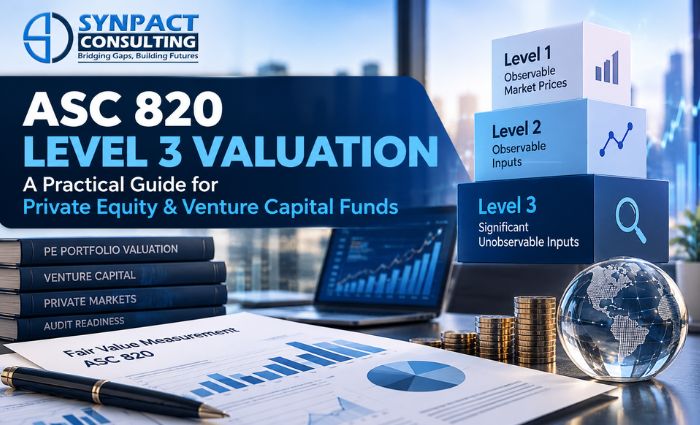
ASC 820 organizes valuation inputs into a three-level hierarchy based primarily on their observability.
Level 1 Inputs
Level 1 generally involves quoted prices in active markets for identical assets or liabilities that the reporting entity can access at the measurement date.
A publicly traded security with an accessible active-market quote is the classic example.
Level 2 Inputs
Level 2 involves observable inputs other than Level 1 quoted prices.
Depending on the asset or liability, these can include observable market information relating to similar securities, interest rates, yield curves, credit spreads and other market-corroborated inputs.
Level 3 Inputs
Level 3 involves significant unobservable inputs.
These become relevant when sufficient directly observable market information is unavailable and the valuation therefore requires assumptions about the inputs market participants would use.
Private-company investments frequently create this challenge because there may be:
- no quoted market price;
- limited recent transaction activity;
- company-specific forecasts;
- complex preferred-stock rights;
- limited comparable transaction data;
- significant differences between the subject company and public peers; or
- securities whose economic rights differ substantially from ordinary common equity.
Importantly, a Level 3 classification does not mean that every input in the valuation is unobservable.
A valuation may incorporate observable public-company multiples, interest rates or market volatility data while also relying on significant unobservable inputs. The hierarchy classification depends on the significance of the inputs used in the overall fair value measurement.
Why Level 3 Valuation Matters for PE and VC Funds
For many private-market investors, valuation is not a once-a-year theoretical exercise.
Fair-value conclusions can feed directly into:
- quarterly and annual financial reporting;
- fund NAV calculations;
- investor and LP reporting;
- audit procedures;
- performance measurement;
- portfolio monitoring;
- secondary transactions;
- internal valuation committee discussions; and
- broader fund governance.
Private investments make the process particularly demanding because the valuation team may need to distinguish between changes in enterprise value and changes in the value of the fund’s specific security.
Those are not always the same thing.
Suppose a VC-backed company has:
- Series A preferred shares;
- Series B preferred shares;
- participating or non-participating preferences;
- conversion rights;
- liquidation preferences;
- employee common stock;
- options; and
- warrants.
Even after estimating the company’s enterprise and equity value, another question remains:
How much of that equity value belongs to the security actually held by the fund?
That allocation problem is one reason private-company Level 3 valuations can become significantly more complex than a standard DCF or comparable-company analysis.
Synpact’s Private Equity & Fund NAV Valuation Services support portfolio-level and fund-level valuation requirements, including recurring reporting needs.
ASC 820 Level 3 Valuation Process: Step by Step
A defensible Level 3 valuation process should create a clear analytical trail from the portfolio company’s facts to the final fair-value conclusion.
Step 1: Understand the Investment and Security Rights
Before selecting a valuation methodology, understand exactly what is being valued.
Review documents such as:
- capitalization tables;
- stock purchase agreements;
- financing documents;
- shareholder agreements;
- debt agreements;
- warrant agreements;
- option schedules;
- liquidation preferences;
- conversion provisions;
- participation rights;
- seniority between preferred classes; and
- other contractual rights that could affect value.
This step is particularly important for venture-backed companies.
Two securities representing the same percentage of fully diluted ownership may have different economic values because their rights are different.
Step 2: Establish the Measurement Date
Fair value is measured as of a specific date.
Therefore, the analysis should use information that is known or knowable and relevant to market participants at the measurement date.
The valuation team should identify developments such as:
- changes in operating performance;
- revised forecasts;
- new financing;
- customer wins or losses;
- changes in cash runway;
- acquisitions;
- restructurings;
- regulatory developments;
- industry multiple movements;
- changes in interest rates;
- comparable-company repricing; and
- other company-specific or market events.
This is why simply carrying forward last quarter’s valuation can create problems.
The question is not:
“What did we conclude last quarter?”
The better question is:
“What has changed since the last measurement date, and how would those changes affect market-participant assumptions today?”
Step 3: Analyze the Most Recent Financing or Transaction
A recent financing round can provide valuable valuation evidence.
But transaction price and fair value should not automatically be treated as permanently interchangeable.
The valuation team should understand:
- when the financing occurred;
- whether it involved new or existing investors;
- whether the transaction was orderly;
- what security was issued;
- what rights came with that security;
- whether strategic considerations affected pricing;
- whether the company’s performance has changed;
- whether market multiples have changed;
- whether financing conditions have changed; and
- whether enough time has passed that the transaction is no longer the best indication of current fair value.
The transaction can be a powerful calibration point, but it is the beginning of the analysis—not necessarily the end.
What Is Calibration in ASC 820 Valuation?
Calibration is one of the most important concepts in private-market fair value measurement.
Assume a fund invests in a private company at a negotiated transaction price.
At that date, the transaction provides evidence about the economics underlying the investment.
A valuation model can be calibrated so that its assumptions are consistent with the observed transaction.
For example, calibration may help evaluate the implied:
- revenue multiple;
- EBITDA multiple;
- discount rate;
- enterprise value;
- equity value;
- volatility;
- expected exit timing; or
- other valuation inputs.
At subsequent measurement dates, those assumptions can be updated to reflect new information.
Example
Assume a company raised capital when:
- revenue was $20 million;
- comparable companies traded around 6.0x forward revenue; and
- the financing implied a company valuation broadly consistent with the relevant market evidence.
Six months later:
- revenue has increased;
- forecast growth has declined;
- public comparable multiples have fallen;
- the company has used more cash than expected; and
- its expected next financing has been delayed.
Using the old financing price without evaluating these developments could miss information that a market participant would consider.
A stronger process starts with the transaction and then recalibrates the valuation as facts and market conditions change.
Step 4: Select the Appropriate Valuation Approach
There is no single method that works for every Level 3 investment.
Depending on the portfolio company and security, valuation professionals may consider the market approach, income approach or other techniques appropriate to the facts and circumstances.
Market Approach
The market approach estimates value using market evidence from comparable businesses or transactions.
Common techniques include:
- guideline public company analysis;
- precedent transaction analysis;
- revenue multiples;
- EBITDA multiples; and
- other sector-specific valuation metrics.
Selecting Comparable Companies
Comparable-company selection should not be based only on industry labels.
Relevant factors may include:
- business model;
- end market;
- company size;
- revenue growth;
- profitability;
- margins;
- geography;
- customer concentration;
- recurring versus transactional revenue;
- capital intensity; and
- risk profile.
For example, two software companies may operate in the same broad sector while having materially different growth, retention, margins and revenue quality.
Those differences can affect the valuation multiples a market participant would consider appropriate.
Income Approach and DCF
A discounted cash flow analysis estimates value based on expected future economic benefits discounted to present value.
A DCF typically requires assumptions about:
- revenue growth;
- gross margins;
- operating expenses;
- EBITDA or EBIT margins;
- taxes;
- capital expenditures;
- working capital;
- terminal growth;
- terminal value; and
- discount rate.
For a mature PE portfolio company with reasonably supportable forecasts, a DCF can provide useful evidence.
For an early-stage venture company with highly uncertain projections, the reliability and weighting of a DCF may require more judgment.
Forecasts Require Market-Participant Analysis
Management forecasts should not automatically be accepted without challenge.
The valuation process should consider questions such as:
- Has management historically achieved its forecasts?
- Have projections changed materially since the last valuation?
- Are margins consistent with the company’s maturity?
- Are growth assumptions supported by pipeline and market conditions?
- Does the forecast require significant future financing?
- Would a market participant make the same assumptions?
A detailed model does not make unsupported assumptions more reliable.
Step 5: Determine Enterprise Value and Equity Value
For operating companies, the selected valuation methods often first estimate enterprise value.
The analysis then considers items necessary to bridge enterprise value to equity value, potentially including:
- cash;
- debt;
- debt-like items;
- non-operating assets;
- excess cash;
- other claims; and
- relevant adjustments.
The exact bridge depends on the company’s facts and the basis used in the valuation methodology.
Once equity value is estimated, the analysis may still need to determine how that value is allocated across the capital structure.
Step 6: Allocate Equity Value Across a Complex Capital Structure
This is often where VC portfolio valuation becomes technically challenging.
A private company may have multiple classes of securities with different economic rights.
Common allocation methods can include:
Option Pricing Method (OPM)
The OPM treats different equity classes as options on the company’s equity value.
It may be useful when future outcomes are uncertain and specific exit scenarios cannot be reliably predicted.
Relevant assumptions can include:
- total equity value;
- volatility;
- expected time to liquidity;
- risk-free rate;
- dividend yield; and
- liquidation breakpoints.
Probability-Weighted Expected Return Method (PWERM)
PWERM explicitly models potential future outcomes.
Examples could include:
- IPO;
- strategic sale;
- financing;
- continued private operation; or
- other liquidity scenarios.
Each scenario can involve:
- an estimated future equity value;
- allocation of proceeds according to contractual rights;
- a probability weighting; and
- discounting to present value where appropriate.
PWERM can be useful when identifiable future scenarios can be reasonably modeled.
Hybrid Method
In some situations, elements of OPM and PWERM may be combined.
For example, a company could have a reasonably identifiable potential exit scenario while significant uncertainty remains around other outcomes.
The appropriate method depends on the facts and circumstances rather than a predetermined formula.
Step 7: Consider Discounts and Security-Specific Adjustments Carefully
A private security may lack the liquidity of a publicly traded security.
However, adjustments such as a discount for lack of marketability should not simply be inserted as an arbitrary percentage.
The analysis should consider the specific characteristics of the security and the underlying valuation framework.
Relevant considerations can include:
- expected holding period;
- liquidity prospects;
- restrictions on transfer;
- expected exit timing;
- volatility;
- dividend distributions;
- contractual rights; and
- company-specific circumstances.
The objective should remain consistent with market-participant assumptions.
Step 8: Reconcile Multiple Valuation Approaches
A strong Level 3 valuation often considers more than one source of evidence where appropriate.
For example:
Market Approach: $94 million enterprise value
DCF: $101 million enterprise value
Recent transaction / calibrated analysis: $97 million
The answer should not automatically be a simple mathematical average.
Instead, the valuation professional should evaluate:
- quality of each data source;
- reliability of management forecasts;
- relevance of comparable companies;
- recency of transaction evidence;
- current market conditions; and
- company-specific developments.
The final conclusion should explain why certain methods received more or less weight.
Quarterly ASC 820 Portfolio Valuation: What Should Change Each Period?
One of the biggest mistakes in recurring portfolio valuation is treating quarterly updates as a mechanical roll-forward.
A good quarterly process asks what changed across four broad areas.
1. Company Performance
Review:
- actual vs. budget;
- revenue growth;
- EBITDA;
- gross margin;
- cash burn;
- customer retention;
- pipeline;
- financing needs; and
- revised forecasts.
2. Market Conditions
Update:
- public comparable multiples;
- relevant transactions;
- interest rates;
- credit conditions;
- sector performance;
- volatility; and
- macroeconomic assumptions.
3. Capital Structure
Identify:
- new financing rounds;
- debt issuance;
- SAFE or convertible-note conversion;
- option grants;
- warrant exercises;
- recapitalizations;
- secondary transactions; and
- other changes in security rights.
4. Liquidity and Exit Expectations
Evaluate whether:
- expected exit timing changed;
- an IPO became more or less likely;
- a sale process began;
- a strategic buyer emerged;
- a financing round was delayed; or
- the expected holding period changed.
Synpact’s Private Equity & VC Support practice supports PE and VC teams across portfolio monitoring, valuation, fund reporting and other parts of the investment lifecycle.
ASC 820 Level 3 Valuation Example
Consider a hypothetical venture fund that owns Series B preferred shares in a private SaaS company.
At the previous financing:
- the company raised $15 million;
- Series B shares were issued at $8.00 per share;
- annual recurring revenue was $12 million;
- revenue was growing rapidly;
- the company expected another financing within 18 months.
At the next quarterly valuation date:
- ARR has increased to $14 million;
- growth is below the original forecast;
- net retention has declined;
- the company has increased cash burn;
- public SaaS multiples have contracted;
- management has delayed the next financing; and
- no new arm’s-length transaction in the company’s shares has occurred.
Weak approach
Carry the Series B investment at $8.00 per share because that was the last financing price.
Stronger analytical approach
The valuation team would evaluate:
- what the prior financing implied about company value;
- how the original valuation model calibrated to that transaction;
- changes in company performance;
- movements in relevant market multiples;
- changes in financing and liquidity expectations;
- the company’s current enterprise/equity value;
- rights of Series B relative to other securities; and
- the resulting value attributable to the fund’s investment.
The conclusion might be higher, lower or similar to the financing price.
What matters is that the result reflects the measurement-date facts and market-participant assumptions, rather than simply anchoring to historical cost.
Common ASC 820 Level 3 Valuation Mistakes
1. Automatically Using the Last Financing Price
A financing round provides valuable evidence, but its relevance must be reassessed as conditions change.
2. Ignoring Security Rights
Preferred and common securities can have materially different economics.
Using fully diluted ownership percentages without analyzing contractual rights can produce misleading results.
3. Using Stale Comparable Multiples
Market conditions can change rapidly.
Comparable-company data should correspond appropriately to the measurement date.
4. Accepting Management Forecasts Without Analysis
Forecasts should be evaluated against historical performance, current operating results and market-participant expectations.
5. Changing Methodologies Without Explaining Why
A change in methodology may be appropriate.
The problem is an unexplained change.
Documentation should explain what changed and why the new method better reflects the facts.
6. Applying Unsupported Discounts
Discounts and adjustments should be supported by the economics of the security and relevant market evidence.
7. Weak Calibration
A model that cannot explain the economics of the original investment transaction may become difficult to defend when subsequent valuations change.
8. Insufficient Documentation
Even a technically reasonable conclusion can create review problems when the supporting rationale is missing.
What Do Auditors Typically Focus On in Level 3 Valuations?
Because Level 3 measurements involve significant judgment, review discussions frequently focus on the assumptions and evidence supporting the conclusion.
Questions may include:
Why was this valuation method selected?
The report should connect methodology selection to the company’s stage, available information, security structure and market evidence.
How were comparable companies selected?
The valuation file should explain both inclusions and meaningful exclusions.
Why did the valuation change from last quarter?
A valuation bridge can help identify changes attributable to:
- operating performance;
- market multiples;
- forecasts;
- capital structure;
- discount rates;
- financing; and
- other factors.
How does the valuation reconcile with the latest financing?
If the valuation differs materially from recent transaction evidence, the report should explain why.
How were preferred-stock rights considered?
For complex capital structures, the analysis should show how liquidation preferences, conversion rights and other economic provisions affected allocation.
Are the significant assumptions consistent?
Inputs across DCF, market approach, OPM, PWERM and other analyses should not contradict each other without explanation.
What Does an Audit-Ready ASC 820 Valuation File Include?
The exact documentation depends on the engagement, but a well-supported file may include:
- valuation date and purpose;
- security description;
- capitalization table;
- financing history;
- relevant security rights;
- company financial statements;
- historical performance;
- management forecasts;
- actual-vs-budget analysis;
- comparable-company selection;
- market multiples;
- transaction evidence;
- DCF assumptions where applicable;
- calibration analysis;
- equity allocation methodology;
- key model inputs;
- sensitivity analyses;
- changes from prior period;
- reconciliation of methods;
- fair-value conclusion; and
- supporting source documentation.
The objective is not simply to create a larger report.
The objective is to create a traceable valuation conclusion.
An independent reviewer should be able to understand how the analysis moved from source data to assumptions, from assumptions to valuation methods, and from those methods to the final fair value conclusion.
ASC 820 Level 3 Valuation Checklist for Fund CFOs
Before closing a quarterly or annual valuation cycle, consider asking:
Investment Data
- Is the latest cap table available?
- Have all security rights been reviewed?
- Were there any new financing transactions?
- Were there any secondary transactions?
Financial Performance
- Are current financial statements available?
- Has actual performance been compared with the prior forecast?
- Has management revised its forecast?
- Have liquidity or financing needs changed?
Market Data
- Are comparable-company multiples current?
- Were significant peer movements investigated?
- Are discount-rate and volatility inputs current?
- Have relevant transaction data been considered?
Valuation Methodology
- Is the selected methodology appropriate?
- Has the prior transaction been calibrated where relevant?
- Are changes from the previous valuation explained?
- Are different approaches reconciled?
Capital Structure
- Are liquidation preferences modeled correctly?
- Are conversion rights considered?
- Are options and warrants included appropriately?
- Does the allocation method reflect the actual security economics?
Documentation
- Can each material assumption be supported?
- Is the source of each major input documented?
- Is sensitivity analysis available where appropriate?
- Can the valuation team explain quarter-over-quarter changes?
If several answers are “no,” the valuation may require additional work before review.
When Should a Fund Consider an Independent ASC 820 Valuation Specialist?
Not every investment necessarily requires the same level of external valuation support.
Independent valuation support can become particularly useful when:
- the investment is material to NAV;
- the portfolio company has a complex capital structure;
- there has been no recent arm’s-length financing;
- performance has materially changed;
- market multiples have moved significantly;
- a company is approaching an exit;
- the fund holds debt plus equity instruments;
- significant judgment is required;
- the valuation has attracted auditor questions; or
- the internal team needs additional capacity during quarterly or year-end reporting.
- For broader transaction and private-market valuation requirements, see Synpact’s Investment & Transaction Valuation Services.
How Synpact Consulting Supports ASC 820 Level 3 Valuations
Level 3 valuation requires more than a spreadsheet.
Fund managers need a process that combines technical valuation analysis, market evidence, financial modeling, capital-structure analysis and clear documentation.
Synpact Consulting provides Valuation Services for private equity funds, venture capital investors, companies, CPA firms and financial teams requiring defensible valuation support.
For ASC 820 and private-market assignments, our support can include:
- independent fair value analysis;
- private-company portfolio valuation;
- Level 3 valuation modeling;
- comparable-company analysis;
- DCF analysis;
- recent-transaction calibration;
- OPM and PWERM analysis;
- complex capital-structure modeling;
- portfolio valuation roll-forwards;
- sensitivity analysis;
- valuation documentation; and
- support for valuation review questions.
Our Fair Value Measurement practice focuses on transparent, audit-ready analysis aligned with applicable financial-reporting requirements.
For funds requiring recurring portfolio and NAV support, Synpact also provides dedicated Private Equity & Fund NAV Valuation Services.
Need Support With an ASC 820 Level 3 Valuation?
When private investments lack observable market prices, the quality of the valuation depends heavily on the quality of the assumptions, methodology and documentation behind it.
Whether you need support with a single complex portfolio company, quarterly Level 3 valuations, fund-wide portfolio valuation, or an existing valuation that is facing additional review, Synpact Consulting can help build a transparent and defensible valuation process.
Discuss your ASC 820 valuation requirement with Synpact Consulting.
Share the investment structure, valuation date and reporting requirement with our team, and we can help determine the appropriate scope and valuation approach.
Frequently Asked Questions About ASC 820 Level 3 Valuation
What is a Level 3 valuation under ASC 820?
A Level 3 fair value measurement involves significant unobservable inputs. It is commonly relevant when directly observable market pricing is unavailable and valuation therefore requires assumptions that reflect those market participants would use.
Are private-company investments always Level 3?
Not necessarily. Classification depends on the inputs significant to the measurement. However, private investments frequently involve significant unobservable inputs and therefore often fall within Level 3.
Is the latest funding round equal to fair value?
Not automatically. A recent orderly transaction can provide important valuation evidence, but the valuation should consider the security involved, transaction circumstances and developments between the transaction date and measurement date.
What valuation methods are used for Level 3 investments?
Depending on the facts, methods can include guideline public-company analysis, transaction analysis, DCF and techniques used to allocate equity across complex capital structures, including OPM or PWERM.
What is calibration in ASC 820 valuation?
Calibration uses transaction evidence to understand and align valuation-model assumptions with the economics implied by the transaction. At later measurement dates, those assumptions can then be updated for changes in company performance and market conditions.
How often should PE and VC portfolio companies be valued?
The appropriate frequency depends on the fund’s reporting requirements, valuation policies and applicable accounting framework. Many investment managers perform recurring quarterly, semiannual or annual valuation processes, with additional analysis when material events occur.
Why are Level 3 valuations difficult to audit?
Level 3 measurements can involve significant judgment and unobservable inputs. Review therefore often focuses heavily on methodology, assumptions, calibration, comparable selection, forecasts, security rights and documentation.
Can a third-party valuation specialist support quarterly ASC 820 valuations?
Yes. An external valuation team can assist with individual complex investments or recurring portfolio valuation processes, depending on the fund’s governance model and reporting requirements.
Final Takeaway
ASC 820 Level 3 valuation is not simply about choosing a DCF model or applying a market multiple.
For private equity and venture capital investments, a defensible fair-value conclusion may require the valuation team to connect:
company performance → market evidence → valuation methodology → capital structure → security rights → measurement-date fair value.
The strongest valuation processes also maintain consistency from one reporting period to the next while clearly explaining why values and assumptions changed.
For PE and VC funds managing multiple private investments, establishing that repeatable process can make quarterly reporting more efficient, improve transparency and make valuation conclusions easier to review.
Looking for independent ASC 820 Level 3 valuation support? Explore Synpact Consulting’s Fair Value Measurement Services or discuss your portfolio valuation requirements with our team.