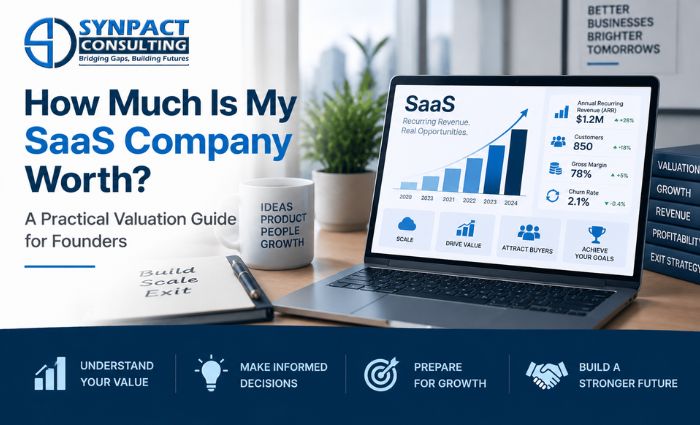
How Much Is My SaaS Company Worth? A Practical Valuation Guide for Founders
If you own or lead a SaaS company, one of the most important questions you may eventually ask is:
“How much is my company actually worth?”
The answer matters in many situations, including:
- Raising capital
- Selling the business
- Evaluating an acquisition offer
- Buying out a shareholder or co-founder
- Estate or gift planning
- Employee equity planning
- Strategic decision-making
For SaaS companies, valuation is often more complex than simply applying a multiple to annual recurring revenue.
Revenue quality, growth, retention, margins, customer concentration, profitability, market conditions, and capital structure can all influence value.
Synpact Consulting provides business valuation services for founders, owners, investors, and companies that need an independent and supportable view of value for financial, tax, investment, transaction, or strategic purposes.
Want to Know What Your SaaS Company Is Worth?
If you are preparing for a sale, raising capital, evaluating an offer, handling a shareholder matter, or simply need an independent valuation, Synpact Consulting can help assess your business based on its actual financial and operating profile.
Request a SaaS Business Valuation Consultation →
Why SaaS Companies Are Valued Differently
SaaS businesses often have characteristics that make them different from traditional companies.
These may include:
- Recurring subscription revenue
- High gross margins
- Low physical asset intensity
- Rapid growth potential
- Strong operating leverage
- Customer churn risk
- Dependence on retention and expansion
Because of this, buyers and investors often focus heavily on the quality and durability of recurring revenue.
Two SaaS companies with the same ARR can have very different valuations if one has stronger retention, higher margins, faster growth, or lower customer concentration.
What Is the Most Common Way to Value a SaaS Company?
There is no single valuation method that works for every SaaS company.
Depending on the business, a professional valuation may consider:
- Revenue or ARR multiples
- EBITDA multiples
- Comparable public companies
- Precedent transactions
- Discounted cash flow analysis
- Recent financing transactions
- Company-specific risk and growth factors
For founders, the most visible method is often the ARR multiple.
But using ARR alone can be misleading.
Synpact has separately discussed market trends in its SaaS Valuation Multiples Guide, which can provide useful market context when evaluating a private software company.
What Is an ARR Multiple?
An ARR multiple compares a company’s enterprise value to its annual recurring revenue.
For example, suppose a SaaS company has:
$5 million ARR
and a market participant applies an illustrative:
5.0x ARR multiple
The implied enterprise value would be:
$25 million
However, this simple calculation does not automatically mean the company is worth $25 million.
The appropriate multiple depends on the quality of the business.
What Determines a SaaS Valuation Multiple?
Several factors can influence whether a SaaS company trades or transacts at a higher or lower multiple.
1. Revenue Growth
Growth is one of the most important valuation drivers.
A SaaS company growing rapidly may attract a higher multiple because investors expect a larger future revenue base.
For example:
- Company A: $5M ARR growing at 15%
- Company B: $5M ARR growing at 60%
Even though current ARR is the same, Company B may command a higher valuation if the growth is sustainable and supported by strong unit economics.
2. Net Revenue Retention
Net Revenue Retention, or NRR, measures how revenue from existing customers changes over time after accounting for:
- Expansion
- Contraction
- Churn
A business with strong NRR may be more valuable because existing customers continue to generate more revenue over time.
3. Customer Churn
High churn can reduce valuation because it increases the amount of new sales activity required simply to maintain the existing revenue base.
Low churn may support stronger valuation expectations because recurring revenue is more durable.
4. Gross Margin
SaaS companies often benefit from relatively high gross margins.
Higher gross margins can support valuation because they provide more room for:
- Sales investment
- Product development
- Operating leverage
- Future profitability
5. Customer Concentration
A company can have strong ARR but still carry significant risk if a large portion of revenue comes from one or two customers.
For example, a company where the largest customer represents 30% of revenue may be viewed differently from a company where no customer represents more than 5%.
6. Profitability and Cash Burn
Growth matters, but growth quality matters too.
A company that grows rapidly while consuming significant cash may be valued differently from a business with similar growth and a more efficient cost structure.
7. Market Conditions
Public SaaS multiples and transaction markets can change over time.
Interest rates, capital availability, technology investor sentiment, and public company performance can all affect private-company valuation benchmarks.
Why Two SaaS Companies With the Same ARR Can Have Different Values
Consider two businesses:
| Metric | Company A | Company B |
|---|---|---|
| ARR | $8M | $8M |
| Revenue Growth | 20% | 55% |
| Net Revenue Retention | 92% | 120% |
| Gross Margin | 68% | 82% |
| Largest Customer | 28% of Revenue | 6% of Revenue |
Company B may justify a higher valuation multiple because its growth, retention, margin profile, and customer diversification are stronger.
This is why online “ARR × multiple” calculators should be treated as rough estimates rather than final valuation conclusions.
How Much Is a SaaS Company Worth Based on ARR?
Founders often search for a simple benchmark.
A practical starting point may be:
Enterprise Value = ARR × Selected Revenue Multiple
But the real work is determining the appropriate multiple.
The multiple should reflect:
- Growth
- Retention
- Margins
- Profitability
- Customer concentration
- Company size
- Competitive position
- Market conditions
A higher-growth, high-retention SaaS company may support a materially different multiple from a slower-growth or higher-risk business.
Enterprise Value vs. Equity Value: What Does the Founder Actually Receive?
This distinction is especially important when a founder is thinking about selling the company.
Enterprise Value represents the value of the operating business.
Equity Value represents the value attributable to shareholders after considering items such as debt and cash.
A simplified bridge may look like:
Equity Value = Enterprise Value + Cash − Debt − Other Debt-Like Items
This means a $30 million enterprise value does not automatically mean shareholders receive $30 million.
For a deeper explanation, see Synpact’s Enterprise Value vs. Equity Value Guide.
Example: From SaaS Enterprise Value to Shareholder Value
Suppose a SaaS company has an enterprise value of:
$40 million
and has:
- Cash: $4M
- Debt: $6M
- Debt-like liabilities: $2M
A simplified equity value calculation would be:
$40M + $4M − $6M − $2M = $36M
The actual transaction may include additional adjustments, but this example shows why founders should understand the difference between headline enterprise value and potential shareholder proceeds.
Synpact has also explained how debt-like items can affect M&A proceeds.
When Should a SaaS Founder Get a Professional Valuation?
Not every business decision requires a formal valuation.
But there are situations where relying only on an online multiple or informal estimate may create unnecessary risk.
Before Selling the Company
If you are preparing for a sale, an independent valuation can help you understand a reasonable value range before entering negotiations.
This may help prevent a founder from accepting an offer simply because the headline number appears attractive.
For founders considering an exit, Synpact provides M&A Buy-Side & Sell-Side Valuation Services.
Before Raising Capital
A valuation can help founders understand how investors may view the company before a financing discussion.
Relevant factors can include:
- Current ARR
- Growth
- Market size
- Retention
- Comparable company multiples
- Capital needs
For startup and venture financing requirements, Synpact also provides Startup & VC Valuation Services.
When Evaluating an Acquisition Offer
If a strategic buyer offers to acquire your company, the key question is not only:
“Is the offer large?”
The better question is:
“Is the offer reasonable relative to the value of the business?”
A founder may need to compare the offer against:
- Standalone valuation
- Comparable transactions
- Expected future growth
- Potential buyer synergies
- Alternative strategic options
Synpact’s guide on how to evaluate whether an acquisition price is reasonable provides additional transaction context.
Have You Received an Offer for Your SaaS Company?
Before accepting or rejecting a transaction, it may be useful to understand what your company could be worth based on its growth, recurring revenue, margins, customer profile, and current market evidence.
Synpact Consulting can provide an independent valuation to support your decision-making.
Discuss Your SaaS Company Valuation →
Valuation for Shareholder or Co-Founder Buyouts
Valuation can also become important when one shareholder wants to purchase another shareholder’s interest.
Examples include:
- A co-founder leaving the business
- A shareholder retirement
- An internal ownership restructuring
- A management buyout
In these situations, an independent valuation can help provide a more objective basis for discussing price.
Valuation for Gift and Estate Planning
Founders who own shares in a privately held software business may also need valuation support for estate or gift planning purposes.
Private-company interests cannot simply be valued using a quoted market price because there is no active public market for the shares.
Depending on the circumstances, the analysis may need to consider:
- Business value
- Ownership percentage
- Control characteristics
- Marketability
- Capital structure
- Applicable tax requirements
Synpact provides Gift & Estate Tax Valuation Services for private-company ownership interests and related planning requirements.
Why Online SaaS Valuation Calculators Can Be Misleading
Online calculators can be useful for obtaining a rough benchmark.
However, they often rely on limited inputs such as:
- ARR
- Growth
- Industry
They may not fully reflect:
- Customer concentration
- Churn
- Profitability
- Capital structure
- Contract terms
- Competitive position
- Market conditions
- Company-specific risks
For strategic decisions involving meaningful amounts of money, a company-specific analysis may be more useful than a generic calculator.
What Information Is Needed to Value a SaaS Company?
A professional valuation typically begins with understanding the business and reviewing relevant financial and operating information.
A founder should be prepared to provide:
- Historical financial statements
- Current management accounts
- Financial projections
- ARR and revenue trends
- Customer churn and retention data
- Customer concentration
- Gross margins
- Sales pipeline
- Capital structure
- Debt and cash balances
- Recent financing information
- Business strategy and growth plans
Start With the Question You Are Trying to Answer
The correct valuation approach depends partly on why you need the valuation.
A founder asking:
“What is my company worth if I sell it?”
may require a different analysis from someone asking:
“What is my ownership interest worth for estate planning?”
Similarly, a valuation prepared for fundraising may focus on different considerations from a valuation prepared to evaluate an acquisition offer.
Before beginning the engagement, define:
- The purpose of the valuation
- The valuation date
- The ownership interest being valued
- The intended users of the analysis
- Any transaction or reporting deadline
This helps ensure that the valuation is designed around the actual business decision.
How to Estimate the Value of Your SaaS Company
Founders often want a quick answer before deciding whether to pursue a formal valuation.
A rough estimate can be useful as a starting point, but it should not be confused with a professional valuation.
A practical way to think about SaaS value is to combine:
- Current ARR or revenue
- Growth rate
- Retention quality
- Gross margin
- Profitability
- Customer concentration
- Current market valuation multiples
For example, suppose your SaaS company has:
- ARR: $6 million
- Revenue growth: 35%
- Net Revenue Retention: 110%
- Gross margin: 78%
- Largest customer: 8% of revenue
If comparable businesses are being valued within an illustrative range of 4.0x to 6.0x ARR, the implied enterprise value could range from:
$24 million to $36 million
However, the final conclusion would depend on how closely your company matches the businesses used as valuation benchmarks.
Why a Valuation Range Is Often More Useful Than a Single Number
Founders sometimes expect a valuation to produce one exact number.
In reality, business value can depend on assumptions about future growth, market conditions, strategic buyers, and transaction structure.
For decision-making, a valuation range can often be more useful.
For example:
| Scenario | Illustrative Enterprise Value |
|---|---|
| Conservative Case | $22M |
| Base Case | $28M |
| Strong Growth Case | $34M |
This gives the founder a framework for evaluating offers, fundraising discussions, or internal decisions.
How Buyers May Value Your SaaS Company Differently
Your company may not have the same value to every buyer.
A financial buyer may focus heavily on:
- Cash flow
- Recurring revenue durability
- Growth
- Leverage capacity
- Future exit potential
A strategic buyer may be willing to pay more because of:
- Product synergies
- Customer cross-selling
- Geographic expansion
- Technology integration
- Competitive advantages
- Cost savings
This is why an acquisition offer should not be evaluated only against a simple ARR multiple.
Founders preparing for a potential transaction can use Synpact’s M&A Buy-Side & Sell-Side Valuation Services to assess transaction value and deal economics.
What Makes a SaaS Company More Valuable?
If you are not planning to sell immediately, understanding valuation drivers can help you improve the business before a future transaction.
Higher Quality Recurring Revenue
Recurring revenue that is contracted, diversified, and supported by strong retention tends to be more attractive than revenue that is volatile or dependent on a small number of customers.
Strong Net Revenue Retention
High NRR indicates that existing customers are maintaining or expanding their spend.
This can reduce the amount of new customer acquisition required to sustain growth.
Lower Customer Concentration
A diversified customer base reduces the risk that losing one account materially affects the company.
High Gross Margins
Higher gross margins can support stronger operating leverage and long-term profitability.
Efficient Growth
Investors and buyers increasingly look at how efficiently a company generates growth.
A business that grows rapidly without excessive cash burn may be viewed more favorably.
Predictable Financial Performance
Companies that consistently meet forecasts may be viewed as lower risk than businesses with unpredictable performance.
What Can Reduce the Value of a SaaS Business?
Several issues can reduce a buyer’s willingness to pay a premium multiple.
These may include:
- High customer churn
- Heavy customer concentration
- Declining ARR growth
- Weak gross margins
- High cash burn
- Unclear financial reporting
- Dependence on one founder
- Weak intellectual property protections
- Short-term customer contracts
- Significant technical debt
Founders considering a future sale should identify these issues early rather than waiting until buyer due diligence begins.
How Much Should I Sell My SaaS Company For?
This is different from asking what the company is worth today.
A selling price should consider:
- Standalone business value
- Current market multiples
- Expected future growth
- Strategic buyer synergies
- Competitive buyer interest
- Transaction structure
- Earnouts or deferred consideration
Suppose an independent valuation indicates a company is worth approximately:
$30 million to $35 million
A strategic buyer might offer:
$40 million
because it expects significant synergies.
Another buyer may offer only:
$27 million
because it views the customer concentration or growth outlook as risky.
The founder should understand not only the headline offer but also the assumptions behind it.
Received an Acquisition Offer? Do Not Look Only at the Headline Number
Deal structure can materially affect how much value you actually receive.
An offer may include:
- Cash at closing
- Buyer stock
- Earnout payments
- Seller financing
- Escrow
- Holdbacks
- Working capital adjustments
For example:
Offer A: $30 million all cash at closing
Offer B: $35 million, but $10 million depends on an earnout
Offer B has a larger headline value, but the actual economics may be less certain.
For more detail, see Synpact’s guide to earnouts in M&A transactions.
Evaluating an Offer for Your SaaS Business?
Before negotiating with a buyer, it can help to understand the standalone value of your business, the potential value to a strategic buyer, and how the proposed deal structure affects your actual proceeds.
Synpact Consulting can provide an independent valuation to support your decision.
Request an Independent SaaS Valuation →
How Much Is My SaaS Company Worth Before Raising Capital?
Fundraising creates a different valuation question.
A founder may want to understand:
- Reasonable pre-money valuation
- Expected investor ownership
- Dilution
- Market benchmarks
- Future financing requirements
For example, suppose a startup raises:
$5 million
at a:
$20 million pre-money valuation
The post-money valuation becomes:
$25 million
The new investor would own approximately:
20%
before considering other dilution effects.
A professional analysis can help founders evaluate whether the proposed valuation is reasonable relative to the business’s growth and market position.
For this type of requirement, Synpact provides Startup & VC Valuation Services.
Pre-Money vs. Post-Money Valuation
Founders should clearly understand this distinction before negotiating a financing round.
Pre-money valuation is the value of the company before the new investment.
Post-money valuation is:
Pre-Money Valuation + New Investment
For example:
- Pre-money valuation: $15M
- New investment: $5M
- Post-money valuation: $20M
The distinction directly affects ownership dilution.
How Much Is My SaaS Company Worth for a Shareholder Buyout?
Shareholder or co-founder buyouts often require a more objective valuation because both sides may have different expectations.
Typical situations include:
- Founder departure
- Partner dispute
- Retirement
- Employee ownership restructuring
- Internal share transfer
An independent valuation can help establish a defensible basis for negotiation.
How Much Is My SaaS Company Worth for Estate or Gift Planning?
Founders may also need a valuation when transferring privately held shares to family members or trusts.
Unlike a public company, a private SaaS business does not have a quoted share price.
The valuation may therefore require analysis of:
- Business value
- Ownership percentage
- Control rights
- Marketability
- Capital structure
- Relevant tax requirements
For these situations, Synpact provides Gift & Estate Tax Valuation Services.
How to Prepare Your SaaS Company for a Valuation
Good preparation can make the valuation process faster and more accurate.
Step 1: Organize Your Financials
Prepare:
- Historical income statements
- Balance sheets
- Cash flow statements
- Current management accounts
Step 2: Prepare SaaS Metrics
Have current data for:
- ARR
- MRR
- Growth
- Gross margin
- Churn
- NRR
- Customer concentration
Step 3: Prepare Financial Forecasts
Forecasts should reflect realistic management expectations.
They may include:
- Revenue
- Customer growth
- Hiring
- Operating expenses
- Profitability
- Cash flow
Step 4: Prepare Your Capital Structure
Provide information regarding:
- Common shares
- Preferred shares
- Options
- Warrants
- Convertible notes
- SAFEs
- Debt
Step 5: Explain the Purpose of the Valuation
A valuation for an upcoming sale is different from a valuation for tax compliance or estate planning.
The provider should understand the intended purpose from the beginning.
SaaS Valuation Readiness Checklist
| Information | Ready? |
|---|---|
| Historical financial statements | ☐ |
| Current ARR / MRR data | ☐ |
| Customer churn / retention | ☐ |
| Gross margin data | ☐ |
| Customer concentration | ☐ |
| Financial forecasts | ☐ |
| Current cap table | ☐ |
| Debt and cash balances | ☐ |
| Recent financing documents | ☐ |
| Purpose of valuation defined | ☐ |
How Long Does a SaaS Business Valuation Take?
The timeline depends on the complexity of the business and the purpose of the valuation.
Factors may include:
- Financial data quality
- Capital structure complexity
- Number of business segments
- Availability of forecasts
- Transaction deadline
- Required valuation methods
The process can usually move more efficiently when the founder provides complete information at the beginning of the engagement.
What Should I Look for in a SaaS Valuation Provider?
Before hiring a valuation provider, ask whether they understand:
- SaaS economics
- ARR and recurring revenue
- Retention and churn
- Comparable company analysis
- Transaction multiples
- Private-company valuation
- Complex capital structures
The provider should also be able to explain the valuation methodology in clear business language rather than simply presenting a final number.
Frequently Asked Questions About SaaS Business Valuation
Can I value my SaaS company using ARR alone?
ARR can provide a useful starting point, but it does not capture all the factors that influence value. Growth, retention, margins, customer concentration, profitability, and market conditions can all materially affect valuation.
Is my SaaS company worth the same amount as my last funding round?
Not necessarily. Business conditions and market valuation multiples may have changed since the financing, and the economic rights of preferred investors may differ from those of common shareholders.
How do I know whether an acquisition offer is fair?
Compare the offer against an independent view of business value, market transactions, future growth prospects, and the structure of the proposed consideration.
Does profitability matter if my SaaS company is growing quickly?
Yes. Growth can be valuable, but investors and buyers also consider the cost required to generate that growth and the company’s path toward sustainable cash flow.
Can a strategic buyer pay more than my standalone valuation?
Yes. A strategic buyer may see additional value from synergies, customer cross-selling, technology integration, or competitive benefits.
How often should I value my SaaS company?
There is no universal schedule for strategic valuations. Founders commonly reassess value when preparing for financing, a potential sale, shareholder transactions, estate planning, or other significant business events.
How Synpact Consulting Can Help SaaS Founders
Synpact Consulting provides valuation support for founders, owners, investors, and private companies that need to understand business value for strategic, investment, transaction, tax, or ownership purposes.
Relevant services include:
- Business Valuation Services
- Startup & VC Valuation
- Investment & Transaction Valuation
- M&A Buy-Side & Sell-Side Valuation
- Gift & Estate Tax Valuation
Want to Know What Your SaaS Company Is Really Worth?
If you are preparing to sell your business, evaluating an acquisition offer, raising capital, buying out a shareholder, or planning a future ownership transfer, an independent valuation can help you make the decision with better information.
Request a SaaS Business Valuation
Tell us why you need the valuation, your approximate ARR or revenue, business stage, and any upcoming transaction or decision deadline.
Synpact Consulting can review your requirement and discuss the appropriate valuation scope.
Email: [email protected]
Phone: (+91) 892-622-7979