
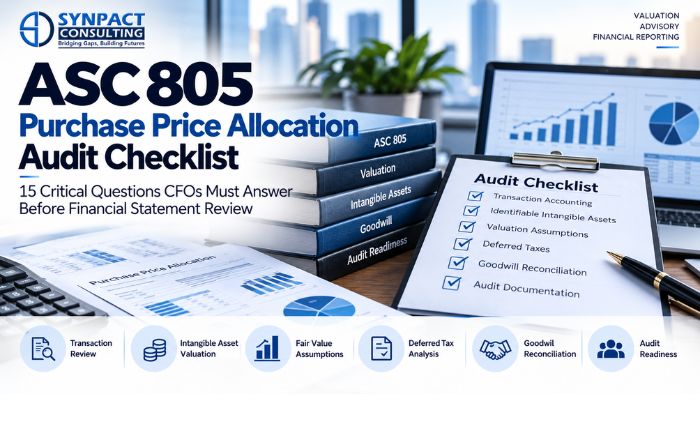
ASC 805 Purchase Price Allocation Audit Checklist: 15 Critical Questions CFOs Must Answer
An acquisition may be complete, but is your purchase price allocation ready for external audit review?
For CFOs, financial controllers, private equity portfolio companies, and M&A accounting teams, the challenge often begins after the transaction closes.
The acquisition agreement is signed. Consideration has been transferred. The acquired business is being integrated. Yet the financial reporting team must still determine how the transaction should be reflected in the consolidated financial statements.
Under ASC 805, Business Combinations, an acquirer generally recognizes identifiable assets acquired and liabilities assumed at their acquisition-date fair values, subject to specified exceptions.
The process requires more than allocating a purchase price across accounting categories. Management must evaluate transaction terms, identify intangible assets, develop valuation assumptions, calculate goodwill, and maintain evidence supporting significant judgments.
A technically sophisticated valuation model is not enough if the underlying data, assumptions, and accounting conclusions cannot be explained.
That is why an ASC 805 PPA audit checklist is a valuable tool for finance leadership.
This guide provides 15 critical questions to help management identify gaps before submitting a purchase price allocation (PPA) for financial reporting review.
It also explains common valuation risks, practical documentation requirements, and how independent valuation support can strengthen the review process.
Preparing a purchase price allocation for an upcoming reporting deadline? Explore Synpact Consulting’s Business Combination & Purchase Price Allocation Services or request a valuation consultation.
What Is an ASC 805 Purchase Price Allocation Audit Review?
A purchase price allocation audit review involves evaluating whether the acquisition accounting and supporting valuation analyses are consistent with the applicable financial reporting framework.
External auditors may assess the completeness and accuracy of management’s accounting records, the reasonableness of significant estimates, and the evidence supporting acquisition-date fair value measurements.
Areas that may receive particular attention include:
- Determination of the acquisition date.
- Identification of the accounting acquirer.
- Consideration transferred, including contingent arrangements.
- Recognition of identifiable assets and liabilities.
- Valuation of customer relationships and developed technology.
- Selection of valuation methods and assumptions.
- Deferred tax effects.
- Useful-life determinations.
- Goodwill reconciliation.
- Completeness of financial reporting disclosures.
A PPA report should provide a traceable connection between transaction documents, financial information, valuation calculations, and the final accounting conclusions.
For a detailed illustration of this process, review our ASC 805 Purchase Price Allocation Case Study for a SaaS Acquisition.
Why CFOs Should Review the PPA Before the Audit Begins
Acquisition accounting frequently involves information from multiple teams.
Legal advisers may hold the purchase agreement and transaction documents. The finance team maintains closing balances and management forecasts. Operational teams provide customer and technology information. Valuation specialists develop fair value analyses.
When these inputs are not coordinated, review issues can arise.
Examples include a consideration schedule that does not reconcile to the closing statement, an intangible asset valuation that uses a forecast different from management’s approved plan, or a goodwill calculation that excludes relevant deferred taxes.
These issues can lead to additional analysis, revisions, and delays.
A structured pre-audit review helps management:
- Identify missing documents early.
- Evaluate the completeness of recognized assets and liabilities.
- Challenge significant valuation assumptions.
- Reconcile valuation outputs with acquisition accounting.
- Organize supporting evidence for review.
- Establish clear ownership of outstanding questions.
The objective is not to eliminate professional judgment. It is to ensure that judgments are transparent, documented, and consistent with the transaction’s economics.
The 15-Question ASC 805 PPA Audit Checklist
The following framework is organized around transaction accounting, identifiable assets, valuation assumptions, and final financial reporting review.
1. Has the Acquisition Date and Accounting Acquirer Been Correctly Identified?
Why it matters
The acquisition date establishes when the acquirer obtains control of the acquired business.
This date is fundamental because acquisition-date fair value measurements generally reflect market conditions and information relevant to that point in time.
The legal closing date and accounting acquisition date are often the same, but they are not necessarily identical in every transaction.
Management should also establish which entity is the accounting acquirer. In some transactions, particularly those involving complex equity arrangements, the accounting conclusion may require analysis beyond the legal form.
Evidence to prepare
- Executed purchase or merger agreement.
- Closing documents.
- Ownership and voting-rights information.
- Relevant control provisions.
- Management’s acquisition-date conclusion.
Common review risk: Using a convenient financial statement date rather than the appropriate acquisition date.
Recommended action: Document the acquisition-date determination before finalizing valuation assumptions.
2. Has the Transaction Been Evaluated as a Business Combination Rather Than an Asset Acquisition?
Why it matters
Not every acquisition qualifies as a business combination under ASC 805.
Management must evaluate whether the acquired set meets the applicable definition of a business.
This distinction can materially affect the accounting for transaction costs, goodwill, acquired assets, and other items.
The optional concentration test and the relevant substantive-process criteria may be important, depending on the transaction.
Evidence to prepare
- Description of acquired activities and assets.
- Analysis of inputs and substantive processes.
- Evaluation of the applicable concentration test.
- Accounting conclusion and supporting rationale.
Common review risk: Assuming that every acquisition of a legal entity automatically qualifies as a business combination.
Recommended action: Resolve the transaction classification before developing the final purchase price allocation.
3. Does the Consideration Transferred Reconcile to the Transaction Documents?
Why it matters
The amount paid at closing may differ from the consideration transferred for accounting purposes.
An acquisition may involve cash, equity, deferred consideration, contingent consideration, and other arrangements.
Some payments associated with the transaction may represent separate transactions rather than acquisition consideration.
Evidence to prepare
- Purchase agreement.
- Closing statement.
- Cash payment records.
- Equity issuance details.
- Deferred payment agreements.
- Earnout provisions.
- Consideration reconciliation schedule.
Common review risk: Using the headline enterprise value or negotiated deal price as the acquisition-date consideration without evaluating the underlying terms.
Recommended action: Prepare a bridge from transaction economics to consideration transferred under ASC 805.
4. Have Earnouts and Contingent Consideration Arrangements Been Properly Evaluated?
Why it matters
Earnout arrangements may require fair value measurement at the acquisition date.
Their value can depend on future revenue, EBITDA, operational milestones, or other performance conditions.
Valuation techniques may include probability-weighted scenarios, discounted cash flow models, or simulation-based methods.
Management must also evaluate whether the arrangement represents contingent consideration or a separate transaction, such as post-combination compensation.
Evidence to prepare
- Earnout agreement.
- Performance definitions.
- Payment thresholds and caps.
- Relevant forecasts.
- Probability assumptions.
- Discount rate or simulation methodology.
- Classification analysis.
Common review risk: Recording the maximum potential earnout payment as its acquisition-date fair value without considering probability, timing, and risk.
Recommended action: Document the contractual terms, classification, and selected valuation approach.
5. Have All Identifiable Intangible Assets Been Considered?
Why it matters
Acquired intangible assets may not appear on the seller’s historical balance sheet.
However, qualifying identifiable intangible assets generally must be recognized separately from goodwill in a business combination.
Examples include:
- Customer relationships.
- Customer contracts.
- Developed technology.
- Trade names and trademarks.
- Order backlog.
- Non-compete agreements.
- Licenses and contractual rights.
- In-process research and development.
The recognition analysis should consider the contractual-legal and separability criteria.
Evidence to prepare
- Commercial contracts.
- Customer information.
- Technology documentation.
- Intellectual property records.
- Brand and licensing information.
- Non-compete provisions.
- Intangible asset identification memorandum.
Common review risk: Assigning most of the purchase consideration to goodwill without sufficiently evaluating separately identifiable intangible assets.
Recommended action: Perform a systematic intangible asset identification review before finalizing the valuation.
For a sector-specific discussion, see our ASC 805 Purchase Price Allocation Guide for Software Acquisitions.
6. Are Customer Relationship Valuation Assumptions Supported by Historical Data?
Why it matters
Customer relationships can represent a significant acquired intangible asset, particularly in businesses with recurring revenue or established commercial accounts.
The Multi-Period Excess Earnings Method (MPEEM) is commonly used to value acquired customer relationships.
The method estimates cash flows attributable to the existing customer base after accounting for appropriate operating costs, taxes, and contributory asset charges.
Key assumptions may include:
- Existing customer revenue.
- Customer attrition.
- Revenue retention.
- Operating margins.
- Expected economic life.
- Contributory asset charges.
- Discount rates.
Evidence to prepare
- Acquisition-date customer population.
- Customer-level or cohort revenue.
- Historical retention data.
- Customer profitability analysis.
- Forecast reconciliation.
- MPEEM calculations.
Common review risk: Including revenue from customers expected to be acquired after the transaction in the valuation of the existing acquired customer base.
Recommended action: Reconcile the customer relationship valuation to the acquisition-date customer population and support the selected attrition assumptions.
Read our detailed ASC 805 Customer Relationship Valuation and MPEEM Guide.
7. Are Developed Technology and Trade Name Valuations Consistent With the Business Model?
Why it matters
Different intangible assets may require different valuation methodologies.
Developed technology may be valued using a relief-from-royalty approach, an income-based method, or another appropriate technique depending on the facts.
Trade names may also be valued using a relief-from-royalty method when supported by the economic characteristics of the asset.
The valuation must consider whether the assumptions reflect the acquired asset’s actual expected use and market-participant economics.
Evidence to prepare
- Technology architecture and roadmap.
- Development and maintenance costs.
- Product revenue forecasts.
- Royalty-rate support.
- Trade name strategy.
- Expected useful lives.
- Obsolescence analysis.
Common review risk: Selecting royalty rates or useful lives without relevant market or business evidence.
Recommended action: Link each valuation assumption to the asset’s expected economic benefits and supporting information.
8. Are Management Forecasts Reasonable and Consistent Across the PPA?
Why it matters
Forecasts often drive the valuation of acquired intangible assets and the broader business.
However, different valuation models may use inconsistent assumptions if the underlying information is not controlled.
For example, a customer relationship model might assume strong retention while the business forecast projects a sharp decline in recurring revenue.
Similarly, the technology valuation may incorporate growth that is not reflected in management’s operating plan.
Evidence to prepare
- Approved management forecast.
- Historical financial performance.
- Budget-to-actual comparisons.
- Transaction investment case.
- Forecast assumption memorandum.
- Reconciliation of forecasts used across valuation models.
Common review risk: Using multiple inconsistent versions of management forecasts without explanation.
Recommended action: Establish a controlled acquisition-date forecast and document justified adjustments made for market-participant assumptions.
9. Are Discount Rates and Asset-Specific Risks Properly Supported?
Why it matters
Discount rates can materially affect the fair values of customer relationships, technology, and other income-producing assets.
The rate should be consistent with the nature of the cash flows and the risks reflected in those projections.
Depending on the valuation, relevant considerations may include:
- Risk-free rates.
- Equity risk premiums.
- Business and industry risk.
- Cost of debt.
- Capital structure.
- Asset-specific uncertainty.
- Market-participant assumptions.
Evidence to prepare
- Discount rate calculation.
- Market data sources.
- Comparable company information.
- Capital structure assumptions.
- Explanation of asset-specific risk adjustments.
Common review risk: Applying the same discount rate to every asset without considering differences in economic risk.
Recommended action: Document the rationale for each material discount rate and verify consistency between risk assumptions and forecast cash flows.
10. Have Contributory Asset Charges and WARA Reasonableness Checks Been Considered?
Why it matters
Certain intangible assets generate economic benefits only with support from other assets.
Under the MPEEM, contributory asset charges recognize required economic returns on supporting assets.
Depending on the valuation, these may include working capital, fixed assets, developed technology, trade names, and assembled workforce.
A Weighted Average Return on Assets (WARA) analysis can also provide a reasonableness check across the returns associated with different asset categories.
Evidence to prepare
- Contributory asset schedule.
- Required return assumptions.
- Supporting asset valuation information.
- WARA calculation, where appropriate.
- Reconciliation to overall business valuation economics.
Common review risk: Overstating the value of a customer relationship asset by ignoring the contribution of supporting assets.
Recommended action: Review contributory asset charges and assess whether the resulting asset returns are economically consistent.
11. Have Deferred Tax Assets and Liabilities Been Evaluated?
Why it matters
Acquisition accounting may create differences between the financial reporting basis and tax basis of acquired assets and liabilities.
These differences can result in deferred tax assets or liabilities under the applicable income tax accounting requirements.
Deferred tax effects can materially influence the purchase price allocation and residual goodwill.
Evidence to prepare
- Tax basis schedules.
- Book-to-tax basis differences.
- Relevant tax rates.
- Deferred tax calculations.
- Acquisition structure analysis.
- ASC 740 accounting conclusions.
Common review risk: Recognizing fair value increases in intangible assets without evaluating the associated deferred tax consequences.
Recommended action: Coordinate the valuation and tax accounting analyses before finalizing goodwill.
For a numerical explanation, see our ASC 805 Deferred Tax Liabilities in Purchase Price Allocation Guide.
12. Does the Goodwill Calculation Reconcile to the Final Acquisition Accounting?
Why it matters
Goodwill is generally calculated as the excess of the aggregate of consideration transferred, any noncontrolling interest, and the acquisition-date fair value of a previously held equity interest over the recognized amount of identifiable net assets acquired, subject to applicable requirements.
For a straightforward 100% acquisition without a previously held interest, the calculation may be presented as:
Goodwill = Consideration Transferred − Fair Value of Identifiable Net Assets Acquired
However, more complex transactions require additional components.
Evidence to prepare
- Consideration reconciliation.
- Final acquired asset and liability schedule.
- Deferred tax calculations.
- Noncontrolling interest analysis, if applicable.
- Previously held interest valuation, if applicable.
- Goodwill calculation.
- Acquisition accounting journal entries.
Common review risk: Treating goodwill as a balancing figure without evaluating whether the underlying identifiable asset and liability measurements are complete.
Recommended action: Reconcile goodwill to the full acquisition accounting schedule and investigate unexpected residual amounts.
13. Are Useful Lives and Subsequent Accounting Implications Documented?
Why it matters
The useful lives assigned to acquired intangible assets can affect future amortization expense and reported earnings.
For example, a customer relationship asset valued at $12 million with a six-year useful life generally produces a different amortization pattern from the same asset with a ten-year useful life.
Useful-life analysis should reflect expected economic consumption and relevant asset-specific factors.
Evidence to prepare
- Customer retention and contract information.
- Technology replacement expectations.
- Brand integration plans.
- Competitive conditions.
- Useful-life memorandum.
- Amortization schedules.
Common review risk: Selecting useful lives based on convenient accounting periods rather than supportable economic expectations.
Recommended action: Document the factors supporting each useful-life conclusion and ensure subsequent accounting schedules are consistent.
14. Have Measurement Period Adjustments Been Properly Classified?
Why it matters
ASC 805 allows a measurement period when acquisition accounting is incomplete at the reporting date.
The measurement period ends when the acquirer obtains the information needed to finalize the relevant accounting or determines that the information is not obtainable. It cannot exceed one year from the acquisition date.
Not every post-acquisition change qualifies as a measurement period adjustment.
The information must relate to facts and circumstances existing at the acquisition date and meet the applicable criteria.
Evidence to prepare
- Acquisition date.
- Provisional accounting schedule.
- Outstanding information requests.
- New acquisition-date evidence.
- Measurement period adjustment memorandum.
- Related journal entries and disclosures.
Common review risk: Treating subsequent operating developments or corrections of accounting errors as measurement period adjustments.
Recommended action: Document why each proposed adjustment qualifies under ASC 805.
Read our ASC 805 Measurement Period Adjustments: 12-Month PPA Rules and Examples.
15. Can the Valuation Conclusions Be Reproduced and Explained During Audit Review?
Why it matters
A valuation conclusion should be supported by sufficient documentation for an informed reviewer to understand the methods, inputs, calculations, and significant judgments.
The reviewer should be able to trace important assumptions to relevant evidence.
Management should also be prepared to explain why alternative methods or assumptions were not selected when those alternatives are significant.
Evidence to prepare
- Final valuation report.
- Supporting financial models.
- Market data sources.
- Management representation and forecast support.
- Significant assumption memoranda.
- Sensitivity analyses.
- Goodwill reconciliation.
- Acquisition accounting schedules.
- Review comments and resolution log.
Common review risk: Providing a polished report without the underlying schedules and supporting information needed to explain material assumptions.
Recommended action: Conduct a structured internal review of the valuation package before submission.
If your team cannot confidently answer several of these 15 questions, the PPA may benefit from an independent readiness review.
Request an ASC 805 PPA Valuation Consultation
Practical Example: Reviewing a $50 Million Acquisition Before Audit
Consider a hypothetical acquisition of a privately held B2B technology company.
The acquirer purchases 100% of the business for $50 million in cash.
The finance team must identify and measure acquired assets and liabilities and determine the resulting goodwill.
Illustrative Purchase Price Allocation
| Component | Acquisition-date fair value |
|---|---|
| Working capital assets, net of operating liabilities | $4,000,000 |
| Property and equipment | $3,000,000 |
| Customer relationships | $14,000,000 |
| Developed technology | $11,000,000 |
| Trade name | $2,000,000 |
| Other identifiable net assets | $1,000,000 |
| Deferred tax liabilities | ($5,000,000) |
| Total identifiable net assets | $30,000,000 |
| Consideration transferred | $50,000,000 |
| Residual goodwill | $20,000,000 |
All figures are hypothetical. The example assumes a 100% acquisition, no previously held interest or noncontrolling interest, and no other relevant consideration components.
What Could an Auditor Question?
The mathematical reconciliation is straightforward. The more difficult questions concern the assumptions behind the amounts.
Customer relationships — $14 million: What supports the selected customer attrition rate? Does the valuation exclude future customers not acquired at the transaction date?
Developed technology — $11 million: What supports the expected economic life? How were technological obsolescence and future development requirements considered?
Trade name — $2 million: Does the buyer intend to continue using the acquired brand? Is the royalty-rate assumption supportable?
Deferred tax liabilities — $5 million: Are the relevant tax basis differences and tax assumptions consistent with the transaction structure?
Goodwill — $20 million: Is the residual consistent with expected synergies, assembled workforce benefits, and other economic factors that do not qualify for separate recognition?
A purchase price allocation can reconcile mathematically while still containing material valuation or accounting deficiencies.
That is why a meaningful audit readiness review should assess both numerical accuracy and economic supportability.
For a more detailed industry example, see our ASC 805 SaaS Purchase Price Allocation Case Study.
Common ASC 805 PPA Audit Findings and How to Address Them
| Potential issue | Why it matters | Recommended response |
|---|---|---|
| Unreconciled consideration | May affect acquisition accounting | Reconcile agreement, closing statement and accounting schedule |
| Missing intangible assets | May overstate goodwill | Perform an asset identification review |
| Unsupported customer attrition | May distort customer relationship fair value | Analyze historical retention and cohorts |
| Inconsistent forecasts | Creates contradictory valuation assumptions | Reconcile models to an approved forecast |
| Unsupported discount rates | May materially affect asset values | Document market inputs and risk assumptions |
| Missing deferred tax analysis | May misstate net assets and goodwill | Coordinate ASC 805 and ASC 740 analysis |
| Unexplained goodwill | May indicate incomplete allocation | Review identifiable assets and acquisition economics |
| Weak workpaper documentation | Makes review more difficult | Maintain reproducible models and evidence |
These are potential review concerns, not a claim that every acquisition will produce the same audit findings.
What Should Be Included in an Audit-Ready PPA Documentation Package?
An organized PPA documentation package should enable management and reviewers to follow the analysis from transaction terms through the final acquisition accounting.
Transaction and Accounting Documents
- Executed acquisition agreement.
- Closing statement and consideration reconciliation.
- Acquisition-date analysis.
- Business combination assessment.
- Acquired asset and liability schedule.
- Relevant accounting memoranda.
Financial and Operational Information
- Historical financial statements.
- Acquisition-date balance sheet.
- Management forecasts.
- Customer retention and revenue data.
- Technology and intellectual property information.
- Relevant market and industry evidence.
Valuation Workpapers
- Business valuation analysis.
- Customer relationship valuation model.
- Developed technology valuation model.
- Trade name valuation model.
- Discount rate support.
- Contributory asset charge calculations.
- Useful-life analysis.
- WARA or other reasonableness analysis, where appropriate.
- Sensitivity analyses.
Final Financial Reporting Support
- Deferred tax calculations.
- Goodwill reconciliation.
- Acquisition accounting journal entries.
- Amortization schedules.
- Provisional amount and measurement period documentation.
- Draft financial statement disclosures.
- Review issue and resolution log.
Not every transaction requires the same package. The scope should reflect the transaction’s complexity, materiality, and applicable reporting requirements.
When Should a Company Engage an Independent PPA Valuation Specialist?
Independent valuation support can be especially valuable when:
- The transaction includes material customer relationships or technology.
- Consideration includes complex earnouts.
- The business operates across multiple products or jurisdictions.
- Management forecasts involve significant uncertainty.
- Multiple valuation methods must be reconciled.
- The acquisition has a significant goodwill balance.
- External financial reporting deadlines are approaching.
- The internal finance team has limited experience with complex intangible asset valuation.
Engaging valuation support early can help identify information requirements and clarify the scope of work before reporting deadlines become urgent.
However, management retains responsibility for the financial reporting conclusions, and the external auditor independently evaluates the relevant audit evidence.
How Synpact Consulting Supports ASC 805 PPA Readiness
Synpact Consulting provides Business Combination and Purchase Price Allocation Services for companies and professional firms requiring valuation support.
Depending on the engagement, the work may include:
- Identifiable intangible asset valuation.
- Customer relationship and technology valuation.
- Income and market approach modeling.
- Fair value assumption analysis.
- Contingent consideration valuation.
- Goodwill reconciliation support.
- Valuation sensitivity analysis.
- Financial reporting workpaper preparation.
- Support with valuation-related review questions.
Our focus is on producing transparent, supportable valuation analyses that finance teams can use within their acquisition accounting process.
Need to assess whether your PPA is ready for financial reporting review?
Speak With Synpact Consulting About Your Acquisition
A Practical Pre-Audit PPA Readiness Scorecard
CFOs and controllers can use the following internal screening framework to prioritize unresolved items.
| Readiness area | Key question | Status |
|---|---|---|
| Transaction classification | Is the accounting framework established? | Complete / Review / Missing |
| Consideration | Does the schedule reconcile? | Complete / Review / Missing |
| Identifiable assets | Have all material assets been assessed? | Complete / Review / Missing |
| Forecasts | Are assumptions consistent and supported? | Complete / Review / Missing |
| Valuation models | Are methods and inputs documented? | Complete / Review / Missing |
| Tax accounting | Have deferred tax implications been assessed? | Complete / Review / Missing |
| Goodwill | Does the final allocation reconcile? | Complete / Review / Missing |
| Audit documentation | Can significant conclusions be explained? | Complete / Review / Missing |
This is an internal project-management tool, not an official ASC 805 compliance score or audit opinion.
A practical next step is to assign an owner and target completion date to every item marked Review or Missing.
Frequently Asked Questions About the ASC 805 PPA Audit Checklist
1. What is an ASC 805 PPA audit checklist?
An ASC 805 PPA audit checklist is a structured review tool used to assess whether acquisition accounting and supporting fair value analyses are complete, documented, and prepared for financial reporting review.
2. Is a purchase price allocation required after every acquisition?
Not every transaction is accounted for as a business combination. The applicable accounting depends on whether the acquired set qualifies as a business and on the transaction’s specific facts. Business combinations within the scope of ASC 805 generally require acquisition accounting.
3. What do auditors typically examine in a purchase price allocation?
Review areas may include transaction classification, consideration transferred, acquired intangible assets, fair value methodologies, significant assumptions, deferred taxes, goodwill, and supporting documentation.
4. What are the most important assumptions in an ASC 805 valuation?
The most significant assumptions depend on the assets being valued. They may include customer attrition, forecast growth, operating margins, royalty rates, useful lives, discount rates, and contributory asset charges.
5. How is goodwill calculated in a purchase price allocation?
In a simple 100% acquisition without a previously held interest or noncontrolling interest, goodwill is generally the excess of consideration transferred over the recognized amount of identifiable net assets acquired. More complex transactions may require additional components.
6. Can a PPA be revised after the acquisition closes?
Yes, qualifying provisional acquisition accounting amounts may be adjusted during the ASC 805 measurement period when new information relates to acquisition-date facts and circumstances. The measurement period cannot exceed one year from the acquisition date.
7. What happens if the purchase price allocation contains an error?
The accounting consequences depend on the nature, timing, and materiality of the error. Error correction is distinct from a qualifying measurement period adjustment and may require consideration of ASC 250 and other applicable reporting requirements.
8. Why is WARA used in a purchase price allocation?
A Weighted Average Return on Assets analysis may help evaluate whether asset-specific required returns are economically consistent with the overall business valuation. It is a reasonableness tool, not a substitute for appropriate asset valuation methods.
9. Can a valuation firm help with PPA audit review questions?
A valuation specialist may assist management by explaining valuation methods, supporting significant assumptions, preparing calculations, and responding to valuation-related questions. The auditor retains responsibility for the audit.
10. How can Synpact Consulting help with ASC 805 purchase price allocation?
Synpact Consulting offers purchase price allocation and related valuation services, including intangible asset valuation, fair value modeling, goodwill reconciliation support, and valuation documentation. Companies can contact the team to discuss transaction complexity, reporting deadlines, and the appropriate engagement scope.
Final Takeaway: An Audit-Ready PPA Requires More Than a Reconciled Spreadsheet
An ASC 805 purchase price allocation is not complete merely because the acquisition consideration has been divided among assets, liabilities, and goodwill.
A supportable analysis should connect:
Transaction documents → Acquisition accounting → Identifiable assets → Fair value assumptions → Valuation models → Goodwill reconciliation → Financial reporting documentation
For CFOs and financial controllers, the most useful question is not simply whether the PPA report has been prepared.
It is whether the significant accounting and valuation conclusions can be clearly explained and supported.
The 15-question framework in this article can help identify documentation gaps, valuation risks, and unresolved issues before external financial reporting review.
Need Independent ASC 805 Purchase Price Allocation Support?
Whether your company has recently completed an acquisition, is finalizing a provisional PPA, or is preparing valuation workpapers for review, Synpact Consulting can discuss your financial reporting valuation requirements.
Request a discussion with our valuation team to review your transaction, reporting timeline, and PPA support needs.
Request an ASC 805 Valuation Consultation
Explore Our Purchase Price Allocation Services
Synpact Consulting
Email: [email protected]
Phone: (+91) 892-622-7979
Website: https://synpactconsulting.com/
Disclaimer: This article provides general educational information and does not constitute accounting, audit, tax, or legal advice. Specific conclusions depend on the transaction facts and applicable accounting requirements.