
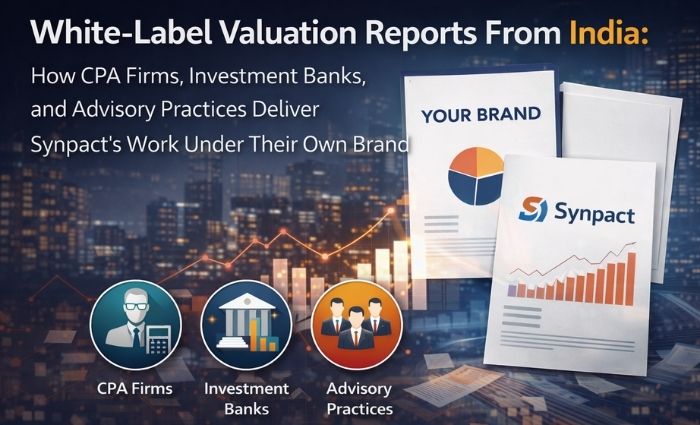
White-Label Valuation Reports From India: How CPA Firms, Investment Banks, and Advisory Practices Deliver Synpact’s Work Under Their Own Brand
Your Client Never Needs to Know — and That Is Entirely Professional
A Managing Partner at a 12-person US advisory firm puts it this way: “My clients pay for my judgement and my firm’s reputation. They do not pay to know which analysts built the model. A plumber does not tell you which wrench manufacturer he used.”
He is right — and he is one of hundreds of advisory firm partners who deliver Synpact’s valuation work to their end clients under their own firm’s letterhead, logo, and contact details. The reports say his firm’s name. They carry his firm’s branding. The contact number on the cover page is his.
His clients receive an audit-ready, Big Four-defensible valuation report that reflects his firm’s quality standard. He delivers it in 7–10 business days instead of 6 weeks. His cost is 70–85% below what he would have paid a US boutique for the same work.
This is white-label valuation outsourcing — and it is the model that is quietly reshaping how advisory firms in the US, UK, and Australia deliver valuation services in 2026.
This blog explains exactly how it works, what the white-label process looks like from brief to delivery, who uses it and why, what you can and cannot customise, and how to verify — before you start — that the quality of the underlying work justifies putting your firm’s name on it.
What White-Label Valuation Actually Means
White-label valuation outsourcing is simple in concept: Synpact performs the analytical work — the DCF model, the comparable company analysis, the WACC build, the DLOM calculation, the full report — and delivers the finished product branded with your firm’s identity rather than Synpact’s.
Your firm’s name appears on the cover page. Your logo is in the header and footer. Your firm’s address and contact details are on the report. Your analyst or partner’s name appears in the reviewer credentials section if you prefer. The report reads, in every respect, as if it was produced entirely within your firm.
What this means practically: your end client — the startup whose 409A you are delivering, the PE fund whose PPA you are presenting, the listed company whose goodwill impairment test you are submitting to audit — sees your firm’s brand. They have no visibility into, and no reason to ask about, the analytical team that built the model.
This is not unusual or ethically questionable. It is the standard model across professional services: law firms use research counsel, accounting firms use specialist tax advisors, investment banks use sector research providers. The firm that signs the report takes professional responsibility for its contents. The analytical work is a sourced input — like data from Capital IQ or comparables from PitchBook — that the signing firm has reviewed and stands behind.
What You Take Responsibility For
When you deliver a white-label Synpact report under your firm’s brand, you are representing that:
You have reviewed the report and its methodology. You are satisfied that the analytical approach is appropriate for the engagement. You stand behind the conclusions as a professional. Your firm is the relationship owner with the end client.
This is exactly the same responsibility you take when you review work produced by an in-house analyst before it goes to a client. The source of the analytical work is different. The professional responsibility is identical.
The White-Label Process — From Brief to Branded Delivery
Here is exactly what the white-label process looks like at Synpact, from the moment you submit a brief to the moment you deliver a branded report to your end client.
Step 1: You Submit the Engagement Brief
You send Synpact the engagement brief through our encrypted client portal — the same brief you would give an in-house analyst. For a 409A valuation, this includes the company’s financials, cap table, valuation date, and purpose. For a PPA, the acquisition agreement, target financials, and purchase price. For a goodwill impairment test, the CGU structure, prior-year model, and current financial projections.
You also provide, once during your first engagement: your firm’s branding assets — logo file (PNG or EPS), firm name as it should appear on the report, address, phone number, email, and any specific report formatting requirements (your house colour scheme, your preferred font, your standard disclaimer language).
Step 2: Synpact Builds the Model and Report
Synpact’s CFA-qualified analyst team performs the full analytical work — financial statement spreading, comparable company screening, WACC construction, DCF or market approach modelling, DLOM analysis, sensitivity tables, and methodology documentation — to the audit-ready standard described in our audit-ready valuation guide.
The report is drafted in your house template — the Word or PDF format you provided during onboarding. Your logo appears in the header. Your firm’s name, address, and contact details appear on the cover page and footer. Your preferred disclaimer language appears in the standard position.
The underlying model — the Excel file — is built to your template if you provided one, or to Synpact’s standard template if you prefer. Either way, it is yours. You own the model file.
Step 3: Internal Review at Synpact
Before delivery to you, every white-label report goes through Synpact’s internal multi-level review — a named senior analyst reviews the methodology, comparable selection, WACC documentation, and sensitivity analysis against the audit-ready standard. This review is the quality control layer that ensures the report you receive is ready to deliver to your end client — not a draft requiring significant rework.
The review process is described in detail in our AI and outsourcing blog — specifically how analyst judgment applied at this stage is what distinguishes audit-defensible output from AI-generated approximations.
Step 4: Draft Delivery to You
The draft report and model are delivered to your secure portal — branded with your firm’s identity throughout. You review it as you would review any internal analyst’s work. You may have questions, comments, or revision requests — these are submitted through the portal and Synpact responds within the same IST business day.
Step 5: Your Review and Sign-Off
You review the methodology, the assumptions, the comparable selection, and the conclusions. If anything requires adjustment — a different comparable excluded, a WACC input updated, a sensitivity scenario added — you submit your comments and Synpact incorporates them.
Most white-label reports require one round of revisions, some require two. Revisions within the scope of the original brief are included at no additional charge. This is your quality control step — the moment where your professional judgement is applied to the work before your name goes on it.
Step 6: Final Branded Report Delivered to Your Client
Once you are satisfied with the report, you deliver it directly to your end client — from your firm’s email, on your firm’s letterhead, with your firm’s contact details. Synpact is not copied. Synpact’s name does not appear anywhere in the document. The report is, from your end client’s perspective, entirely yours.
Standard turnaround: 7–10 business days from brief submission to first draft delivery. Rush turnaround (3–5 business days) is available with a premium. See our pricing guide for full cost benchmarks.
Who Uses White-Label Valuation — and Why
White-label delivery is the default model for the majority of Synpact’s ongoing clients. Here are the four primary client types who use it and their specific reasons.
US CPA Firms — Expanding Valuation Capacity Without Hiring
The most common white-label client is a US CPA firm — typically 10–100 partners — that provides valuation services to its existing audit and advisory clients but does not have the in-house analytical depth to deliver complex 409A valuations, PPAs, or goodwill impairment tests without referring them out or hiring additional staff.
White-label outsourcing allows these firms to keep the engagement in-house — under their brand, at their billing rate — while accessing analytical capability they do not maintain internally. The economics are compelling: they bill the client at US boutique rates ($5,000–$18,000 for a 409A), pay Synpact at India outsourcing rates ($1,200–$2,500 for the same work), and retain the margin. The client receives a professionally branded report from the firm they know and trust. Our dedicated guide for US CPA firms white-labelling valuation work to India covers the full model in detail.
Boutique Investment Banks — Deal Support Under Their Brand
Boutique investment banks using Synpact for deal execution support — LBO models, comparable company analyses, CIM financial sections — receive all deliverables in their house format, with their logo and branding. The pitch book that goes to the client says the boutique’s name. The LBO model that goes into the data room is in the boutique’s Excel template.
This is identical to how bulge bracket banks use their own internal analyst teams — the partner’s name is on the pitch, the analysts built it. The only difference is geography. As we described in our boutique IB deal execution blog, this overnight delivery model is what allows boutique IBs to compete with larger firms on analytical bandwidth.
PE Funds — Quarterly NAV and Portfolio Reports in Fund Format
PE funds using Synpact for quarterly NAV calculations and ILPA reporting receive all deliverables in their fund’s standard LP report template. The quarterly report that goes to LPs is branded with the fund’s name and logo. The valuation methodology documentation that goes to the fund’s auditors is in the fund’s format.
LPs receive reports that are consistent with every prior quarter’s format — because Synpact works within the fund’s established template from the first engagement. The analytical work changes every quarter; the presentation format is stable.
Australian Advisory Firms — AASB-Compliant Reports in Their Format
Australian firms using Synpact for AASB 3 PPA work, AASB 136 impairment tests, and AASB 13 fair value measurements receive reports formatted to Australian professional standards — with AUD pricing, ASX-listed comparables where relevant, and ASIC-standard documentation — all under the Australian firm’s branding.
The AEST-IST time zone overlap makes this an operationally smooth relationship — as we documented in our Australian advisory firm guide.
What You Can Customise — A Complete List
Clients frequently ask what elements of the white-label report they can control. The answer is: essentially everything that is presentation rather than methodology. Here is the complete customisation menu.
Cover page: Your firm’s full name, your logo (any format — we work with PNG, EPS, PDF), your firm’s tagline or positioning statement if you use one, the report title in your preferred format, the valuation date, and the “prepared for” client name in whatever format you use.
Header and footer: Your logo in the header, your firm name, your website URL, your email address, and your phone number in the footer. Your preferred page numbering format.
Colour scheme: Your firm’s brand colours applied to section headers, table headers, chart elements, and callout boxes. We match your hex codes or Pantone references.
Font: Your preferred body and heading fonts. We work with any standard professional font family.
Report structure: Your preferred section order, your standard table of contents format, your preferred methodology section heading conventions.
Disclaimer language: Your firm’s standard legal disclaimer and scope limitation language, placed in your preferred position (cover page, inside cover, or appendix).
Credentials section: Your firm’s credential description in the reviewer section — or, if you prefer, the reviewer section can be omitted or framed in generic terms that do not reference Synpact.
Model template: The Excel model is built to your template — your colour coding, your tab structure, your formula conventions, your sensitivity table format.
What is not customised: The methodology itself — the WACC inputs, the comparable selection, the DLOM approach, the sensitivity analysis structure. These are determined by what is analytically correct and audit-defensible, not by presentation preference. This is the professional standard we maintain on every report regardless of whose name appears on it.
The Quality Assurance Question — Why Your Name Is Safe on This Report
The most important question any firm should ask before adopting a white-label model is: “Can I genuinely stand behind the quality of this report — not just as a presentation, but as a professional opinion?”
The honest answer depends entirely on whether the underlying analytical work meets the standard that the signing firm represents. A white-label report that is methodologically inadequate — incorrect comparable selection, unsourced WACC inputs, missing sensitivity analysis — creates professional liability for the firm whose name appears on it, regardless of who produced the analysis.
This is why Synpact’s audit-ready standard is not a marketing claim but a technical commitment. Every white-label report contains the six elements that Big Four audit teams require: methodology narrative, WACC documentation with sourced inputs, comparable selection rationale with exclusion documentation, sensitivity analysis, assumption sourcing, and reviewer credentials. These elements are present regardless of whose logo is on the cover page.
The practical test: request a sample white-label report in your format, for the specific engagement type you need, before committing. Review the methodology section against the 20-question audit-ready checklist in our audit quality guide. If the report passes that checklist, you can put your name on it with confidence. If it does not — from Synpact or any other provider — do not.
We provide sample white-label reports in your format, for your specific engagement type, within one business day of your request. No sales call required. Contact us with the engagement type and your branding assets and we will demonstrate exactly what you would be delivering to your clients.
The Economics — What White-Label Means for Your Firm’s Profitability
The white-label model creates a specific, measurable profitability dynamic for advisory firms that most partners do not fully model before they start.
The Margin Expansion Calculation
Consider a US CPA firm billing a client $8,000 for a Series B 409A valuation. Under three delivery scenarios:
| Delivery Model | Revenue | Cost | Gross Margin |
|---|---|---|---|
| In-house analyst (fully loaded) | $8,000 | $6,200 | $1,800 (23%) |
| US boutique referral (no margin) | $8,000 | $8,000 | $0 (0%) |
| Synpact white-label | $8,000 | $1,800 | $6,200 (78%) |
The white-label model converts a low-margin or zero-margin engagement into one of the highest-margin service lines in the practice. At 10 engagements per year, the margin difference between in-house delivery and white-label outsourcing is approximately $43,000 in additional gross profit — at the same billing rate, with the same client relationship, delivering the same report quality.
For firms running 20–40 valuation engagements per year — common for a Top 100 US CPA firm with an active valuation practice — the cumulative margin enhancement from white-label outsourcing is $86,000–$172,000 per year. This is the financial case for the model, independent of the cost reduction argument.
The Capacity Expansion Calculation
Beyond margin, white-label outsourcing expands the volume of engagements a firm can take on without adding headcount. A firm whose in-house analyst can handle 12–15 engagements per year can take on 40–60 engagements per year through white-label outsourcing — because the analytical capacity scales with demand rather than being capped by the number of employed analysts.
This capacity expansion is directly revenue-generative: engagements that were previously declined or referred out because of capacity constraints are now retained within the practice, billed at the firm’s standard rate, and delivered under the firm’s brand.
The 5-year financial model we published earlier this year quantifies the full economics of this capacity expansion at the firm level — including the break-even analysis at different engagement volumes.
Common Questions About White-Label Delivery
“Does my client have any right to know who produced the analysis?”
In most professional services contexts — advisory, accounting, legal — there is no general obligation to disclose the identity of the analytical resources used in producing a client deliverable, provided the signing professional has reviewed and stands behind the work. The professional responsibility lies with the signing firm, not with the analytical team.
Where a specific engagement agreement or client contract contains a clause requiring disclosure of third-party involvement, that clause must be honoured. Most standard engagement letters do not contain such a clause — but review your specific engagement letter before adopting the white-label model for a new client.
“What if my client asks directly who produced the analysis?”
If a client asks, the honest answer is that the analytical work was performed by a specialist India-based valuation team under your firm’s direction and quality review. This is consistent with how Big Four firms describe their India delivery centres — not with embarrassment, but as a feature. The India delivery model is a quality and efficiency advantage, not something to be concealed.
The white-label model means you do not proactively identify Synpact. It does not mean you misrepresent the source if a client directly asks.
“Can I add my own analyst’s name to the reviewer credentials section?”
Yes — with the important caveat that the named reviewer must have genuinely reviewed the report. If your senior associate or partner has reviewed the report and is comfortable taking professional responsibility for its contents, naming them as the reviewer is appropriate. If the named reviewer has not reviewed the report, naming them creates a misrepresentation. The professional standard is that the person named as reviewer has actually reviewed.
“What if the report is challenged by an auditor and I need backup support?”
Synpact provides audit defence support as a standard element of every white-label engagement. If your end client’s auditor challenges the methodology, the comparable selection, or the WACC documentation, Synpact prepares the technical response — which you deliver under your firm’s name. Our audit and compliance liaison service specifically covers this post-delivery support. In our history of white-label engagements, reports have consistently passed Big Four audit review — but the support is in place if needed.
Frequently Asked Questions
How do I get Synpact set up with my firm’s branding for the first time?
During onboarding — which takes 3–4 weeks as described in our onboarding playbook — you provide your branding assets: logo file, colour codes, preferred fonts, standard disclaimer language, and a sample of your existing report format if you have one. Synpact creates a master template in your format. Every subsequent engagement uses that template — you do not need to re-brief the formatting on each engagement.
Can I use different branding for different clients — for example if I work under multiple operating entities?
Yes. We maintain separate branded templates for firms that operate under multiple brands or that want different report formatting for different client types (e.g., one format for PE fund clients, another for corporate clients). Each template is stored separately and applied per your instruction in each engagement brief.
What happens to the branding assets you hold — are they secure?
Your branding assets — logo files, colour codes, template files — are stored on Synpact’s secure internal systems with the same access controls and encryption that apply to all client data. They are not shared with any third party and are deleted on request. Our data security guide covers our full data security framework, which applies to branding assets as well as financial data.
Can Synpact match our exact Excel model architecture — tabs, formula structure, colour coding?
Yes. Provide your standard Excel model template during onboarding and we build all financial models to that architecture. If you do not have a standard template, Synpact uses our default professional template — which you can review and request modifications to until it matches your house style.
We are a UK firm — can the white-label reports be formatted in GBP with UK regulatory references?
Yes. UK-format white-label reports use GBP pricing, UK GAAP or IFRS references as appropriate, FRC documentation standards, and UK-standard disclaimer language. UK client contact details and phone number formats are applied. The report is indistinguishable from a UK-produced valuation report in every presentation respect.
How do we handle the situation where a client’s auditor wants to speak directly with the valuation team?
This is handled through your firm as the intermediary. If the auditor wants a technical call on the WACC methodology or the comparable selection, Synpact prepares the technical briefing and talking points — which your partner or analyst presents in the auditor call. If the auditor specifically requests to speak with the analytical team directly, that is a conversation to have with the client about the engagement structure. Most auditors are satisfied with the signing firm’s technical response without requiring direct access to the analytical team. Our audit and compliance liaison team prepares the technical defence materials in every case.
What is the minimum commitment to start using white-label delivery?
There is no minimum commitment. A single pilot engagement — one 409A, one PPA, one impairment test — establishes the template and the workflow. Most clients run one pilot engagement and then move to steady state. The pilot is your quality verification step: if the branded report meets your standard, the model works. If it does not, you have invested in one engagement and learned something important. Contact us to request a sample branded report in your format — that is the zero-commitment starting point.
Conclusion: Your Brand. Their Expertise. Your Client’s Trust.
White-label valuation outsourcing is not a compromise — it is a professional model that has been standard in advisory, accounting, and legal services for decades. The firm whose name is on the report takes professional responsibility for the work. The analytical team that built the model provides the depth, the speed, and the cost efficiency that makes the model economically compelling.
What Synpact adds to this model is a specific quality commitment: every white-label report meets the audit-ready standard described in our published checklist, is reviewed by a named CFA-qualified analyst before delivery, and is delivered in your firm’s format at 70–85% below what the same work would cost at a US boutique.
Your clients receive a report from a firm they trust — yours. You receive the margin and capacity expansion that comes from specialist outsourcing at India cost structures. And the analytical quality underneath your brand is the same quality that passes Big Four audit review on the underlying engagement.
The starting point is a sample. Send us your logo, your preferred report format, and the engagement type you want to test. We will deliver a sample white-label report within one business day — so you can see exactly what your clients would receive before you commit to anything.
→ Request a White-Label Sample Report in Your Format — Delivered in 1 Business Day
Related Reading on Synpact Blog:
- Why US CPA Firms Are White-Labelling Valuation Work to India in 2026
- The True Cost of Valuation Outsourcing to India in 2026
- How to Onboard a Valuation Outsourcing Team Without Disrupting Your Workflow
- What “Audit-Ready” Actually Means in 2026 — A CFO’s Checklist
- Data Security in Valuation Outsourcing — A Technical Checklist for CFOs
- Is AI Making India Valuation Analysts Obsolete — Or Making Them Better?