
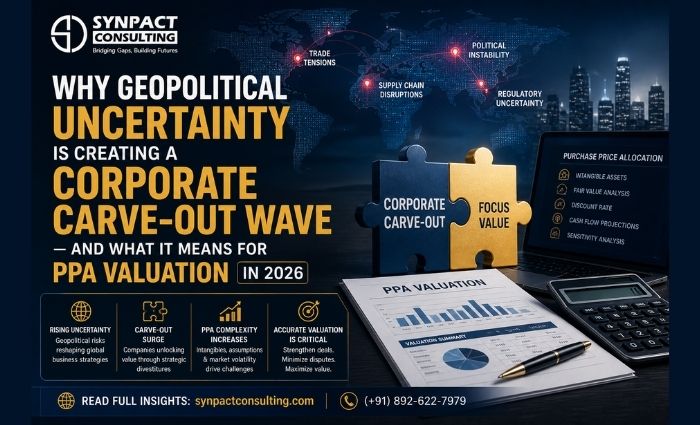
Why Geopolitical Uncertainty Is Creating a Corporate Carve-Out Wave — and What It Means for PPA Valuation in 2026
The Deal Type That Is Defining 2026
In the M&A markets of the past decade, the dominant transaction type was the platform acquisition — a buyer purchasing an entire company, integrating it, and building value through scale. That model is not disappearing in 2026, but it is sharing the stage with a different transaction type that has quietly become the defining deal structure of the current environment: the corporate carve-out.
Carve-outs are set to define global mergers and acquisitions in 2026 as boards simplify portfolios under mounting geopolitical pressures and fast-moving disruption from artificial intelligence, according to KPMG’s Global M&A Outlook 2026, based on a survey of 700 M&A decision-makers worldwide.
The numbers behind this trend are not marginal. 57% of corporate dealmakers and 71% of private equity firms are open to or actively pursuing portfolio rationalisation in 2026, with just over half of corporates expecting carve-out activity to rise moderately to significantly over the next 12 to 24 months.
This is not a coincidence. The geopolitical environment of 2026 — the Iran war, US tariffs, trade fragmentation, and supply chain restructuring pressure — has created a specific set of strategic pressures that make carve-outs the logical response for a wide range of corporate boards. Understanding why carve-outs are accelerating is the first step. Understanding what carve-outs mean for PPA valuation under ASC 805 — which is the most technically demanding valuation consequence of every carve-out transaction — is what this blog is about.
Why Geopolitical Uncertainty Specifically Drives Carve-Outs
The link between geopolitical uncertainty and carve-out activity is not intuitive until you think about it from the board’s perspective. A board managing a diversified conglomerate in a stable macro environment can afford to carry non-core businesses — they generate cash, they have some strategic optionality, and the cost of separation is not worth the benefit of focus. In a stable world, complexity is manageable.
Geopolitical uncertainty changes this calculus in three specific ways.
Risk Concentration Becomes Visible and Intolerable
When the world is calm, the risk of a diversified business is diffuse and hard to see. When the world is not calm — when Iran closes the Strait of Hormuz, when tariffs redraw supply chain economics overnight, when sanctions regimes shift with each news cycle — the geopolitical exposure of non-core businesses becomes suddenly, acutely visible to boards and investors.
Portfolio separation activity, including carve-outs, divestitures and staged ownership structures, is no longer a byproduct of other strategic choices. It has become a structural mechanism for reshaping portfolios in response to a more volatile environment. Rising carve-out activity is being driven primarily by strategy rather than stress — dealmakers cite portfolio optimisation and renewed focus on core businesses as leading catalysts, far outweighing short-term market pressure or regulatory concerns.
A manufacturing conglomerate with a non-core consumer goods division that depends on Gulf-transit supply chains is now carrying visible geopolitical risk in a business unit that does not fit its core industrial identity. The cost-benefit of carrying that division has shifted. The carve-out decision — which might have been deferred indefinitely in a stable environment — becomes urgent.
Capital Reallocation Becomes Strategically Critical
The Iran war, the tariff regime, and AI-driven disruption are simultaneously creating investment requirements across sectors. Energy companies need to invest in supply chain resilience. Technology companies need to invest in AI infrastructure. Industrial companies need to invest in reshoring capacity. Separation is being used to simplify operating models, unlock capital for reinvestment, and sharpen strategic focus — carve-outs are moving to the centre of portfolio strategy, and execution capability is emerging as a defining institutional advantage.
A company that needs $2 billion to invest in supply chain resilience but carries $1.5 billion of goodwill in a non-core division has a straightforward answer: carve out the non-core division, deploy the proceeds into the strategic priority, and emerge with a simpler, better-capitalised, more focused business. The geopolitical environment is not creating the decision to carve out — it is accelerating a decision that was already strategically logical and providing the capital reallocation urgency to act on it now.
PE Firms Are Ready Buyers With Dry Powder
The carve-out wave requires not just sellers but buyers. Private equity has both the capital and the motivation to be the natural acquirer of carved-out assets. 71% of private equity dealmakers are actively pursuing or open to portfolio separation, and 55% already have such transactions under consideration. PE is positioning itself as a natural buyer for divested assets, viewing carve-outs as opportunities to refocus businesses and deploy fresh capital outside large corporate structures.
The combination — strategic sellers motivated by geopolitical risk concentration and capital reallocation needs, and PE buyers with dry powder and appetite for carve-out acquisitions — is what makes 2026 the year the carve-out wave actually hits the market rather than remaining a boardroom discussion.
After a year of portfolio reassessment, 2026 will be the moment that those decisions hit the market. Carve-outs are accelerating, not just as a defensive move, but as a proactive strategy for value creation. Private equity sponsors are becoming more sophisticated — buying entire groups and then carving out separate businesses to sell off, becoming more confident in remodelling the businesses they buy.
What Makes a Carve-Out PPA Different From a Standard Acquisition PPA
Every acquisition that qualifies as a business combination under ASC 805 requires a Purchase Price Allocation — the process of assigning the total purchase consideration to the identifiable assets acquired and liabilities assumed at fair value as of the acquisition date, with any residual recorded as goodwill. Under ASC 805, every acquisition requires the buyer to allocate the total purchase price to identifiable assets and liabilities at fair value — including intangibles that never appeared on the target’s balance sheet. For middle-market deals, identified intangibles commonly represent 30–60% of total consideration, and each carries its own valuation methodology, useful life assumption, and amortisation consequence.
A carve-out PPA is not simply a standard PPA applied to a smaller business. It has structural characteristics that make it materially more complex — and more technically demanding — than the PPA for a standalone company acquisition. Understanding these differences is essential for any CPA firm partner or CFO who is managing the post-close accounting for a carve-out transaction.
The Standalone Basis Problem
The most fundamental complexity in a carve-out PPA is that the acquired business has never existed as a standalone entity. It was embedded in a larger corporate structure — sharing shared services, management overhead, IT infrastructure, facilities, intellectual property licenses, financing, and corporate functions with the parent company.
The PPA must reflect the fair value of the carved-out business as if it were a standalone entity — not as it was embedded in the parent. This requires the valuation analyst to construct a set of standalone financial statements for the carved-out business, which involves:
Allocating shared costs to the carved-out business on a reasonable basis — typically based on headcount, revenue, or square footage, depending on the cost category. If the parent charged the carved-out division $2 million per year in corporate overhead, that charge needs to be reconstructed as a market-rate standalone cost — which may be higher or lower than the intercompany allocation.
Identifying and valuing intercompany agreements that will need to be replaced with third-party arrangements post-close. A transition services agreement (TSA) — under which the parent continues to provide IT, HR, finance, and other services to the carved-out business for an agreed period — is standard in carve-out transactions. The cost and duration of the TSA affects the standalone EBITDA profile of the business and therefore the PPA cash flow model.
Adjusting for any financing or treasury arrangements that existed within the corporate structure and will not transfer to the carved-out entity. A carved-out business that benefited from the parent’s investment-grade credit rating and cheap intercompany financing will face higher standalone financing costs — which the PPA must reflect.
The Intangible Asset Identification Challenge
In a standard acquisition, the target company has its own set of clearly identified intangible assets — customer relationships, technology, brand, non-compete agreements — that the valuation analyst identifies and values. In a carve-out, the intangible asset landscape is more complex because many of the most valuable intangibles may be shared with the parent and not fully transferring.
Consider a technology company that is carving out its industrial software division. The parent’s core brand — including its customer relationships at the enterprise level — may span both the retained business and the carved-out division. The carved-out business may rely on technology platforms that are owned by the parent and used under a license that will become a third-party license post-close. The customer relationships may be partially shared — the same enterprise customer buys both the industrial software and the retained product line.
Each of these situations requires a specific analytical determination: which intangible assets are transferring to the acquired entity, which are staying with the parent, and which are shared in a way that requires partial allocation or licensing arrangement modelling. The PPA must reflect only the intangibles that are genuinely transferring — not intangibles that will remain with the parent.
Execution risk remains a key constraint for carve-outs: 52% of corporates cite operational disentanglement as the biggest challenge, followed by valuation complexity at 43% and IT and data separation at 40%. The valuation complexity that 43% of deal teams identify as their primary challenge is largely the intangible asset identification problem in the PPA — it is the most technically demanding element of carve-out post-close accounting.
The Goodwill Residual — More Uncertain in a Carve-Out
In a standard acquisition PPA, goodwill is the residual — the excess of purchase price over the fair value of net identifiable assets. A goodwill balance that represents 20–30% of total consideration is not unusual and reflects genuine synergy value and assembled workforce value. A goodwill balance that represents 60–70% of total consideration in a standard acquisition is a signal that the intangible asset identification may be incomplete.
In a carve-out PPA, the goodwill residual is inherently more uncertain because the standalone financial profile — which drives the fair value of the acquired reporting unit — is based on pro forma standalone financials rather than historical standalone actuals. If the standalone cost allocation methodology is aggressive (allocating less shared cost to the carved-out business than it would genuinely bear on a market-rate standalone basis), the implied fair value of the acquired unit is higher, and the goodwill residual is lower. If the methodology is conservative, the opposite occurs.
This means the goodwill amount in a carve-out PPA is a direct function of methodology choices in the standalone financial reconstruction — choices that the auditor will scrutinise carefully and that the buyer’s CPA firm must be prepared to defend.
The Five Most Commonly Mishandled Elements of a Carve-Out PPA
Based on the specific challenges of carve-out transactions, here are the five elements of the PPA that are most frequently inadequate in first-draft carve-out valuations — and what the correct approach looks like.
1. Customer Relationship Intangible — The Revenue Attribution Problem
The customer relationship intangible is typically the largest identified intangible in a service or technology business PPA. It is valued using the Multi-Period Excess Earnings Method (MPEEM), which calculates the present value of the excess earnings attributable to the customer relationship after charging for all other contributing assets.
In a carve-out, the customer relationship identification requires an additional step: determining which customers belong to the carved-out business versus the parent. If an enterprise customer buys multiple product lines — some transferring, some staying — the revenue attributable to the transferred customer relationship must be carefully segmented. Using total customer revenue without adjustment overstates the customer relationship intangible and produces a PPA that allocates too much value to this intangible, leaving too little for other identified intangibles and producing an incorrect goodwill residual.
The correct approach: obtain a customer-by-customer revenue attribution from the deal team, clearly segmenting revenue from transferred customers versus shared customers versus retained customers. Apply the MPEEM only to the revenue stream that is genuinely transferring.
2. Technology and IP — Licensed vs. Transferred
In many carve-out transactions, the technology platform that the carved-out business has been using belongs to the parent and is not being transferred — it is being licensed to the carved-out entity under a post-close IP license agreement. The PPA analyst must determine whether the technology is transferring (in which case it is an identified intangible asset to be valued and put on the opening balance sheet) or licensing (in which case the license cost is an operating expense in the standalone financials, and the technology is not an identified intangible in the PPA).
Getting this wrong — treating a licensed technology as a transferred intangible, or vice versa — produces a materially incorrect PPA. The determination is based on the definitive transaction documents — specifically, the Intellectual Property Assignment Agreement and the IP License Agreement that are typically part of the carve-out transaction structure.
3. Trade Name and Brand — Shared vs. Exclusive
If the carved-out business has been operating under the parent’s brand — using the parent’s trade name in its marketing, website, and customer communications — the post-close brand arrangement is a critical PPA input. Three scenarios are possible:
The carved-out business retains the right to use the parent’s trade name indefinitely — in which case the trade name intangible is a transferred asset to be valued in the PPA at its fair value to the carved-out entity.
The carved-out business is granted a transitional license to use the parent’s trade name for a defined period (typically 12–24 months) while rebranding — in which case the trade name has a finite useful life equal to the transition period, and the rebranding cost is a post-close operating expense.
The carved-out business immediately adopts a new brand with no use of the parent’s trade name — in which case there is no trade name intangible in the PPA, but the rebranding cost and the loss of brand equity during transition must be reflected in the near-term cash flow projections.
Each of these scenarios produces a materially different PPA outcome. The correct determination is based on the brand transition plan agreed in the transaction documents.
4. The Discount Rate — Carved-Out Entity vs. Parent
The discount rate used in the PPA — both in the DCF that determines the overall fair value of the acquired unit and in the individual intangible asset valuations — must reflect the risk profile of the carved-out entity on a standalone basis. It does not reflect the risk profile of the parent company or the acquirer.
This distinction matters because the carved-out entity’s standalone risk profile is typically higher than the parent’s. Without the parent’s diversification, scale, brand support, and balance sheet strength, the carved-out business is riskier. A higher discount rate reduces the fair value of identified intangibles — particularly long-duration customer relationships — and increases the implied goodwill residual.
In the current geopolitical environment, the discount rate for a carved-out entity also needs to incorporate a geopolitical risk premium if the business has meaningful exposure to the Iran war energy disruption, tariff-affected supply chains, or other current geopolitical factors. As described in our geopolitical risk premium guide, this premium should be explicitly documented and supported by current market data.
5. The Contributory Asset Charge — Often Underestimated in Carve-Outs
The MPEEM for customer relationships requires a charge for all other assets contributing to the earnings stream — the contributory asset charge (CAC). The CAC is a return on and return of each contributing asset, deducted from the total earnings stream to isolate the excess earnings attributable to the specific intangible being valued.
In a carve-out, the contributing asset base is often larger and more complex than in a standard acquisition, because the carved-out business may rely on assets that are being put in place specifically for the carve-out — new IT systems replacing the parent’s shared systems, new facilities replacing shared space, new management functions replacing the parent’s shared services. These are real contributing assets that require a CAC, even though they may not have existed in the carved-out entity’s historical financial statements.
Underestimating the contributory asset charge — by using only the assets that are visible in the historical financials and ignoring the standalone asset requirements — overstates the excess earnings attributable to the customer relationship and overstates the customer relationship intangible value. This is one of the most common errors in carve-out PPAs and one of the most frequently challenged by auditors.
The ASC 805 Timeline in a Carve-Out Context — Why It Is Tighter Than You Think
Under ASC 805, the buyer has a measurement period of up to 12 months from the acquisition date to finalise the PPA. During the measurement period, provisional amounts can be adjusted as additional information about facts and circumstances that existed at the acquisition date becomes available.
This 12-month measurement period sounds generous. In carve-out transactions, it is not. Here is why.
The typical timeline framework for a purchase price allocation is: simple transactions at 4–8 weeks, moderate complexity with some intangibles at 8–10 weeks, complex transactions with multiple intangibles or international elements at 10–16 weeks, and highly complex transactions in technology or life sciences at 16–24 weeks.
Carve-out PPAs almost always fall into the complex or highly complex category — not because of sector complexity, but because of the structural complexity described above: standalone financial reconstruction, intangible asset attribution, brand transition determination, contributory asset charge estimation for post-close asset base. A carve-out PPA that is structurally straightforward in terms of the business being acquired can still take 16 weeks because of the data availability and methodology complexity.
The practical pressure is that public company buyers must include provisional PPA amounts in their quarterly financial statements — even before the measurement period is complete. A buyer that closes a carve-out transaction in March 2026 must include a provisional PPA in its Q1 2026 financial statements, filed within 45 days of quarter-end. The provisional PPA must be sufficiently complete to avoid an audit qualification — which means the core intangible asset identification and valuation must be substantially complete within 45 days of close, not within 12 months.
Companies benefit from completing initial allocations within 90 days to support interim reporting requirements and strategic planning processes. For public company acquirers, 90 days is not a target — it is effectively a requirement for the first set of post-close financial statements.
This is where the turnaround speed of a white-label PPA outsourcing model becomes directly valuable. A PPA that Synpact can complete in 10–14 business days — from a complete brief to a branded first draft — gives the buyer’s CPA firm sufficient time to review, revise, and finalise the provisional PPA within the Q1 or Q2 reporting deadline, without the CPA firm’s in-house team being the bottleneck.
What the Geopolitical Environment Specifically Adds to Carve-Out PPA Complexity in 2026
Beyond the structural complexity of carve-out PPAs that exists in any environment, the 2026 geopolitical context adds specific analytical demands.
Supply Chain Asset Valuation — Geopolitically Adjusted
Many of the carve-outs being driven by geopolitical uncertainty involve businesses with supply chain exposure to conflict-affected regions, tariff-affected trade corridors, or Gulf-transit-dependent logistics. The PP&E and right-of-use asset valuations for these businesses must reflect the current environment — not the pre-war replacement cost or pre-tariff import cost.
A distribution business carved out of a manufacturing conglomerate may have inventory, equipment, and logistics assets whose values are directly affected by the current energy cost and supply chain disruption environment. The fair value of a diesel-dependent fleet of distribution vehicles, for example, reflects current replacement cost — which is higher than pre-war in a market where equipment prices have been affected by energy cost inflation.
Revenue Projections — Which Baseline to Use
The carve-out PPA requires a revenue projection for the carved-out business as the basis for the MPEEM and the overall DCF. In the current environment, the question of which revenue baseline to use is genuinely difficult: the LTM revenue reflects pre-war conditions, the current quarter revenue reflects the initial shock of the conflict, and the forward projection depends on scenario assumptions about conflict resolution and supply chain normalisation.
The correct approach — as described in our oil price and energy sector valuation guide — is a scenario-weighted projection that explicitly addresses the geopolitical assumptions in each scenario. A carve-out PPA that uses a single-scenario revenue projection without geopolitical scenario analysis will be challenged by the auditor if the carved-out business has meaningful exposure to the current geopolitical environment.
Intangible Asset Useful Lives — Shorter in Volatile Environments
The useful life assigned to each identified intangible asset determines its amortisation charge, which affects the buyer’s post-close EBITDA and earnings. Customer relationship useful lives are typically estimated based on historical customer attrition data — the average duration of the acquired customer relationships.
In the current geopolitical environment, historical attrition data may understate the forward attrition risk for certain customer types. A B2B customer relationship in a supply-chain-disrupted sector — where the customer is actively reshoring, diversifying suppliers, or restructuring its procurement — carries higher forward attrition risk than the same relationship in a stable environment. The useful life assumption for these customer relationships should be reviewed against the current market context, not simply derived from historical data without adjustment.
The Discount Rate — Elevated in the Current Environment
As documented in our geopolitical risk premium guide, WACC for companies with geopolitical exposure is materially higher in April 2026 than it was in January 2026. For carve-out PPAs with acquisition dates in Q1–Q2 2026, the discount rate used across all intangible asset valuations must reflect this elevated environment — sourced to the specific date of the acquisition.
A PPA that uses a discount rate derived from pre-war market data is not a valid PPA for an acquisition that closed after March 2026. The auditor will check the date of the rate inputs, and a discount rate sourced from December 2025 will not be accepted for a March 2026 closing date without specific justification.
The CPA Firm’s Role — What to Review Before Delivering the PPA to the Client
For CPA firms delivering carve-out PPAs under their own brand — whether produced in-house or through a white-label outsourcing arrangement — here is the review checklist that a senior partner should apply before the PPA goes to the client.
Standalone financial reconstruction: Have the standalone financials been prepared using a documented, reasonable cost allocation methodology? Has the TSA cost and duration been reflected? Have intercompany financing arrangements been unwound?
Intangible asset identification: Has each potential intangible asset class been considered — customer relationships, technology, trade name, non-compete agreements, backlog, favourable contracts? For each intangible not identified, is there documented rationale for its exclusion (e.g., the trade name is transitional and therefore a finite-life asset, not an indefinite-life asset)?
Intangible asset attribution: For each identified intangible, has the revenue or cash flow stream attributable to that specific intangible been correctly segmented from the overall business — distinguishing transferred customers from shared customers, transferred technology from licensed technology?
Contributory asset charges: Has the CAC been calculated for all contributing assets — including assets being put in place post-close that were not in the historical financials?
Discount rate sourcing: Is the discount rate sourced to a specific date that is at or close to the acquisition date? Does it reflect the current geopolitical risk environment? Has a geopolitical risk premium been considered and documented?
Revenue projections: Are the revenue projections based on standalone financials — not on the historical performance within the parent’s structure? Do they reflect the current geopolitical environment for businesses with relevant exposure?
Goodwill residual reasonableness: Is the goodwill residual as a percentage of total consideration within a defensible range? Is there documentation supporting the goodwill balance as representing genuine assembled workforce value, synergy value, or going-concern value — rather than intangible assets that should have been separately identified?
ASC 805 measurement period: Is the PPA timeline consistent with the reporting requirements for the buyer’s next set of financial statements? Has the buyer been advised of the provisional reporting requirement?
This checklist is the difference between a carve-out PPA that survives Big Four or PCAOB review and one that requires a restatement. A PPA that routes an outsized share of consideration to goodwill without substantiated intangible analysis will draw auditor scrutiny. Assigning useful lives without support is another common error.
The Opportunity for CPA Firms and Advisory Practices
The carve-out wave of 2026 is creating a specific and significant business opportunity for CPA firms and advisory practices that can deliver high-quality, audit-ready carve-out PPAs at the speed the market requires.
43% of deal teams cite valuation complexity as their biggest carve-out challenge. Those deal teams need a valuation partner that understands the specific structural complexities of carve-out PPAs — not a generalist valuation team that has never dealt with standalone financial reconstruction, intangible attribution, and TSA cost modelling in a single engagement.
The economics are compelling. A carve-out PPA — which is inherently more complex than a standard acquisition PPA — bills at $20,000–$50,000 for a mid-market transaction, and $50,000–$150,000 for a large corporate carve-out with multiple intangible asset classes and complex standalone financial reconstruction. At Synpact’s white-label delivery cost — typically $4,000–$9,000 for a mid-market carve-out PPA — the gross margin per engagement is 75–85%.
For a CPA firm that wants to build or expand a valuation practice on the back of the 2026 carve-out wave, the positioning is straightforward: establish yourself as the firm that understands carve-out PPA complexity, delivers audit-ready work at the speed the measurement period requires, and has the analytical infrastructure to handle the standalone financial reconstruction that most generalist valuation teams find challenging. The detailed revenue model for building this practice is covered in our valuation practice building guide.
The starting point is a single carve-out PPA pilot — submit the brief, receive the branded draft, review against the checklist above. The quality of the output is the proof of the model.
→ Submit a Carve-Out PPA Brief or Request a Sample — 10 Business Day Delivery
Related Reading on Synpact Blog:
- How the Iran War Is Changing WACC, DCF Models, and Goodwill Impairment Triggers in 2026
- Oil Above $120: What the Iran War Means for Energy Sector Valuations
- White-Label Valuation Reports From India: The Complete Process Guide
- What “Audit-Ready” Actually Means in 2026 — A CFO’s Checklist
- Business Combination & Purchase Price Allocation (PPA) — Synpact
- Goodwill & Intangible Impairment Testing — Synpact
- M&A Buy-Side & Sell-Side Valuation — Synpact
- Fair Value Measurement — Synpact
- Valuation Services — Synpact