
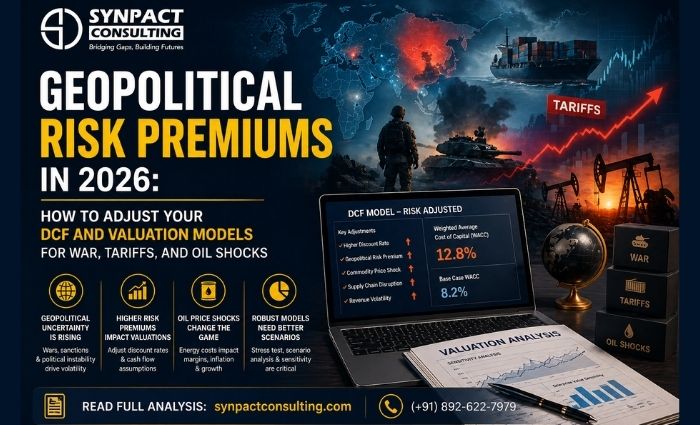
Geopolitical Risk Premiums in 2026: How to Adjust Your DCF and Valuation Models for War, Tariffs, and Oil Shocks
The Question Every Valuation Professional Is Being Asked Right Now
In January 2026, a CFO commissioning a DCF-based business valuation would have received a model built on a set of assumptions that felt stable: a risk-free rate derived from current Treasury yields, an equity risk premium from the latest Damodaran update, a company-specific risk premium based on size and industry, and a beta pulled from a screen of comparable public companies.
By April 2026, the same CFO is asking a different question: “Does this DCF account for the Iran war? Does it account for the tariffs? How are you pricing in the fact that the world looks fundamentally different than it did four months ago?”
This is the geopolitical risk premium question — and it is the most consequential methodology question in valuation practice right now. Traditional DCF models heavily weighted toward historical performance and linear growth projections risk systematically mispricing geopolitical exposure in this environment. Deal teams can no longer rely on a generalised country risk premium and call it a day.
This blog is the complete methodology guide for building a defensible geopolitical risk premium into a DCF in 2026. It covers what the geopolitical risk premium is, how it is different from the country risk premium, where it sits in the WACC build, how to size it by exposure type, how to document it for audit purposes, and what the current 2026 geopolitical environment means for specific engagement types. It is written for valuation analysts, CPA firm partners reviewing DCF-based reports, and CFOs who need to understand what their advisors should be doing — and whether they are doing it.
What the Geopolitical Risk Premium Is — and What It Is Not
The Standard WACC Build — A Brief Recap
Before adding a geopolitical risk premium, it helps to be precise about where it fits in the WACC structure. A standard CAPM-based WACC for a private company has the following components:
Cost of Equity = Risk-Free Rate + (Beta × Equity Risk Premium) + Size Premium + Company-Specific Risk Premium
WACC = (Cost of Equity × Equity Weight) + (Cost of Debt × (1 – Tax Rate) × Debt Weight)
Each component has a standard source and a standard methodology:
The risk-free rate is the yield on the 10-year US Treasury as of the measurement date — or, for non-US valuations, the yield on the relevant sovereign bond adjusted for default risk.
The equity risk premium (ERP) is the additional return investors demand for holding equities over risk-free assets. The Damodaran ERP — updated monthly and available publicly — is the most widely used source in US valuation practice.
The size premium compensates for the additional risk of smaller companies. The Duff & Phelps (now Kroll) size premium study is the standard source for US practice.
The company-specific risk premium (CSRP) is the analyst’s adjustment for risks specific to the subject company that are not captured by beta, size, or the ERP. It is the most judgment-intensive component of the WACC build.
Where the Geopolitical Risk Premium Lives
The geopolitical risk premium is not a sixth, separate component of the WACC. It is an explicit adjustment within two existing components, depending on how it is being applied:
For country-level geopolitical risk — risk that is systematic to a particular geography or trade corridor — it belongs in an adjusted ERP or as a country risk premium (CRP) add-on. This is how Damodaran treats country risk in his country-level ERP calculations: the country risk premium is added to the base ERP to reflect the additional systematic risk of operating in a country with elevated political, regulatory, or conflict risk.
For company-specific geopolitical risk — risk that is idiosyncratic to the subject company’s exposure to geopolitical factors (supply chain concentration in a conflict zone, revenue dependence on a sanctioned market, energy cost sensitivity to a disrupted shipping route) — it belongs in the CSRP. This is the more common application for US-domiciled private company valuations in 2026, where the subject company itself is not in a conflict zone, but its operations are materially affected by geopolitical events.
In valuation work, geopolitical events like the Iran-US standoff increase the country risk premium (CRP) and overall equity risk premium (ERP) used in DCF models. Discount rates rise as investors demand higher returns for uncertainty. Even diversified international portfolios now carry an added 1–3% risk premium, depending on the severity and duration of tensions.
The key distinction for documentation purposes: a geopolitical risk premium that is not explicitly identified, sized, and documented — but is instead buried in an undifferentiated CSRP — will not survive audit scrutiny for a measurement date in Q1–Q2 2026. The macro environment is too visible and too consequential for a reviewer to accept a CSRP that does not specifically address geopolitical exposure.
What the Geopolitical Risk Premium Is Not
It is not a forecast. The analyst does not need to predict whether the Iran war will end in 60 days or 180 days, or whether the US will impose new tariffs on additional trading partners. The geopolitical risk premium reflects the uncertainty that exists as of the measurement date — the range of outcomes that a rational investor would price into their required return for holding the subject company’s equity. Uncertainty is measurable even when outcomes are not predictable.
It is not a double-count. If the cash flow projections already incorporate scenario-based assumptions about energy cost increases and revenue impacts from geopolitical disruption, the geopolitical risk premium should reflect residual uncertainty — the risk that even the downside scenario is not bearish enough — not the same risk that is already embedded in the cash flow assumptions.
It is not permanent. The geopolitical risk premium is calibrated to the environment as of the measurement date. A valuation with a January 2026 measurement date has a different geopolitical risk premium than one with an April 2026 measurement date, which has a different premium than one with a hypothetical July 2026 measurement date if the conflict has resolved. The premium is time-stamped, not timeless.
The 2026 Geopolitical Environment — What Is Actually Being Priced
To size a geopolitical risk premium correctly, the analyst needs a specific, current understanding of the risk environment as of the measurement date. Here is the 2026 geopolitical environment that is material to valuation as of April 30, 2026.
The Iran War and the Strait of Hormuz
Joint US-Israeli military strikes beginning February 28, 2026 targeted Iran’s leadership and key nuclear and military infrastructure. Iran’s retaliation has been broader and more aggressive than in prior episodes, including attacks across Gulf Cooperation Council countries and disruptions to shipping through the Strait of Hormuz, which handles nearly 20% of the global oil supply.
The key question for markets is no longer the initial shock, but how long elevated energy prices and geopolitical uncertainty persist. If disruptions to energy flows through the Strait of Hormuz or key production facilities prove durable, the impact could broaden beyond energy into inflation expectations, interest rates, and corporate margins.
As of April 30, 2026, a fragile ceasefire is in place but the Strait remains functionally impaired, negotiations between the US and Iran are ongoing in Islamabad, and no permanent resolution is in sight. The risk of re-escalation is real and actively priced in energy markets.
Valuation relevance: Any company with direct energy cost exposure, Gulf supply chain dependencies, or revenue from energy-importing economies carries a measurable geopolitical risk exposure that did not exist at this magnitude in 2025.
US Tariffs and Trade Fragmentation
The tariff situation changed significantly at the start of 2026: on January 20, 2026, the Supreme Court ruled 6–3 that the broad tariffs imposed under IEEPA were unlawful, but the administration responded by imposing a 10% global import duty under Section 122 of the Trade Act, later raised to 15% — the maximum permitted.
Separately, China continues to face tariff rates of 125%+, and multiple bilateral trade negotiations are in progress with uncertain outcomes. The US continues to fundamentally reshape its economic and geopolitical relationships as it pursues a transactional approach to foreign policy, accelerating geopolitical fragmentation and exposing fractures in the Western alliance.
Valuation relevance: Companies with China-linked supply chains, US import-dependent cost structures, or export-dependent revenue models carry tariff-specific geopolitical risk that must be explicitly addressed in the WACC build or the cash flow scenario framework.
The IMF’s Assessment
The IMF’s April 2026 World Economic Outlook describes the global economy as operating “in the shadow of war.” The transmission of the current war-infused shock to inflation will differ across countries, reflecting varying exposure to commodity markets, the strength of anchoring of inflation expectations, and the extent of exchange rate depreciation.
The IMF’s global geopolitical risk index — based on the Caldara-Iacoviello measure tracking major newspaper coverage of adverse geopolitical events — is at elevated levels not seen since the post-2022 Russia-Ukraine period. This is not anecdotal. It is a quantified, sourced, citable measure of the geopolitical risk environment that analysts can reference in their documentation.
Valuation relevance: The IMF’s assessment provides authoritative third-party support for an elevated geopolitical risk environment as of April 2026 — precisely the kind of sourced, credible reference that makes a WACC adjustment defensible in audit.
How to Size the Geopolitical Risk Premium — A Practical Framework
Sizing a geopolitical risk premium requires moving from the general observation that “geopolitical risk is elevated” to a specific, documented, defensible number that can be defended to a Big Four reviewer, an IRS auditor, or a counterparty’s valuation team in an M&A context.
Here is the framework.
Step 1: Classify the Subject Company’s Geopolitical Exposure
The first step is a systematic assessment of the subject company’s exposure to the current geopolitical environment. Five exposure categories cover the vast majority of cases:
Energy cost exposure: Does the company have meaningful direct energy costs — diesel, jet fuel, natural gas, electricity from gas-fired generation — as a percentage of its total cost structure? A trucking company with diesel representing 35% of operating costs has high direct energy exposure. A software company with minimal physical operations has low or zero direct energy exposure.
Supply chain geography: Does the company source inputs, components, or finished goods from conflict-affected regions, Gulf-transit-dependent shipping routes, or China (for tariff exposure)? A medical device manufacturer sourcing components from Chinese suppliers has direct tariff exposure. A domestic professional services firm has none.
Revenue geography: Does the company generate meaningful revenue from energy-importing economies facing consumer demand compression (much of Asia, Europe), or from Gulf-region customers whose purchasing power is directly impaired by the conflict? A US-only consumer services company has low revenue geography exposure. An exporter to Asian markets has elevated exposure.
Capital structure sensitivity: Does the company’s cost of debt depend on credit spreads that are affected by the macro uncertainty? Highly leveraged companies — particularly those in PE portfolios — face wider credit spreads in the current environment.
Regulatory and sanctions exposure: Does the company have operations, customers, or counterparties in sanctioned jurisdictions, or in sectors facing heightened regulatory scrutiny from the geopolitical environment (defence, energy, critical minerals)?
Classify each exposure as High, Medium, Low, or None. The composite exposure profile drives the premium range in Step 2.
Step 2: Select the Premium Range by Exposure Profile
Based on current market evidence, practitioner guidance, and the severity of the 2026 geopolitical environment, the following premium ranges are appropriate for a measurement date in Q1–Q2 2026:
Zero geopolitical exposure (domestic-only, no energy cost sensitivity, no supply chain geography risk, minimal leverage): 0 basis points. No geopolitical risk premium is warranted for a company that is genuinely insulated from the current environment. Adding a premium without exposure is not conservative — it is unsupported.
Low exposure (minor energy cost sensitivity, domestic revenue, limited supply chain geography): 25–75 basis points. Analysts recommend adding an explicit geopolitical risk premium to WACC — typically 0.5–2% for moderate tensions, scaling higher if Strait of Hormuz risks materialise. The lower end of this range — 25–75 bps — is appropriate for companies with limited but non-zero exposure.
Moderate exposure (meaningful energy cost exposure or one significant supply chain geography risk, primarily domestic revenue): 75–150 basis points. This is the most common category for US mid-market companies in manufacturing, transportation, consumer goods, and energy-adjacent sectors.
High exposure (significant energy cost sensitivity, Gulf-linked supply chain, export-dependent revenue in energy-importing markets, or direct tariff exposure on cost structure): 150–250 basis points. Research on geopolitical risk and cross-border M&A pricing suggests that companies with meaningful exposure to conflict-prone regions may require a significant geo-risk premium adjustment to their cost of equity — and that this figure is highly asymmetric across sectors. An energy logistics business and a domestic software company are in entirely different risk universes.
Extreme exposure (direct energy sector operations, Gulf-region revenue dependence, active sanctions risk): 250 basis points and above, or alternatively, handled through explicit scenario analysis in the cash flow projections rather than a single-point WACC adjustment.
Step 3: Position Within the Range
Once the range is selected, the analyst positions within it based on three factors:
Duration uncertainty: The longer and more uncertain the geopolitical disruption, the higher within the range. A conflict with a clear path to resolution in 60–90 days warrants a lower premium than one — like the current Iran situation — where the ceasefire is fragile, negotiations are ongoing, and re-escalation risk is explicitly priced in energy futures.
Company-specific sensitivity: A company whose margins move by 1% for every $10/barrel change in oil price has higher sensitivity than one whose margins are insulated by long-term supply contracts or fuel hedges. Quantify the sensitivity if the data supports it; use judgment if it does not.
Reversibility: Geopolitical risks that could cause permanent structural damage — loss of a key customer, permanent supply chain disruption, regulatory sanction — warrant a higher premium than risks that are likely to be temporary even if severe.
Step 4: The Double-Count Check
Before finalising the premium, check for double-counting with the cash flow projections:
If the DCF cash flows already include a downside scenario that explicitly models elevated energy costs, reduced revenue in affected markets, and compressed margins — the geopolitical risk premium in the WACC should be calibrated to residual uncertainty, not to the same risk already in the cash flows.
If the DCF cash flows use a single base case projection without scenario analysis — the geopolitical risk premium in the WACC carries the full weight of the geopolitical risk. In this case, the premium should be at the higher end of the applicable range.
If the DCF uses scenario-weighted cash flows with explicit geopolitical scenarios — the geopolitical risk premium in the WACC may be reduced or eliminated, with the risk fully captured in the probability-weighted cash flow numerator.
Document which approach you are using and why. An undocumented choice between these three approaches is the most common source of audit challenge on WACC builds in the current environment.
How to Document the Geopolitical Risk Premium for Audit
A geopolitical risk premium that cannot be defended in documentation is not a geopolitical risk premium — it is a plug. Here is the documentation standard that makes it defensible.
The Four-Part Documentation Structure
Part A — Macro environment as of measurement date. A concise, sourced description of the geopolitical environment as of the valuation measurement date. This is not a news summary — it is a valuation-relevant characterisation of the risk factors that a rational investor would price on the measurement date. Reference the IMF WEO April 2026, the BlackRock Geopolitical Risk Indicator, current oil price levels, and the status of the Strait of Hormuz as of the measurement date. The BlackRock Geopolitical Risk Indicator tracks the relative frequency of brokerage reports and financial news stories associated with specific geopolitical risks, adjusted for sentiment — providing a quantified, market-calibrated measure of geopolitical risk attention. This is a citable, sourced metric that belongs in your macro environment section.
Part B — Subject company exposure assessment. The five-category exposure assessment from Step 1 above, completed for the subject company with specific supporting data. “Energy costs represent X% of total COGS based on the company’s FY2025 financial statements.” “Y% of the company’s raw material inputs transit the Strait of Hormuz based on supplier geography data.” Specific numbers, sourced to the company’s own financial data, make this section defensible. General assertions (“the company has some energy exposure”) do not.
Part C — Premium selection and range justification. The selected premium, the range from which it was selected, the sources supporting the range (practitioner guidance, market commentary, comparable transaction evidence), and the specific factors that positioned the premium within the range (duration uncertainty, company sensitivity, reversibility). Quote specific sources. Market commentary supports an added 1–3% risk premium for diversified international portfolios, scaling with severity and duration of tensions. This is a citable range from a named advisory source — use it.
Part D — Double-count reconciliation. Explicit documentation of the relationship between the geopolitical risk premium in the WACC and the geopolitical assumptions in the cash flow projections. Which risks are in the cash flows? Which are in the WACC? Why are they not the same risks counted twice?
This four-part structure is what separates an audit-ready geopolitical risk premium from an unsupported number that will be challenged by every sophisticated reviewer.
Engagement-Specific Applications
409A Valuations for Startups in Affected Sectors
For 409A valuations with a measurement date after March 1, 2026, the geopolitical risk premium question is most acute for startups in logistics, energy, manufacturing, and consumer applications. The OPM used in most 409A valuations is not directly affected by WACC — it uses volatility as its primary option-pricing input — but the DCF component of a 409A (used for enterprise value estimation at Series B and beyond) is directly affected.
For early-stage companies where the 409A relies primarily on the asset approach or comparable transaction data, the geopolitical risk premium manifests through the selection of comparable transactions: post-March 2026 transactions in affected sectors will show compressed multiples that reflect the current geopolitical environment. Using pre-war comparable transactions without adjustment understates the geopolitical discount that the market is applying.
Goodwill Impairment Tests Under ASC 350
For goodwill impairment tests, the geopolitical risk premium directly affects both the discount rate in the income approach and the comparable company multiples in the market approach. For companies in sectors with high geopolitical exposure — energy, manufacturing, logistics, aviation — both approaches are simultaneously compressed: higher discount rates reduce DCF value, and lower market multiples reduce the market approach indication.
The simultaneous compression from both sides of the valuation triangle is what makes the 2026 impairment environment particularly aggressive for geopolitically exposed companies. A goodwill impairment test that does not explicitly address the geopolitical risk premium for an affected sector company will reach a fair value conclusion that is too high relative to what the current market would pay — which is precisely the definition of an impairment.
M&A Valuations and Fairness Opinions
For M&A valuations — particularly sell-side fairness opinions and buy-side valuation analyses — the geopolitical risk premium has a direct impact on negotiated deal pricing. Working capital is a specific vulnerability in 2026 M&A: defining “normal” working capital is genuinely problematic when targets may be hoarding inventory to front-run supply chain disruption, or suffering from depleted stock. Using a historical twelve-month average as the peg risks unfairly penalising prudent stockpiling or leaving the buyer needing to inject immediate liquidity post-close.
The geopolitical risk premium in the buyer’s DCF analysis establishes the maximum price the buyer will pay. The geopolitical risk premium in the seller’s fairness opinion establishes the minimum price the board will accept. When both sides are using the same methodology — which they should be — the spread between buyer and seller value indications narrows, and the deal has a better chance of reaching a price both parties can defend to their stakeholders.
PE Fund NAV Calculations
For PE fund quarterly NAV calculations, the geopolitical risk premium affects both the WACC in the income approach and the comparable company multiples used in the market approach. For funds with portfolio companies in geopolitically exposed sectors — which, in the current environment, includes most manufacturing, industrials, energy, and logistics holdings — the Q1 2026 NAV is materially affected by the geopolitical risk premium.
LP expectations for Q1 2026 NAVs in affected sectors should already be set for downward revisions from Q4 2025. The explanation — geopolitical risk premium expansion driven by the Iran war and tariff environment — is both technically accurate and investor-communicable. Funds that document this clearly in their Q1 2026 LP letters will face fewer LP questions than those that present the NAV decline without context.
The Damodaran Framework — Using the World’s Most Cited Source
Aswath Damodaran at NYU Stern is the most cited source in valuation practice for both the ERP and country risk premiums. His methodology for incorporating country risk into the cost of equity is directly applicable to the current geopolitical environment — and his monthly updates provide a time-stamped, publicly available source that makes WACC documentation straightforward.
The Damodaran CRP methodology: Country risk premium = (Country Default Spread) × (Relative Equity Market Volatility). The country default spread is derived from sovereign credit default swaps or Moody’s/S&P country ratings. The relative equity market volatility adjusts for the fact that equity markets are more volatile than sovereign bond markets.
For US domestic valuations in 2026, the Damodaran base ERP already incorporates the market-level geopolitical risk that is priced into US equity markets as of each monthly update date. What it does not capture is company-specific geopolitical exposure that is above and beyond the market average. That company-specific component — the CSRP adjustment described in Part 3 — is what the analyst adds on top of the Damodaran ERP.
The documentation implication: use the Damodaran ERP from the month of your measurement date as the base. Add the company-specific geopolitical risk premium as a documented CSRP adjustment. The two together give you a WACC that is both market-calibrated (through Damodaran) and company-specific (through the CSRP adjustment) — the combination that survives sophisticated review.
Damodaran publishes his updated ERP data on his website at the beginning of each month. For any valuation with a measurement date in March or April 2026, the relevant ERP updates are publicly available and should be cited by specific month in the documentation.
Scenario Analysis as an Alternative or Complement
For companies with extreme or highly uncertain geopolitical exposure — where a single-point WACC adjustment does not capture the range of possible outcomes — scenario analysis in the cash flow projections is a more rigorous approach than a large WACC adjustment.
A three-scenario framework appropriate for the current environment:
Base case (probability: 40–50%): Ceasefire holds and Strait of Hormuz progressively reopens over 60–90 days. Oil prices normalise to $85–95 range by Q3 2026. Tariff environment stabilises at current levels. The company’s energy costs and supply chain return to near-normal by H2 2026.
Moderate disruption case (probability: 30–40%): Ceasefire breaks down and is renegotiated. Strait remains functionally impaired through Q3 2026. Oil prices remain elevated at $100–115. Tariff escalation continues modestly. The company faces sustained margin compression through 2026 with partial recovery in 2027.
Severe disruption case (probability: 15–25%): Full-scale conflict resumes. Strait of Hormuz remains closed for 6+ months. Oil reaches $130–150. Supply chain disruptions force operational changes. Revenue in affected markets declines materially. Recovery timeline extends into 2028.
The probability-weighted DCF across these three scenarios, with a normalised WACC at the base level (without a large geopolitical risk premium in the WACC itself), produces a value that is arguably more transparent and defensible than a single-scenario DCF with a large, hard-to-justify WACC premium.
Analysts recommend running scenario analysis — base case, upside oil spike, and prolonged disruption scenarios — and monitoring forward curves and implied volatility in oil futures, which provide real-time market pricing of the risk.
The choice between the single-point WACC premium approach and the scenario analysis approach depends on the engagement type, the availability of scenario-specific financial data, and the sophistication of the intended audience. For 409A and impairment purposes where a single concluded value is required, the WACC premium approach is simpler to implement. For M&A fairness opinions and PE fund NAV purposes where the range of value is as important as the point estimate, the scenario analysis approach is more informative and more defensible.
Conclusion: Geopolitical Risk Is Now a Core Valuation Input, Not a Footnote
The valuation profession has always acknowledged geopolitical risk in principle. In most pre-2024 environments, it was a footnote — a risk factor mentioned in the report introduction, perhaps a small CSRP adjustment, rarely the subject of a detailed methodology section.
2026 has changed that. Geopolitical risk is no longer a distant concern — it is a core valuation input in 2026. The Iran war, the US tariff regime, and the broader fragmentation of global trade and security arrangements have created a geopolitical environment that is directly, measurably, and materially affecting the value of companies across sectors and geographies. A valuation that does not explicitly address this environment — in the WACC, in the cash flow projections, or in both — is not a complete valuation for a measurement date in Q1–Q2 2026.
The methodology for addressing it is not new. The country risk premium framework, the CSRP adjustment approach, and the scenario analysis technique have all existed for decades. What is new is the urgency, the magnitude, and the visibility of the geopolitical risk that must be incorporated.
The four-part documentation structure described in this blog is the standard that will hold up to audit, to counterparty challenge, and to LP scrutiny. It is also the standard that Synpact applies to every DCF-based valuation produced for US advisory firms, CPA practices, and PE funds — with the geopolitical risk premium explicitly sized, sourced, and documented for every engagement with a post-March 2026 measurement date.
If you have a DCF-based valuation in progress with a measurement date in Q1–Q2 2026 — a goodwill impairment test, a 409A, a PPA, or an M&A fairness opinion — and you are not certain that the geopolitical risk premium has been addressed with this level of rigour, the time to address it is before the report goes out, not after a reviewer questions it.
→ Submit a Brief for a Geopolitical Risk Premium Review or a Full DCF Update — Overnight Turnaround
Related Reading on Synpact Blog:
- How the Iran War Is Changing WACC, DCF Models, and Goodwill Impairment Triggers in 2026
- Why US Tariffs Are Making India-Based Financial Outsourcing More Attractive in 2026
- What “Audit-Ready” Actually Means in 2026 — A CFO’s Checklist
- White-Label Valuation Reports From India: The Complete Process Guide
- White-Label 409A Valuation: The Complete Guide for Startups and CPA Firms
- Goodwill & Intangible Impairment Testing — Synpact
- M&A Buy-Side & Sell-Side Valuation — Synpact
- Private Equity & Fund NAV Valuation — Synpact
- 409A Valuation — Synpact
- Valuation Services — Synpact