
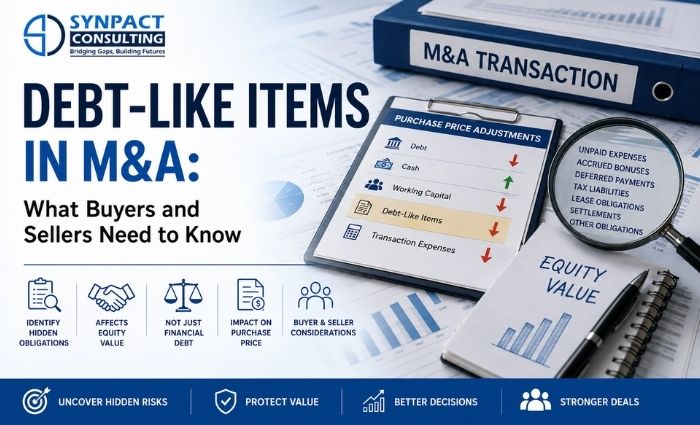
Debt-Like Items in M&A: What Buyers and Sellers Need to Know
In an M&A transaction, agreeing on the headline Enterprise Value is only one part of determining how much the seller ultimately receives.
After Enterprise Value is established, buyers and sellers generally need to consider several balance-sheet and transaction-specific adjustments before arriving at the final Equity Value.
These adjustments commonly include:
- Debt
- Cash
- Working capital
- Unpaid transaction expenses
- Other debt-like obligations
Among these items, debt-like items are often one of the most heavily negotiated because they do not always appear as conventional bank debt on the balance sheet.
A liability may be classified as a current liability under accounting standards but still have characteristics that cause a buyer to treat it as debt-like for transaction purposes.
Likewise, another liability may appear economically significant but properly belong in normalized working capital rather than the debt adjustment.
Understanding this distinction is essential for buyers, sellers, private equity firms, investment bankers, corporate development teams, and transaction advisors.
Debt-like item analysis is therefore commonly performed as part of Due Diligence & Valuation and should be integrated with the broader analysis of working capital, Quality of Earnings, cash, debt, and purchase price adjustments.
What Are Debt-Like Items in M&A?
Debt-like items are obligations that may not be classified as traditional financial debt but are treated similarly to debt when converting Enterprise Value into Equity Value.
The underlying economic principle is generally that the buyer should not pay the seller for value that will need to be used after closing to satisfy obligations economically attributable to the pre-closing business or seller.
Traditional debt is relatively easy to identify.
Examples include:
- Term loans
- Revolving credit facilities
- Bank borrowings
- Notes payable
- Certain shareholder loans
Debt-like items are less straightforward.
Potential examples may include:
- Unpaid transaction expenses
- Accrued transaction bonuses
- Deferred acquisition consideration
- Certain tax liabilities
- Overdue capital expenditures
- Certain lease-related obligations
- Litigation or settlement obligations
- Unfunded employee-related liabilities
- Seller-specific contractual obligations
The exact treatment depends on the transaction, accounting facts, purchase agreement definitions, and whether the item has already been reflected elsewhere in the purchase price mechanism.
Why Debt-Like Items Matter
Debt-like items can directly reduce the amount payable to shareholders even when the negotiated Enterprise Value remains unchanged.
For example, assume a buyer and seller agree that the business has an Enterprise Value of:
$150 million
The company has:
- $20 million of conventional debt
- $5 million of cash
- $4 million of agreed debt-like items
Illustrative Enterprise Value to Equity Value Bridge
| Item | Amount |
|---|---|
| Enterprise Value | $150M |
| Less: Debt | ($20M) |
| Less: Debt-Like Items | ($4M) |
| Add: Cash | $5M |
| Indicative Equity Value | $131M |
The shareholders therefore receive an indicative $131 million before considering any additional adjustments such as normalized working capital.
This is why understanding how debt and cash affect transaction value is essential when evaluating the economics of an acquisition.
Enterprise Value vs. Equity Value
Debt-like items make more sense when viewed through the distinction between Enterprise Value and Equity Value.
Enterprise Value generally represents the value of the underlying operating business available to all capital providers.
Equity Value represents the value attributable to shareholders after considering relevant cash, debt, debt-like obligations, and other transaction adjustments.
A simplified transaction bridge may therefore be expressed as:
Equity Value = Enterprise Value + Cash − Debt − Debt-Like Items ± Other Adjustments
Working capital adjustments may also be incorporated depending on the transaction structure.
This bridge is especially important when analyzing whether an acquisition price is economically reasonable rather than focusing only on the headline offer. For a broader valuation framework, see How to Evaluate Whether an Acquisition Price Is Reasonable.
Debt-Like Items Are Not Defined by Accounting Classification Alone
A common mistake is assuming that debt-like items can be identified simply by reviewing whether a liability is classified as debt under GAAP, IFRS, or another accounting framework.
M&A purchase price analysis is based on transaction economics as well as financial reporting classification.
An obligation may not qualify as accounting debt but still be considered debt-like if, economically, the buyer will need to settle a pre-closing obligation after acquiring the business.
Conversely, a large liability should not automatically be treated as debt-like if it is already reflected in normal operating working capital.
This is why debt-like item identification is typically a detailed component of financial due diligence rather than a mechanical balance-sheet exercise.
Debt-Like Items vs. Working Capital
One of the most important distinctions in transaction analysis is whether an obligation belongs in:
- Debt
- Debt-like items
- Net working capital
- Another separate purchase price adjustment
This classification can have a material impact on seller proceeds.
Typical Working Capital Liability
A normal operating liability generally:
- Arises in the ordinary course of business
- Recurs regularly
- Supports the company’s ongoing operating cycle
- Is included consistently in both historical working capital and the closing calculation
Examples may include ordinary:
- Accounts payable
- Accrued payroll
- Operating accruals
Potential Debt-Like Liability
A potential debt-like item may:
- Relate to a non-recurring obligation
- Represent financing rather than normal operations
- Relate specifically to the transaction
- Be attributable economically to the seller or pre-closing period
- Require post-closing payment without generating an equivalent future operating benefit
Illustrative Classification
| Item | Potential Transaction Treatment |
|---|---|
| Normal Accounts Payable | Working Capital |
| Accrued Ordinary Payroll | Working Capital |
| Bank Term Loan | Debt |
| Unpaid Investment Banking Fee | Potential Debt-Like Item |
| Transaction Bonus | Potential Debt-Like Item |
| Deferred Revenue | Transaction-Specific Analysis |
There is no universal classification rule that applies to every transaction. The purchase agreement should clearly establish how relevant accounts and obligations will be treated.
Why Double Counting Must Be Avoided
One of the biggest risks in purchase price adjustments is double counting.
If an obligation reduces net working capital and is also separately deducted as a debt-like item, the seller may effectively be charged twice for the same liability.
Example
Assume a company has an accrued transaction bonus of:
$1.5 million
If that amount:
- Reduces closing working capital by $1.5 million, and
- Is separately deducted as a $1.5 million debt-like item,
the seller could suffer a total purchase price reduction of:
$3 million
for an underlying obligation of only $1.5 million.
This is why buyers and sellers should analyze working capital and debt-like items together rather than treating them as separate diligence workstreams.
Common Debt-Like Item #1: Unpaid Transaction Expenses
Unpaid transaction expenses are among the most common debt-like items identified in M&A transactions.
Examples may include:
- Investment banking fees
- Legal fees
- Transaction accounting fees
- Due diligence advisory fees
- Success fees
- Other seller-side deal costs
If these expenses relate to the sale process and remain unpaid at closing, the buyer may argue that they should reduce Equity Value.
Illustrative Example
| Unpaid Transaction Expense | Amount |
|---|---|
| Investment Banking Fee | $1.5M |
| Legal Fees | $0.6M |
| Accounting & Advisory Fees | $0.4M |
| Total Potential Debt-Like Amount | $2.5M |
If the buyer will inherit responsibility for paying these amounts after closing, a $2.5 million reduction to Equity Value may be negotiated.
These issues are particularly relevant in buy-side and sell-side transactions where detailed pricing analysis forms part of the broader M&A Buy-Side & Sell-Side Valuation process.
Common Debt-Like Item #2: Transaction Bonuses
Employee bonuses can require careful analysis because ordinary operating bonuses and transaction-triggered bonuses may receive different treatment.
Ordinary Operating Bonus
An annual employee bonus earned through normal business operations may be considered an operating working capital liability, depending on historical practice and the purchase agreement.
Transaction Bonus
A bonus payable specifically because the business is sold may be viewed as a transaction-specific obligation and therefore treated as debt-like or seller-funded.
Change-of-Control Payment
Certain executive or employee compensation arrangements may become payable when control of the business changes.
These amounts should be reviewed carefully because they may represent obligations triggered directly by the acquisition.
Common Debt-Like Item #3: Deferred or Contingent Acquisition Consideration
A company may itself have completed previous acquisitions and still owe consideration to former owners of those businesses.
Examples may include:
- Deferred purchase price
- Seller notes
- Contingent consideration
- Acquisition earnouts
If those obligations remain outstanding when the company is sold again, a buyer may consider whether they should be deducted from Equity Value.
The analysis becomes more complex when the amount is contingent on future performance because the final liability may not yet be known.
Common Debt-Like Item #4: Tax Liabilities
Tax balances are another frequently negotiated area.
Not every tax liability is necessarily debt-like.
Ordinary operating taxes may already be reflected in working capital, while certain historical or transaction-related tax liabilities may warrant separate treatment.
Potential areas include:
- Income tax liabilities
- Unpaid historical taxes
- Tax audit exposures
- Transaction-related taxes
- Pre-closing tax obligations
Tax treatment can also depend significantly on whether the transaction is structured as an asset sale or equity sale.
Common Debt-Like Item #5: Unpaid Capital Expenditures
Capital expenditure obligations can create another difficult classification issue.
Suppose the seller has already committed to a significant equipment purchase before closing, but payment will not occur until after the acquisition.
The buyer may argue that the obligation economically belongs to the pre-closing business.
Potential examples include:
- Committed equipment purchases
- Construction obligations
- Major technology implementation commitments
- Deferred maintenance spending
Whether these amounts qualify as debt-like depends on the facts, contractual commitments, and whether the related asset or economic benefit transfers to the buyer.
Common Debt-Like Item #6: Employee-Related Liabilities
Employee obligations can extend beyond ordinary payroll accruals.
Potential debt-like items may include:
- Unfunded pension obligations
- Deferred compensation
- Change-of-control payments
- Unpaid transaction bonuses
- Certain accrued severance obligations
The key question is whether the obligation represents a normal recurring cost included in working capital or an extraordinary pre-closing liability that the buyer will need to fund.
Common Debt-Like Item #7: Litigation and Settlement Obligations
Known litigation or settlement liabilities may also require separate treatment.
Suppose a company has agreed to pay a legal settlement of:
$3 million
but only $500,000 has been paid before closing.
The remaining:
$2.5 million
may become a transaction adjustment if the buyer will be responsible for settling the obligation.
The exact treatment may depend on indemnification provisions, escrows, insurance coverage, and other transaction protections.
Known Liabilities vs. Contingent Liabilities
Debt-like item analysis becomes more difficult when an obligation is uncertain.
A known fixed liability is relatively straightforward.
A contingent liability may depend on:
- Future litigation outcomes
- Tax audits
- Contract disputes
- Performance conditions
- Regulatory proceedings
Rather than making a direct purchase price deduction, buyers and sellers may address these risks through:
- Escrow
- Holdback
- Indemnification
- Specific representations and warranties
- Contingent purchase price mechanisms
This illustrates why debt-like item analysis can affect both price and transaction structure.
Debt-Like Items and Quality of Earnings
Debt-like item analysis is closely connected with Quality of Earnings analysis.
For example, a QoE review may identify:
- Under-accrued employee bonuses
- Unrecorded vendor liabilities
- Unpaid professional fees
- Deferred operating expenses
- Historical tax exposures
These findings may initially affect normalized earnings or working capital analysis and may subsequently need to be evaluated for potential debt-like treatment.
The important objective is to ensure that the same economic issue is not reflected multiple times in the purchase price calculation.
Debt-Like Items and Financial Due Diligence
A comprehensive Due Diligence & Valuation review should not stop at reported bank debt.
Buyers may review:
- General ledger accounts
- Accrued liabilities
- Legal invoices
- Tax accounts
- Employee compensation arrangements
- Historical acquisitions
- Capital expenditure commitments
- Litigation schedules
- Related-party balances
The purpose is to identify obligations that could reduce the economic value delivered to the buyer or require additional funding after closing.
Debt-Like Items and Acquisition Valuation
Debt-like items do not normally change the standalone Enterprise Value derived from valuation methodologies such as DCF, comparable companies, or precedent transactions.
Instead, they generally affect the bridge from Enterprise Value to Equity Value.
This distinction is important when using Investment & Transaction Valuation to assess deal pricing.
A business can therefore have an Enterprise Value of $200 million under a valuation analysis while shareholders receive materially less because of debt and other transaction adjustments.
Detailed Example: How Debt-Like Items Affect Seller Proceeds
Assume a buyer values a target business at:
Enterprise Value = $250 million
The balance sheet and financial diligence process identify:
- Bank Debt: $30 million
- Cash: $12 million
- Unpaid Transaction Fees: $3 million
- Transaction Bonuses: $2 million
- Deferred Acquisition Consideration: $4 million
- Historical Tax Liability: $1 million
Enterprise Value to Equity Value Bridge
| Item | Amount |
|---|---|
| Enterprise Value | $250M |
| Add: Cash | $12M |
| Less: Bank Debt | ($30M) |
| Less: Transaction Fees | ($3M) |
| Less: Transaction Bonuses | ($2M) |
| Less: Deferred Acquisition Consideration | ($4M) |
| Less: Historical Tax Liability | ($1M) |
| Indicative Equity Value | $222M |
Although the negotiated Enterprise Value is $250 million, the indicative amount attributable to shareholders is $222 million before considering any additional working capital adjustment or other deal-specific items.
This example demonstrates why buyers and sellers should evaluate transaction value comprehensively rather than focusing only on the headline purchase multiple.
Private Equity Perspective on Debt-Like Items
Debt-like item analysis is particularly important for private equity investors because additional liabilities can affect the amount of sponsor equity required at closing.
A previously unidentified $5 million debt-like obligation may:
- Increase required equity funding
- Reduce available cash
- Affect leverage
- Reduce projected IRR
- Reduce projected MOIC
For this reason, debt-like liabilities commonly form part of the diligence and re-underwriting process described in How Private Equity Firms Evaluate Investment Opportunities.
Synpact also supports investment firms throughout this process through its broader Private Equity & VC Support Services.
Key Questions Buyers Should Ask
When evaluating potential debt-like items, buyers should consider:
- Does the obligation relate to the pre-closing period?
- Will the buyer need to settle it after closing?
- Is it part of normal operating working capital?
- Has it already been reflected in normalized EBITDA?
- Has it already reduced closing working capital?
- Is it included in conventional debt?
- Does the buyer receive an equivalent asset or future economic benefit?
- Is the obligation fixed or contingent?
These questions help determine the appropriate transaction treatment and reduce the risk of double counting.
Key Takeaway
Debt-like items are transaction-specific obligations that may reduce Equity Value even though they do not appear as conventional bank debt.
Potential examples include unpaid transaction expenses, transaction bonuses, deferred acquisition consideration, certain tax liabilities, employee obligations, committed expenditures, and litigation-related liabilities.
The most important challenge is not simply identifying liabilities—it is determining whether each item belongs in debt, working capital, a separate purchase price adjustment, or another transaction mechanism.
A disciplined analysis should therefore integrate debt-like item identification with financial due diligence, Quality of Earnings analysis, and Investment & Transaction Valuation.
This integrated approach helps buyers understand the true funding requirement of an acquisition and helps sellers evaluate how balance-sheet and transaction adjustments may affect the proceeds they ultimately receive.
How Buyers Identify Debt-Like Items During Due Diligence
Identifying debt-like items requires more than reviewing the company’s bank debt schedule. Buyers generally need to examine the broader balance sheet, transaction expenses, employee obligations, tax exposures, historical acquisitions, and contractual commitments to determine whether additional liabilities should reduce Equity Value.
This analysis is commonly performed as part of Due Diligence & Valuation because many debt-like obligations do not appear in the same financial statement line item.
Buyers may therefore review:
- General ledger detail
- Accounts payable aging
- Accrued expense schedules
- Employee compensation arrangements
- Transaction invoices
- Tax accounts
- Historical acquisition agreements
- Lease obligations
- Litigation schedules
- Capital expenditure commitments
- Related-party balances
The objective is not to classify every liability as debt-like. The objective is to understand which obligations are part of normal operating working capital and which economically belong in the Enterprise Value-to-Equity Value bridge.
Step 1: Review the General Ledger for Unusual Liabilities
The general ledger is often one of the most useful sources for identifying potential debt-like obligations.
Buyers may examine accounts such as:
- Accrued professional fees
- Other accrued liabilities
- Deferred compensation
- Tax payables
- Employee-related accruals
- Acquisition liabilities
- Long-term provisions
- Related-party accounts
Large, unusual, or non-recurring balances should be investigated to understand their economic nature.
Illustrative Liability Review
| Account | Balance | Potential Treatment |
|---|---|---|
| Normal Accounts Payable | $6.5M | Working Capital |
| Accrued Transaction Fees | $1.8M | Potential Debt-Like Item |
| Deferred Acquisition Payment | $2.5M | Potential Debt-Like Item |
| Annual Employee Bonus Accrual | $1.2M | Working Capital / Transaction-Specific Review |
The accounting label alone does not determine treatment. Each balance should be evaluated based on its origin, expected settlement, and treatment elsewhere in the purchase price mechanism.
Step 2: Analyze Accounts Payable Aging
Accounts payable are typically part of normal working capital. However, unusually old or deferred supplier balances may require further analysis.
For example, if a company historically pays suppliers within 45 days but significant invoices have remained unpaid for more than 120 days immediately before closing, the buyer may question whether those balances represent normal operating liabilities.
Potential warning signs include:
- Large overdue vendor balances
- Payment plans
- Disputed invoices
- Capital expenditure invoices included in AP
- Transaction-related professional fees
This is one reason debt-like item analysis should be coordinated with the working capital review performed during financial due diligence.
Step 3: Review Transaction Expenses
Transaction expenses can become one of the largest debt-like adjustments in a sale process.
Common examples include:
- Investment banking fees
- Legal fees
- Accounting advisory fees
- Tax advisory fees
- Management success fees
- Sale bonuses
The key question is generally whether the seller has already paid these costs or whether the buyer will inherit an unpaid obligation after closing.
Transaction Expense Example
| Expense | Total Fee | Paid Before Closing | Unpaid at Closing |
|---|---|---|---|
| Investment Banking | $2.0M | $0.5M | $1.5M |
| Legal | $0.8M | $0.3M | $0.5M |
| Accounting Advisory | $0.5M | $0.2M | $0.3M |
| Total | $3.3M | $1.0M | $2.3M |
The $2.3 million unpaid amount may be considered debt-like if the buyer would otherwise need to fund those seller-related transaction expenses after closing.
Step 4: Analyze Employee Compensation Obligations
Employee-related liabilities can be particularly difficult because some belong in normal working capital while others may be transaction-specific.
Buyers may review:
- Annual bonuses
- Transaction bonuses
- Retention bonuses
- Deferred compensation
- Severance obligations
- Change-of-control payments
- Pension liabilities
Annual Bonus vs. Transaction Bonus
An ordinary annual bonus earned through normal operating performance may appropriately remain in working capital.
A transaction bonus payable only because the company has been sold may be more appropriately treated as a seller-specific or debt-like obligation.
Clear classification is important because the same liability should not reduce both working capital and Equity Value separately.
Step 5: Review Deferred Compensation
Deferred compensation arrangements may create liabilities that become payable after closing even though the underlying employee service occurred before closing.
These arrangements can include:
- Deferred executive bonuses
- Supplemental retirement arrangements
- Long-term incentive compensation
- Deferred management payments
If the buyer assumes responsibility for a pre-closing obligation, it may seek a corresponding purchase price adjustment.
Step 6: Analyze Historical Acquisition Liabilities
Companies that have completed prior acquisitions may still owe payments to former sellers.
These obligations may include:
- Seller notes
- Deferred purchase consideration
- Earnouts
- Contingent consideration
These liabilities should be reviewed carefully because they can survive a subsequent sale of the company.
For example, a target may have:
- Deferred purchase consideration: $4 million
- Estimated earnout liability: $3 million
If the acquiring buyer assumes these obligations, the total potential debt-like adjustment could reach:
$7 million
Where contingent consideration is involved, the analysis should also consider the structure described in Understanding Earnouts in M&A Transactions.
Step 7: Analyze Tax Liabilities
Tax liabilities often require detailed legal, tax, and financial analysis because different types of taxes may receive different transaction treatment.
Potential areas include:
- Historical income taxes
- Sales and use taxes
- Payroll taxes
- VAT or GST
- Property taxes
- Tax audit exposures
Ordinary recurring tax balances may already be reflected in working capital. Historical liabilities attributable to pre-closing periods may be treated separately depending on the purchase agreement.
Step 8: Analyze Lease Obligations
Lease treatment can be complex because accounting standards may place certain lease liabilities on the balance sheet even though the transaction may treat those obligations differently.
Potential considerations include:
- Finance leases
- Operating leases
- Overdue rent
- Lease termination obligations
- Unusual landlord incentives or liabilities
The parties should clearly determine which lease liabilities are included in debt, debt-like items, working capital, or excluded from the purchase price bridge.
Step 9: Review Litigation and Regulatory Obligations
Known legal or regulatory obligations may create liabilities that are economically attributable to the pre-closing business.
Potential examples include:
- Settled litigation payable after closing
- Regulatory fines
- Contractual dispute settlements
- Known remediation obligations
Contingent legal risks may instead be addressed through escrow, indemnification, insurance, or other transaction protections.
Step 10: Analyze Capital Expenditure Commitments
Capital expenditure obligations can become contentious when the company committed to spending before closing but the buyer will make the payment after closing.
Example
Assume the seller has signed a binding agreement to purchase equipment for:
$3 million
The equipment is scheduled for delivery immediately after closing.
The buyer receives the asset but also funds the $3 million payment.
The appropriate treatment may depend on:
- Whether the expenditure is included in the valuation forecast
- Whether the buyer receives equivalent economic value
- Whether the payment relates to maintenance or growth CapEx
- The terms of the purchase agreement
This illustrates why not every unpaid commitment should automatically be classified as debt-like.
Step 11: Review Related-Party Balances
Related-party balances should also be examined before closing.
Examples may include:
- Shareholder loans
- Amounts payable to founders
- Affiliate balances
- Intercompany financing
- Owner-controlled property arrangements
Some balances may need to be settled before closing, while others may be treated as debt or debt-like obligations.
Debt-Like Items and the Working Capital Peg
One of the most important transaction principles is ensuring that debt-like items and the working capital peg are calculated consistently.
If a liability was historically included when determining normalized working capital, removing it from closing working capital and then deducting it again as debt-like may create double counting.
Illustrative Double-Count Example
Assume:
- Accrued liability: $2 million
- Working Capital Peg: calculated with the liability included
If the closing statement:
- Includes the $2 million liability in working capital, and
- Also deducts $2 million as debt-like,
the economic impact could effectively become:
$4 million
even though only one $2 million obligation exists.
This is why working capital and debt-like items should be analyzed together rather than in isolation.
How Debt-Like Items Affect Acquisition Price Reasonableness
A transaction may initially appear attractive based on the headline Enterprise Value or purchase multiple.
However, once debt-like obligations are incorporated, the buyer’s total funding requirement may increase materially.
This should be incorporated into the broader analysis of whether an acquisition price is reasonable.
Illustrative Example
Assume:
- Enterprise Value: $180M
- Debt: $20M
- Cash: $5M
- Debt-Like Items: $8M
- Working Capital Shortfall: $2M
| Item | Amount |
|---|---|
| Enterprise Value | $180M |
| Add: Cash | $5M |
| Less: Debt | ($20M) |
| Less: Debt-Like Items | ($8M) |
| Less: Working Capital Shortfall | ($2M) |
| Indicative Equity Value | $155M |
The difference between the $180 million headline Enterprise Value and the $155 million indicative Equity Value is economically significant.
Debt-Like Items and Quality of Earnings
Debt-like obligations may also emerge from Quality of Earnings analysis.
For example, QoE work may identify:
- Under-accrued payroll liabilities
- Unrecorded supplier costs
- Unpaid professional fees
- Recurring expenses classified incorrectly
- Deferred compensation
Some findings may affect normalized EBITDA, others may affect working capital, and others may ultimately be treated as debt-like.
The transaction team should reconcile these findings carefully to avoid overlapping adjustments.
Debt-Like Items in Private Equity Transactions
Private equity investors typically incorporate debt-like item findings directly into their acquisition models.
Additional liabilities may affect:
- Equity contribution
- Sources and uses
- Debt financing
- Free cash flow
- IRR
- MOIC
For example, discovering an additional $10 million of debt-like items may require the sponsor to contribute additional equity if lenders are unwilling to finance those obligations.
This is why balance-sheet and diligence adjustments form an important part of the underwriting process described in How Private Equity Firms Evaluate Investment Opportunities.
Synpact supports investors in this process through its Private Equity & VC Support Services, including transaction analysis, modeling, valuation, and diligence support.
Debt-Like Items and the Investment Committee
Material debt-like findings may also need to be reflected in the Investment Committee materials before a transaction receives final approval.
An Investment Committee may review:
- Enterprise Value
- Equity purchase price
- Debt
- Cash
- Debt-like items
- Working capital adjustment
- Total equity funding
For a broader explanation of how transaction findings are presented to decision-makers, see What Is an Investment Committee Memorandum?.
Buyer Due Diligence Checklist for Debt-Like Items
Buyers should generally review:
- All debt agreements
- Accrued liability accounts
- Transaction expense schedules
- Employee bonus arrangements
- Deferred compensation
- Historical acquisition agreements
- Seller notes
- Earnout liabilities
- Tax liabilities
- Lease obligations
- Litigation schedules
- Capital expenditure commitments
- Related-party balances
Seller Preparation Checklist
Sellers can reduce transaction surprises by preparing their own debt-like item schedule before detailed buyer diligence begins.
A seller should consider:
- Identifying all potential debt-like obligations
- Separating working capital liabilities from debt-like items
- Documenting amounts already paid
- Reviewing transaction expense accruals
- Identifying potential double-counting issues
- Preparing explanations for unusual liabilities
This process can help management understand how the headline valuation may translate into actual shareholder proceeds.
Key Takeaway
Identifying debt-like items requires detailed analysis of the company’s liabilities, transaction expenses, employee arrangements, tax exposures, historical acquisitions, lease commitments, litigation, and other contractual obligations.
The most important issue is not simply whether a liability exists. The analysis should determine whether the obligation belongs in normal working capital, conventional debt, a debt-like adjustment, or another transaction mechanism.
Buyers and sellers should therefore integrate debt-like item analysis with Due Diligence & Valuation, Quality of Earnings analysis, M&A Buy-Side & Sell-Side Valuation, and the broader Enterprise Value-to-Equity Value bridge.
A disciplined approach helps buyers understand the true acquisition funding requirement and helps sellers avoid unexpected reductions in transaction proceeds.
How Sellers Should Prepare for Debt-Like Item Negotiations
Debt-like item analysis should not be treated as a buyer-only diligence exercise. Sellers can materially improve transaction readiness by identifying potential debt-like obligations before the buyer begins detailed financial due diligence.
A well-prepared seller should understand:
- Which liabilities may be treated as conventional debt
- Which items belong in normal working capital
- Which obligations may be considered debt-like
- Which balances could create double-counting issues
- How each adjustment could affect final Equity Value
This preparation is particularly important when the headline valuation is attractive but the business has significant transaction expenses, historical acquisition liabilities, employee obligations, or other non-operating liabilities.
Sellers preparing for a transaction may benefit from reviewing these issues alongside M&A Buy-Side & Sell-Side Valuation Services so that headline valuation and expected shareholder proceeds are evaluated together.
Step 1: Prepare a Debt-Like Item Schedule
Before detailed buyer diligence begins, management should prepare a schedule of all potential debt-like obligations.
The schedule may include:
- Conventional debt
- Seller notes
- Deferred acquisition consideration
- Earnout liabilities
- Transaction fees
- Transaction bonuses
- Deferred compensation
- Tax liabilities
- Lease-related obligations
- Capital expenditure commitments
- Litigation or settlement liabilities
- Related-party balances
Each item should then be classified based on its expected treatment in the transaction.
Illustrative Debt-Like Item Schedule
| Item | Amount | Seller Position | Potential Buyer Position |
|---|---|---|---|
| Bank Term Loan | $12.0M | Debt | Debt |
| Unpaid Deal Fees | $1.8M | Seller Expense | Debt-Like |
| Annual Bonus Accrual | $1.2M | Working Capital | Working Capital |
| Transaction Bonus | $0.9M | Seller Expense | Debt-Like |
| Deferred Acquisition Payment | $2.5M | Debt-Like | Debt-Like |
Preparing this schedule early allows the seller to identify areas likely to become negotiation points before the buyer presents its own adjustment schedule.
Step 2: Reconcile Debt-Like Items with Working Capital
One of the most important seller-side exercises is reconciling potential debt-like liabilities with the working capital calculation.
This is necessary because a liability that already reduces closing net working capital should not automatically be deducted again as a debt-like item.
Example of Potential Double Counting
Assume a company has:
$1.5 million of accrued employee bonuses
The agreed working capital peg includes normal bonus accruals.
If the $1.5 million liability also appears in closing working capital, the buyer should carefully evaluate whether a separate $1.5 million debt-like deduction would duplicate the economic impact.
Working capital definitions and debt-like item definitions therefore need to be reviewed together.
This analysis also connects directly with the broader concepts discussed in What Buyers Examine During Financial Due Diligence.
Step 3: Distinguish Operating Liabilities from Seller-Specific Obligations
Sellers should identify whether an obligation is part of the normal operating cycle or specifically relates to the transaction or pre-closing ownership period.
Normal Operating Liability
Examples may include:
- Ordinary accounts payable
- Recurring payroll accruals
- Normal employee bonuses
- Regular operating expenses
Potential Seller-Specific Liability
Examples may include:
- Transaction success fees
- Change-of-control bonuses
- Unpaid seller advisory fees
- Certain historical tax exposures
- Deferred consideration from prior acquisitions
This distinction is often more important than the accounting label attached to the liability.
How Buyers and Sellers Negotiate Debt-Like Items
Debt-like item negotiations generally focus on economic responsibility.
The buyer may argue:
The liability relates to the pre-closing business and will require cash after closing, so it should reduce Equity Value.
The seller may respond:
The obligation is part of normal operations, is already captured in working capital, or provides the buyer with an equivalent economic benefit.
The final treatment depends on the specific facts and purchase agreement.
Example: Buyer vs. Seller Debt-Like Adjustment
Assume the buyer identifies the following potential debt-like items:
| Item | Buyer Adjustment | Seller Adjustment |
|---|---|---|
| Unpaid Transaction Fees | $2.0M | $2.0M |
| Annual Bonus Accrual | $1.5M | $0 |
| Deferred Acquisition Consideration | $3.0M | $3.0M |
| Committed Growth CapEx | $2.5M | $0 |
| Historical Tax Exposure | $1.0M | $0.5M |
| Total | $10.0M | $5.5M |
The parties therefore have a:
$4.5 million disagreement
even though they may fully agree on the headline Enterprise Value.
Why Growth CapEx Can Be Controversial
Committed capital expenditures are not automatically debt-like.
The appropriate treatment depends on whether the buyer receives an asset or future economic benefit in exchange for the payment.
For example, assume a company has committed:
$5 million
to a new manufacturing line.
If the buyer receives a new operating asset with equivalent economic value, treating the full $5 million as debt-like may overstate the adjustment.
However, if the expenditure is required merely to restore existing operations because maintenance spending was deferred, the buyer may have a stronger argument that the obligation should affect transaction economics.
Debt-Like Items and Maintenance CapEx
Maintenance capital expenditure is particularly important because it may represent spending required simply to sustain the company’s existing earnings capacity.
If a seller has delayed necessary maintenance before closing, reported EBITDA and cash flow may appear temporarily stronger.
That issue may affect:
- Quality of Earnings
- Cash conversion
- Debt-like item analysis
- Acquisition valuation
These issues should be analyzed together as part of a comprehensive Due Diligence & Valuation process.
Debt-Like Items and Deferred Revenue
Deferred revenue is one of the most debated transaction liabilities.
The seller has often already received the cash, while the buyer inherits the obligation to deliver future products or services.
Consider a SaaS company with:
- Deferred Revenue: $8M
- Estimated Future Fulfillment Cost: $2M
Potential transaction approaches may include:
- Including the full $8M in working capital
- Including only the estimated fulfillment cost
- Negotiating another contract-specific adjustment
There is no universal answer. The treatment should reflect the economics of the customer obligation and the negotiated purchase price structure.
Debt-Like Items and Customer Deposits
Customer deposits create similar issues.
If customers have paid before closing but the buyer must perform the work afterward, the buyer inherits a future cost obligation without receiving the corresponding customer cash.
Potential treatment should consider:
- Amount of cash collected
- Expected cost to fulfill
- Expected gross margin
- Whether deposits are recurring in normal operations
For businesses with significant customer prepayments, these issues can materially affect transaction value.
Debt-Like Items and Unused Vacation / PTO
Accrued vacation or paid time off can also become a negotiation item.
The appropriate treatment depends on:
- Local employment law
- Company policy
- Historical accounting treatment
- Whether accrued balances transfer with employees
In some transactions, PTO is treated as normal working capital. In others, unusually large accumulated balances may be addressed separately.
Debt-Like Items and Pension Obligations
Underfunded pension obligations can represent material future cash requirements.
Buyers may therefore analyze:
- Funded status
- Minimum required contributions
- Plan liabilities
- Actuarial assumptions
- Expected future contributions
Depending on the transaction structure, unfunded pension liabilities may result in a direct debt-like adjustment or another negotiated protection.
Debt-Like Items and Related-Party Loans
Shareholder and related-party balances should generally be identified clearly before closing.
Potential examples include:
- Founder loans
- Loans from affiliated entities
- Intercompany financing
- Amounts payable to shareholders
These balances may need to be repaid, forgiven, contributed to equity, or otherwise settled before or at closing.
Debt-Like Items and Litigation Risk
Known legal liabilities can sometimes be quantified and included directly in transaction adjustments.
Uncertain litigation is more difficult.
Rather than estimating a debt-like deduction, parties may use:
- Escrow
- Holdback
- Special indemnity
- Representations and warranties insurance
This allows transaction participants to allocate risk without necessarily reducing purchase price by the full potential claim amount.
Debt-Like Items and Purchase Price Structure
Not every identified risk should necessarily result in a direct dollar-for-dollar purchase price deduction.
Depending on certainty and timing, buyers and sellers may use:
- Direct debt-like adjustment
- Escrow
- Holdback
- Earnout
- Specific indemnification
The appropriate structure depends on whether the obligation is fixed, contingent, disputed, or dependent on future events.
For situations involving contingent consideration, see Understanding Earnouts in M&A Transactions.
Debt-Like Items and Acquisition Pricing
Debt-like findings can materially change the amount a buyer effectively pays for the equity even when the negotiated Enterprise Value remains unchanged.
Consider:
- Enterprise Value: $300M
- Cash: $15M
- Conventional Debt: $40M
- Debt-Like Items: $12M
- Working Capital Shortfall: $4M
Illustrative Final Purchase Price Bridge
| Transaction Item | Amount |
|---|---|
| Enterprise Value | $300M |
| Add: Cash | $15M |
| Less: Conventional Debt | ($40M) |
| Less: Debt-Like Items | ($12M) |
| Less: Working Capital Shortfall | ($4M) |
| Indicative Equity Value | $259M |
The difference between Enterprise Value and Equity Value is:
$41 million
This is why acquisition pricing should be evaluated through the entire purchase price bridge rather than through the headline multiple alone.
For additional transaction pricing context, see How to Evaluate Whether an Acquisition Price Is Reasonable.
How Debt-Like Findings Affect M&A Valuation
Debt-like items generally do not change the Enterprise Value produced by operating valuation methodologies.
However, they can materially change the amount attributable to equity holders.
This makes debt-like analysis particularly relevant when performing Investment & Transaction Valuation and M&A Buy-Side & Sell-Side Valuation.
Private Equity Sources and Uses Impact
For private equity sponsors, debt-like obligations may directly affect the sources and uses schedule.
Example
Initial underwriting assumes:
- Equity Purchase Price: $200M
- Transaction Fees: $10M
- Debt Financing: $120M
- Sponsor Equity: $90M
Diligence then identifies:
$8 million of additional debt-like items
If debt capacity does not change, sponsor equity may increase from:
$90M to $98M
This can reduce projected investment returns.
Such findings form part of the broader investment underwriting process discussed in How Private Equity Firms Evaluate Investment Opportunities.
Debt-Like Item Sensitivity Analysis
When the treatment of certain obligations remains uncertain, buyers may model multiple scenarios.
| Scenario | Debt-Like Items | Indicative Equity Value |
|---|---|---|
| Seller Case | $4M | $176M |
| Base Case | $8M | $172M |
| Conservative Buyer Case | $13M | $167M |
This analysis helps decision-makers understand the purchase price sensitivity to unresolved diligence items.
How Debt-Like Items Affect Investment Committee Approval
Material debt-like findings may require an updated Investment Committee analysis.
For example, the committee may need to review:
- Updated Equity Value
- Revised sources and uses
- Additional sponsor equity
- Revised debt capacity
- Updated IRR
- Updated MOIC
For a detailed overview of the decision document used in many investment processes, see What Is an Investment Committee Memorandum?.
Seller Best Practices
Sellers preparing for an M&A transaction should consider:
- Preparing a debt-like item schedule before buyer diligence
- Reconciling liabilities with working capital
- Separating normal operating accruals from transaction-specific obligations
- Quantifying unpaid transaction expenses
- Reviewing historical acquisition liabilities
- Identifying tax and employee-related exposures
- Documenting potential double-counting issues
Early preparation can reduce surprises and improve the seller’s ability to defend proposed transaction proceeds.
Buyer Best Practices
Buyers should consider:
- Reviewing detailed general ledger accounts
- Analyzing accrued liability schedules
- Reviewing transaction expenses
- Reviewing compensation agreements
- Analyzing tax exposures
- Reviewing prior acquisition agreements
- Identifying capital commitments
- Reconciling debt-like items with working capital
These procedures should be coordinated with broader Due Diligence & Valuation Services so the transaction team has one consistent purchase price bridge.
Key Takeaway
Debt-like item negotiations can materially affect transaction proceeds even when the parties agree on Enterprise Value.
The most effective approach is to analyze each obligation based on economic substance and determine whether it belongs in working capital, conventional debt, debt-like items, or another transaction mechanism.
Sellers should identify these issues before entering detailed negotiations, while buyers should reconcile all potential adjustments to avoid double counting.
Debt-like item analysis should therefore be integrated with Quality of Earnings analysis, Financial Due Diligence, Investment & Transaction Valuation, and the broader Enterprise Value-to-Equity Value framework.
Frequently Asked Questions About Debt-Like Items in M&A
What is a debt-like item in an M&A transaction?
A debt-like item is an obligation that may not be classified as traditional bank debt but is treated similarly to debt when calculating the amount payable to shareholders in an acquisition.
Potential examples can include unpaid transaction expenses, deferred acquisition consideration, transaction bonuses, certain tax liabilities, employee-related obligations, and other pre-closing liabilities that the buyer may need to settle after closing.
Why do debt-like items reduce Equity Value?
Enterprise Value generally represents the value of the operating business before considering the company’s financing structure and certain transaction-specific obligations.
If the buyer assumes an obligation that economically belongs to the pre-closing business, that obligation may reduce the amount attributable to the seller’s equity.
This is part of the broader bridge explained in How Debt and Cash Affect Transaction Value.
Are debt-like items the same as financial debt?
No. Conventional financial debt typically includes term loans, revolving facilities, notes payable, and other financing obligations.
Debt-like items may not meet the accounting definition of financial debt but can still have similar economic consequences in a transaction.
Are accounts payable considered debt-like?
Ordinary accounts payable arising through the normal operating cycle are generally treated as working capital rather than debt-like.
However, unusually overdue vendor balances, transaction-related invoices, or liabilities outside normal operations may require separate analysis.
Are transaction expenses debt-like?
Unpaid transaction expenses are commonly considered potential debt-like items because they generally relate to the seller’s sale process rather than the future operating business.
Examples may include unpaid investment banking, legal, accounting, tax advisory, and success fees.
Are employee bonuses debt-like items?
It depends on the nature of the bonus.
An ordinary annual operating bonus may be included in working capital, while a transaction bonus or change-of-control payment triggered by the acquisition may be treated as a seller obligation or debt-like item.
Is deferred revenue a debt-like item?
Deferred revenue is transaction-specific and often heavily negotiated.
The seller may have already received customer cash, while the buyer inherits the future service or product obligation. Depending on the transaction, deferred revenue may be included in working capital, adjusted for future fulfillment costs, or addressed through another purchase price mechanism.
Are tax liabilities debt-like?
Certain tax liabilities may be debt-like, particularly when they relate to historical or pre-closing periods.
Ordinary recurring operating taxes may already be included in working capital, so the parties should carefully avoid double counting.
Can capital expenditures be debt-like?
Committed or unpaid capital expenditures may require analysis, but they are not automatically debt-like.
The treatment may depend on whether the buyer receives an equivalent asset or economic benefit and whether the expenditure represents normal growth investment or deferred maintenance required to sustain existing operations.
What is the difference between a debt-like item and a working capital item?
A working capital item generally arises through the recurring operating cycle of the business.
A debt-like item is more likely to represent a financing, non-operating, seller-specific, or pre-closing obligation that requires settlement without being part of normal ongoing working capital.
Why is double counting a risk?
If the same liability reduces closing working capital and is also deducted separately as debt-like, the seller may effectively suffer two purchase price reductions for one underlying obligation.
This is why debt-like analysis should be coordinated with Financial Due Diligence and the closing working capital schedule.
When are debt-like items identified?
Potential debt-like items are typically identified during financial due diligence and then refined during purchase agreement negotiations and preparation of the closing statement.
Sophisticated sellers may also identify them proactively before launching the transaction.
Can debt-like items affect the valuation multiple?
Debt-like items generally affect the bridge from Enterprise Value to Equity Value rather than the operating valuation multiple itself.
However, the underlying issue that creates the liability may sometimes affect perceived business risk and therefore influence valuation indirectly.
How do private equity firms analyze debt-like items?
Private equity firms typically incorporate agreed debt-like adjustments into their sources and uses analysis, purchase price bridge, financing requirements, and return model.
Unexpected liabilities can increase required sponsor equity and reduce projected returns.
For more on this process, see How Private Equity Firms Evaluate Investment Opportunities.
Can sellers dispute debt-like adjustments?
Yes. Sellers may challenge an adjustment when they believe an item is already included in working capital, provides an equivalent economic benefit to the buyer, is not attributable to the pre-closing period, or is being measured inconsistently with the purchase agreement.
Comprehensive Debt-Like Items Checklist
The following checklist provides a practical framework for buyers and sellers when reviewing potential debt-like obligations.
| Category | Potential Items to Review |
|---|---|
| Financial Debt | Loans, revolvers, notes, shareholder financing |
| Transaction Costs | Banker, legal, accounting, tax and advisory fees |
| Employee Obligations | Transaction bonuses, deferred compensation, severance |
| Historical Acquisitions | Seller notes, deferred consideration, earnouts |
| Tax | Historical tax liabilities, audit exposures, unpaid taxes |
| Capital Expenditures | Committed CapEx, deferred maintenance, unpaid equipment |
| Legal | Settlements, litigation liabilities, regulatory penalties |
| Employee Benefits | Pensions, PTO, retirement obligations |
| Related Parties | Founder loans, shareholder balances, affiliate financing |
| Customer Obligations | Deferred revenue, deposits and prepayments |
Detailed Debt-Like Item Example
Consider a target company that has negotiated an Enterprise Value of:
$225 million
The buyer’s financial diligence identifies the following balance-sheet and transaction adjustments:
| Adjustment | Amount |
|---|---|
| Bank Debt | $25.0M |
| Cash | $10.0M |
| Unpaid Transaction Expenses | $2.5M |
| Transaction Bonuses | $1.5M |
| Deferred Acquisition Consideration | $3.0M |
| Historical Tax Liability | $1.0M |
| Working Capital Shortfall | $2.0M |
Indicative Purchase Price Bridge
| Item | Amount |
|---|---|
| Enterprise Value | $225.0M |
| Add: Cash | $10.0M |
| Less: Bank Debt | ($25.0M) |
| Less: Transaction Expenses | ($2.5M) |
| Less: Transaction Bonuses | ($1.5M) |
| Less: Deferred Acquisition Consideration | ($3.0M) |
| Less: Historical Tax Liability | ($1.0M) |
| Less: Working Capital Shortfall | ($2.0M) |
| Indicative Equity Value | $200.0M |
The headline Enterprise Value is $225 million, but the indicative shareholder value falls to approximately $200 million after considering cash, debt, debt-like obligations, and working capital.
This is why comprehensive Investment & Transaction Valuation should consider not only headline valuation but also the mechanics that determine final Equity Value.
How Debt-Like Items Affect Buyer Returns
Debt-like liabilities can also materially affect buyer returns.
Consider a private equity acquisition where the sponsor originally expects to invest:
$80 million of equity
Diligence identifies an additional:
$8 million of debt-like obligations
If financing remains unchanged, sponsor equity may increase to:
$88 million
If exit proceeds remain the same, the higher initial equity investment reduces both MOIC and IRR.
This is why financial diligence findings can materially change the investment recommendation presented in an Investment Committee Memorandum.
Debt-Like Items and Quality of Earnings Should Be Reconciled
A strong transaction analysis should reconcile debt-like findings with Quality of Earnings analysis.
For example:
- If an expense was added back to EBITDA because it was considered non-recurring, does an unpaid liability still exist?
- If compensation was normalized through EBITDA, has the corresponding accrual also been considered?
- If a historical expense is treated as debt-like, has it already affected normalized earnings?
This reconciliation helps avoid overstating or understating transaction adjustments.
Debt-Like Items and Commercial Due Diligence
Most debt-like items are identified through financial and legal diligence, but commercial findings can sometimes provide useful context.
For example, significant customer losses, supplier dependency, or declining demand may explain why liabilities have accumulated or why certain commitments may become economically burdensome after closing.
For a broader understanding of non-financial acquisition risks, see Commercial Due Diligence Red Flags.
When Should a Seller Perform Debt-Like Item Analysis?
Ideally, a seller should begin this analysis before the formal sale process or before detailed buyer diligence begins.
Early analysis can help management:
- Estimate expected shareholder proceeds
- Identify potential negotiation issues
- Prepare supporting documentation
- Reduce surprises
- Coordinate working capital and debt treatment
- Improve transaction readiness
This preparation can also help sellers evaluate whether a proposed offer remains attractive after considering all adjustments.
When Should a Buyer Perform Debt-Like Item Analysis?
Buyers should begin evaluating debt-like obligations during financial diligence and continue refining the analysis through signing and closing.
The analysis should ultimately align with:
- The purchase agreement
- Closing statement
- Sources and uses
- Financing documents
- Investment model
Synpact supports buyers and investment teams through Due Diligence & Valuation Services and related transaction analysis.
Final Debt-Like Item Decision Framework
For each potential liability, buyers and sellers should ask the following questions:
- Does the obligation relate to the pre-closing business?
- Will the buyer need to fund it after closing?
- Is it part of the ordinary operating cycle?
- Is it already included in net working capital?
- Is it already included in conventional debt?
- Has the item affected normalized EBITDA?
- Does the buyer receive an equivalent asset or future economic benefit?
- Is the amount fixed or contingent?
- Could another transaction mechanism address the risk more appropriately?
Answering these questions helps determine whether the item should be classified as debt-like or treated elsewhere in the transaction.
Conclusion
Debt-like items are one of the most important—and frequently misunderstood—components of the Enterprise Value-to-Equity Value bridge.
While traditional bank debt is generally easy to identify, debt-like obligations can arise from many different areas of the business, including:
- Transaction expenses
- Employee compensation
- Historical acquisitions
- Tax liabilities
- Capital commitments
- Litigation
- Employee benefits
- Related-party balances
- Customer obligations
The correct treatment depends on economic substance rather than accounting terminology alone.
Buyers should ensure that they are not acquiring hidden pre-closing obligations without an appropriate adjustment, while sellers should ensure that ordinary operating liabilities are not incorrectly classified or double counted.
Debt-Like Items Should Be Analyzed as Part of the Entire Deal
Debt-like analysis should never be performed in isolation.
It should be reconciled with:
- Net working capital
- Quality of Earnings
- Cash and debt
- Normalized EBITDA
- Purchase price adjustments
- Transaction structure
- Sources and uses
For this reason, debt-like item analysis naturally forms part of broader Financial Due Diligence and M&A Buy-Side & Sell-Side Valuation.
How Synpact Consulting Can Help
Synpact Consulting supports buyers, sellers, private equity firms, investors, and corporate development teams with transaction-focused valuation and financial analysis.
Relevant services include:
- Due Diligence & Valuation
- Investment & Transaction Valuation
- M&A Buy-Side & Sell-Side Valuation
- Private Equity & VC Support
Need Support Evaluating Debt-Like Items?
If you are evaluating an acquisition, preparing a company for sale, reviewing an Enterprise Value-to-Equity Value bridge, or conducting financial diligence, Synpact Consulting can help identify and analyze potential debt-like obligations and their effect on transaction value.
Contact Synpact Consulting to discuss your M&A valuation, financial due diligence, purchase price adjustment, or transaction advisory requirements.