
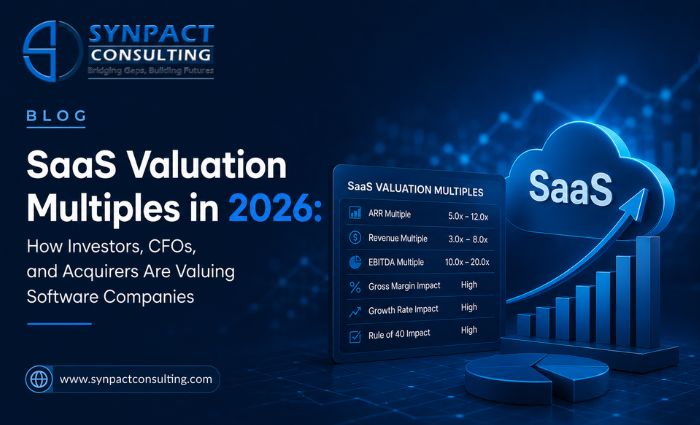
SaaS Valuation Multiples in 2026: How Investors, CFOs, and Acquirers Are Valuing Software Companies
The Software-as-a-Service (SaaS) sector continues to attract significant investment across the United States, United Kingdom, and Australia. While the valuation frenzy of previous years has evolved into a more disciplined environment, high-performing SaaS businesses continue to command premium valuations.
In 2026, investors are focusing less on growth at all costs and more on sustainable revenue, profitability, customer retention, and operational efficiency. As a result, understanding how valuation multiples are determined has become essential for founders preparing for fundraising, CFOs managing shareholder expectations, and acquirers evaluating potential transactions.
Whether you are preparing for an investment round, acquisition, stock option issuance, or strategic planning exercise, understanding the latest SaaS valuation methodologies can help you make informed decisions and maximise enterprise value.
Why SaaS Valuation Matters More Than Ever in 2026
The SaaS market has matured significantly over the past decade. Investors now have access to extensive benchmarking data, making valuation decisions more data-driven than ever before.
Today’s valuation process extends far beyond revenue growth. Investors and buyers assess:
- Recurring revenue quality
- Customer retention metrics
- Profitability trends
- Market position
- Product differentiation
- AI integration capabilities
- Scalability potential
For companies seeking funding, an accurate valuation helps establish credibility with investors. For businesses involved in mergers and acquisitions, valuation becomes a critical component of transaction negotiations.
Additionally, many SaaS companies require independent valuations for tax, accounting, and compliance purposes, including 409A Valuation Services, financial reporting, and audit requirements.
The Key Metrics Investors Review Before Assigning a Valuation
Annual Recurring Revenue (ARR)
ARR remains one of the most important indicators of SaaS value.
Investors view recurring revenue as more predictable and reliable than one-time sales. Companies with strong ARR growth typically receive higher valuation multiples.
A SaaS company generating $10 million in ARR with strong retention and profitability may receive significantly higher multiples than a company generating the same revenue through non-recurring contracts.
Net Revenue Retention (NRR)
Net Revenue Retention measures a company’s ability to retain and expand revenue from existing customers.
General benchmarks include:
- Below 100%: Weak
- 100%-110%: Acceptable
- 110%-120%: Strong
- Above 120%: Exceptional
Companies with high NRR demonstrate customer satisfaction and successful upselling strategies.
Customer Acquisition Cost (CAC)
Investors carefully analyse how efficiently a company acquires customers.
A lower CAC relative to customer lifetime value indicates a sustainable growth model.
Businesses that spend excessively to generate revenue often experience valuation pressure.
Gross Margin
High gross margins remain one of the defining characteristics of successful SaaS businesses.
Typical benchmarks:
- Below 60%: Below average
- 60%-75%: Good
- 75%-85%: Excellent
Strong margins indicate scalability and operational efficiency.
Rule of 40
The Rule of 40 has become one of the most influential SaaS performance metrics.
The formula combines:
Revenue Growth Rate + EBITDA Margin
For example:
- Revenue Growth: 25%
- EBITDA Margin: 18%
Rule of 40 Score = 43%
Companies exceeding 40% generally receive stronger investor interest and higher valuation multiples.
Revenue Multiples vs EBITDA Multiples
Revenue Multiples
Revenue multiples remain the most common valuation approach for growth-stage SaaS businesses.
Formula:
Enterprise Value = Revenue × Revenue Multiple
This method is particularly useful when companies prioritise growth over profitability.
EBITDA Multiples
For mature SaaS businesses, investors often focus on EBITDA multiples.
Formula:
Enterprise Value = EBITDA × EBITDA Multiple
This approach becomes increasingly relevant as companies move toward profitability and operational maturity.
Typical SaaS Valuation Multiples in 2026
While valuation multiples vary based on industry, geography, growth profile, and market conditions, general market observations suggest the following ranges:
| SaaS Profile | Typical Revenue Multiple |
|---|---|
| Slow Growth | 2x – 4x |
| Moderate Growth | 4x – 7x |
| High Growth | 7x – 12x |
| Market Leaders | 12x – 20x+ |
Companies demonstrating strong retention, AI capabilities, and efficient growth often receive premium valuations.
However, valuation should never rely solely on benchmark multiples. Professional valuation specialists typically incorporate broader market analysis, company-specific risk factors, and financial projections.
How AI-Powered SaaS Companies Are Receiving Premium Valuations
Artificial Intelligence continues to reshape valuation dynamics.
Investors increasingly reward SaaS companies that successfully integrate AI into their products and operations.
Premium factors include:
- Proprietary AI models
- Strong automation capabilities
- High customer adoption rates
- Measurable productivity gains
- Scalable infrastructure
Companies leveraging AI effectively often achieve valuation premiums compared to traditional SaaS businesses operating in the same market segment.
Factors That Increase SaaS Valuation
Several characteristics consistently drive higher valuations.
Strong Revenue Growth
Companies demonstrating predictable growth typically attract greater investor interest.
High Customer Retention
Low churn rates indicate product-market fit and customer satisfaction.
Diversified Customer Base
Reducing dependence on a small number of customers lowers business risk.
Scalable Business Model
Efficient growth with controlled operating costs supports higher valuations.
Strong Competitive Position
Companies with clear market differentiation generally achieve better valuation outcomes.
Factors That Reduce SaaS Valuation
Certain risk factors can significantly impact valuation.
High Customer Churn
Frequent customer loss undermines revenue predictability.
Customer Concentration Risk
Dependence on a few major customers increases uncertainty.
Weak Profitability
Poor margin performance can reduce investor confidence.
Inconsistent Growth
Volatile revenue trends create forecasting challenges.
Competitive Pressure
Markets with limited differentiation often experience lower valuation multiples.
How Private Equity Firms Evaluate SaaS Acquisitions
Private equity firms have become major participants in the SaaS acquisition landscape.
Their evaluation process typically focuses on:
- Recurring revenue stability
- Cash flow generation
- Market opportunity
- Operational scalability
- Cross-selling potential
- Margin expansion opportunities
PE buyers often conduct extensive due diligence, including financial reviews, technology assessments, and customer analyses before determining valuation.
Businesses preparing for acquisition frequently engage valuation professionals to establish defensible market values and support transaction negotiations.
How CFOs Can Improve Company Value Before a Funding Round
Preparation can significantly influence valuation outcomes.
Key initiatives include:
Improve Financial Reporting
Investors expect reliable, transparent financial information.
Reduce Customer Churn
Retention improvements directly impact valuation.
Strengthen Revenue Forecasting
Predictability increases investor confidence.
Enhance Operational Efficiency
Improved margins often lead to better multiples.
Build Scalable Processes
Documented systems support growth expectations.
When a Formal Independent Valuation Is Required
Many SaaS businesses eventually require independent valuations for compliance, accounting, or strategic purposes.
Common scenarios include:
- Fundraising
- Mergers and acquisitions
- Equity compensation plans
- Financial reporting
- Purchase price allocation
- Goodwill impairment testing
- Tax compliance requirements
For example, US startups issuing stock options often require independent 409A Valuation Services to establish fair market value and maintain compliance.
Similarly, businesses involved in acquisitions may require Purchase Price Allocation (PPA) Services and Goodwill Impairment Testing to meet financial reporting obligations.
How Synpact Consulting Supports SaaS Valuations
At Synpact Consulting, we help SaaS businesses, investors, CPA firms, and corporate finance teams navigate complex valuation requirements.
Our services include:
- Business Valuation Services
- 409A Valuation Services
- Financial Modelling Services
- Purchase Price Allocation (PPA)
- Goodwill Impairment Testing
- Audit Support Services
Our valuation specialists combine technical expertise with industry knowledge to deliver defensible, audit-ready valuation reports tailored to the unique characteristics of software and technology businesses.
Conclusion
SaaS valuation in 2026 is no longer driven solely by revenue growth. Investors, CFOs, and acquirers are increasingly focused on sustainable growth, profitability, customer retention, and operational efficiency.
Companies that understand these valuation drivers can position themselves more effectively for fundraising, acquisitions, compliance requirements, and strategic planning initiatives.
Whether you are preparing for a funding round, issuing employee equity, planning an acquisition, or conducting financial reporting activities, obtaining an independent valuation can provide valuable insight into your company’s true market value.
As market conditions continue to evolve, businesses that combine strong fundamentals with scalable growth strategies will remain best positioned to achieve premium valuations.
Frequently Asked Questions
What is the average SaaS valuation multiple in 2026?
Most SaaS companies are valued between 2x and 12x revenue, depending on growth rate, profitability, retention metrics, and market position.
What is ARR in SaaS valuation?
ARR stands for Annual Recurring Revenue and represents the predictable revenue generated from recurring subscriptions over a twelve-month period.
Why do investors use revenue multiples instead of profit multiples?
Many SaaS companies prioritise growth over profitability. Revenue multiples allow investors to compare businesses at different stages of development.
What is the Rule of 40?
The Rule of 40 combines revenue growth and EBITDA margin. A combined score above 40% is generally considered a strong performance indicator.
Do AI-powered SaaS companies receive higher valuations?
Many investors currently assign premium valuations to AI-enabled SaaS businesses that demonstrate strong adoption, scalability, and measurable customer value.
When is a 409A valuation required?
US companies issuing stock options typically require a 409A valuation to establish fair market value and maintain compliance with IRS regulations.
How can SaaS companies increase valuation multiples?
Companies can improve valuation by increasing growth rates, reducing churn, improving margins, diversifying customers, and strengthening operational efficiency.