
ASC 820 fair value measurement: the complete outsourcing guide for CFOs in 2026
ASC 820 compliance is non-negotiable — but building the in-house capacity to execute it is expensive, slow, and often unnecessary. Here is the complete guide to outsourcing fair value measurement work without sacrificing defensibility.
Every quarter, finance teams across the US face the same pressure: their auditors want defensible Level 3 fair value measurements, their PE or VC backers want AICPA-compliant portfolio valuations, and their board wants it all done yesterday.
The problem is not knowledge. Most CFOs understand ASC 820. The problem is capacity and cost — hiring a senior valuation analyst in New York or Chicago runs $150,000–$220,000 per year. For a service you need quarterly, that economics rarely makes sense.
This guide covers what ASC 820 actually requires, where US firms are outsourcing it, what the outsourcing process looks like, and what to watch for. For details on Synpact’s fair value measurement service, see our service page.
What ASC 820 actually requires — the essentials
ASC 820 (FASB Accounting Standards Codification Topic 820) defines fair value as the price that would be received to sell an asset or paid to transfer a liability in an orderly transaction between market participants at the measurement date. It applies whenever another US GAAP standard requires a fair value measurement.
The three-level hierarchy
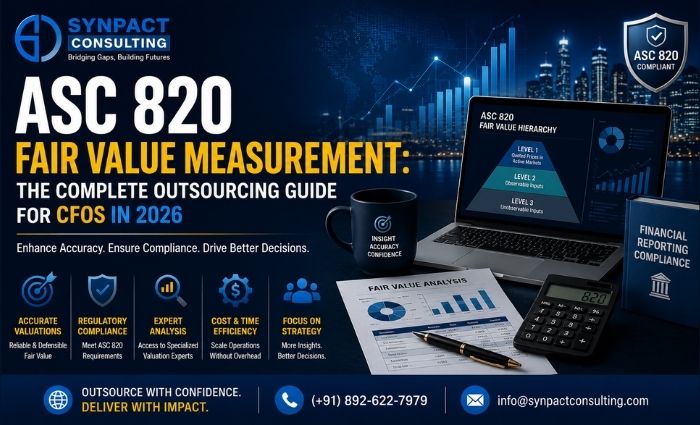
The standard organizes inputs into three levels based on observability:
| Level | Input type | Example assets | Outsourcing complexity |
|---|---|---|---|
| Level 1 | Quoted prices in active markets for identical assets | Publicly traded stocks, ETFs | Low — market price observable |
| Level 2 | Observable inputs other than Level 1 prices | Corporate bonds, interest rate swaps, similar company transactions | Medium — model-based with market inputs |
| Level 3 | Unobservable inputs — significant management judgment | Private company equity, PE portfolio investments, complex derivatives, intangibles | High — full valuation model required |
The Level 3 work is where most outsourcing decisions are made. These assets cannot be valued by looking up a price — they require DCF models, option pricing (Black-Scholes, OPM), guideline public company analysis, and documented methodology. This is precisely the work that Synpact’s fair value measurement team handles for US clients on a white-label basis.
Where ASC 820 intersects with other standards
ASC 820 does not exist in isolation. It is triggered by multiple other standards that require fair value measurement:
- ASC 805 — Business combinations require acquired assets and liabilities to be measured at fair value. See our guide on purchase price allocation (PPA) and the ASC 805 12-month deadline.
- ASC 350 — Goodwill and intangible impairment testing requires fair value comparison. Read our ASC 350 impairment guide for 2026.
- ASC 718 — Stock-based compensation (ESOPs, options) requires fair value of equity instruments. Synpact covers this under stock-based compensation valuation.
- ASC 815 — Derivatives and hedging instruments must be measured at fair value each reporting period.
- PE/VC fund reporting — Limited partners expect AICPA-compliant portfolio valuations quarterly. Synpact’s PE and fund NAV valuation service handles this directly.
Why CFOs are outsourcing ASC 820 work in 2026
The case for outsourcing fair value measurement has strengthened significantly over the past two years. Three forces are driving it:
1. Auditor scrutiny is at an all-time high
PCAOB inspection reports in 2024 and 2025 repeatedly flagged fair value measurement as a top deficiency area. Auditors are now requiring more detailed documentation of valuation techniques, sensitivity analyses, and independence. An in-house estimate with limited documentation no longer passes. A third-party report with a signed opinion letter does.
2. Geopolitical volatility has made Level 3 harder
With oil above $100, tariff regimes shifting quarterly, and discount rates at multi-decade highs, the assumptions underlying Level 3 valuations change materially between quarters. What worked as a methodology in Q1 may need a complete rebuild by Q3. Firms that outsource get a fresh analytical view each period — not a rubber-stamped rollforward. See how geopolitical risk premiums are affecting DCF assumptions in 2026.
3. The cost math no longer works for in-house
A senior valuation analyst in a US metro: $150,000–$220,000 salary plus benefits. They work on ASC 820 maybe 30–40% of their time. The rest is overhead. Outsourcing to Synpact gives you a full senior analyst team for the engagements you actually need — at 60–70% of in-house cost. The economics of valuation outsourcing are simply not comparable anymore.
What ASC 820 outsourcing actually covers
When a US CFO or CPA firm outsources ASC 820 work to Synpact, here is what is included in a standard engagement:
| Deliverable | Included | Notes |
|---|---|---|
| Level classification memo (L1/L2/L3 determination) | ✓ Always | Required for audit disclosure |
| Valuation model (DCF, market comps, OPM/PWERM) | ✓ Always | Approach selected based on asset type |
| Sensitivity analysis on key inputs | ✓ Always | Required for L3 disclosure |
| Signed valuation opinion letter | ✓ Always | Analyst credentials disclosed |
| Audit support documentation package | ✓ Always | Formatted for auditor review |
| White-label formatting (your firm’s letterhead) | ✓ Available | Full NDA and confidentiality |
| Quarterly rollforward and update | ✓ Available | Reduced fee for repeat engagements |
| ASC 820 disclosure language for footnotes | ✓ Available | Draft language for your auditor to review |
Who uses Synpact for ASC 820 outsourcing?
CPA firms and audit support practices
The most common use case: a CPA firm’s client has PE-backed equity on the balance sheet or acquired intangibles from an acquisition. The firm needs an independent ASC 820 valuation to support the audit. They cannot do it in-house without a credentialed valuation specialist. Synpact delivers the report under NDA — the CPA firm presents it under their engagement. This is classic white-label valuation outsourcing.
PE and VC fund managers
Funds with portfolio companies must value their holdings quarterly for LP reporting. Under ILPA standards and AICPA guidance, Level 3 assets require independent support. Synpact’s PE fund NAV valuation team handles quarterly portfolio valuations — often within 5–7 business days of receiving updated financials. For PE-related due diligence, see our PE due diligence and valuation service.
Corporate CFOs at PE-backed companies
If your company is PE-backed or recently went through an acquisition, you likely have ASC 820 obligations you didn’t have before — contingent consideration, earnouts, warrant liabilities, or complex debt instruments. These all require quarterly fair value marks. Synpact handles each of these under our debt and derivatives valuation practice.
Investment banks supporting M&A transactions
When a transaction closes, the acquiring entity’s finance team often needs support building the fair value measurement framework for Day 1 accounting. Synpact works alongside investment banking teams to deliver the ASC 820 and ASC 805 inputs on deal timelines — not standard 3-week turnarounds.
The outsourcing process — what to expect
Standard ASC 820 engagement timeline (Synpact)
- Day 1: Intake form submitted — asset description, financials, prior valuation (if any), reporting period, auditor name
- Day 1–2: Analyst assigned, methodology confirmed, data gaps flagged
- Day 2–5: Valuation model built — comps pulled, DCF or OPM constructed, sensitivity table prepared
- Day 5–6: Senior partner QC review — methodology, assumptions, disclosure language
- Day 6–7: Final report delivered — PDF + editable model + opinion letter
- Post-delivery: Auditor query support included at no additional charge
For rush engagements — audit deadlines, quarter-end crunch, deal closings — see our dedicated guide on 48-hour rush valuation turnaround.
In-house vs outsourced ASC 820: the honest comparison
| Factor | In-house team | Outsourced to Synpact |
|---|---|---|
| Cost (annual, single analyst) | $150K–$220K + benefits | Pay per engagement — 60–70% lower |
| Auditor independence | Management estimate — scrutinized | Third-party opinion — cleaner audit |
| Methodology depth (L3) | Varies by analyst skill | CFA/ASA credentialed team, consistent |
| Scalability (quarter-end surge) | Fixed headcount — bottleneck | Dedicated rush queue available |
| White-label delivery | N/A | Full NDA, your firm’s branding |
| Auditor query support | In-house time cost | Included post-delivery |
| Setup time | 3–6 months to hire + onboard | First report in 7 business days |
Frequently asked questions — ASC 820 outsourcing
Can a third-party valuation firm provide ASC 820 reports that my auditors will accept?
Yes — in fact, auditors generally prefer third-party reports for Level 3 fair value measurements because they provide an independent basis for the measurement rather than a management estimate. The key requirements are that the firm has credentialed analysts (CFA, ASA, or CPA with valuation specialization), uses documented methodology aligned with ASC 820’s hierarchy, and provides a signed opinion letter. Synpact meets all three. Our reports are accepted by Big 4, regional, and national audit firms across the US.
What is the difference between ASC 820 and a 409A valuation?
A 409A valuation determines the fair market value of a private company’s common stock for the purpose of setting employee stock option strike prices under IRC Section 409A — it is a tax compliance requirement. ASC 820 is a financial reporting standard that governs how fair value is measured and disclosed in GAAP financial statements. They use similar valuation techniques but serve different purposes: 409A is for IRS compliance, ASC 820 is for financial statement reporting. A company can need both simultaneously, and they may produce different values because they use different standards of value and measurement dates.
How often do PE funds need ASC 820 valuations?
Most PE and VC funds with institutional limited partners need ASC 820-compliant portfolio valuations quarterly — aligned with their quarterly LP reporting cycle. Some funds with less active LP bases do it semi-annually or annually. The AICPA’s guidance for investment companies (ASC 946) effectively requires Level 3 portfolio investments to be valued at fair value for each reporting period. Synpact’s PE fund NAV valuation team handles quarterly rolling engagements with reduced fees for repeat periods.
What data do you need from us to start an ASC 820 engagement?
The minimum data we need to begin: (1) description of the asset or liability being measured, (2) the company’s or fund’s most recent financial statements (last 2–3 years if available), (3) the measurement date and reporting period, (4) any prior valuation report or management estimate, (5) the name of the auditing firm so we can tailor the documentation to their requirements, and (6) any known material events since the last measurement date. For portfolio company valuations, we also need the original investment terms and cap table. We send a structured intake checklist on engagement confirmation.
Will my client or auditor know you did the work?
Only if you want them to. Synpact operates on a fully white-label basis for CPA firms and advisory practices — the report is delivered under your firm’s letterhead, with your branding and contact details. We sign an NDA before any work begins and our analysts do not communicate directly with your clients. For CPA firms, the engagement is structured so that you remain the client-facing party throughout. See how this works in practice in our white-label valuation report walkthrough.
How does ASC 820 fair value measurement differ from IFRS 13?
ASC 820 (US GAAP) and IFRS 13 (international) are substantially converged — both define fair value as an exit price, use a three-level input hierarchy, and require similar disclosures. The practical differences are minor: IFRS 13 has slightly different disclosure requirements for Day 1 gains and losses and some differences in how the principal market is determined. For US companies with international operations, Synpact can produce reports that are compliant with both standards simultaneously. Our valuation services team has experience across ASC, IFRS, and Ind AS frameworks.
What is the typical cost of an outsourced ASC 820 engagement?
Cost depends on the complexity and level of the asset being measured. A straightforward Level 2 instrument (e.g., a corporate bond or interest rate swap) is significantly less than a complex Level 3 private equity portfolio company or a convertible note with embedded derivatives. Synpact’s fees are typically 60–70% below what a US-based valuation firm would charge for equivalent work, with no sacrifice in quality or defensibility. We provide upfront fixed-fee quotes on all engagements — no billing surprises. Contact us for a scoped quote within 24 hours.
Can you handle ASC 820 valuations for complex instruments — warrants, convertibles, earnouts?
Yes. Complex instruments are a core part of our practice. We use Black-Scholes, binomial lattice, Monte Carlo simulation, and scenario-weighted OPM models depending on the instrument structure. For warrant liabilities, convertible notes, and SAFE agreements, we produce quarterly marks with full sensitivity tables. For contingent consideration (earnouts) under ASC 805, we model probability-weighted scenarios. See our convertible debt and preferred equity valuation and warrants and option-linked securities service pages for details.
How to get started
Getting a scoped quote from Synpact takes less than 10 minutes. Here is what to have ready:
- Description of the asset or liability (type, issuer, reporting period)
- Most recent financial statements for the underlying entity
- Name of your auditing firm
- Measurement date and report delivery deadline
- Any prior valuation or management estimate
Before you choose a valuation outsourcing partner, read our 12-question evaluation guide. And if you are a CPA firm considering white-label valuation for the first time, our sample report walkthrough shows exactly what the deliverable looks like.
Get a scoped ASC 820 quote in 24 hours
Fixed fees. Signed NDA before work begins. Auditor-accepted opinion letter on every report.