
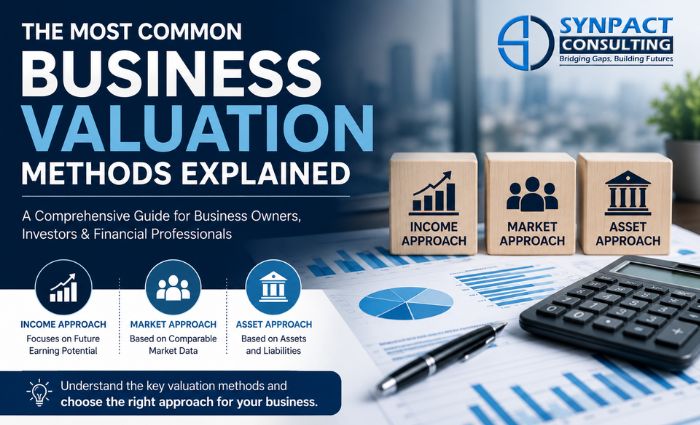
The Most Common Business Valuation Methods Explained
Determining the value of a business is rarely as simple as applying a standard formula or multiplying revenue by an industry benchmark. Every business has unique financial characteristics, growth prospects, operational risks, and market dynamics that influence its economic value. As a result, valuation professionals rely on a range of recognized methodologies rather than a single calculation.
Business valuation methods provide structured frameworks for estimating what a business is worth under specific circumstances. Whether the objective is preparing for a merger or acquisition, raising capital, complying with financial reporting requirements, planning an ownership transition, or resolving shareholder disputes, selecting the appropriate valuation method is essential to producing a reliable and defensible conclusion.
Different valuation methods answer different questions. Some focus on a company’s future earning potential, while others rely on market evidence from comparable businesses or assess the value of the company’s underlying assets. No single methodology is universally applicable, which is why experienced valuation professionals often evaluate multiple approaches before reaching a final opinion of value.
Understanding how these methods work helps business owners, investors, corporate finance teams, and advisors make more informed financial decisions while gaining greater confidence in the valuation process.
In this guide, we’ll explain the three primary business valuation approaches, discuss the most commonly used valuation methods within each approach, examine when each methodology is appropriate, and explore how professionals determine which method best reflects a company’s fair market value.
Why Business Valuation Methods Matter
Selecting the appropriate valuation method is just as important as calculating the value itself.
An inappropriate methodology can produce misleading results, affect transaction negotiations, create financial reporting issues, or increase the risk of disputes among stakeholders.
Professional valuation specialists consider several factors before selecting a valuation approach, including:
- The purpose of the valuation
- Industry characteristics
- Business size and complexity
- Historical financial performance
- Availability of market data
- Nature of the company’s assets
- Future growth expectations
- Risk profile
- Regulatory or reporting requirements
For example, a rapidly growing SaaS company with predictable recurring revenue may be best evaluated using an Income Approach, while a real estate holding company may be better suited to an Asset Approach.
Choosing the right methodology ensures that the valuation reflects the economic realities of the business rather than relying on assumptions that may not apply.
The Three Primary Business Valuation Approaches
Although numerous valuation techniques exist, they generally fall into three recognized categories:
1. Income Approach
The Income Approach estimates value based on the company’s expected future economic benefits.
Rather than focusing solely on historical performance, this approach evaluates the future cash flows or earnings the business is expected to generate and converts those future benefits into present value using an appropriate discount or capitalization rate.
This approach is widely used for:
- Profitable operating businesses
- High-growth companies
- Technology companies
- Professional service firms
- Healthcare organizations
- Manufacturing businesses
- Companies with predictable cash flows
Because investors purchase businesses for the returns they expect to receive in the future, the Income Approach is often considered one of the most economically meaningful valuation methodologies.
2. Market Approach
The Market Approach estimates value by comparing the subject company with similar businesses that have recently been sold or are publicly traded.
Rather than projecting future performance, this approach relies on observable market evidence.
Professionals analyze valuation multiples such as:
- Enterprise Value / EBITDA
- Enterprise Value / Revenue
- Price / Earnings
The challenge lies in identifying truly comparable businesses, as differences in size, profitability, growth, and risk can significantly affect valuation multiples.
3. Asset Approach
The Asset Approach determines value based on the fair market value of a company’s assets after deducting its liabilities.
Rather than emphasizing earnings or market transactions, this approach focuses on the company’s underlying economic resources.
It is commonly used for:
- Asset-intensive businesses
- Holding companies
- Real estate entities
- Investment companies
- Businesses facing liquidation
- Companies with inconsistent earnings
For certain businesses, particularly those whose value is primarily tied to tangible assets, the Asset Approach may provide the most reliable indication of value.
Why There Is No Universal Valuation Method
One of the most common questions business owners ask is:
“Which valuation method is the most accurate?”
The answer is that no single valuation method is universally superior.
Each methodology is designed to evaluate value from a different perspective, and the most appropriate approach depends on the specific facts and circumstances of the engagement.
For example:
- A profitable software company may be valued primarily using discounted cash flow analysis.
- A manufacturing company may require both Income and Market Approaches.
- A holding company with significant real estate investments may rely heavily on an Asset Approach.
Professional valuation is therefore not about finding the “best” method but about selecting the method—or combination of methods—that most accurately reflects the business’s economic reality.
When Professionals Use Multiple Valuation Methods
In many engagements, valuation specialists apply more than one methodology.
This allows them to:
- Cross-check valuation conclusions
- Evaluate the consistency of assumptions
- Assess the strengths and limitations of each approach
- Improve the reliability of the final conclusion
For example, a valuation may include:
- Discounted Cash Flow (Income Approach)
- Guideline Public Company Method (Market Approach)
- Adjusted Net Asset Method (Asset Approach)
Each method provides an independent indication of value, which professionals reconcile after evaluating the quality of the underlying data and assumptions.
This multi-method approach helps produce a more balanced and defensible valuation opinion.
What You’ll Learn in This Guide
Throughout this article, we’ll examine:
- The Income Approach and its most common valuation methods
- The Market Approach and how comparable company analysis works
- The Asset Approach and when asset-based valuation is appropriate
- The advantages and limitations of each methodology
- How valuation professionals decide which method to apply
- Common misconceptions about business valuation methods
- Practical examples illustrating how different methods produce different results
By the end of this guide, you’ll have a clearer understanding of how professional valuation specialists determine which methodology best reflects the value of a business and why selecting the right approach is critical to producing meaningful valuation conclusions.
The Income Approach to Business Valuation
Among all business valuation methods, the Income Approach is one of the most widely used and respected. It estimates the value of a business based on its ability to generate future economic benefits rather than relying solely on historical financial performance or asset values.
The underlying principle is straightforward:
A business is worth the present value of the future economic benefits it is expected to generate for its owners.
This reflects how investors typically evaluate acquisitions. They are not purchasing a company’s past performance—they are investing in its future cash flows, profitability, and long-term growth potential.
Because of this forward-looking perspective, the Income Approach is commonly applied in mergers and acquisitions, private equity transactions, financial reporting engagements, tax planning, and strategic decision-making.
How the Income Approach Works
The Income Approach follows a structured analytical process designed to convert expected future earnings into today’s value.
Although the calculations can become highly technical, the process generally involves the following steps:
Step 1: Understand the Business
Before building any valuation model, professionals develop a comprehensive understanding of the company by evaluating:
- Business model
- Products and services
- Industry position
- Customer relationships
- Competitive advantages
- Management team
- Revenue drivers
- Cost structure
- Growth opportunities
- Business risks
Understanding these factors helps determine whether future projections are realistic.
Step 2: Analyze Historical Financial Performance
Historical performance provides the foundation for future expectations.
Professionals review:
- Revenue trends
- Gross margins
- EBITDA
- Operating income
- Free cash flow
- Capital expenditures
- Working capital
- Debt levels
Historical consistency often improves confidence in future projections.
Step 3: Develop Financial Forecasts
Future projections generally include:
- Revenue growth
- Operating expenses
- EBITDA
- Taxes
- Capital expenditures
- Working capital requirements
- Free Cash Flow
The quality of these forecasts significantly influences valuation reliability.
Professionals typically challenge management assumptions to ensure projections remain realistic and supportable.
Step 4: Estimate Risk
Future earnings involve uncertainty.
Accordingly, valuation professionals estimate the level of investment risk associated with achieving projected cash flows.
Risk considerations include:
- Industry volatility
- Customer concentration
- Competition
- Economic conditions
- Interest rates
- Management dependence
- Financial leverage
- Company size
Higher perceived risk generally results in lower valuation.
Step 5: Convert Future Benefits into Present Value
Because money expected in the future is worth less than money available today, future cash flows are discounted to present value.
This process reflects:
- Time value of money
- Investment risk
- Opportunity cost
- Expected investor returns
The resulting figure represents today’s estimated value of future economic benefits.
Common Income Approach Methods
Although several techniques exist within the Income Approach, two methods are most frequently used in professional valuation engagements.
1. Discounted Cash Flow (DCF) Method
The Discounted Cash Flow (DCF) method is considered one of the most comprehensive valuation techniques because it focuses directly on the future cash-generating ability of the business.
Rather than relying on historical multiples, DCF estimates value by:
- Forecasting future free cash flows
- Estimating a terminal value
- Selecting an appropriate discount rate
- Converting future cash flows into present value
Because DCF evaluates expected future performance, it is particularly useful for businesses experiencing growth, expansion, or changing financial conditions.
When DCF Is Most Appropriate
The DCF method is commonly used when:
- Reliable financial forecasts are available
- Future growth is expected
- Cash flows are relatively predictable
- Long-term planning is possible
- Management has credible business plans
Industries frequently using DCF include:
- Technology
- Healthcare
- Manufacturing
- Professional Services
- Renewable Energy
- Consumer Products
Advantages of DCF
- Focuses on future performance
- Company-specific analysis
- Flexible assumptions
- Widely accepted by investors
- Appropriate for high-growth businesses
Limitations of DCF
DCF is powerful—but highly dependent on assumptions.
Small changes in:
- Revenue growth
- Discount rate
- Profit margins
- Terminal growth
can materially affect valuation conclusions.
For this reason, experienced professionals perform sensitivity analyses to understand how different assumptions influence value.
2. Capitalization of Earnings Method
The Capitalization of Earnings Method estimates business value by converting a representative level of maintainable earnings into value using a capitalization rate.
Unlike DCF, which projects multiple future years, this method assumes the business will continue generating relatively stable earnings over time.
It is often appropriate for mature businesses with predictable financial performance.
Typical Applications
This method is commonly used for:
- Family-owned businesses
- Professional practices
- Distribution companies
- Established manufacturers
- Stable service businesses
Advantages
- Simpler than DCF
- Less dependent on long-term forecasts
- Effective for mature businesses
- Easier to explain to stakeholders
Limitations
- Less suitable for rapidly growing businesses
- Assumes stable future earnings
- Sensitive to capitalization rate selection
3. Capitalization of Cash Flow Method
Closely related to the Capitalization of Earnings Method, the Capitalization of Cash Flow Method focuses on sustainable cash flow rather than accounting earnings.
Many investors consider cash flow a better indicator of value because it reflects the actual funds available to owners after operating requirements.
This method is appropriate when:
- Cash flows are stable
- Growth expectations are modest
- Historical performance is consistent
Professionals carefully normalize financial statements before applying this methodology to ensure cash flow reflects ongoing operations rather than unusual or one-time events.
Why the Discount Rate Matters
One of the most critical components of the Income Approach is the discount rate.
The discount rate reflects the return an investor expects after considering the risks associated with the business.
A company operating in a highly competitive or volatile industry typically requires a higher discount rate than a mature business with predictable earnings.
Factors influencing the discount rate include:
- Company size
- Industry risk
- Financial leverage
- Customer concentration
- Economic outlook
- Management quality
- Market conditions
Even small adjustments to the discount rate can significantly impact the final valuation, which is why its selection requires careful analysis and professional judgment.
Real-World Example
Imagine two software companies with identical annual revenue of $10 million.
Company A
- 25% annual revenue growth
- Strong recurring subscription income
- Diversified customer base
- Experienced management
- Low debt
Company B
- Flat revenue growth
- Project-based income
- Heavy reliance on three customers
- High debt
- Owner-dependent operations
Although current revenue is the same, Company A would generally receive a higher valuation under the Income Approach because its future cash flows are expected to be stronger and less risky.
This example demonstrates why valuation professionals focus on future earning potential, not just current financial results.
Key Takeaway
The Income Approach values a business based on the economic benefits it is expected to generate in the future. Whether using Discounted Cash Flow, Capitalization of Earnings, or Capitalization of Cash Flow, the objective is the same: estimate the present value of future returns while accounting for the risks associated with achieving them.
For businesses with predictable operations, sustainable profitability, and credible growth prospects, the Income Approach often provides one of the most meaningful indications of value.
The Market Approach to Business Valuation
While the Income Approach estimates value based on a company’s future earning potential, the Market Approach determines value by comparing the subject business to similar companies that have either been sold in private transactions or are publicly traded.
The concept is based on a simple economic principle:
If comparable businesses are selling for certain valuation multiples, a similar business should generally trade within a comparable range after adjusting for differences in size, growth, profitability, and risk.
For this reason, the Market Approach is widely used in mergers and acquisitions, private equity transactions, fairness opinions, tax engagements, financial reporting, and strategic planning.
However, one of the biggest misconceptions is that professionals simply search for an industry multiple and multiply it by EBITDA or revenue. In reality, selecting appropriate comparables requires detailed financial analysis and significant professional judgment.
How the Market Approach Works
The Market Approach follows a structured process designed to compare the subject company with businesses that share similar economic characteristics.
A typical engagement involves:
Step 1: Understanding the Business
Before selecting comparables, valuation professionals evaluate:
- Industry sector
- Business model
- Products and services
- Customer profile
- Geographic markets
- Competitive positioning
- Revenue sources
- Profitability
- Capital structure
- Growth strategy
Only after understanding these characteristics can meaningful comparisons be made.
Step 2: Identifying Comparable Companies
Finding comparable companies is often the most challenging part of the Market Approach.
Professionals rarely select companies based solely on industry classification.
Instead, they evaluate factors such as:
- Annual revenue
- EBITDA
- Operating margins
- Growth rate
- Customer concentration
- Market share
- Geographic footprint
- Product mix
- Capital intensity
- Risk profile
The closer the similarities, the more reliable the comparison.
Step 3: Analyzing Market Data
Depending on the engagement, professionals may analyze:
- Public company trading multiples
- Recent merger and acquisition transactions
- Industry acquisition databases
- Private transaction data
- Capital market trends
These data sources provide insight into how investors are pricing businesses with similar characteristics.
The Guideline Public Company Method (GPCM)
One of the most widely recognized techniques within the Market Approach is the Guideline Public Company Method (GPCM).
Under this method, valuation professionals compare the subject company to publicly traded businesses operating in the same or similar industries.
Because public companies disclose detailed financial information, they provide a valuable source of market evidence.
Common valuation multiples include:
- Enterprise Value / EBITDA
- Enterprise Value / EBIT
- Enterprise Value / Revenue
- Price / Earnings (P/E)
These multiples serve as reference points rather than definitive valuation answers.
Professionals must adjust for differences between public companies and privately held businesses before applying these multiples.
Advantages of GPCM
- Based on observable market data
- Reflects current investor sentiment
- Widely accepted in valuation practice
- Useful across many industries
Limitations of GPCM
Public companies are often:
- Larger
- More diversified
- Better capitalized
- More liquid
- Subject to greater regulatory oversight
Private businesses typically require adjustments for:
- Size
- Liquidity
- Marketability
- Operational risk
- Customer concentration
Applying public company multiples without appropriate adjustments can significantly overstate value.
The Guideline Transaction Method (GTM)
Another important Market Approach technique is the Guideline Transaction Method, which analyzes actual acquisition transactions involving similar businesses.
Unlike GPCM, which examines companies currently trading in public markets, GTM evaluates businesses that have already been bought or sold.
Transaction data often reflects:
- Acquisition premiums
- Strategic buyer considerations
- Control value
- Market conditions at the time of sale
Because acquisitions typically involve transferring control of a business, transaction multiples may differ from public trading multiples.
Typical Sources
Professionals analyze:
- Private acquisition databases
- M&A transaction reports
- Industry transaction publications
- Investment banking research
- Market intelligence platforms
This information helps estimate what informed buyers have recently paid for comparable businesses.
Comparable Company Analysis (CCA)
Comparable Company Analysis (CCA) is one of the most frequently used techniques within investment banking, private equity, and corporate finance.
Its objective is to determine how similar companies are valued by the market.
The process generally includes:
- Selecting comparable companies
- Collecting financial data
- Calculating valuation multiples
- Adjusting for differences
- Applying appropriate multiples to the subject company
Although the concept appears straightforward, identifying truly comparable businesses requires extensive research and professional judgment.
Understanding Valuation Multiples
Valuation multiples simplify comparisons between businesses by expressing value relative to a financial metric.
Some of the most common multiples include:
Enterprise Value / EBITDA
Perhaps the most widely used multiple in M&A transactions.
EBITDA serves as a proxy for operating performance before financing and accounting decisions.
This multiple is especially useful for:
- Manufacturing
- Healthcare
- Distribution
- Business services
- Industrial companies
Enterprise Value / Revenue
Revenue multiples are often used when profitability is limited or inconsistent.
Examples include:
- High-growth SaaS companies
- Early-stage technology businesses
- Venture-backed startups
- Digital platforms
Revenue alone does not determine value, but it can provide useful benchmarks when supported by strong growth prospects.
Price / Earnings (P/E)
Frequently applied to publicly traded companies, the P/E ratio compares equity value to net earnings.
Although widely recognized by investors, P/E multiples are generally less common in private company valuation because capital structures and tax strategies can vary significantly.
Selecting Truly Comparable Companies
This is where valuation professionals add significant value.
Two companies may operate in the same industry while having vastly different economic characteristics.
Professionals evaluate:
Financial Characteristics
- Revenue
- EBITDA margins
- Profitability
- Growth rate
- Cash flow
- Capital expenditures
Operational Characteristics
- Products
- Services
- Customer base
- Geographic reach
- Market share
- Technology
Risk Characteristics
- Customer concentration
- Supplier dependence
- Management depth
- Financial leverage
- Competitive position
- Regulatory exposure
The objective is to compare businesses that investors would realistically consider similar—not merely businesses that share the same industry code.
Common Mistakes When Using Market Multiples
Business owners frequently misunderstand how valuation multiples should be applied.
Common mistakes include:
Using Average Industry Multiples
Industry averages rarely reflect the unique characteristics of a specific business.
Ignoring Profitability
Two companies with identical revenue may deserve completely different valuation multiples because of differences in EBITDA margins.
Ignoring Growth
Businesses growing at 20% annually generally receive higher valuation multiples than businesses with stagnant revenue.
Ignoring Risk
Customer concentration, management dependence, litigation, or financial leverage can significantly reduce valuation.
Comparing Public Companies Directly with Private Businesses
Public companies benefit from greater liquidity and access to capital.
Private companies generally require appropriate valuation adjustments before public market multiples can be applied.
Real-World Example
Imagine two industrial equipment distributors.
| Metric | Company Alpha | Company Beta |
|---|---|---|
| Revenue | $50 Million | $50 Million |
| EBITDA Margin | 21% | 10% |
| Revenue Growth | 18% | 4% |
| Customer Base | Highly Diversified | Top 3 Customers = 70% |
| Debt | Low | High |
Although both companies generate identical revenue, Company Alpha would likely command a higher EBITDA multiple because it offers stronger profitability, better growth prospects, lower customer concentration, and lower financial risk.
This illustrates why valuation professionals analyze the quality of earnings—not just the size of the business.
Key Takeaway
The Market Approach estimates value by comparing a business with similar companies that have been sold or are publicly traded. However, reliable valuations require much more than applying a standard industry multiple.
Experienced valuation professionals evaluate financial performance, operational characteristics, growth prospects, and business-specific risks before selecting comparable companies and applying valuation multiples. When performed correctly, the Market Approach provides valuable insight into how the market currently prices businesses with similar economic characteristics.
The Asset Approach to Business Valuation
Unlike the Income Approach, which focuses on future earning potential, or the Market Approach, which relies on comparable transactions, the Asset Approach determines value by analyzing what a business owns and what it owes.
The underlying principle is straightforward:
The value of a business is equal to the fair market value of its assets minus the fair market value of its liabilities.
This methodology is particularly useful when a company’s value is primarily derived from its tangible or identifiable assets rather than its future earnings.
Although the Asset Approach is not appropriate for every business, it plays an important role in many valuation engagements involving holding companies, asset-intensive businesses, financial reporting, and liquidation scenarios.
How the Asset Approach Works
The Asset Approach begins with identifying all assets and liabilities recorded on the company’s balance sheet.
However, professional valuation does not simply rely on book values reported in the financial statements.
Instead, valuation specialists determine the fair market value of each significant asset and liability as of the valuation date.
The process generally includes:
Step 1: Identify Business Assets
Professionals review both tangible and intangible assets, including:
Tangible Assets
- Cash and cash equivalents
- Accounts receivable
- Inventory
- Land
- Buildings
- Machinery and equipment
- Vehicles
- Furniture and fixtures
- Investments
Intangible Assets
Many businesses derive substantial value from intangible assets that may not be fully reflected on the balance sheet.
Examples include:
- Customer relationships
- Trade names
- Trademarks
- Patents
- Proprietary technology
- Software
- Copyrights
- Non-compete agreements
- Licenses
- Brand recognition
Accurately identifying and valuing these assets is an important component of many valuation engagements.
Step 2: Identify Liabilities
Professionals also analyze all outstanding obligations, including:
- Accounts payable
- Bank loans
- Lines of credit
- Lease obligations
- Deferred tax liabilities
- Accrued expenses
- Employee benefit obligations
- Contingent liabilities
Only after adjusting both assets and liabilities to fair market value can the business’s net asset value be determined.
Net Asset Value (NAV) Method
One of the most common techniques within the Asset Approach is the Net Asset Value (NAV) Method.
This method estimates business value by calculating:
Fair Market Value of Assets – Fair Market Value of Liabilities = Net Asset Value
Unlike book value, NAV reflects the current economic value of the company’s assets rather than historical accounting costs.
For example:
A manufacturing facility purchased ten years ago may have a book value of $2 million, while its current market value could be $4.8 million.
Similarly, certain equipment may have depreciated significantly for accounting purposes while retaining substantial market value.
These adjustments help produce a more realistic estimate of business value.
Adjusted Net Asset Method
The Adjusted Net Asset Method expands upon the basic NAV approach by adjusting all significant assets and liabilities to their estimated fair market values.
Typical adjustments include:
Asset Adjustments
- Real estate revaluation
- Equipment appraisal
- Inventory write-downs
- Customer relationship valuation
- Intellectual property valuation
- Investment portfolio adjustments
Liability Adjustments
- Contingent liabilities
- Environmental obligations
- Pending litigation
- Deferred compensation
- Warranty obligations
Because these adjustments better reflect economic reality, the Adjusted Net Asset Method is often considered more reliable than relying solely on accounting book values.
Book Value vs. Fair Market Value
Many business owners mistakenly assume that the value shown on the balance sheet represents the value of the business.
In reality, book value and fair market value often differ significantly.
Book Value
Book value reflects historical accounting records after depreciation, amortization, and other accounting adjustments.
It is primarily designed for financial reporting rather than estimating market value.
Fair Market Value
Fair market value reflects what knowledgeable buyers and sellers would reasonably agree upon under current market conditions.
Professional valuation adjusts assets and liabilities to reflect this economic reality.
As a result, the Asset Approach generally relies on fair market value—not accounting book value.
Liquidation Value
Another important concept within the Asset Approach is Liquidation Value.
Rather than assuming the business will continue operating, liquidation value estimates what could reasonably be recovered if the company’s assets were sold.
There are two common forms:
Orderly Liquidation
Assets are sold over a reasonable period, allowing management time to maximize proceeds.
Forced Liquidation
Assets must be sold immediately, often resulting in significantly lower prices.
Liquidation value is commonly considered in:
- Bankruptcy proceedings
- Business closures
- Creditor negotiations
- Insolvency analysis
- Distressed transactions
Because liquidation assumes a different economic scenario than an ongoing business, it frequently produces lower valuation conclusions than the Income or Market Approaches.
When Is the Asset Approach Most Appropriate?
Although the Asset Approach is valuable, it is not universally applicable.
Professionals typically consider it appropriate for:
Holding Companies
Organizations primarily owning investments or real estate rather than operating businesses.
Real Estate Companies
Where property values represent the majority of enterprise value.
Manufacturing Businesses
Especially those with significant investments in machinery, facilities, and equipment.
Investment Companies
Whose value is closely tied to financial assets.
Capital-Intensive Businesses
Such as utilities, transportation companies, or heavy industrial operations.
Distressed Businesses
Where future earnings are uncertain and asset recovery becomes more relevant.
Advantages of the Asset Approach
The Asset Approach offers several important benefits:
- Based on identifiable assets and liabilities
- Particularly useful for asset-intensive businesses
- Appropriate for liquidation scenarios
- Less dependent on long-term financial forecasts
- Helpful when earnings are inconsistent
For businesses whose value is closely tied to tangible assets, this methodology can provide a meaningful indication of value.
Limitations of the Asset Approach
Despite its strengths, the Asset Approach also has limitations.
It may undervalue businesses that generate significant earnings through intangible factors such as:
- Strong customer relationships
- Brand reputation
- Proprietary technology
- Skilled workforce
- Intellectual capital
- Future growth opportunities
For example, a successful software company with relatively few tangible assets may derive most of its value from future cash flows rather than its balance sheet.
In such cases, the Income Approach often provides a more representative indication of value.
Practical Example
Consider two companies with identical net assets of $8 million.
Company Alpha
- Owns commercial real estate
- Large equipment portfolio
- Stable asset values
- Limited growth expectations
Company Beta
- Cloud-based software company
- Minimal tangible assets
- Strong recurring revenue
- High projected growth
Although both companies report similar net assets, Company Beta would likely receive a significantly higher valuation under the Income Approach because investors are primarily purchasing its future earning potential rather than its physical assets.
This illustrates why selecting the appropriate valuation methodology depends on the economic characteristics of the business—not simply the figures reported on the balance sheet.
Key Takeaway
The Asset Approach provides an effective framework for valuing businesses whose economic value is closely tied to their assets. By adjusting assets and liabilities to fair market value, professionals can estimate a company’s net asset value and assess its worth under various scenarios, including ongoing operations and liquidation.
However, because many modern businesses derive value from future earnings, intellectual property, and customer relationships, valuation specialists often consider the Asset Approach alongside the Income and Market Approaches before reaching a final conclusion.
How Valuation Professionals Choose the Right Business Valuation Method
One of the most common questions business owners ask is:
“Which business valuation method should I use?”
The answer is that there is rarely a single “correct” method.
Professional valuation specialists evaluate the purpose of the engagement, the characteristics of the business, the availability of financial information, and the reliability of market data before selecting the most appropriate methodology.
Rather than applying the same approach to every company, professionals tailor their analysis to the facts and circumstances of each engagement.
For example:
| Business Type | Preferred Valuation Approach |
|---|---|
| SaaS Company | Income Approach |
| Manufacturing Business | Income + Market Approach |
| Real Estate Holding Company | Asset Approach |
| Investment Holding Company | Asset Approach |
| Healthcare Practice | Income + Market Approach |
| Family-Owned Business | Income + Market Approach |
| Distressed Company | Asset Approach + Liquidation Analysis |
The objective is to select the methodology that most accurately reflects the company’s economic value—not simply the easiest method to calculate.
Why Professionals Often Use Multiple Valuation Methods
In many valuation engagements, more than one valuation method is applied.
This provides several benefits:
- Cross-checks valuation conclusions
- Improves reliability
- Reduces dependence on a single assumption
- Highlights differences between approaches
- Provides greater confidence to stakeholders
For example:
| Valuation Method | Indicated Value |
|---|---|
| Discounted Cash Flow | $18.7 Million |
| Guideline Public Company Method | $19.4 Million |
| Adjusted Net Asset Method | $16.2 Million |
Rather than averaging these figures, valuation professionals evaluate:
- Reliability of financial projections
- Availability of market evidence
- Nature of the business
- Asset intensity
- Future growth expectations
- Quality of comparable companies
This process is known as reconciliation and requires professional judgment.
Real-World Case Study
Consider a privately owned engineering consulting firm with the following profile:
Financial Overview
- Annual Revenue: $22 million
- EBITDA Margin: 24%
- Revenue Growth: 14%
- Long-term client contracts
- Minimal debt
- Strong management team
- Limited tangible assets
Income Approach
The Discounted Cash Flow method indicates a value of $30.8 million, reflecting the firm’s strong projected cash flows and recurring client relationships.
Market Approach
Comparable consulting firms suggest a value of $29.6 million, based on observed EBITDA multiples in recent transactions.
Asset Approach
The Adjusted Net Asset Method produces a value of $12.5 million, reflecting the firm’s relatively limited tangible assets.
Professional Conclusion
Because the company’s value is driven primarily by future earnings, client relationships, and intellectual capital—not physical assets—the valuation specialist places greater weight on the Income and Market Approaches.
This example demonstrates why different methodologies can produce different indications of value and why professional judgment is essential when reconciling valuation results.
Common Misconceptions About Business Valuation Methods
Understanding what valuation methods cannot do is just as important as understanding what they can.
Misconception #1: There Is One Correct Formula
There is no universal formula that applies to every business. The appropriate methodology depends on the company’s industry, financial profile, assets, growth prospects, and the purpose of the valuation.
Misconception #2: Revenue Determines Business Value
Revenue is only one component of valuation.
Investors also evaluate:
- Profitability
- Cash flow
- Growth potential
- Competitive advantages
- Customer concentration
- Operational risk
Misconception #3: Industry Multiples Always Produce Accurate Results
Industry averages provide a useful starting point but should never replace a detailed valuation.
Even companies operating in the same industry can justify materially different valuation multiples.
Misconception #4: Book Value Equals Business Value
Financial statements record assets based on accounting rules, whereas valuation estimates economic value under current market conditions.
These values often differ significantly.
Misconception #5: Online Valuation Calculators Replace Professional Analysis
Online calculators rely on generalized assumptions and limited inputs.
Professional valuation involves detailed financial analysis, market research, normalization adjustments, risk assessment, and informed professional judgment—elements that generic tools cannot fully capture.
Expert Insight
Valuation Is Both Financial Analysis and Professional Judgment
Business valuation combines quantitative analysis with qualitative assessment.
Financial models provide a framework, but experienced valuation professionals also evaluate:
- Business strategy
- Industry dynamics
- Competitive positioning
- Customer quality
- Management capability
- Economic conditions
- Transaction purpose
These factors influence both methodology selection and the interpretation of valuation results.
A technically sound valuation explains why a conclusion was reached—not simply what the conclusion is.
How Synpact Consulting Can Help
Selecting the right valuation methodology is critical to producing a credible and defensible valuation conclusion. At Synpact Consulting, our valuation professionals evaluate each engagement based on its purpose, the company’s financial characteristics, industry dynamics, and applicable valuation standards before determining the most appropriate approach.
Our valuation services support:
- Business Owners
- CPA Firms
- Investment Banks
- Private Equity Firms
- Corporate Finance Teams
- Financial Advisory Firms
Our capabilities include:
- Business Valuation
- 409A Valuation
- Purchase Price Allocation (ASC 805)
- Fair Value Measurement (ASC 820)
- Goodwill Impairment Testing (ASC 350)
- Financial Modeling
Whether you are preparing for a merger or acquisition, raising capital, meeting financial reporting requirements, or planning a shareholder transaction, our team delivers objective, technically rigorous valuation analyses that support informed decision-making.
Need Guidance on the Right Valuation Method?
If you’re unsure which valuation methodology is appropriate for your business or transaction, Synpact Consulting can help you evaluate the available approaches and determine the one that best aligns with your objectives.
Frequently Asked Questions (FAQs)
1. What are the three main business valuation approaches?
The three primary approaches are the Income Approach, Market Approach, and Asset Approach. Each estimates value from a different perspective and may be used individually or together depending on the engagement.
2. Which valuation method is the most accurate?
There is no universally most accurate method. The appropriate methodology depends on the nature of the business, the purpose of the valuation, and the quality of available financial and market data.
3. Why do valuation professionals use more than one method?
Using multiple methods allows professionals to compare results, assess consistency, and develop a more reliable valuation conclusion.
4. What is the Difference Between the Income and Market Approaches?
The Income Approach values a business based on expected future cash flows, while the Market Approach estimates value by comparing the business with similar companies that have been sold or are publicly traded.
5. When is the Asset Approach most appropriate?
The Asset Approach is commonly used for holding companies, real estate entities, investment companies, capital-intensive businesses, and liquidation scenarios.
6. What is Discounted Cash Flow (DCF)?
DCF is an Income Approach method that estimates business value by projecting future cash flows and discounting them to present value using an appropriate discount rate.
7. What are valuation multiples?
Valuation multiples compare business value to financial metrics such as EBITDA, revenue, or earnings to estimate value based on market evidence.
8. Why isn’t book value the same as business value?
Book value reflects historical accounting records, while business valuation estimates current economic value under market conditions.
9. Can two businesses with the same revenue have different values?
Yes. Differences in profitability, growth, cash flow, customer concentration, and risk can result in significantly different valuations.
10. How often should a business be valued?
Businesses often obtain valuations before significant events such as acquisitions, fundraising, shareholder transactions, succession planning, financial reporting, or tax planning. Some organizations also update valuations periodically to support strategic decision-making.
Conclusion
Business valuation is not about selecting a single formula—it is about applying the methodology that best reflects the economic reality of the business. The Income, Market, and Asset Approaches each provide valuable insights, but their usefulness depends on the company’s financial characteristics, industry, assets, growth prospects, and the purpose of the engagement.
Experienced valuation professionals evaluate multiple methodologies, assess the strengths and limitations of each, and reconcile the results to produce an objective and well-supported conclusion.
For business owners, investors, lenders, and corporate finance teams, understanding these valuation methods leads to better-informed decisions, stronger negotiations, and greater confidence in the valuation process.
Related Insight