
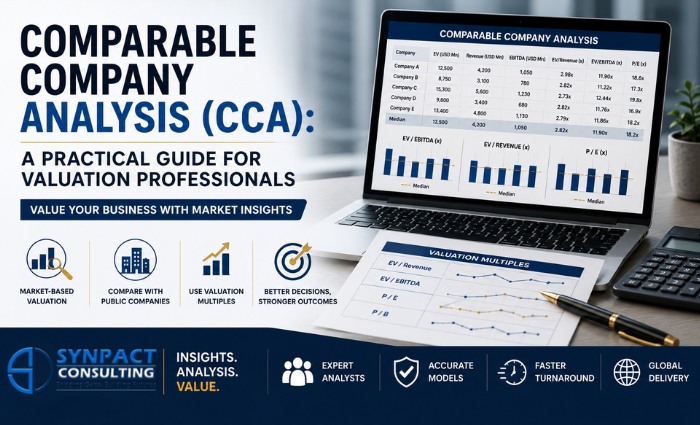
Comparable Company Analysis (CCA): A Practical Guide for Valuation Professionals
Valuation professionals use a variety of methodologies to determine the fair value of a business. Among the most widely used approaches is Comparable Company Analysis (CCA), a market-based valuation method that estimates a company’s value by comparing it with similar publicly traded businesses.
Whether supporting mergers and acquisitions, investment decisions, fairness opinions or strategic planning initiatives, CCA remains a fundamental tool for investment bankers, valuation consultants, private equity firms and corporate finance professionals.
Because financial markets continuously reflect investor expectations, CCA provides valuable insights into how the market values businesses within a particular industry.
In this guide, we explore how Comparable Company Analysis works, the key valuation multiples used, its advantages and limitations, and its role in modern valuation engagements.
What Is Comparable Company Analysis (CCA)?
Comparable Company Analysis is a valuation methodology that estimates the value of a company by analysing the market valuation of similar businesses.
The underlying assumption is straightforward:
Similar companies operating in similar industries should trade at similar valuation multiples.
By examining publicly traded peer companies, valuation professionals can derive valuation benchmarks and apply those benchmarks to the target company.
CCA is often referred to as:
- Trading Comps
- Public Company Comparables
- Comparable Company Valuation
- Market Multiple Valuation
It is one of the most commonly used market-based valuation approaches worldwide.
Why CCA Is Widely Used in Valuation
CCA is popular because it reflects current market conditions and investor sentiment.
Unlike purely theoretical valuation approaches, comparable company analysis uses actual market data.
Professionals frequently use CCA for:
- Business valuation
- Mergers and acquisitions
- IPO preparation
- Fairness opinions
- Strategic planning
- Capital raising
- Investor presentations
The methodology provides a practical market perspective that complements other valuation approaches such as DCF valuation.
How Comparable Company Analysis Works
The CCA process generally involves several structured steps.
Step 1: Understand the Target Company
Before selecting comparable businesses, analysts must fully understand the company being valued.
Key factors include:
- Industry
- Business model
- Revenue size
- Growth profile
- Profitability
- Geographic presence
- Customer base
- Capital structure
These characteristics help identify appropriate peer companies.
Step 2: Select Comparable Companies
Selecting the right peer group is one of the most important aspects of the analysis.
Analysts typically look for companies with similar:
- Industry focus
- Products and services
- Revenue levels
- Growth rates
- Margins
- Business risks
No two companies are identical, but selecting the closest possible peers improves valuation accuracy.
Step 3: Collect Financial Information
Analysts gather financial data from publicly available sources.
Common data points include:
- Revenue
- EBITDA
- Net income
- Enterprise value
- Market capitalisation
- Debt levels
- Cash balances
This information forms the foundation of the valuation analysis.
Step 4: Calculate Valuation Multiples
After gathering data, valuation multiples are calculated.
These multiples indicate how the market values comparable companies relative to their financial performance.
Understanding Valuation Multiples
Valuation multiples are the core output of Comparable Company Analysis.
Several multiples are commonly used.
EV / Revenue Multiple
The Enterprise Value to Revenue multiple compares total company value to annual revenue.
Formula:
This multiple is often used for:
- High-growth companies
- Early-stage businesses
- Technology companies
where profitability may not yet be fully established.
EV / EBITDA Multiple
The EV / EBITDA multiple is one of the most widely used valuation metrics.
Formula:
It is particularly useful because EBITDA approximates operating cash flow before financing and accounting decisions.
Investment bankers frequently rely on EV / EBITDA multiples when evaluating acquisitions.
Price-to-Earnings (P/E) Ratio
The P/E ratio compares share price to earnings per share.
Formula:
This metric is commonly used when evaluating mature public companies.
Price-to-Book (P/B) Ratio
The Price-to-Book ratio compares market value to book value.
Formula:
It is frequently used for:
- Financial institutions
- Asset-intensive businesses
- Banking organisations
Step 5: Apply Multiples to the Target Company
After establishing a range of market multiples, analysts apply those multiples to the target company’s financial metrics.
For example:
If comparable companies trade at:
8.0x EV / EBITDAand the target company generates:
$10 million EBITDAthen:
Estimated Enterprise Value = $80 millionAnalysts typically use multiple valuation ranges rather than a single figure.
Adjusting for Differences Between Companies
No two companies are identical.
Professionals often adjust their analysis to account for:
- Growth differences
- Profitability differences
- Geographic exposure
- Customer concentration
- Industry risk
- Market position
These adjustments improve the reliability of valuation conclusions.
Advantages of Comparable Company Analysis
CCA offers several important benefits.
Market-Based Valuation
CCA reflects actual investor behaviour and current market conditions.
Widely Accepted
The methodology is recognised and used globally by:
- Investment banks
- Private equity firms
- Valuation consultants
- Corporate finance teams
Easy to Communicate
Market multiples are often easier for clients and investors to understand than more complex valuation approaches.
Useful Benchmarking Tool
CCA provides valuable context for evaluating valuation reasonableness.
Limitations of Comparable Company Analysis
Although powerful, CCA has limitations.
Difficulty Finding Perfect Comparables
No two businesses are exactly alike.
Differences in strategy, geography and operations can affect valuation outcomes.
Market Volatility
Multiples can fluctuate based on market conditions.
This may distort valuation conclusions.
Short-Term Market Sentiment
Market pricing sometimes reflects temporary investor sentiment rather than long-term fundamentals.
Limited Insight Into Future Potential
CCA focuses on current market pricing rather than future cash flow generation.
This is why professionals often combine CCA with DCF valuation.
CCA vs DCF Valuation
Both methodologies are widely used.
Comparable Company Analysis
- Market-based
- Uses public company multiples
- Reflects current market sentiment
DCF Valuation
- Intrinsic valuation approach
- Based on future cash flows
- Focuses on long-term value creation
Most valuation professionals use both methods together to develop balanced valuation conclusions.
When Valuation Professionals Use CCA
CCA is commonly applied in:
Mergers and Acquisitions
Determining fair acquisition values.
Fairness Opinions
Supporting transaction decisions.
IPO Valuation
Assessing appropriate pricing ranges.
Strategic Planning
Evaluating business performance relative to peers.
Fundraising
Supporting investor discussions and negotiations.
How Technology Has Improved Comparable Company Analysis
Modern valuation professionals increasingly use advanced tools and databases to improve efficiency.
These tools help analysts:
- Screen peer companies
- Gather financial data
- Calculate valuation multiples
- Benchmark performance
- Monitor market activity
Many firms also leverage business valuation outsourcing and financial modelling outsourcing services to support large-scale valuation projects.
Why Global Firms Use Valuation Outsourcing Services
As valuation workloads increase, many organisations work with specialised valuation support providers.
Benefits include:
- Access to experienced analysts
- Improved scalability
- Faster turnaround times
- Cost efficiency
- Enhanced analytical support
Leading valuation outsourcing companies in India provide support for investment banks, CPA firms, advisory firms and private equity organisations worldwide.
Why Synpact Consulting
Synpact Consulting supports valuation professionals with:
- Comparable Company Analysis
- DCF Modelling
- Financial Modelling
- Business Valuation
- Transaction Advisory Support
- Portfolio Valuation
- Purchase Price Allocation
Our experienced professionals help clients deliver accurate, scalable and efficient valuation solutions.
Conclusion
Comparable Company Analysis remains one of the most important valuation methodologies used by financial professionals today. By leveraging market-based benchmarks and valuation multiples, CCA provides valuable insights into how investors value similar businesses.
Although it has limitations, CCA serves as a powerful complement to DCF valuation and other valuation approaches. When used correctly, it helps business owners, investors and advisors make informed financial decisions.
As valuation requirements continue to grow in complexity, understanding Comparable Company Analysis remains an essential skill for modern valuation professionals.
Looking for Expert Valuation Support?
Contact Synpact Consulting today to learn how our valuation specialists can support your business valuation, financial modelling and transaction advisory needs.