
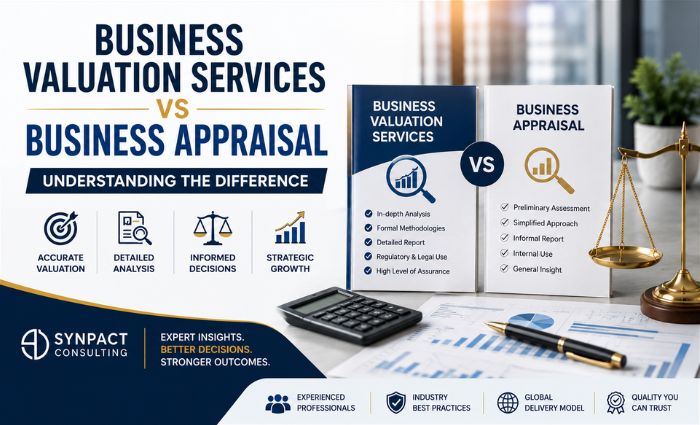
Business Valuation Services vs Business Appraisal: Understanding the Difference
When businesses, investors and financial professionals discuss determining the value of a company, the terms business valuation and business appraisal are often used interchangeably. While both concepts relate to assessing the worth of a business, they are not always identical in scope, methodology or purpose.
Understanding the distinction between business valuation services and business appraisal is important for business owners, CPA firms, investment banks, advisory firms, private equity funds and corporate finance professionals.
Choosing the wrong approach can result in inaccurate decision-making, regulatory complications or missed strategic opportunities.
In this article, we explain the differences between business valuation services and business appraisal, when each is used and how organisations can select the right solution for their needs.
What Are Business Valuation Services?
Business valuation services involve a comprehensive and professional assessment of a company’s economic value.
A valuation is typically performed by experienced valuation professionals using recognised methodologies and financial analysis techniques.
The objective is to determine the fair value of a business based on:
- Financial performance
- Market conditions
- Industry trends
- Risk factors
- Future earnings potential
- Asset values
- Capital structure
Business valuations are often used in high-stakes financial, legal and strategic situations where accuracy and defensibility are essential.
What Is a Business Appraisal?
A business appraisal is also an assessment of business value, but the term is often used more broadly.
In some regions and industries, “business appraisal” is simply another term for business valuation.
However, in many cases, an appraisal may involve a less detailed assessment that focuses on estimating value for a specific purpose.
Business appraisals are frequently used for:
- Preliminary decision-making
- Internal planning
- Informal assessments
- Business owner insights
- Initial transaction discussions
The level of analysis and documentation may vary depending on the intended use.
Why the Terminology Creates Confusion
One reason for confusion is that terminology differs across industries and jurisdictions.
For example:
- Some valuation professionals use both terms interchangeably.
- Certain courts and regulatory bodies prefer the term “business valuation.”
- Some business brokers use “business appraisal” for preliminary value estimates.
- Tax authorities may require formal valuation reports rather than appraisal opinions.
Because terminology can vary, organisations should focus on the scope and purpose of the engagement rather than the label alone.
Key Differences Between Business Valuation and Business Appraisal
Although there is overlap, several important differences often exist.
Purpose
Business Valuation
Typically performed for:
- Mergers and acquisitions
- Financial reporting
- Tax compliance
- Litigation support
- Shareholder disputes
- Estate planning
- Purchase price allocation
Business Appraisal
Often performed for:
- Internal planning
- Preliminary business assessments
- Informal transaction discussions
- Owner decision-making
Valuation engagements generally involve more formal requirements.
Depth of Analysis
Business Valuation
A professional valuation typically includes:
- Historical financial analysis
- Industry research
- Market benchmarking
- Financial modelling
- Risk assessment
- Multiple valuation methodologies
Business Appraisal
Appraisals may involve:
- Simplified calculations
- Limited financial review
- Preliminary estimates
- Reduced documentation
The depth of analysis is often lower than a formal valuation engagement.
Reporting Standards
Business valuation services frequently follow recognised professional standards.
Examples include:
- AICPA valuation standards
- ASA standards
- NACVA standards
- International Valuation Standards (IVS)
Formal valuation reports often include extensive supporting documentation and methodology explanations.
Business appraisals may not always require the same level of documentation.
Regulatory Acceptance
Formal valuations are often required in situations involving:
- Courts
- Tax authorities
- Auditors
- Regulatory agencies
- Financial reporting requirements
Business appraisals may be appropriate for internal decision-making but may not satisfy regulatory requirements.
Common Business Valuation Methodologies
Professional business valuation services typically rely on established methodologies.
Income Approach
The income approach focuses on a company’s future earning potential.
Common methods include:
- Discounted Cash Flow (DCF)
- Capitalisation of Earnings
This approach is widely used when future cash flows are predictable.
Market Approach
The market approach compares the business to similar companies.
Common techniques include:
- Comparable Company Analysis
- Precedent Transaction Analysis
This method reflects current market conditions and industry trends.
Asset-Based Approach
The asset approach evaluates the value of a company’s assets minus liabilities.
It is often used for:
- Asset-intensive businesses
- Holding companies
- Liquidation scenarios
When Should You Use Business Valuation Services?
Business valuation services are recommended when accuracy, compliance and defensibility are important.
Common situations include:
Mergers and Acquisitions
Buyers and sellers require reliable valuation analysis to support negotiations and transactions.
Financial Reporting
Accounting standards often require fair value assessments.
Tax Planning
Business valuations support estate planning, gift tax planning and corporate tax compliance.
Litigation Support
Valuation analysis is frequently used in legal disputes and shareholder conflicts.
Fundraising
Investors often require independent valuation assessments before providing capital.
When Is a Business Appraisal Appropriate?
Business appraisals may be suitable when organisations require a general understanding of business value.
Examples include:
- Initial sale discussions
- Strategic planning
- Business owner reviews
- Preliminary investment evaluations
In these situations, a less detailed estimate may be sufficient.
The Role of Financial Modelling in Business Valuation
Modern business valuation services rely heavily on financial modelling.
Valuation professionals frequently develop:
- DCF models
- Forecasting models
- Scenario analyses
- Sensitivity analyses
- Three-statement models
This analytical foundation helps improve valuation accuracy and decision-making.
Many firms now leverage financial modelling outsourcing and offshore valuation services to support these activities efficiently.
Why Global Firms Are Increasingly Outsourcing Valuation Services
As valuation requirements become more complex, many organisations are turning to specialised valuation providers.
Benefits include:
- Access to valuation expertise
- Improved scalability
- Faster turnaround times
- Reduced operating costs
- Enhanced analytical capabilities
Leading valuation outsourcing companies in India support investment banks, CPA firms, advisory firms and private equity organisations worldwide.
How to Choose the Right Valuation Provider
When selecting a valuation partner, organisations should evaluate:
Technical Expertise
Review professional qualifications and industry experience.
Methodology
Ensure recognised valuation methodologies are used.
Industry Knowledge
Industry-specific expertise can improve valuation accuracy.
Quality Assurance
Review quality control procedures and review processes.
Communication
Clear communication is essential throughout the engagement.
Why Synpact Consulting
Synpact Consulting provides specialised valuation support services for investment banks, CPA firms, advisory firms, private equity funds and corporate finance teams.
Our services include:
- Business valuation
- Financial modelling
- Portfolio valuation
- Purchase price allocation
- Transaction advisory support
- Offshore valuation services
We help organisations improve efficiency, increase capacity and deliver accurate valuation solutions that support critical business decisions.
Conclusion
Although the terms business valuation and business appraisal are sometimes used interchangeably, they often differ in purpose, scope and level of analysis.
Business valuation services provide a comprehensive and defensible assessment of value, making them suitable for transactions, compliance, financial reporting and legal matters. Business appraisals may be appropriate for preliminary planning and internal decision-making.
Understanding the distinction helps organisations choose the right approach for their specific needs.
As valuation requirements continue to grow, working with experienced valuation professionals ensures accurate analysis, better decision-making and stronger business outcomes.
Looking for Professional Business Valuation Services?
Contact Synpact Consulting today to learn how our valuation experts can support your organisation with accurate, scalable and reliable valuation solutions.