
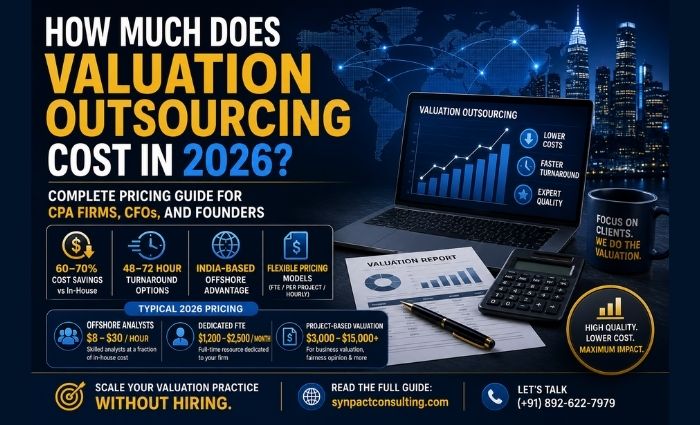
How Much Does Valuation Outsourcing Cost in 2026? Complete Pricing Guide for CPA Firms, CFOs, and Founders
You Are Not Asking the Wrong Question
You opened Google and typed “how much does a valuation cost.” You scrolled past three pages of results that all said the same thing: “It depends.”
It does depend — but not in the unhelpful way every consulting firm wants you to believe. The pricing in this market is well-documented if you know where to look. The reason providers are vague is not because pricing is genuinely impossible to quote; it is because vagueness preserves negotiating leverage for the seller.
This guide does the opposite. It gives you the actual ranges across every major valuation service, the four-tier provider taxonomy that explains the spread, the hidden costs that derail budgets, and the unit economics that explain why CPA firms are quietly building white-label valuation lines on top of offshore providers.
If you are a CPA partner deciding whether to build internally or outsource, a CFO scoping a Big 4 alternative, or a founder shopping a 409A — by the end of this guide you will know exactly what you should be paying, what should raise red flags, and how to negotiate.
The Answer in One Table
Here is what the US market actually pays for valuation services in 2026:
| Service | Big 4 / Top Independent | US Boutique | India Outsourced (Synpact tier) |
|---|---|---|---|
| 409A Valuation | $15,000 – $50,000 | $5,000 – $12,000 | $1,500 – $5,000 |
| PPA / Purchase Price Allocation (ASC 805) | $35,000 – $150,000+ | $15,000 – $40,000 | $5,000 – $18,000 |
| Goodwill Impairment Testing (ASC 350) | $25,000 – $100,000 | $12,000 – $35,000 | $4,000 – $15,000 |
| Stock-Based Compensation Valuation (ASC 718) | $10,000 – $40,000 | $4,000 – $12,000 | $1,500 – $5,000 |
| Pitch Book / CIM Preparation | $40,000 – $150,000 | $15,000 – $50,000 | $3,500 – $15,000 |
| Equity Research Report (Initiation Coverage) | $20,000 – $60,000 | $8,000 – $25,000 | $2,500 – $8,000 |
| 3-Statement Financial Model (Build from Scratch) | $25,000 – $80,000 | $10,000 – $30,000 | $3,000 – $12,000 |
| DCF Valuation Model | $10,000 – $35,000 | $5,000 – $15,000 | $1,500 – $6,000 |
| Outsourced CFO (Monthly Retainer) | N/A — typically partner billing | $8,000 – $25,000/month | $2,500 – $10,000/month |
| Bookkeeping (Monthly Retainer) | N/A | $2,500 – $8,000/month | $500 – $3,000/month |
These are not theoretical numbers. They reflect what is actually being quoted across the market in 2026 — and they are the numbers your competitors are basing their pricing decisions on.
Why the Spread Is So Wide — and Why Most of It Is Not About Quality
A founder seeing the 409A range above ($1,500 to $50,000) reasonably asks: what am I getting for the extra $48,500?
The honest answer breaks down into five components:
1. Brand and Audit Insurance (40–50% of the premium). A Duff & Phelps/Kroll signature carries weight in audit committee meetings and SEC filings that an unknown firm’s signature does not. For pre-IPO companies and SEC registrants, this premium is rational. For a Series A startup, it is overpaying for protection you do not need yet.
2. Senior Reviewer Time (20–25%). Big 4 partners and managing directors bill at $800–$1,500/hour. Their time on your engagement — even if just 4 hours of review — adds $3,000–$6,000 to the cost. Offshore senior reviewers with comparable credentials (CFA, ASA, CVA) bill at a fraction.
3. Real Estate, Overhead, and Compensation Differential (15–20%). Manhattan office space, US healthcare benefits, and US salary structures account for a meaningful share of every Big 4 invoice. Geography is the largest single cost driver after brand.
4. Methodology Differentiation (5–10%). Surprisingly small. The methodologies — DCF, market multiples, OPM/PWERM/Hybrid allocation, DLOM analysis — are standardized across the profession. The math does not get more accurate at a higher price point. It gets more thoroughly documented and more defensively reviewed.
5. Speed Premium or Discount (variable). Rush turnarounds (under 7 days) typically command a 25–50% premium at boutique firms. India-based providers like Synpact often deliver rush at standard rates — the time zone arbitrage makes 48-hour turnarounds economically feasible. See The 48-Hour Valuation: How Synpact Delivers Audit-Ready Reports on Rush Timelines for the operational mechanics.
The implication: when you pay Big 4 prices, only about 5–10% of the premium goes to methodological superiority. The rest is brand, overhead, and seniority — all of which can be replaced with offshore capacity if your audit context permits.
Service-by-Service Deep Dive
409A Valuation
What you actually need: an independent appraisal that establishes Safe Harbor under IRC Section 409A for your stock option grants.
Pricing benchmarks:
- Software-bundled (Carta, Pulley, AngelList): $2,000–$4,500. Best for vanilla cap tables at Seed/Series A.
- India outsourced: $1,500–$5,000. Best for companies wanting Big 4 methodology at startup pricing.
- US boutique: $5,000–$12,000. Best for Series B+ with complex secondaries.
- Big 4: $15,000–$50,000+. Best for pre-IPO / SEC registrants.
What drives cost up: complex cap tables (multiple preferred classes, warrants, convertibles), recent secondary transactions, near-term IPO timeline (PWERM/Hybrid required), unusual industries, restated financials.
What drives cost down: vanilla cap structure, no recent material events, clear comparable companies, previous engagement history with the provider (refresh discount typical).
For the full 409A walkthrough — methodologies, Safe Harbor mechanics, audit triggers, and the 12-question provider checklist — see 409A Valuation for US Startups in 2026: Complete Guide.
PPA (Purchase Price Allocation) under ASC 805
What you actually need: an audit-ready allocation of your acquisition consideration across tangible assets, identifiable intangibles (customer relationships, trademarks, technology, non-competes), and goodwill — completed within the 12-month measurement period.
Pricing benchmarks:
- India outsourced: $5,000–$18,000
- US boutique: $15,000–$40,000
- Big 4: $35,000–$150,000+
What drives cost: number of identifiable intangibles, complexity of customer base (cohort analysis required for relationship intangibles), contingent consideration valuation, debt-free cash-free vs debt-assumed structure, multi-jurisdictional operations.
Hidden cost trap: If your PPA is delayed past the 12-month ASC 805 measurement period, you lose the ability to make measurement period adjustments. Late PPA work essentially has to be reissued as a “true-up” with separate documentation — doubling the original cost. For why CPA firms are increasingly outsourcing this work entirely, see PPA Valuation Outsourcing: What CPA Firms and CFOs Need to Know Before the 12-Month ASC 805 Deadline.
Goodwill Impairment Testing under ASC 350
What you actually need: an annual impairment test (or interim trigger-based test) of each reporting unit’s carrying value against its fair value.
Pricing benchmarks:
- India outsourced: $4,000–$15,000 per reporting unit
- US boutique: $12,000–$35,000 per reporting unit
- Big 4: $25,000–$100,000 per reporting unit
What drives cost: number of reporting units, complexity of revenue forecasting, recent triggering events (acquisitions, restructurings, geopolitical shocks), need for both qualitative (“Step 0”) and quantitative (“Step 1”) analysis.
2026-specific cost driver: Geopolitical risk premiums have made WACC adjustments significantly more contested. Auditors are pushing back on standard CRP additions, demanding empirical support. Providers without recent macro-modeling experience are charging more — or worse, getting the answer wrong. For the full framework, see Goodwill Impairment Testing Under ASC 350: What Triggers It, How It Works, and Why CFOs Are Outsourcing It in 2026 and the related analysis on Geopolitical Risk Premiums in DCF and Valuation Models.
Stock-Based Compensation Valuation (ASC 718)
What you actually need: Black-Scholes (or lattice/Monte Carlo for complex awards) valuation of option grants, RSUs, performance awards, and SARs for compensation expense recognition.
Pricing benchmarks:
- India outsourced: $1,500–$5,000 per measurement period
- US boutique: $4,000–$12,000
- Big 4: $10,000–$40,000
Bundling opportunity: Your 409A and ASC 718 work share inputs — FMV, volatility, expected term. Engaging the same provider for both should yield a 20–30% bundled discount. If your provider quotes them as fully separate engagements, push back.
Pitch Book and CIM Preparation (Investment Banking Support)
What you actually need: a polished 25–60 page pitch book, teaser, or Confidential Information Memorandum supporting a sell-side mandate, capital raise, or strategic process.
Pricing benchmarks:
- India outsourced: $3,500–$15,000 per deck
- US boutique: $15,000–$50,000
- Big 4 / Bulge bracket internal: $40,000–$150,000+
What drives cost: depth of industry research, number of comparable companies/transactions to be analyzed, custom financial modeling requirements, design polish (a Goldman-grade deck takes 80+ hours of pure design time), data room support requirements.
Why boutique investment banks outsource: A two-partner boutique IB working on three sell-side mandates simultaneously cannot economically staff three internal analyst teams. Offshore deal-support teams provide the modeling and deck capacity, while the partners retain client relationship and process control.
Equity Research and Sector Coverage
What you actually need: initiation coverage report, comparable company analysis (“public comps”), precedent transaction analysis, sector primer, or model maintenance.
Pricing benchmarks:
- Initiation coverage report (full): $2,500–$8,000 (India) / $8,000–$25,000 (US boutique)
- Public comps update: $500–$2,000 per refresh
- Precedent transactions analysis: $1,500–$5,000
Recurring engagement opportunity: Buy-side analysts and family offices increasingly engage offshore equity research providers on a retainer basis ($2,000–$6,000/month for ongoing coverage of 5–10 names). The economics make sense for any analyst covering more names than they can deeply maintain alone.
Financial Modeling (3-Statement, DCF, LBO, Sensitivity)
What you actually need: an integrated, auditable, formula-driven model that links income statement, balance sheet, and cash flow with proper circular reference handling.
Pricing benchmarks:
- 3-Statement Build (from scratch): $3,000–$12,000 (India) / $10,000–$30,000 (US boutique)
- DCF Model: $1,500–$6,000 (India) / $5,000–$15,000 (US boutique)
- LBO Model: $3,000–$10,000 (India) / $12,000–$35,000 (US boutique)
- Model audit / quality control review: $2,000–$8,000 (India)
Critical quality marker: Ask for sample models before signing. Look for (a) clear formatting conventions, (b) blue-for-input/black-for-formula discipline, (c) flagged hardcodes, (d) circular reference handling via iterative calculation, and (e) embedded sensitivity tables.
Outsourced CFO and Recurring Finance Operations
What you actually need: monthly close, MIS reporting, board pack preparation, budgeting/forecasting, audit liaison, and strategic finance partnership — without the $250,000 fully-loaded cost of a full-time hire.
Pricing benchmarks:
- India outsourced (Synpact tier): $2,500–$10,000/month depending on transaction volume and entity count
- US boutique fractional CFO: $8,000–$25,000/month
- Full-time hire equivalent: $200,000–$350,000 fully loaded annually
Pricing variables: Number of legal entities, transaction volume per month, number of bank accounts to reconcile, payroll complexity, multi-currency requirements, audit support intensity, board reporting cadence.
For startups burning $50,000–$150,000/month, an outsourced CFO at $5,000/month replaces what would otherwise be a $25,000/month internal Controller plus part-time advisory CFO — meaningful runway preservation.
The Hidden Costs That Derail Budgets
Sticker price is rarely the final price. Here are the seven cost categories that surprise buyers most:
1. Revision rounds. Most providers include 1–2 revision rounds in the base fee. Beyond that, hourly billing kicks in. Auditors who challenge methodology can trigger 3–5 rounds easily. Always confirm the revision allowance in writing.
2. Auditor walkthrough calls. Some providers charge $500–$2,000 per audit walkthrough call after the first one. If your Big 4 auditor schedules three calls, you have just added $4,500 in unplanned costs.
3. Methodology change requests. If your audit committee asks the provider to re-run the analysis using a different allocation method (OPM → Hybrid, for example), this is often billed as a new engagement at 50–70% of original cost.
4. Backup data and source documentation. Some providers charge separately for delivering the underlying Capital IQ/PitchBook exports, comparable company tear sheets, or sensitivity tables. Ask upfront.
5. Working hours and time zone surcharges. A few providers charge premium rates for after-hours or weekend work. Relevant for rush engagements.
6. Project management overhead. Some firms add a 10–15% PM fee on top of analyst hours. Always ask whether the quoted price is “all in” or whether PM is separately billed.
7. Currency and wire fees. International engagements often pass through wire fees ($25–$50 per transaction) or apply unfavorable exchange conversions. For multi-engagement relationships, negotiate annual flat-fee structures.
The Unit Economics Most CPA Firms Are Quietly Running
For CPA firms, the math behind white-label valuation outsourcing is the most compelling lead-gen story in the entire profession.
Here is the typical setup:
- Client invoice for a 409A valuation: $7,500 (priced at US boutique market rate)
- Wholesale cost from offshore white-label provider: $2,200
- Partner review time (4 hours at internal cost): $400
- Gross margin per engagement: $4,900 (65%)
- Cycle time: 7–10 business days
A CPA firm that issues 40 valuation engagements per year (a modest book) generates $196,000 in gross margin from a service line that requires zero internal hiring, zero training overhead, and zero practice-management complexity. The same firm’s traditional audit practice typically runs at 35–45% margin.
Multiply across 409As, PPAs, goodwill impairment, and stock comp work, and the white-label valuation line becomes the single highest-margin offering in the firm. For the full revenue model, see How to Build a Valuation Practice Line Using White-Label Outsourcing: A Revenue Model for CPA Firms in 2026.
To see what a finished white-label deliverable actually looks like before you sign, walk through What Does a White-Label Valuation Report Actually Look Like? A Section-by-Section Walkthrough.
How to Vet Pricing Quotes — A 7-Point Negotiation Framework
Before you accept any quote, run it through this filter:
- Is the price “all in” or modular? Get a written confirmation that includes revisions, auditor calls, and final deliverable formats.
- What is the refresh discount? Most reputable providers offer 25–40% off subsequent engagements for the same client. If yours does not, you are subsidizing their new-business acquisition.
- Is rush pricing transparent? Confirm in writing what triggers a rush surcharge and how much it is.
- What is the scope of senior reviewer time? A report signed by a partner with 2 hours of review is different from one signed with 8 hours of review. Ask.
- Are model files included? Final reports without supporting Excel models are nearly useless during audit. Confirm the deliverable list explicitly.
- Is there volume pricing? If you anticipate 3+ engagements per year (PPA + Goodwill + 409A is a common bundle), ask for an annual master agreement with stepped pricing.
- What are the cancellation terms? Some providers retain 50% of the engagement fee upon cancellation regardless of work completed. Push for a milestone-based cancellation schedule.
For the broader provider evaluation framework — covering credentials, audit defense, methodology, and turnaround — see How to Choose a Valuation Outsourcing Partner in India: 12 Questions to Ask Before You Sign.
How Synpact Prices
For full transparency, here is how Synpact’s pricing structure works across the most common engagements:
- 409A Valuation: Starting at $1,500 for vanilla Seed-stage cap tables, scaling to $5,000 for complex Series C with secondaries. Refresh engagements at 30–40% discount.
- PPA (ASC 805): Starting at $5,000 for single-target acquisitions, scaling with intangible asset count and contingent consideration complexity.
- Goodwill Impairment (ASC 350): Starting at $4,000 per reporting unit. Multi-unit packages priced at meaningful step-down.
- Pitch Books / CIMs: Starting at $3,500 for teasers, $8,000–$15,000 for full CIMs depending on industry depth.
- Financial Modeling: $3,000–$12,000 depending on complexity and integration requirements.
- Outsourced CFO: $2,500–$10,000/month depending on entity count and transaction volume.
- Rush turnaround: 48 hours available across most service lines at standard pricing — no surcharge.
Annual master service agreements covering multiple engagement types unlock additional volume discounts. For complete service-level pricing and engagement structures, see Synpact’s Valuation Services hub or Investment Banking Support and Outsourced CFO services.
Frequently Asked Questions
Is the cheaper offshore option going to fail an audit?
Not if the methodology is sound and the deliverable is documented properly. Audit defensibility is a function of methodology rigor and documentation completeness — not geography. The four prongs of IRC 409A Safe Harbor (independence, qualifications, reasonable methodology, refresh discipline) make no reference to provider location.
Why do Big 4 firms charge 10x more for what looks like the same deliverable?
Brand insurance, senior partner billing rates, US overhead, and audit committee comfort. For pre-IPO and SEC-registered companies the premium is sometimes rational. For Series A through Series C startups it almost never is.
Should I bundle 409A, ASC 718, and goodwill testing with one provider?
Yes — for two reasons. First, the inputs overlap (FMV, volatility, WACC), so the same provider can amortize learning across engagements and offer 20–30% bundled discounts. Second, having one provider eliminates reconciliation errors during audit when separate firms produce inconsistent inputs.
How much should I budget annually for a Series A startup?
A Series A startup typically incurs: one 409A refresh ($2,500–$5,000), quarterly stock comp accruals ($1,500–$3,000), and an annual outsourced CFO retainer ($30,000–$60,000). Total annual finance/valuation outsourcing budget: $35,000–$70,000. Compare against a single internal Controller hire ($150,000+ fully loaded).
How quickly can offshore providers turn around urgent work?
True 48-hour turnaround is feasible for 409As, ASC 718, and standard DCF work. PPA and complex goodwill testing realistically require 5–10 business days minimum due to comparable analysis depth. Beware providers promising 48-hour PPA work — corners are being cut.
What about data security and confidentiality with offshore providers?
Reputable providers operate under signed NDAs, ISO 27001 frameworks, secure data rooms, and SOC 2 controls. The same security infrastructure used by US Big 4 offshore captives. Always confirm NDA terms and data handling protocols upfront.
My Big 4 auditor is uncomfortable with offshore-prepared valuations. Is this a real obstacle?
Almost never in 2026. Big 4 auditors review hundreds of offshore-prepared valuations per year — including from their own captive offshore teams. What auditors object to is poor methodology, not poor passports. A well-documented offshore valuation faces no greater scrutiny than a well-documented domestic one.
What is the realistic minimum engagement size?
Most professional offshore providers will not engage below ~$1,500. Below that price point, the documentation overhead consumes the entire margin and corners get cut. If you find a provider quoting $500 for a 409A, expect to receive what amounts to a templated spreadsheet, not a defensible report.
The valuation outsourcing market in 2026 is mature, well-priced, and globally distributed. The tier you pick should match the audit context you operate in — not your unconscious assumption about what “professional” looks like.
For most Series A through Series C startups, mid-market CPA firms, and boutique investment banks, the math overwhelmingly favors offshore providers with US-credentialed senior reviewers. You retain methodology rigor, audit defensibility, and turnaround speed — at one-fifth the cost of Big 4 engagement.
For pre-IPO companies, SEC registrants, and litigation contexts, the Big 4 brand premium remains rational.
Everywhere else, the question is no longer whether to outsource. It is which provider meets your standard.
Ready to Discuss Your Engagement?
If you are scoping a 409A, PPA, goodwill impairment, financial model, pitch book, or recurring CFO engagement — Synpact will provide a written, scope-locked quote within one business day, with no obligation.
Book your free 30-minute strategy call →
Or explore service-level details: