
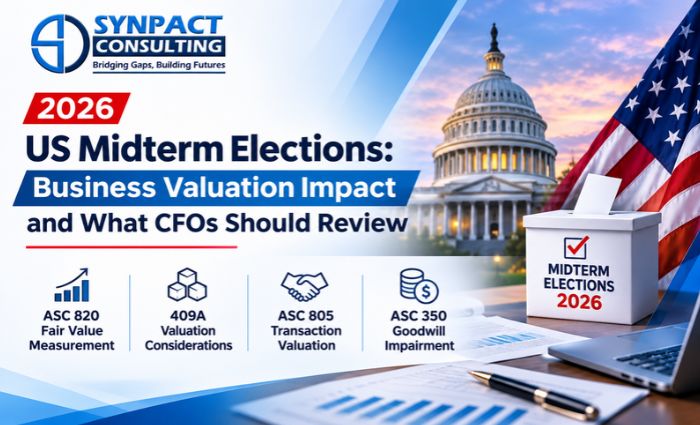
2026 US Midterm Elections: Business Valuation Impact and What CFOs Should Review
The 2026 midterm elections business valuation impact is becoming an important consideration for US CFOs, business owners, valuation professionals, private equity investors, and financial reporting teams. Following the November 3, 2026 elections, the United States is preparing for a shift to divided government, with Democrats winning control of both chambers of Congress while President Donald Trump remains in office.
For businesses, the most important question is not simply which political party controls Congress. It is how changing expectations around tax policy, regulation, federal spending, trade, capital markets, and economic growth could influence future cash flows, investment risk, and enterprise value.
These developments may create additional considerations for 409A valuations, ASC 820 fair value measurements, ASC 350 goodwill impairment assessments, ASC 805 purchase price allocations, and M&A transaction valuations.
At Synpact Consulting, we help US businesses, CPA firms, valuation practices, and financial advisory teams address complex valuation and financial modeling requirements through disciplined analysis and supporting documentation.
Analysis date: November 10, 2026. This article distinguishes confirmed election developments from potential future policy and valuation scenarios.
What Changed After the 2026 US Midterm Elections?
The November 2026 midterm elections changed the balance of power in Washington. Democrats secured control of the US House of Representatives and Senate, creating a divided-government environment for the next Congress beginning in January 2027.
This political structure may influence the pace of federal legislation, congressional oversight, budget negotiations, agency nominations, and the implementation of economic policy.
However, election results do not automatically change corporate tax rates, financial reporting standards, valuation methodologies, or existing regulatory obligations.
Businesses should distinguish among three categories of developments:
- Confirmed changes: Election results and the incoming congressional balance of power.
- Potential policy developments: Proposed tax legislation, regulatory changes, spending decisions, and trade measures.
- Economic consequences: Changes in business forecasts, market expectations, financing conditions, and investment risk supported by available evidence.
For valuation purposes, this distinction matters because an uncertain political outcome should not automatically become an adjustment to enterprise value.
2026 Midterm Elections Business Valuation Impact: Five Key Drivers
1. Corporate Tax Policy and After-Tax Cash Flows
Corporate tax assumptions are important inputs in many business valuation models. Potential changes in tax legislation, credits, deductions, or incentives may affect projected after-tax cash flows and investment decisions.
However, a proposed tax change is not the same as enacted legislation.
When preparing a discounted cash flow (DCF) analysis, valuation professionals should evaluate the applicable tax law and consider alternative policy outcomes only when those scenarios are reasonable, relevant, and supportable.
For example, a manufacturing company considering a major capital investment may evaluate different outcomes for available tax incentives. The selected assumptions should reflect the valuation date, applicable law, and market-participant expectations rather than unsupported predictions.
2. Interest Rates, Financing Costs, and Discount Rates
Political and fiscal uncertainty may influence investor expectations, Treasury yields, credit spreads, and access to financing.
These market factors can affect the discount rates used in valuation models.
A higher required rate of return generally reduces the present value of future cash flows, assuming all other factors remain constant. Conversely, improving financing conditions may support higher valuations.
However, a change in congressional control does not, by itself, establish the direction of interest rates or the appropriate weighted average cost of capital (WACC).
Valuation teams should examine observable market data, company-specific risk, capital structure, and consistency between projected cash flows and discount rate assumptions.
3. Regulatory and Compliance Uncertainty
Businesses operating in heavily regulated industries may face changes in oversight priorities, enforcement activity, or future regulatory proposals.
Industries potentially exposed to changing policy expectations include financial services, healthcare, energy, technology, infrastructure, and government contracting.
Potential valuation effects may arise through:
- Changes in expected operating expenses.
- Compliance and reporting costs.
- Delays in approvals or investment projects.
- Changes in customer demand.
- Additional capital expenditure requirements.
- Changes in projected profitability or risk.
These factors should be evaluated based on their actual or reasonably supportable effect on a company’s economics.
4. Trade Policy and Supply Chain Exposure
Trade measures, tariffs, import restrictions, and international supply chain conditions can influence cost structures and competitive positioning.
Companies dependent on imported materials or overseas production may be particularly sensitive to changes in trade costs.
For valuation purposes, relevant questions include whether the company can pass higher costs to customers, substitute suppliers, or adjust production without materially reducing margins.
Analysts should avoid assuming that every business will experience the same outcome. The effects depend on industry exposure, supplier concentration, pricing power, and operational flexibility.
5. Investor Confidence and M&A Activity
Private equity firms, strategic acquirers, lenders, and institutional investors evaluate transaction opportunities using assumptions about growth, financing availability, expected returns, and potential exit values.
Policy uncertainty may cause some investors to reassess transaction timing or investment scenarios. Other businesses may find acquisition opportunities if valuations, financing terms, or competitive conditions become more favorable.
Neither outcome is automatic.
Valuation professionals should evaluate actual transaction evidence, financing conditions, market multiples, and the strategic economics of each proposed deal.
Which US Industries Could Experience the Greatest Valuation Sensitivity?
The 2026 election results may have different implications across industries. The following table identifies potential valuation exposures rather than predicting winners or losers.
| Industry | Potential Business Exposure | Valuation Consideration |
|---|---|---|
| Healthcare | Reimbursement, pricing, regulation and consolidation | Revenue forecasts, margins and impairment indicators |
| Technology and AI | AI regulation, infrastructure spending and capital requirements | Growth assumptions, WACC and intangible asset values |
| Energy and Utilities | Tax incentives, permitting and capital expenditure | Project cash flows and investment returns |
| Manufacturing | Tariffs, supply chains and domestic investment incentives | Operating margins and capital expenditure forecasts |
| Financial Services | Regulatory oversight, lending conditions and credit risk | Asset values, credit spreads and financial instrument valuation |
| Private Equity and M&A | Financing availability, exit timing and transaction activity | Portfolio valuations, transaction multiples and scenario analysis |
Companies should assess exposure at the individual business level rather than applying a broad political adjustment to valuation models.
How the 2026 Midterm Elections Could Affect ASC 820 Fair Value Measurement
ASC 820 Fair Value Measurement establishes the framework for determining fair value when another applicable accounting standard requires or permits it.
Fair value reflects market-participant assumptions at the relevant measurement date. It does not represent management’s preferred estimate or an unsupported prediction of future policy outcomes.
Political and economic uncertainty may affect observable market inputs or the assumptions market participants would use to price certain assets and liabilities.
Level 3 Valuation Considerations
Level 3 measurements often involve significant unobservable inputs, including company forecasts, discount rates, marketability assumptions, and scenario probabilities.
When these assumptions are affected by changing economic conditions, valuation professionals may need to revisit the supporting evidence.
Relevant considerations include:
- Whether projected cash flows remain supportable.
- Whether discount rates reflect current market conditions.
- Whether comparable company multiples remain relevant.
- Whether market-participant assumptions have changed.
- Whether alternative scenarios require additional analysis.
- Whether sensitivity disclosures and workpapers remain appropriate.
For a deeper explanation of financial reporting requirements, read Synpact Consulting’s ASC 820 Fair Value Measurement Outsourcing Guide.
Private Debt and Credit Valuation
Changes in financing conditions may also affect private debt instruments.
Market-required yields, borrower creditworthiness, liquidity, and contractual terms can cause fair value to differ from outstanding principal.
For a detailed technical discussion, see our ASC 820 Private Debt Valuation Guide, covering credit spreads, convertible notes, and financial reporting considerations.
409A Valuation After the 2026 Midterm Elections: When Should Companies Reassess FMV?
Privately held businesses issuing employee stock options must carefully evaluate common stock fair market value when determining exercise prices.
Under applicable Section 409A rules, qualifying nonqualified stock options generally require an exercise price at least equal to the underlying stock’s FMV on the grant date, along with other conditions for the relevant exemption.
The election results alone do not automatically invalidate an existing 409A valuation.
However, companies may need to reassess an earlier valuation when subsequent developments materially affect business value.
Potential triggers include:
- Material changes in financial forecasts.
- Significant financing transactions.
- Major changes in expected business performance.
- New transaction evidence affecting equity value.
- Changes in capital structure.
- Material regulatory developments affecting the business.
- Significant changes in anticipated liquidity events.
The relevant question is whether new information materially changes the valuation assumptions or common stock FMV, not whether an election has occurred.
Our 409A Valuation Audit Review: 10 Questions Auditors Ask explains how finance teams can document valuation changes, capitalization assumptions, and supporting evidence.
ASC 350 Goodwill Impairment: Could Policy Uncertainty Create New Risks?
Companies with goodwill and certain intangible assets may need to evaluate whether changing economic conditions indicate potential impairment.
Under ASC 350, goodwill impairment analysis focuses on the relationship between a reporting unit’s carrying amount and fair value, subject to the applicable accounting requirements.
Potential developments that could affect impairment assessments include:
- Declining expected revenue or profitability.
- Adverse changes in the regulatory environment.
- Increased operating costs.
- Higher market discount rates.
- Changes in competitive conditions.
- Reduced market capitalization or transaction multiples.
- Negative developments in an important business segment.
A political event does not automatically create a goodwill impairment charge.
Instead, management must evaluate whether the facts and circumstances indicate that the fair value of a reporting unit may have fallen below its carrying amount, applying the relevant accounting guidance.
For businesses with material goodwill balances, sensitivity testing and a documented review of significant assumptions may be especially useful during periods of uncertainty.
ASC 805 Purchase Price Allocation and M&A Transactions
Companies completing acquisitions must consider the fair value of acquired assets and assumed liabilities under the applicable business combination accounting requirements.
Under ASC 805, a purchase price allocation may involve customer relationships, developed technology, trade names, contingent consideration, and other identifiable assets or liabilities.
Economic and policy developments may influence transaction assumptions, including:
- Customer revenue growth and attrition.
- Projected operating margins.
- Cost of capital.
- Expected useful lives of intangible assets.
- Contingent consideration probabilities.
- Market-participant assumptions.
These inputs must be evaluated using the circumstances and information relevant to the acquisition date.
Synpact Consulting’s ASC 805 Purchase Price Allocation Case Study demonstrates how valuation professionals analyze customer relationships, developed technology, trade names, and goodwill in a hypothetical SaaS acquisition.
Practical Valuation Example: How Policy Scenarios Can Change Enterprise Value
Consider a hypothetical US manufacturing company evaluating its enterprise value after the 2026 midterm elections.
Management identifies uncertainty involving supply chain costs, future capital expenditure, and customer demand.
Rather than assigning an arbitrary election-related discount to the company, the valuation team develops three illustrative operating scenarios.
| Scenario | Probability | Illustrative Enterprise Value |
|---|---|---|
| Upside: stronger margins and demand | 25% | $60 million |
| Base: stable operating performance | 50% | $50 million |
| Downside: cost pressure and slower growth | 25% | $38 million |
Illustrative Probability-Weighted Calculation
Probability-weighted enterprise value:
(25% × $60M) + (50% × $50M) + (25% × $38M) = $49.5 million
The result demonstrates how multiple economic outcomes can be evaluated without assuming that one political development determines the company’s future.
However, this simplified illustration is not a complete valuation methodology. In a real engagement, analysts must ensure that scenario values, probabilities, cash flow assumptions, and discount rates are internally consistent and supported by evidence.
All figures are hypothetical and do not represent a client engagement or a forecast of actual post-election market performance.
What CFOs and Valuation Professionals Should Review Before Year-End 2026
With year-end financial reporting approaching, companies may benefit from a structured review of valuation assumptions and significant developments.
1. Revisit Financial Forecasts
Compare existing budgets and forecasts against current operating performance, updated business expectations, and material developments.
2. Review Discount Rates and Market Data
Evaluate relevant interest rates, market multiples, credit spreads, and other valuation inputs as of the appropriate measurement date.
3. Assess Industry-Specific Exposure
Identify which proposed or implemented policy developments could materially affect the company’s operations, customers, suppliers, or capital requirements.
4. Evaluate Goodwill and Impairment Indicators
Review whether adverse changes in financial performance, business prospects, or market conditions require further impairment assessment.
5. Review 409A Valuation Assumptions
For private companies preparing new employee option grants, consider whether the existing common stock valuation remains appropriate under applicable requirements.
6. Reassess Transaction and Investment Assumptions
For companies planning acquisitions, fundraising, or investment transactions, review financing assumptions, projected synergies, transaction multiples, and potential downside scenarios.
7. Strengthen Valuation Documentation
Maintain a clear record of source data, management assumptions, market evidence, scenario analysis, and significant valuation judgments.
Companies and professional advisory teams seeking technical support can explore Synpact Consulting’s Fair Value Measurement Services for complex financial reporting and valuation requirements.
Why Independent Valuation Support Matters During Economic Uncertainty
Periods of uncertainty can increase the importance of transparent valuation methodologies, supportable assumptions, and consistent documentation.
For CFOs, CPA firms, private equity investors, and financial advisory teams, the objective is not to predict political outcomes with certainty.
It is to develop valuation conclusions that reflect relevant evidence, reasonable market-participant assumptions, and the facts applicable to each measurement date.
Independent valuation and financial modeling support may be valuable when an organization faces:
- Complex financial reporting valuations.
- Significant unobservable valuation inputs.
- Changes in forecasts or financing conditions.
- Goodwill impairment concerns.
- Acquisition-related purchase price allocations.
- Private company equity valuation requirements.
- Complex debt or convertible securities.
- Additional internal or external valuation review.
How Synpact Consulting Supports US Businesses and Valuation Firms
Synpact Consulting provides valuation and financial modeling support for businesses, CPA firms, independent valuation practices, and professional advisory teams.
Our relevant capabilities include:
- 409A Valuation: Common stock FMV analysis and equity valuation support.
- ASC 820 Fair Value Measurement: Financial instrument valuation, Level 3 analysis, and supporting documentation.
- ASC 350 Goodwill Impairment: Reporting unit valuation and impairment-related analytical support.
- ASC 805 Purchase Price Allocation: Acquired intangible asset valuation and business combination analysis.
- Financial Modeling: DCF modeling, sensitivity analysis, scenario evaluation, and investment-related financial analysis.
We focus on analytical rigor, clear workpapers, and practical collaboration with professional teams managing complex valuation requirements.
Frequently Asked Questions
How do the 2026 midterm elections affect business valuations?
The elections may influence business valuation indirectly through expectations about tax policy, regulation, financing conditions, economic growth, and investment risk. Actual valuation effects depend on company-specific exposure and supportable market evidence.
Will the 2026 midterm elections change corporate tax rates?
The election results do not automatically change corporate tax rates. Any future changes would depend on legislation and the applicable legal process. Valuation models should distinguish enacted tax law from proposed policy scenarios.
Should private companies update their 409A valuations after the election?
Not solely because an election occurred. An update may be necessary when material developments affect common stock FMV or when an earlier valuation no longer meets applicable requirements.
Can political uncertainty affect ASC 820 fair value measurements?
Yes, when uncertainty affects relevant market-participant assumptions, observable market data, expected cash flows, credit spreads, or other valuation inputs. Measurements must reflect conditions at the appropriate measurement date.
Could the elections trigger goodwill impairment testing?
Election results alone do not automatically trigger goodwill impairment. However, adverse business or economic developments may contribute to impairment indicators that require evaluation under ASC 350.
How can the elections affect mergers and acquisitions?
Changes in financing conditions, expected growth, regulatory scrutiny, and investor confidence may influence transaction assumptions. The actual impact depends on the industry, transaction structure, and market conditions.
What should CFOs prioritize before year-end 2026?
CFOs should review material changes in financial forecasts, relevant market inputs, potential impairment indicators, transaction assumptions, and the documentation supporting significant valuation estimates.
How can Synpact Consulting help with valuation uncertainty?
Synpact Consulting provides financial modeling, business valuation, fair value measurement, equity valuation, and transaction-related analytical support for US businesses and professional advisory firms.
Prepare Your Business Valuation Strategy for 2027
The 2026 US midterm elections introduce a new political environment, but the underlying principles of sound valuation remain unchanged.
Businesses should focus on the economic substance of policy developments, the reliability of financial forecasts, the quality of market evidence, and the documentation supporting valuation conclusions.
Whether your organization is reviewing fair value measurements, evaluating goodwill impairment, planning an acquisition, or preparing a private company equity valuation, a disciplined analytical approach can support more informed financial decisions.
Need professional valuation or financial modeling support?
Connect with Synpact Consulting to discuss your 409A, ASC 820, ASC 805, ASC 350, or financial modeling requirements.
Synpact Consulting — Bridging Gaps, Building Futures
Website: www.synpactconsulting.com
Email: [email protected]
Phone: +91 892-622-7979
Contact Synpact Consulting to Discuss Your Valuation Requirements