
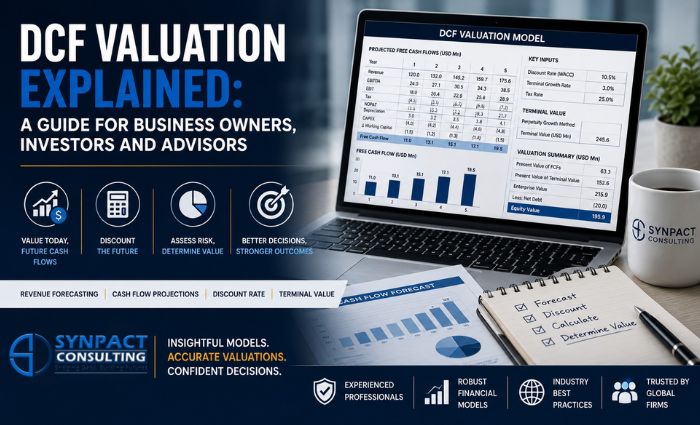
DCF Valuation Explained: A Guide for Business Owners, Investors and Advisors
Determining the true value of a business is one of the most important aspects of financial decision-making. Whether you are a business owner planning a sale, an investor evaluating an acquisition, or an advisor supporting strategic transactions, understanding valuation methodologies is essential.
Among all valuation techniques, Discounted Cash Flow (DCF) valuation is widely regarded as one of the most comprehensive and theoretically sound approaches. It focuses on a simple principle: a business is worth the present value of the cash it is expected to generate in the future.
DCF valuation is used extensively by investment banks, private equity firms, valuation consultants, corporate finance teams and investors around the world. While the concept may seem straightforward, developing an accurate DCF model requires detailed financial analysis, forecasting expertise and sound assumptions.
In this guide, we explain how DCF valuation works, its key components, advantages, limitations and practical applications.
What Is DCF Valuation?
DCF valuation, or Discounted Cash Flow valuation, is a method used to estimate the intrinsic value of a business, investment or asset.
The approach calculates value by forecasting future cash flows and then discounting those cash flows back to their present value using an appropriate discount rate.
The fundamental principle behind DCF valuation is:
A dollar received today is worth more than a dollar received in the future.
This is known as the time value of money.
DCF analysis attempts to determine how much future cash flows are worth in today’s terms.
The Core DCF Formula
Where:
- CF = Future Cash Flow
- r = Discount Rate
- t = Time Period
- n = Forecast Horizon
The formula discounts each projected cash flow to present value and sums them together to estimate total enterprise value.
Why DCF Valuation Is Important
DCF valuation focuses on the underlying economics of a business rather than market sentiment alone.
Unlike valuation methods that rely solely on market comparisons, DCF analysis considers:
- Future revenue growth
- Profitability
- Operating performance
- Capital requirements
- Business risk
- Long-term value creation
This makes DCF particularly useful for businesses with strong future growth potential.
How Discounted Cash Flow Analysis Works
The DCF process generally follows several key steps.
Step 1: Forecast Revenue
The first step involves estimating future revenue.
Analysts typically forecast revenue for:
- 5 years
- 7 years
- 10 years
depending on the business and industry.
Forecast assumptions may consider:
- Historical performance
- Market trends
- Competitive position
- Industry growth
- Management plans
Accurate forecasting is critical because revenue drives most other financial projections.
Step 2: Project Operating Expenses
After forecasting revenue, analysts estimate future expenses.
These include:
- Cost of goods sold
- Operating expenses
- Marketing costs
- Administrative expenses
- Research and development
The objective is to estimate future operating profitability.
Step 3: Calculate Free Cash Flow
Free Cash Flow (FCF) represents cash available to investors after accounting for operating costs and investment requirements.
A simplified formula is:
Where:
- EBIT = Earnings Before Interest and Taxes
- T = Tax Rate
- D&A = Depreciation and Amortisation
- CAPEX = Capital Expenditures
- NWC = Net Working Capital
Free cash flow is the foundation of DCF valuation.
Step 4: Determine the Discount Rate
The discount rate reflects investment risk.
Most business valuations use the Weighted Average Cost of Capital (WACC) as the discount rate.
The discount rate incorporates:
- Equity risk
- Debt costs
- Industry risk
- Company-specific risk
Higher risk results in a higher discount rate and lower valuation.
Step 5: Calculate Terminal Value
Most businesses continue beyond the forecast period.
Analysts estimate a terminal value representing the value of future cash flows beyond the projection horizon.
Common approaches include:
Perpetuity Growth Method
Assumes cash flows grow indefinitely at a stable rate.
Exit Multiple Method
Applies a valuation multiple based on comparable companies or transactions.
In many DCF models, terminal value accounts for a significant portion of total valuation.
Step 6: Discount Cash Flows to Present Value
Each projected cash flow and terminal value is discounted back to today’s value.
The sum of these present values produces the estimated enterprise value.
Key Components of a DCF Model
A professional DCF model typically includes:
Revenue Forecasts
Projected future sales and growth assumptions.
Operating Margins
Expected profitability over time.
Capital Expenditures
Investment required to support growth.
Working Capital
Cash tied up in operations.
Discount Rate
Reflecting investment risk.
Terminal Value
Representing long-term business value.
Advantages of DCF Valuation
DCF remains one of the most respected valuation methodologies because of several strengths.
Focuses on Fundamentals
DCF valuation is based on future cash generation rather than market sentiment.
Flexible
Can be applied across industries and business sizes.
Forward Looking
Considers future performance rather than relying solely on historical data.
Comprehensive
Incorporates multiple financial and operational assumptions.
Widely Accepted
Used by:
- Investment banks
- Private equity firms
- Corporate finance teams
- Valuation consultants
- Financial institutions
Limitations of DCF Valuation
Despite its strengths, DCF analysis has limitations.
Sensitive to Assumptions
Small changes in:
- Revenue growth
- Discount rates
- Terminal growth
can significantly impact valuation.
Forecasting Uncertainty
Long-term projections may not always be accurate.
Complexity
Building reliable DCF models requires advanced financial modelling expertise.
Time Intensive
Developing and validating assumptions can require substantial effort.
When DCF Valuation Is Most Appropriate
DCF analysis is particularly useful when:
Valuing Growing Businesses
Future cash flow potential is a major value driver.
Mergers and Acquisitions
Buyers and sellers need detailed intrinsic value analysis.
Strategic Planning
Management teams evaluate growth opportunities.
Investment Decisions
Investors assess long-term returns.
Financial Reporting
Valuation support may be required for compliance purposes.
DCF vs Comparable Company Analysis
DCF and Comparable Company Analysis (CCA) are frequently used together.
DCF
- Based on intrinsic value
- Uses future cash flows
- Highly customised
Comparable Company Analysis
- Based on market multiples
- Relies on peer comparisons
- Reflects current market sentiment
Most valuation professionals use both methods to validate conclusions.
DCF vs Asset-Based Valuation
Asset-based valuation focuses on:
- Tangible assets
- Liabilities
- Net asset value
DCF focuses on:
- Future earnings
- Cash flow generation
- Long-term growth potential
For operating businesses, DCF often provides a more complete picture of value.
How Professional Valuation Firms Use DCF Models
Professional valuation firms use DCF models in:
- Business valuation engagements
- Fairness opinions
- Transaction advisory
- Purchase price allocation
- Investment analysis
- Strategic planning
Many organisations now utilise business valuation outsourcing and financial modelling outsourcing services to support these activities efficiently.
Learn more about leading valuation outsourcing companies in India and their valuation support capabilities:
Internal Link
Why Synpact Consulting
Synpact Consulting provides specialised valuation and financial modelling support for:
- Investment banks
- CPA firms
- Advisory firms
- Private equity funds
- Corporate finance teams
Our professionals assist with:
- DCF modelling
- Business valuation
- Financial modelling
- Portfolio valuation
- Purchase price allocation
- Transaction advisory support
We help organisations deliver accurate, scalable and efficient valuation solutions.
Conclusion
DCF valuation remains one of the most powerful and widely used valuation methodologies in modern finance. By focusing on future cash flow generation and intrinsic value, it provides decision-makers with a robust framework for evaluating businesses and investment opportunities.
While DCF analysis requires careful assumptions and advanced financial modelling expertise, its ability to capture long-term value makes it an essential tool for business owners, investors and advisors.
Whether you are evaluating an acquisition, raising capital or planning for future growth, understanding DCF valuation can significantly improve financial decision-making.
Looking for Expert Valuation Support?
Contact Synpact Consulting today to learn how our valuation and financial modelling professionals can help you develop accurate DCF models and support critical business decisions.