
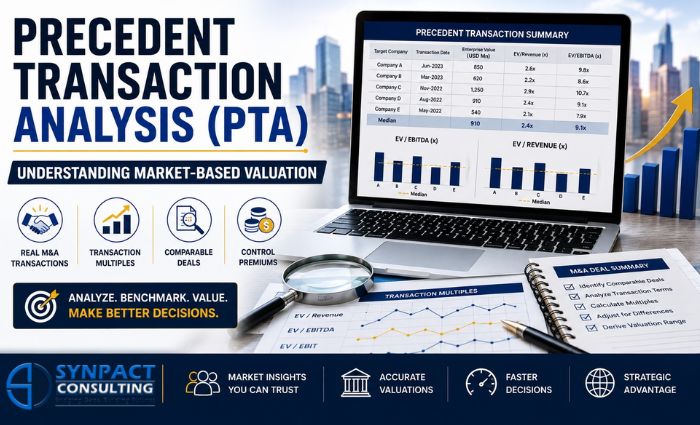
Precedent Transaction Analysis (PTA): Understanding Market-Based Valuation
Valuing a business accurately is one of the most important aspects of mergers and acquisitions, investment decisions and corporate finance transactions. Financial professionals use several valuation methodologies to determine what a company is worth, and one of the most powerful market-based approaches is Precedent Transaction Analysis (PTA).
Precedent Transaction Analysis estimates the value of a business by examining the prices paid in previous acquisitions involving similar companies. Unlike theoretical valuation approaches, PTA reflects actual transactions where buyers and sellers agreed on a price, making it highly relevant in real-world deal environments.
Investment bankers, private equity firms, valuation consultants, corporate finance teams and strategic acquirers rely heavily on PTA because it provides insight into how the market has valued comparable businesses under actual transaction conditions.
Together with DCF Valuation and Comparable Company Analysis (CCA), PTA forms one of the three core valuation methodologies used globally.
In this guide, we explain how PTA works, how transaction multiples are calculated, its advantages and limitations, and how valuation professionals use it in practice.
What Is Precedent Transaction Analysis?
Precedent Transaction Analysis is a valuation methodology that estimates a company’s value using data from previously completed mergers, acquisitions and business transactions.
The underlying principle is simple:
If comparable businesses were acquired at specific valuation multiples, a similar company today may be worth a comparable valuation range.
Rather than analysing public market prices, PTA focuses on actual acquisition transactions.
Because acquisition prices often include strategic value and control premiums, PTA typically reflects what buyers are willing to pay to gain ownership and control of a business.
This makes PTA particularly useful for M&A transactions and private company valuations.
Why PTA Is Important in Business Valuation
PTA provides valuable insights that other methodologies may not fully capture.
It reflects:
- Actual buyer behaviour
- Market transaction activity
- Industry acquisition trends
- Strategic acquisition premiums
- Control value
Unlike public trading multiples, transaction multiples often include the additional value that buyers are willing to pay to obtain operational control of a business.
This makes PTA especially relevant when evaluating acquisition targets and negotiating transaction pricing.
How Precedent Transaction Analysis Works
The PTA process involves several structured steps designed to identify relevant transactions and derive meaningful valuation conclusions.
Step 1: Identify Comparable Transactions
The first step is selecting transactions involving companies that closely resemble the target company.
Analysts consider factors such as:
- Industry
- Business model
- Products and services
- Revenue size
- Geographic presence
- Customer base
- Growth profile
- Profitability
The quality of comparable transaction selection significantly affects the reliability of the analysis.
Step 2: Gather Transaction Data
Once relevant transactions have been identified, analysts collect financial and transaction information.
Key data points typically include:
- Transaction value
- Enterprise value
- Revenue
- EBITDA
- EBIT
- Net income
- Transaction date
- Buyer profile
- Deal structure
This information is often obtained from:
- SEC filings
- Company announcements
- M&A databases
- Regulatory disclosures
- Financial news sources
Step 3: Calculate Transaction Multiples
After gathering transaction data, analysts calculate valuation multiples.
These multiples provide benchmarks that can be applied to the target company.
The most commonly used transaction multiples include:
- EV / Revenue
- EV / EBITDA
- EV / EBIT
- Price / Earnings
Understanding Enterprise Value
Many PTA calculations rely on Enterprise Value (EV).
Enterprise Value represents the total value of a business and includes both equity and debt.
The formula is:
Enterprise Value provides a more complete representation of company value than market capitalisation alone.
EV / Revenue Multiple
The EV / Revenue multiple compares total enterprise value to annual revenue.
Formula:
This multiple is commonly used when:
- Profitability is limited
- Companies are in growth stages
- Technology businesses are being evaluated
- SaaS companies are analysed
Revenue-based multiples are particularly useful when earnings are not yet stable.
EV / EBITDA Multiple
The EV / EBITDA multiple is one of the most widely used valuation metrics in M&A transactions.
Formula:
Investment bankers frequently use EV / EBITDA because it focuses on operating performance while minimising the impact of financing and accounting differences.
EV / EBIT Multiple
The EV / EBIT multiple compares enterprise value to operating earnings.
Formula:
This metric is particularly useful when comparing companies with different depreciation and amortisation profiles.
Price-to-Earnings (P/E) Multiple
The Price-to-Earnings ratio compares equity value to net earnings.
Formula:
While less commonly used in PTA than EV-based metrics, it remains relevant for certain industries and valuation situations.
What Are Control Premiums?
One of the key distinctions between PTA and public company analysis is the presence of control premiums.
A control premium represents the additional value a buyer is willing to pay to gain ownership and control of a business.
Buyers may pay premiums because they expect:
- Operational synergies
- Revenue growth opportunities
- Cost savings
- Market expansion
- Strategic advantages
As a result, transaction multiples often exceed public market trading multiples.
Why PTA Often Produces Higher Valuations
Because acquisition transactions include control premiums, PTA valuations frequently generate higher valuation ranges than Comparable Company Analysis.
For example:
A public company may trade at:
8x EBITDAwhile a buyer may acquire a similar company at:
10x EBITDAbecause of expected strategic benefits.
This premium is one of the reasons PTA is particularly useful in M&A environments.
Advantages of Precedent Transaction Analysis
PTA offers several significant advantages.
Reflects Real Market Activity
PTA uses actual transactions rather than hypothetical assumptions.
This provides valuable insight into buyer behaviour.
Incorporates Strategic Value
Transaction prices often reflect synergies and strategic benefits.
This makes PTA highly relevant in acquisition scenarios.
Widely Accepted by Financial Professionals
PTA is commonly used by:
- Investment banks
- Private equity firms
- Corporate acquirers
- Valuation consultants
- Advisory firms
Useful for Private Company Valuation
Private companies often lack public market pricing data.
PTA provides a practical alternative using comparable transactions.
Limitations of PTA
Despite its strengths, PTA has limitations.
Limited Comparable Transactions
Suitable transactions may not always exist.
Finding truly comparable deals can be challenging.
Market Conditions Change
Transactions completed several years ago may not reflect current market conditions.
Data Availability
Private transaction information is often limited.
Incomplete data can reduce accuracy.
Unique Deal Characteristics
Each transaction has unique circumstances that may affect pricing.
These factors can make comparisons difficult.
PTA vs Comparable Company Analysis (CCA)
Both PTA and CCA are market-based valuation approaches.
Comparable Company Analysis
- Uses public market prices
- Reflects minority ownership value
- Based on current trading multiples
Precedent Transaction Analysis
- Uses acquisition prices
- Includes control premiums
- Reflects actual buyer behaviour
Most valuation professionals use both methodologies together.
PTA vs DCF Valuation
DCF Valuation
- Intrinsic valuation approach
- Based on future cash flows
- Focuses on long-term value creation
PTA
- Market-based valuation approach
- Based on completed acquisitions
- Reflects transaction pricing
Combining both approaches often produces more balanced valuation conclusions.
When Valuation Professionals Use PTA
PTA is frequently applied in:
Mergers and Acquisitions
Evaluating acquisition targets and transaction pricing.
Fairness Opinions
Assessing whether transaction consideration is financially fair.
Private Company Valuation
Supporting negotiations between buyers and sellers.
Strategic Planning
Evaluating acquisition opportunities and market positioning.
Capital Raising
Providing valuation support during fundraising discussions.
The Role of Financial Modelling in PTA
Although PTA is a market-based methodology, financial modelling still plays a critical role.
Analysts frequently build models to:
- Calculate transaction multiples
- Compare valuation ranges
- Analyse sensitivity scenarios
- Evaluate acquisition premiums
- Support fairness opinions
Many organisations use financial modelling outsourcing and business valuation outsourcing services to support these activities efficiently.
Why Firms Are Increasingly Outsourcing Valuation Support
As transaction activity increases, many organisations rely on specialised valuation support providers.
Benefits include:
- Access to experienced analysts
- Faster turnaround times
- Improved scalability
- Financial modelling expertise
- Reduced operational costs
Leading valuation outsourcing companies in India support investment banks, CPA firms, advisory firms and private equity organisations worldwide.
Why Synpact Consulting
Synpact Consulting provides specialised support for:
- Precedent Transaction Analysis
- Comparable Company Analysis
- DCF Valuation
- Business Valuation
- Financial Modelling
- Transaction Advisory Support
- Purchase Price Allocation
- Portfolio Valuation
Our professionals help clients deliver accurate, scalable and efficient valuation solutions that support critical business decisions.
Conclusion
Precedent Transaction Analysis remains one of the most important market-based valuation methodologies used by financial professionals. By analysing actual acquisition transactions and transaction multiples, PTA provides valuable insight into what buyers are willing to pay for similar businesses.
While no valuation method is perfect, PTA offers a practical and highly relevant perspective on market value, especially in mergers and acquisitions. When combined with DCF Valuation and Comparable Company Analysis, it helps professionals develop robust and defensible valuation conclusions.
For business owners, investors, advisors and financial institutions, understanding PTA is essential for making informed transaction and investment decisions.
Looking for Expert Valuation Support?
Contact Synpact Consulting today to learn how our valuation professionals can support your business valuation, financial modelling and transaction advisory requirements.