
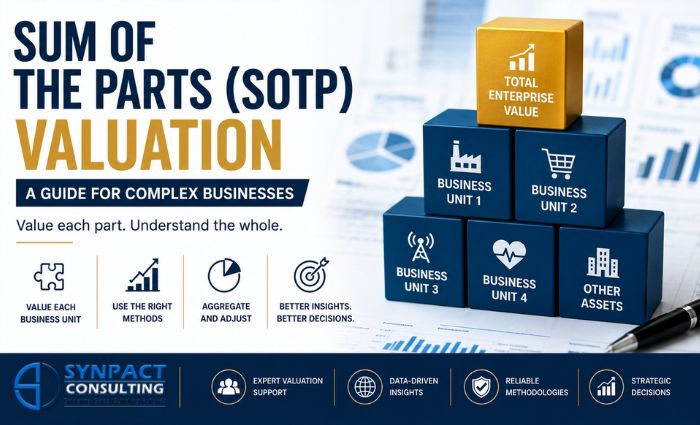
Sum of the Parts (SOTP) Valuation: A Guide for Complex Businesses
Valuing a business is rarely a straightforward exercise. While some companies operate within a single industry or business segment, many large organisations generate revenue from multiple business units that have distinct products, markets, risk profiles and growth trajectories.
Applying a single valuation methodology to such businesses can sometimes oversimplify reality and produce inaccurate results.
This is where Sum of the Parts (SOTP) Valuation becomes valuable.
SOTP valuation is a specialised valuation methodology used to determine the value of diversified companies by valuing each business segment separately and then combining those values into a total enterprise value.
Investment banks, private equity firms, valuation consultants and corporate finance professionals frequently use SOTP analysis when evaluating conglomerates, diversified enterprises and companies with multiple operating divisions.
In this guide, we explain how SOTP valuation works, when it should be used, its advantages and limitations, and why it remains an important tool in modern valuation practice.
What Is SOTP Valuation?
Sum of the Parts (SOTP) Valuation is a valuation methodology that estimates the total value of a company by separately valuing each of its business segments and then adding those values together.
The basic principle is:
The total value of a diversified company equals the combined value of its individual businesses and assets.
Unlike traditional valuation methods that view the organisation as a single entity, SOTP recognises that different divisions may have significantly different characteristics.
For example:
A company may operate:
- A technology division
- A manufacturing division
- A healthcare division
- A real estate portfolio
Each segment may require a different valuation approach and multiple.
SOTP allows analysts to capture these differences more accurately.
Why SOTP Valuation Is Used
Many diversified businesses contain segments with varying:
- Growth rates
- Profit margins
- Risk profiles
- Capital requirements
- Market opportunities
Applying a single valuation multiple to the entire organisation may understate or overstate value.
SOTP analysis provides a more detailed and realistic valuation by evaluating each business unit independently.
This methodology is especially useful for:
- Conglomerates
- Holding companies
- Diversified corporations
- Multi-industry organisations
- Businesses considering restructuring
When SOTP Valuation Is Most Appropriate
SOTP valuation is commonly used when companies operate across multiple industries or business segments.
Examples include:
Conglomerates
Large organisations with multiple unrelated business lines.
Holding Companies
Businesses that own stakes in multiple subsidiaries.
Diversified Public Companies
Corporations operating across several industries.
Corporate Restructuring
Companies considering spin-offs, divestitures or asset sales.
Strategic Transactions
Businesses evaluating acquisition and disposal opportunities.
How Sum of the Parts Valuation Works
SOTP analysis follows a structured process.
Step 1: Identify Business Segments
The first step is dividing the organisation into separate operating units.
Examples may include:
- Consumer products
- Technology
- Healthcare
- Manufacturing
- Financial services
- Real estate
Each segment should have identifiable financial performance and operating characteristics.
Step 2: Analyse Segment Financials
Once segments have been identified, analysts evaluate:
- Revenue
- EBITDA
- EBIT
- Net income
- Cash flow
- Growth rates
- Capital expenditure requirements
Segment-level financial analysis forms the foundation of SOTP valuation.
Step 3: Select Appropriate Valuation Methodologies
Different segments may require different valuation approaches.
For example:
Technology Segment
May be valued using:
- EV / Revenue
- DCF Valuation
Manufacturing Segment
May be valued using:
- EV / EBITDA
- Comparable Company Analysis
Real Estate Assets
May be valued using:
- Net Asset Value (NAV)
- Market appraisal methods
This flexibility is one of the key strengths of SOTP analysis.
Step 4: Value Each Business Segment
Each segment is independently valued using the most appropriate methodology.
For example:
Segment A
Technology Division
Value = $300 Million
Segment B
Manufacturing Division
Value = $250 Million
Segment C
Healthcare Division
Value = $200 Million
Step 5: Combine Segment Values
The individual segment values are added together.
Formula:
Using the example above:
Technology Division = $300 Million

Manufacturing Division = $250 Million

Healthcare Division = $200 Million

Total Segment Value = $750 Million
Step 6: Adjust for Corporate Assets and Liabilities
The final step involves adjusting for:
Additions
- Excess cash
- Investments
- Non-operating assets
Deductions
- Debt
- Pension liabilities
- Other corporate obligations
Formula:
The result represents the estimated equity value of the organisation.
Advantages of SOTP Valuation
SOTP valuation offers several important benefits.
Greater Accuracy
Different business units are valued according to their specific characteristics.
This often produces more realistic valuation outcomes.
Better Strategic Insights
SOTP analysis helps management understand which segments create the most value.
Useful for Restructuring Decisions
Companies considering:
- Spin-offs
- Divestitures
- Asset sales
can evaluate opportunities more effectively.
Captures Hidden Value
Diversified businesses are sometimes undervalued by the market.
SOTP analysis can reveal value that may not be reflected in consolidated financial statements.
Supports Investor Communication
Investors often use SOTP analysis to understand the value contribution of different business units.
Limitations of SOTP Valuation
Despite its advantages, SOTP analysis has limitations.
Data Availability
Segment-level financial information may not always be available.
Complexity
SOTP models can become highly detailed and time-consuming.
Multiple Valuation Assumptions
Different methodologies introduce additional assumptions and judgement.
Potential Double Counting
Care must be taken to avoid counting assets or cash flows more than once.
SOTP vs DCF Valuation
Both methodologies are widely used.
DCF Valuation
- Values the company as a single entity
- Focuses on future cash flows
- Intrinsic valuation approach
SOTP Valuation
- Values each segment separately
- Captures business unit differences
- Particularly useful for diversified companies
Many professionals use both methodologies together.
SOTP vs Comparable Company Analysis
Comparable Company Analysis
- Uses peer company multiples
- Market-based approach
- Focuses on similar companies
SOTP Valuation
- Values individual business segments
- Can incorporate multiple methodologies
- Better suited for diversified organisations
Real-World Examples of SOTP Valuation
SOTP analysis is frequently applied to:
Conglomerates
Companies operating across multiple industries.
Large Holding Companies
Businesses with numerous subsidiary investments.
Diversified Technology Firms
Companies with software, hardware and cloud divisions.
Industrial Groups
Organisations with manufacturing, logistics and service businesses.
Private Equity Portfolios
Investment firms evaluating portfolio company value.
How Valuation Professionals Use SOTP Analysis
Investment bankers and valuation consultants often use SOTP analysis for:
- Mergers and acquisitions
- Fairness opinions
- Strategic planning
- Investor presentations
- Corporate restructuring
- Spin-off analysis
Because of its flexibility, SOTP remains an important tool in complex valuation engagements.
The Role of Financial Modelling in SOTP Valuation
Sophisticated financial models are essential for effective SOTP analysis.
Analysts use financial modelling to:
- Forecast segment performance
- Calculate valuation multiples
- Perform sensitivity analysis
- Evaluate restructuring scenarios
Many firms leverage financial modelling outsourcing and business valuation outsourcing services to support complex valuation projects.
Why Firms Outsource Valuation Support
As valuation projects become more sophisticated, organisations increasingly work with specialised valuation providers.
Benefits include:
- Access to experienced analysts
- Improved scalability
- Faster turnaround times
- Cost efficiency
- Enhanced analytical capabilities
Leading valuation outsourcing companies in India provide support for investment banks, CPA firms, advisory firms and private equity organisations worldwide.
Why Synpact Consulting
Synpact Consulting supports clients with:
- SOTP Valuation
- DCF Valuation
- Comparable Company Analysis
- Precedent Transaction Analysis
- Financial Modelling
- Business Valuation
- Transaction Advisory Support
Our valuation professionals help organisations deliver accurate, scalable and actionable valuation insights.
Conclusion
Sum of the Parts (SOTP) Valuation is a powerful methodology for analysing diversified businesses and complex corporate structures. By valuing each business segment independently, SOTP provides a more nuanced and accurate view of enterprise value than many traditional approaches.
For conglomerates, holding companies and diversified organisations, SOTP analysis can uncover hidden value, improve strategic decision-making and support major corporate transactions.
When combined with DCF Valuation, Comparable Company Analysis and Precedent Transaction Analysis, SOTP becomes an essential component of a comprehensive valuation framework.
Looking for Expert Valuation Support?
Contact Synpact Consulting today to learn how our valuation professionals can help your organisation with SOTP analysis, financial modelling and advanced business valuation solutions.