
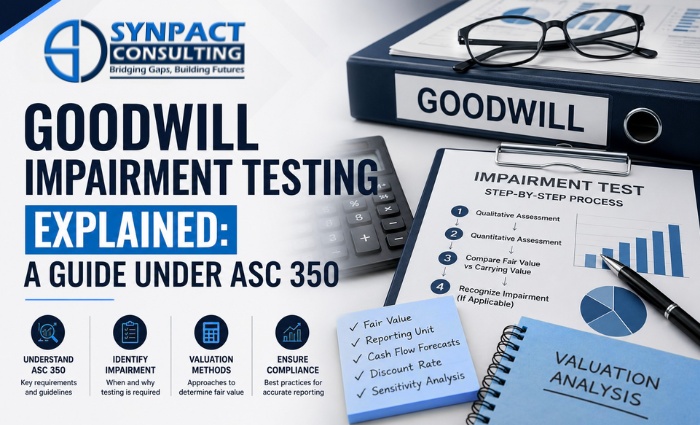
Goodwill Impairment Testing Explained: A Guide Under ASC 350
When businesses acquire another company, the purchase price often exceeds the fair value of the identifiable assets and liabilities acquired. This excess amount is recognised as goodwill, one of the most significant intangible assets on a company’s balance sheet.
Unlike many other intangible assets, goodwill is not amortised. Instead, accounting standards require businesses to assess whether goodwill has lost value over time through a process known as goodwill impairment testing.
Under ASC 350 – Intangibles – Goodwill and Other, companies must evaluate goodwill periodically and whenever events indicate that its carrying value may no longer be recoverable.
For CFOs, auditors, valuation professionals, private equity firms and corporate finance teams, understanding goodwill impairment testing is an essential part of professional business valuation services that support accurate financial reporting, regulatory compliance and strategic decision-making.
This guide explains how goodwill impairment testing works, the requirements under ASC 350, valuation methodologies used and best practices for businesses.
What Is Goodwill?
Goodwill is an intangible asset that represents the future economic benefits arising from assets that cannot be individually identified and separately recognised.
Goodwill typically includes:
- Brand reputation
- Customer loyalty
- Skilled workforce
- Expected business synergies
- Market position
- Future growth opportunities
Unlike goodwill, intangible asset valuation focuses on separately identifying and measuring assets such as customer relationships, brands, patents and proprietary technology.
How Goodwill Is Created
Goodwill is created during a business acquisition when the purchase price exceeds the fair value of the acquired company’s identifiable net assets. Before goodwill can be recognised, organisations perform Purchase Price Allocation (PPA) to assign the acquisition price to identifiable tangible assets, intangible assets and liabilities acquired.
For example:
- Purchase Price = $120 Million
- Fair Value of Net Identifiable Assets = $95 Million
Goodwill = $25 Million
This goodwill reflects the premium paid for future economic benefits that cannot be separately identified.
What Is Goodwill Impairment Testing?
Goodwill impairment testing is the process of determining whether the carrying amount of goodwill exceeds its fair value.
If goodwill is determined to be impaired, the company must recognise an impairment loss in its financial statements.
The objective is to ensure that goodwill remains fairly stated and does not overstate the company’s financial position.
Understanding ASC 350
ASC 350 provides accounting guidance for goodwill and other intangible assets.
Under ASC 350:
- Goodwill is not amortised
- Goodwill must be tested for impairment at least annually
- Additional testing is required whenever triggering events occur
- Impairment losses cannot be reversed under U.S. GAAP
The standard helps maintain transparency and consistency in financial reporting.
When Is Goodwill Impairment Testing Required?
Companies generally perform goodwill impairment testing:
Annual Testing
Most organisations perform testing once every fiscal year.
Triggering Events
Additional testing may be required if significant events occur, such as:
- Declining revenues
- Reduced profitability
- Loss of major customers
- Increased competition
- Economic downturns
- Regulatory changes
- Significant changes in market conditions
- Declining stock price
- Business restructuring
These events may indicate that goodwill has lost value.
Qualitative Assessment (Step 0)
ASC 350 allows companies to first perform a qualitative assessment.
This assessment considers whether it is more likely than not that the fair value of the reporting unit is less than its carrying amount.
Factors evaluated include:
- Industry conditions
- Economic environment
- Financial performance
- Market changes
- Operational challenges
If no indicators of impairment exist, further quantitative testing may not be necessary.
Quantitative Assessment
If the qualitative assessment indicates potential impairment, or if management chooses to bypass it, a quantitative test is performed.
The process compares:
- Carrying value of the reporting unit
- Fair value of the reporting unit
If:
Fair Value < Carrying Value
then goodwill impairment exists.
The impairment loss equals the amount by which carrying value exceeds fair value, limited to the recorded goodwill balance.
How Fair Value Is Determined
Determining fair value measurement requires professional valuation analysis using recognised methodologies that comply with ASC 820 and current market conditions.
Several valuation methodologies may be applied depending on the business.
Income Approach
The Income Approach estimates fair value using projected future cash flows. One of the most widely accepted techniques is DCF valuation, which calculates the present value of expected future cash flows to determine business value.
Common techniques include:
- Discounted Cash Flow (DCF)
- Multi-period cash flow analysis
This is one of the most commonly used methods in goodwill impairment testing.
Market Approach
The Market Approach estimates value using Comparable Company Analysis, market multiples and comparable transactions involving similar businesses operating in the same industry.
- Comparable public companies
- Market multiples
- Comparable transactions
This method reflects current market conditions.
Cost Approach
Although less common for goodwill testing, the Cost Approach may be appropriate for certain asset groups where replacement cost better reflects value.
Common Indicators of Goodwill Impairment
Businesses should monitor several warning signs.
Examples include:
- Declining cash flows
- Reduced profitability
- Loss of key management
- Increased market competition
- Industry disruption
- Technological changes
- Adverse legal developments
- Lower market capitalisation
These indicators may require immediate impairment testing.
Challenges in Goodwill Impairment Testing
Goodwill impairment testing often involves significant judgement.
Common challenges include:
Forecasting Future Cash Flows
Reliable financial projections are essential.
Selecting Discount Rates
Small changes in discount rates can materially impact valuation. Many organisations also leverage financial modelling outsourcing to build complex valuation models, perform sensitivity analysis and support goodwill impairment assessments with greater accuracy.
Market Volatility
Economic uncertainty affects valuation assumptions.
Reporting Unit Identification
Determining the correct reporting unit requires careful analysis.
Documentation
Supporting assumptions must be sufficiently documented for auditors.
Best Practices for Goodwill Testing
Businesses can improve the quality of impairment testing by:
- Performing regular monitoring
- Updating financial forecasts
- Using current market data
- Documenting assumptions thoroughly
- Engaging experienced valuation professionals
- Reviewing valuation models annually
These practices help improve compliance and reduce audit risk.
Why Companies Outsource Goodwill Valuation
Many global organisations partner with experienced valuation outsourcing companies in India because goodwill impairment testing requires specialised valuation expertise, advanced financial modelling and audit-ready documentation. Outsourcing helps businesses improve efficiency, reduce turnaround time and access dedicated valuation professionals.
Benefits include:
- Independent valuation analysis
- Experienced professionals
- Audit-ready documentation
- Regulatory compliance
- Faster turnaround
- Advanced financial modelling capabilities
Specialist valuation providers also help businesses manage peak workloads without expanding internal teams.
Why Synpact Consulting
Synpact Consulting provides specialised valuation solutions for businesses, investment firms and advisory organisations.
Our expertise includes:
- Goodwill Impairment Testing
- ASC 350 Compliance
- Purchase Price Allocation (PPA)
- Fair Value Measurement (ASC 820)
- Intangible Asset Valuation
- Business Valuation
- Financial Modelling
- Transaction Advisory Support
Our experienced valuation professionals deliver accurate, audit-ready and defensible valuation reports tailored to your financial reporting and strategic requirements.
Conclusion
Goodwill impairment testing is a critical part of financial reporting under ASC 350. By regularly assessing whether goodwill remains recoverable, businesses improve transparency, comply with accounting standards and provide investors with more reliable financial information.
As acquisition activity continues to grow, goodwill balances are becoming increasingly significant. Accurate impairment testing supported by robust valuation methodologies helps businesses minimise risk, satisfy auditors and make informed strategic decisions.
Looking for Expert Goodwill Impairment Testing Services?
Contact Synpact Consulting today to learn how our valuation professionals can assist with goodwill impairment testing, business valuation, fair value measurement and financial reporting support.
Frequently Asked Questions (FAQs)
What is goodwill impairment testing?
Goodwill impairment testing is the process of determining whether the recorded value of goodwill on a company’s balance sheet exceeds its current fair value. If goodwill is impaired, the business must recognize an impairment loss in its financial statements in accordance with ASC 350.
When is goodwill impairment testing required?
Companies are generally required to perform goodwill impairment testing at least once every year. Additional testing may also be necessary when significant events occur, such as declining revenues, market disruptions, loss of major customers or business restructuring.
What is ASC 350?
ASC 350 is the U.S. accounting standard that provides guidance on accounting for goodwill and other intangible assets. It requires businesses to test goodwill for impairment rather than amortizing it over time.
How is goodwill impairment calculated?
Goodwill impairment is determined by comparing the fair value of the reporting unit with its carrying amount. If the carrying amount exceeds the fair value, the difference—up to the recorded goodwill balance—is recognized as an impairment loss.
Which valuation methods are used for goodwill impairment testing?
Valuation professionals commonly use:
Income Approach (Discounted Cash Flow)
Market Approach (Comparable Company Analysis)
Comparable Transactions
Other valuation techniques depending on the nature of the business and available market data.
Can goodwill impairment be reversed?
Under U.S. GAAP (ASC 350), goodwill impairment losses cannot be reversed once they have been recognized. Businesses should ensure accurate valuations and thorough documentation before recording an impairment charge.
Why do companies outsource goodwill impairment testing?
Many organizations outsource goodwill impairment testing to experienced valuation professionals because it requires specialized expertise in financial modeling, valuation methodologies, accounting standards and audit documentation. Outsourcing also improves efficiency and helps ensure regulatory compliance.
How does goodwill impairment relate to Purchase Price Allocation (PPA)?
Goodwill is initially recognized during Purchase Price Allocation (PPA) after a business acquisition. Once recorded, that goodwill must be tested periodically for impairment under ASC 350 to ensure its carrying value remains recoverable.
Which industries commonly require goodwill impairment testing?
Goodwill impairment testing is common across many industries, including:
Technology
Healthcare
Financial Services
Manufacturing
Consumer Goods
Private Equity Portfolio Companies
Professional Services
Any business involved in mergers and acquisitions may be required to perform goodwill impairment testing.
How can Synpact Consulting help with goodwill impairment testing?
Synpact Consulting provides professional goodwill impairment testing services, fair value measurement, Purchase Price Allocation (PPA), business valuation, financial modelling and transaction advisory support. Our valuation experts help businesses prepare accurate, audit-ready reports that comply with ASC 350 and other applicable accounting standards.