
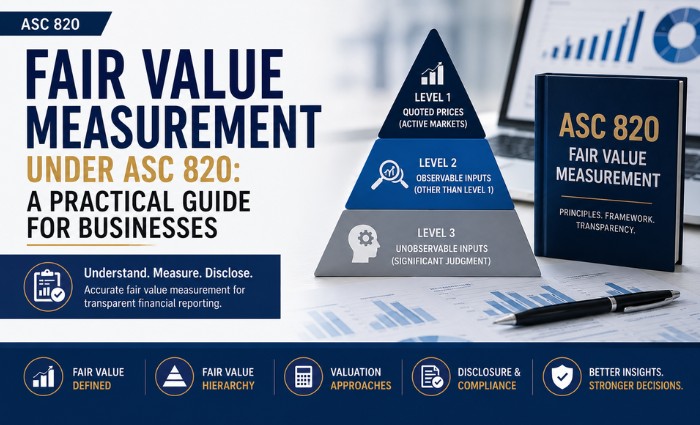
Fair Value Measurement Under ASC 820: A Practical Guide for Businesses
Financial reporting requires businesses to present information that accurately reflects the economic reality of their assets and liabilities. One of the most important accounting concepts supporting this objective is fair value measurement.
Under U.S. Generally Accepted Accounting Principles (GAAP), fair value measurement is governed by ASC 820 – Fair Value Measurement. This standard establishes a consistent framework for measuring fair value and enhances transparency in financial reporting.
Whether a company holds investments, intangible assets, derivative instruments, business acquisitions or complex financial instruments, ASC 820 often plays a critical role in determining how those assets and liabilities are reported.
For CFOs, auditors, private equity firms, investment managers and valuation professionals, understanding ASC 820 is essential for regulatory compliance and accurate financial reporting.
This guide explains how fair value measurement works, the fair value hierarchy, valuation methodologies and common compliance challenges businesses encounter.
What Is Fair Value Measurement?
Fair value measurement refers to the process of estimating the price that would be received to sell an asset or paid to transfer a liability in an orderly transaction between market participants at the measurement date.
ASC 820 defines fair value as:
The price that would be received to sell an asset or paid to transfer a liability in an orderly transaction between market participants at the measurement date.
This definition focuses on an exit price rather than the original purchase price.
The objective is to determine the value that market participants would assign to an asset or liability under current market conditions.
Understanding ASC 820
ASC 820 does not determine when fair value should be applied.
Instead, it establishes:
- A consistent definition of fair value
- A framework for measuring fair value
- Disclosure requirements
- A hierarchy of valuation inputs
The standard promotes consistency across financial reporting and valuation practices.
Why Fair Value Measurement Matters
Fair value measurement provides stakeholders with more relevant and transparent financial information.
It helps:
- Investors evaluate risk
- Improve financial statement accuracy
- Support acquisition accounting
- Enhance transparency
- Ensure regulatory compliance
- Improve investment decision-making
Without fair value measurements, financial statements may not accurately reflect current market conditions.
The Definition of Fair Value
ASC 820 assumes that fair value is determined from the perspective of market participants.
Several key assumptions apply:
Orderly Transaction
The transaction is not forced or distressed.
Market Participants
Buyers and sellers are independent, knowledgeable and willing to transact.
Measurement Date
Valuation reflects conditions existing at the reporting date.
Principal Market
The valuation assumes the most advantageous or principal market available.
These assumptions create consistency across fair value estimates.
The Fair Value Hierarchy
One of the most important aspects of ASC 820 is the Fair Value Hierarchy.
The hierarchy categorises valuation inputs into three levels based on observability.
Level 1 Inputs
Level 1 inputs represent the highest quality valuation inputs.
These are:
- Quoted prices
- Active markets
- Identical assets or liabilities
Examples include:
- Publicly traded stocks
- Exchange-traded securities
- Actively traded ETFs
Because market prices are directly observable, minimal judgement is required.
Level 2 Inputs
Level 2 inputs are observable but not directly quoted for identical assets.
Examples include:
- Similar asset pricing
- Interest rate curves
- Market yield data
- Credit spreads
- Bond pricing
Level 2 valuations require some adjustments and professional judgement.
Level 3 Inputs
Level 3 inputs involve significant management assumptions and unobservable data.
Examples include:
- Private company investments
- Illiquid securities
- Intangible assets
- Complex derivatives
- Private equity investments
Level 3 valuations often require extensive financial modelling and valuation expertise.
Why Level 3 Valuations Receive More Scrutiny
Level 3 measurements involve greater subjectivity.
As a result:
- Auditors perform detailed reviews
- Regulators examine assumptions
- Investors evaluate disclosures carefully
Proper documentation becomes particularly important.
Valuation Approaches Used Under ASC 820
ASC 820 recognises three primary valuation approaches.
Market Approach
The Market Approach estimates value using market transactions involving comparable assets or businesses.
Examples include:
- Comparable Company Analysis
- Market multiples
- Comparable transactions
This approach is commonly used when reliable market data exists.
Income Approach
The Income Approach estimates value based on future economic benefits.
Common techniques include:
- Discounted Cash Flow Analysis
- Earnings capitalisation
- Excess earnings methods
DCF remains one of the most frequently used methodologies for fair value measurement.
Cost Approach
The Cost Approach estimates value based on replacement or reproduction cost.
This approach is often applied to:
- Fixed assets
- Certain intangible assets
- Specialised equipment
The methodology focuses on the cost required to replace an asset’s service potential.
Common Assets Subject to Fair Value Measurement
ASC 820 applies across many asset categories.
Private Equity Investments
Private equity funds frequently require fair value measurement for portfolio companies.
Valuation professionals often use:
- DCF analysis
- Market multiples
- Transaction benchmarks
to estimate fair value.
Debt Instruments
Debt securities may require periodic fair value assessments.
Examples include:
- Corporate bonds
- Structured debt
- Convertible notes
Intangible Assets
Common intangible assets include:
- Customer relationships
- Trademarks
- Brands
- Technology assets
- Patents
Many of these assets arise during acquisitions and Purchase Price Allocation engagements.
Derivative Instruments
Derivatives often require complex fair value models.
Examples include:
- Options
- Warrants
- Swaps
- Forward contracts
These valuations frequently involve advanced modelling techniques.
Fair Value Measurement in Mergers and Acquisitions
Fair value measurement plays a major role in acquisition accounting.
Following a transaction, businesses often perform:
- Purchase Price Allocation (PPA)
- Intangible asset valuation
- Goodwill calculations
ASC 820 principles support these activities by providing valuation guidance.
Challenges in Fair Value Measurement
Although ASC 820 provides a framework, fair value measurement can be highly complex.
Limited Market Data
Private assets often lack observable market pricing.
Valuation Assumptions
Growth rates, discount rates and future projections require professional judgement.
Economic Volatility
Changing market conditions can significantly affect valuation conclusions.
Documentation Requirements
Supporting assumptions and methodologies requires substantial effort.
Common ASC 820 Compliance Mistakes
Several mistakes frequently occur during fair value engagements.
Inadequate Documentation
Weak documentation can create audit issues.
Unsupported Assumptions
Valuation assumptions must be evidence-based.
Incorrect Hierarchy Classification
Misclassifying assets within the hierarchy can create reporting errors.
Failure to Update Valuations
Market conditions change over time and valuations must remain current.
Why Businesses Outsource Fair Value Valuation
Many organisations work with specialised valuation providers to support ASC 820 compliance.
Benefits include:
- Access to experienced valuation professionals
- Independent analysis
- Audit-ready documentation
- Regulatory compliance
- Faster reporting cycles
- Improved valuation consistency
Many global organisations rely on valuation outsourcing companies in India to support fair value measurement, financial reporting and transaction-related valuation requirements.
How Fair Value Measurement Relates to Other Valuation Services
Fair value measurement often intersects with:
Purchase Price Allocation
Acquired assets must be measured at fair value.
Business Valuation Services
Businesses often require fair value estimates for financial reporting and strategic transactions.
DCF Valuation
Future cash flow analysis remains a widely used fair value methodology.
Financial Modelling Outsourcing
Complex valuation models frequently require dedicated analytical support.
Why Synpact Consulting
Synpact Consulting provides specialised support for:
- ASC 820 Valuation
- Fair Value Measurement
- Purchase Price Allocation
- Business Valuation
- Financial Modelling
- Intangible Asset Valuation
- Transaction Advisory Support
Our professionals help businesses, private equity firms, investment managers and advisory organisations navigate complex financial reporting and valuation requirements with confidence.
Conclusion
Fair Value Measurement under ASC 820 plays a critical role in modern financial reporting. By providing a consistent framework for estimating asset and liability values, ASC 820 improves transparency, comparability and decision-making.
Whether measuring private company investments, intangible assets, financial instruments or acquisition-related assets, businesses must apply robust valuation methodologies and maintain strong documentation practices.
As valuation requirements become increasingly complex, partnering with experienced valuation professionals can help organisations achieve compliance, reduce risk and improve reporting quality.
Looking for Expert Fair Value Measurement Support?
Contact Synpact Consulting today to learn how our valuation professionals can support your ASC 820, financial reporting and business valuation requirements.