
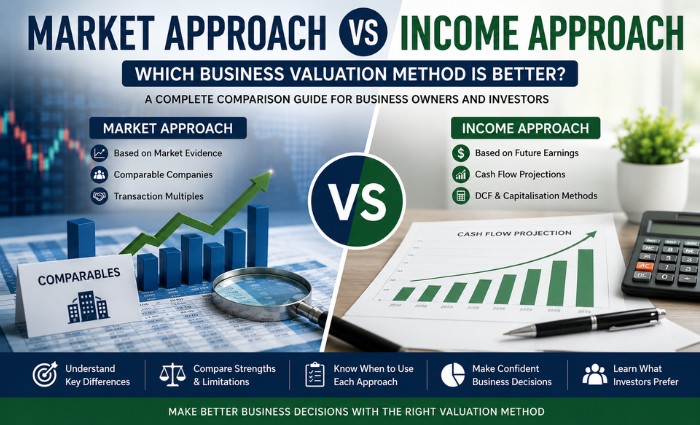
Market Approach vs Income Approach: Which Business Valuation Method Is Better?
When determining the value of a business, one of the first questions valuation professionals must answer is which valuation approach is most appropriate.
While many business owners assume there is a single formula that determines value, professional business valuation is far more nuanced. The value of a business depends not only on its financial performance but also on its industry, growth prospects, market conditions, purpose of the valuation, and the availability of reliable data.
Among the three primary business valuation approaches recognized under professional valuation standards—the Income Approach, Market Approach, and Asset Approach—the Income Approach and Market Approach are by far the most commonly used for profitable operating businesses.
Both methods aim to estimate the fair value of a business, but they answer fundamentally different questions.
- The Income Approach asks: “What is this business worth based on the future economic benefits it is expected to generate?”
- The Market Approach asks: “What are similar businesses worth in today’s market?”
Although both methods often produce reasonable valuation estimates, they rely on different assumptions, different sources of information, and different analytical techniques. Understanding these differences is essential for business owners, investors, financial professionals, and anyone involved in mergers and acquisitions, succession planning, financial reporting, or tax matters.
In this guide, we’ll compare the Market Approach and the Income Approach in detail, explain when each method is appropriate, discuss their strengths and limitations, and explore why professional valuation specialists frequently consider both approaches before reaching a final valuation conclusion.
Why Choosing the Right Valuation Method Matters
Selecting the appropriate valuation methodology is not simply a technical exercise—it directly affects the credibility and usefulness of the valuation.
Different valuation methods can produce different conclusions because each focuses on different aspects of a business.
For example:
- A rapidly growing technology company may have relatively modest current earnings but significant future growth potential.
- A mature manufacturing business may generate highly predictable cash flows with limited growth opportunities.
- A privately held consulting firm may have few tangible assets but substantial earning capacity.
- A real estate holding company may derive most of its value from its underlying assets rather than its operating income.
Applying the wrong valuation approach can lead to conclusions that do not accurately reflect the company’s economic reality.
This is why experienced valuation professionals evaluate the specific facts and circumstances of each engagement before selecting a valuation methodology.
The Three Primary Business Valuation Approaches
Professional valuation standards generally recognize three broad approaches to business valuation.
1. Income Approach
The Income Approach estimates value based on the future economic benefits a business is expected to generate.
Rather than focusing on historical performance alone, this approach evaluates the company’s ability to produce future cash flows or earnings and converts those future benefits into present value.
The two most common methods within the Income Approach are:
- Discounted Cash Flow Method
- Capitalisation of Cash Flow Method
These methods are particularly useful when a business’s future earning capacity is the primary driver of value.
Related Reading:
2. Market Approach
The Market Approach estimates value by comparing the subject company with other businesses that have been sold or are publicly traded.
Instead of projecting future cash flows, this approach analyzes market evidence such as:
- Comparable company transactions
- Public company trading multiples
- Acquisition multiples
- Industry benchmarks
The underlying principle is straightforward:
Similar businesses operating under similar conditions should have similar values.
However, identifying truly comparable businesses requires careful analysis and professional judgment.
3. Asset Approach
Although this article focuses on the Market Approach and Income Approach, it is worth noting the third major valuation methodology.
The Asset Approach estimates value based on the fair market value of a company’s assets minus its liabilities.
It is commonly used for:
- Asset-intensive businesses
- Holding companies
- Real estate entities
- Investment companies
- Liquidation analyses
For most profitable operating businesses, however, either the Income Approach or the Market Approach is generally more relevant.
Why There Is No “Best” Valuation Method
One of the most common misconceptions among business owners is the belief that one valuation method is always superior to another.
In reality, no single approach is universally considered the best.
Instead, the most appropriate method depends on several factors, including:
- Nature of the business
- Industry characteristics
- Financial performance
- Growth expectations
- Availability of reliable financial data
- Availability of comparable market transactions
- Purpose of the valuation
- Applicable professional standards
For example:
- A mature company with predictable earnings may be well suited to the Capitalisation of Cash Flow Method.
- A high-growth startup may require a Discounted Cash Flow analysis.
- A company operating in an active acquisition market may benefit from a Market Approach based on comparable transactions.
Professional valuation specialists often consider multiple approaches before determining which provides the most reliable indication of value.
The Fundamental Difference Between the Two Approaches
Although both approaches seek to estimate fair value, they rely on different perspectives.
Income Approach
The Income Approach focuses on:
- Future earning capacity
- Expected cash flow
- Business-specific risks
- Long-term growth
- Investment return expectations
It asks:
“What future economic benefits will this business generate?”
Market Approach
The Market Approach focuses on:
- Actual market transactions
- Comparable companies
- Investor behavior
- Market pricing
- Industry valuation multiples
It asks:
“How are similar businesses being valued today?”
Neither perspective is inherently better.
Instead, each provides valuable information that helps valuation professionals understand the company’s value from different viewpoints.
Why Professional Valuations Often Use Multiple Methods
Professional valuation reports rarely rely on only one valuation methodology.
Instead, valuation specialists frequently perform:
- Income Approach analysis
- Market Approach analysis
- Cross-checks between methodologies
- Reconciliation of valuation indications
Using multiple approaches provides several advantages:
- Improves reliability
- Reduces dependence on a single assumption
- Provides market validation
- Enhances credibility
- Supports a more balanced valuation conclusion
For example, if both the Income Approach and Market Approach produce similar valuation conclusions, confidence in the final estimate generally increases.
If the results differ significantly, the valuation professional investigates the reasons and determines which method better reflects the company’s economic reality.
Common Situations Where Both Approaches Are Considered
Both the Market Approach and the Income Approach are frequently applied in valuations prepared for:
- Mergers and acquisitions
- Shareholder buyouts
- Succession planning
- Estate and gift tax planning
- Financial reporting
- Purchase price allocation
- Strategic planning
- Litigation support
- Fairness opinions
- Investment analysis
The specific weighting assigned to each approach depends on the facts and circumstances of the engagement.
What You’ll Learn in This Guide
In the sections that follow, we’ll examine:
- How the Income Approach works
- How the Market Approach works
- Key differences between the two methods
- Advantages and limitations of each
- Practical valuation examples
- When each approach is most appropriate
- How valuation professionals reconcile multiple methods
- Common misconceptions
- Frequently asked questions
By the end of this guide, you’ll have a clear understanding of how these two widely used valuation approaches differ and why professional judgment remains one of the most important components of any credible business valuation.
Key Takeaway
The Market Approach and the Income Approach are two of the most widely used methods for valuing profitable businesses, but they measure value from different perspectives. While the Income Approach focuses on a company’s future earning capacity, the Market Approach relies on real-world market evidence from comparable businesses. Rather than viewing one method as universally superior, professional valuation specialists evaluate the specific characteristics of the business and often apply multiple approaches to develop a well-supported valuation conclusion.
Understanding the Income Approach
The Income Approach is one of the most widely accepted methods of business valuation because it measures value based on a company’s ability to generate future economic benefits. Rather than focusing solely on historical financial performance or current market prices, this approach estimates what a business is worth today by analyzing the cash flows or earnings it is expected to produce in the future.
From an investor’s perspective, the value of any business ultimately depends on the future returns it can generate. Whether purchasing a small privately held company or acquiring a multinational corporation, investors are primarily interested in the future cash flow they expect to receive. The Income Approach reflects this principle by converting anticipated future benefits into present value.
For this reason, the Income Approach is commonly used in mergers and acquisitions, financial reporting, tax planning, shareholder disputes, succession planning, and strategic business decisions.
How the Income Approach Works
The Income Approach begins with a simple premise:
A business is worth the present value of the future economic benefits it is expected to generate.
Unlike valuation methods that rely on market transactions, the Income Approach focuses specifically on the financial performance and earning capacity of the business being valued.
Rather than asking what similar companies have sold for, this approach asks:
“How much future cash flow can this business reasonably generate, and what is that stream of income worth today?”
Answering this question requires careful analysis of financial statements, expected future performance, investment risk, industry conditions, and long-term growth prospects.
The Two Primary Income Approach Methods
Although the Income Approach represents a single valuation approach, professionals typically apply one of two primary methods depending on the characteristics of the business.
Discounted Cash Flow (DCF) Method
The Discounted Cash Flow Method estimates value by projecting future cash flows over several years and discounting those projected cash flows back to present value using an appropriate discount rate.
This method is particularly appropriate when:
- The business is experiencing rapid growth.
- Future earnings are expected to change significantly.
- Major investments are planned.
- Cash flows fluctuate from year to year.
- Management has reliable financial forecasts.
Because each year’s expected performance is modeled individually, the DCF Method provides flexibility when valuing businesses undergoing meaningful operational or financial changes.
Related Reading: DCF Valuation: A Practical Guide for Business Owners
Capitalisation of Cash Flow Method
The Capitalisation of Cash Flow Method is generally used when a company has reached a mature stage of development and generates relatively stable annual cash flows.
Rather than forecasting multiple years individually, this method estimates a representative level of sustainable annual cash flow and converts that recurring economic benefit into business value using a capitalization rate.
It is commonly applied to:
- Professional service firms
- Manufacturing businesses
- Healthcare practices
- Engineering companies
- Family-owned businesses
- Established privately held companies
Related Reading: Capitalisation of Cash Flow Method Explained
Future Cash Flow Is the Foundation
Regardless of which Income Approach method is selected, future cash flow remains the central component of the valuation.
Depending on the engagement, valuation professionals may analyze:
- Free Cash Flow
- Operating Cash Flow
- EBITDA
- EBIT
- Seller’s Discretionary Earnings (SDE)
- Net Cash Flow
The choice depends on the company’s size, ownership structure, industry, and the purpose of the valuation.
Before these earnings measures are used, professionals typically perform financial normalization by removing unusual, non-recurring, and owner-specific items that do not reflect the company’s ongoing earning capacity.
This process helps estimate the sustainable level of future economic benefit that a hypothetical buyer could reasonably expect.
Understanding Present Value
One of the fundamental concepts behind the Income Approach is the time value of money.
A dollar received today is generally worth more than a dollar received several years from now because today’s money can be invested to generate additional returns.
As a result, future cash flows must be converted into today’s dollars before determining business value.
This process is known as discounting.
The discount rate reflects the return an investor requires after considering the risks associated with owning the business.
Businesses with greater uncertainty require higher expected returns, resulting in higher discount rates and lower present values.
Key Factors Considered Under the Income Approach
Professional valuation specialists consider a wide range of quantitative and qualitative factors when applying the Income Approach.
Historical Financial Performance
Historical results help establish trends in:
- Revenue growth
- Profitability
- Operating margins
- Cash generation
- Capital expenditures
- Working capital requirements
Future Growth Expectations
Future projections are developed after evaluating:
- Industry outlook
- Market demand
- Competitive position
- Management strategy
- Expansion opportunities
- Economic conditions
Business Risk
Investment risk influences both discount rates and capitalization rates.
Professionals evaluate factors such as:
- Customer concentration
- Management depth
- Competitive advantages
- Financial leverage
- Industry volatility
- Operational stability
Advantages of the Income Approach
- Focuses on the company’s own earning capacity rather than external market pricing.
- Reflects business-specific risks and opportunities.
- Suitable for businesses with limited comparable market data.
- Recognized under professional valuation standards worldwide.
- Provides flexibility for both stable and high-growth businesses.
Limitations of the Income Approach
- Depends heavily on assumptions regarding future performance.
- Requires reliable financial information.
- Can be sensitive to changes in discount or capitalization rates.
- Forecast accuracy becomes increasingly important for long-term projections.
- Professional judgment plays a significant role in determining key assumptions.
When the Income Approach Is Most Appropriate
The Income Approach is generally preferred when:
- The business is profitable.
- Future earnings can be reasonably estimated.
- Reliable financial records are available.
- The company’s value is driven primarily by its earning capacity.
- Comparable market transactions are limited or unavailable.
Because many privately held businesses derive most of their value from future earnings rather than tangible assets, the Income Approach is frequently considered the primary valuation methodology.
Key Takeaway
The Income Approach estimates business value by focusing on future earning capacity rather than historical cost or market pricing. Whether using the Discounted Cash Flow Method or the Capitalisation of Cash Flow Method, the objective remains the same: estimating the present value of the economic benefits a business is expected to generate. By incorporating financial performance, future growth, investment risk, and professional judgment, the Income Approach provides one of the most comprehensive frameworks for valuing profitable businesses.
Understanding the Market Approach
While the Income Approach estimates value based on a company’s future earning capacity, the Market Approach determines value by comparing the business with similar companies that have been sold or are publicly traded.
The underlying principle is based on one of the most fundamental concepts in economics:
A knowledgeable buyer is unlikely to pay significantly more for a business than the price at which a comparable business could be acquired.
Instead of projecting future cash flows, the Market Approach relies on actual market evidence to estimate what investors are willing to pay for similar businesses under similar circumstances.
Because it reflects real-world transactions, the Market Approach is widely used in mergers and acquisitions, private equity transactions, financial reporting, fairness opinions, and strategic planning.
How the Market Approach Works
The Market Approach estimates value by analyzing valuation multiples derived from comparable companies.
The general process involves:
- Identifying companies similar to the subject business.
- Collecting financial and transaction data.
- Calculating valuation multiples.
- Adjusting for differences between companies.
- Applying appropriate multiples to the subject company’s financial metrics.
The objective is to estimate what informed buyers are currently paying for businesses with comparable characteristics.
The Three Primary Market Approach Methods
Professional valuation specialists generally apply one or more of the following Market Approach methods.
1. Guideline Public Company Method (GPCM)
The Guideline Public Company Method compares the subject company with publicly traded businesses operating in the same or similar industries.
Professionals analyze valuation multiples derived from stock market prices, including:
- Enterprise Value to EBITDA (EV/EBITDA)
- Enterprise Value to Revenue (EV/Revenue)
- Price-to-Earnings (P/E)
- Enterprise Value to EBIT (EV/EBIT)
Because public companies often differ significantly from privately held businesses in terms of size, liquidity, and access to capital, valuation specialists typically make appropriate adjustments before applying public market multiples.
2. Guideline Transaction Method (Precedent Transactions)
This method analyzes actual acquisition transactions involving businesses comparable to the company being valued.
Instead of relying on stock market pricing, professionals review completed mergers and acquisitions to determine the valuation multiples paid by strategic buyers and financial investors.
These transactions often provide valuable insight into market pricing because they reflect real purchase decisions rather than public trading activity.
Common sources of transaction data include:
- Private M&A databases
- Investment banking reports
- Industry acquisition studies
- Publicly disclosed transactions
3. Comparable Company Analysis (CCA)
Comparable Company Analysis (CCA) is one of the most frequently used valuation techniques within the Market Approach.
Rather than selecting companies solely because they operate in the same industry, valuation professionals evaluate numerous factors to determine whether companies are truly comparable.
These factors include:
- Industry
- Products and services
- Business model
- Company size
- Revenue
- Profitability
- Growth rate
- Geographic markets
- Customer base
- Capital structure
The goal is to identify businesses that investors would reasonably consider similar to the subject company.
Understanding Valuation Multiples
The Market Approach relies heavily on valuation multiples because they allow professionals to compare businesses of different sizes.
Some of the most commonly used multiples include:
EV/EBITDA
Enterprise Value to EBITDA is one of the most widely used valuation multiples because EBITDA provides a measure of operating profitability before financing decisions, taxes, depreciation, and amortization.
Many middle-market acquisitions are negotiated using EV/EBITDA multiples.
EV/Revenue
Revenue multiples are commonly used when:
- Businesses have inconsistent earnings.
- Companies are in high-growth industries.
- Profitability varies significantly.
- Early-stage companies have limited operating history.
Price-to-Earnings (P/E)
The Price-to-Earnings ratio compares equity value with net income.
It is commonly used for profitable public companies but is generally less useful for privately held businesses because differences in capital structure and owner compensation can distort earnings.
Selecting Comparable Companies
Choosing appropriate comparable companies is one of the most important aspects of the Market Approach.
Professionals consider factors such as:
- Industry classification
- Products and services
- Revenue size
- Profit margins
- Customer mix
- Growth expectations
- Business lifecycle
- Geographic presence
- Competitive position
- Risk profile
No two businesses are identical, which is why professional judgment is required when evaluating comparability.
Adjustments Under the Market Approach
Rarely does a comparable company perfectly match the subject business.
Valuation professionals therefore evaluate differences that may justify adjustments, including:
- Company size
- Growth prospects
- Profitability
- Market position
- Customer concentration
- Financial leverage
- Liquidity
- Ownership characteristics
These adjustments help ensure that the selected multiples appropriately reflect the subject company’s specific characteristics.
Advantages of the Market Approach
- Reflects actual investor behavior and market pricing.
- Easy for business owners and investors to understand.
- Widely accepted in mergers and acquisitions.
- Provides useful market validation for other valuation methods.
- Can be highly reliable when strong comparable data exists.
Limitations of the Market Approach
- Finding truly comparable companies can be difficult.
- Private transaction data is often limited.
- Public companies may differ significantly from private businesses.
- Market conditions can change rapidly.
- Significant professional judgment is required when selecting and adjusting comparable companies.
When the Market Approach Is Most Appropriate
The Market Approach is generally preferred when:
- Reliable comparable companies exist.
- Sufficient transaction data is available.
- The industry has an active merger and acquisition market.
- Market pricing is considered a reliable indicator of value.
- The valuation requires benchmarking against current investor behavior.
It is particularly useful for businesses operating in industries with frequent acquisitions and abundant market data.
Key Takeaway
The Market Approach estimates business value by comparing the subject company with similar businesses that have been sold or are publicly traded. By analyzing valuation multiples such as EV/EBITDA, EV/Revenue, and comparable transaction data, valuation professionals estimate what informed buyers are willing to pay under current market conditions. While the Market Approach provides valuable market-based evidence, its reliability depends on the availability of high-quality comparable companies and the professional judgment used to adjust for differences between businesses.
Market Approach vs Income Approach: A Side-by-Side Comparison
Both the Market Approach and the Income Approach are recognized under professional valuation standards and are widely used to estimate the value of privately held and publicly traded businesses. However, they rely on different assumptions, different sources of information, and different analytical techniques.
Understanding these differences helps business owners, investors, and financial professionals determine which approach is more appropriate for a particular valuation engagement.
Comparison Overview
| Income Approach | Market Approach |
|---|---|
| Based on future earning capacity | Based on current market evidence |
| Uses projected or sustainable cash flow | Uses comparable companies and transactions |
| Company-specific analysis | Market-driven analysis |
| Requires discount or capitalization rates | Requires valuation multiples |
| Highly dependent on financial forecasts | Highly dependent on quality of comparable companies |
| Reflects intrinsic value | Reflects market value |
| Useful when limited market data exists | Useful when active market data is available |
Difference #1: Source of Value
Income Approach
The Income Approach estimates value based on the future economic benefits the business is expected to generate.
Its underlying assumption is that investors purchase businesses primarily for their future cash flows.
The valuation therefore depends on:
- Future profitability
- Expected cash flow
- Growth expectations
- Business-specific risks
- Required investment returns
Market Approach
The Market Approach estimates value based on how similar businesses are currently priced in the marketplace.
Rather than forecasting future performance, it relies on actual market evidence such as:
- Public company valuations
- Private acquisition transactions
- Industry multiples
- Comparable company analysis
Difference #2: Primary Data Used
The quality of any valuation depends heavily on the data supporting it.
| Income Approach | Market Approach |
|---|---|
| Historical financial statements | Public company pricing |
| Management forecasts | Private transaction databases |
| Cash flow projections | Industry acquisition multiples |
| Growth assumptions | Comparable company financial information |
| Risk analysis | Current market activity |
The Income Approach depends primarily on company-specific financial information, while the Market Approach depends on external market evidence.
Difference #3: Key Assumptions
Income Approach Assumptions
- Future earnings can be estimated reasonably.
- Historical performance is representative of future operations.
- Appropriate discount or capitalization rates can be determined.
- Management forecasts are reliable.
Market Approach Assumptions
- Comparable companies exist.
- Market transactions reflect fair value.
- Comparable multiples are representative.
- Differences between businesses can be adjusted appropriately.
Difference #4: Sensitivity to Assumptions
Both approaches are sensitive to assumptions, but the nature of those assumptions differs.
Income Approach
Small changes in:
- Revenue growth
- Profit margins
- Discount rate
- Capitalization rate
- Terminal growth
can significantly change the estimated value.
Market Approach
Similarly, valuation conclusions may change depending on:
- Comparable company selection
- Transaction quality
- Market timing
- Selected valuation multiples
- Adjustment methodology
Difference #5: Business Types
Income Approach Is Generally Better For
- Mature operating businesses
- Growing companies
- Service businesses
- Professional practices
- Companies with reliable forecasts
Market Approach Is Generally Better For
- Industries with active acquisition markets
- Businesses with many comparable companies
- Companies where strong transaction data exists
- Businesses operating in mature industries
Practical Example
Assume two manufacturing companies each generate annual EBITDA of $5 million.
Income Approach
A valuation professional projects future cash flows, evaluates industry risks, determines an appropriate discount rate, and estimates intrinsic value based on future earnings.
Market Approach
The professional identifies similar manufacturing companies that recently sold for approximately 7× EBITDA.
Applying this market multiple results in an estimated enterprise value of approximately $35 million.
If the Income Approach also produces a value close to $35 million, confidence in the overall valuation increases.
If the two approaches differ significantly, the valuation professional investigates the reasons before reaching a final conclusion.
Which Method Do Buyers Prefer?
Sophisticated buyers rarely rely on only one valuation methodology.
Strategic acquirers, private equity firms, and institutional investors commonly evaluate:
- Discounted Cash Flow analysis
- Comparable Company Analysis
- Precedent Transactions
- Industry valuation multiples
Multiple approaches help buyers assess value from different perspectives and reduce reliance on any single assumption.
Which Method Do Auditors and Regulators Prefer?
For financial reporting and regulatory purposes, valuation professionals frequently consider multiple valuation methods.
Auditors generally expect valuation reports to explain:
- Why a particular method was selected.
- Why other methods were considered.
- How assumptions were developed.
- Why the final conclusion is reasonable.
The emphasis is not on selecting one universally superior approach but on applying the method—or combination of methods—that best reflects the company’s economic reality.
Why Professionals Often Reconcile Multiple Methods
Professional valuation engagements commonly include both the Income Approach and the Market Approach.
After completing each analysis, the valuation specialist compares the results and determines whether:
- One approach should receive greater weight.
- Both approaches should be weighted equally.
- Certain methods should be excluded.
- Additional analysis is required.
This reconciliation process improves the reliability and credibility of the final valuation conclusion.
Key Takeaway
The Income Approach and the Market Approach estimate business value from different perspectives. The Income Approach focuses on future earning capacity, while the Market Approach relies on observable market evidence. Rather than viewing these approaches as competitors, professional valuation specialists often use both methods together to develop a balanced, well-supported estimate of value. Selecting the most appropriate methodology ultimately depends on the company’s characteristics, available data, and the purpose of the valuation.
When Should You Use the Income Approach?
The Income Approach is generally the preferred valuation methodology when a company’s value is driven primarily by its ability to generate future earnings and cash flow.
It is particularly appropriate when:
- The business has predictable future cash flows.
- Management can prepare reliable financial forecasts.
- The company has a stable operating history.
- Comparable market transactions are limited.
- The business derives most of its value from future earning potential rather than tangible assets.
Examples include:
- Professional service firms
- Healthcare practices
- Software companies
- Engineering firms
- Manufacturing businesses
- Established family-owned businesses
For these businesses, future earning capacity often provides the best indication of value.
When Should You Use the Market Approach?
The Market Approach is often most appropriate when reliable comparable companies or transaction data are available.
It is commonly used when:
- Recent acquisitions have occurred within the industry.
- Public companies provide meaningful benchmarks.
- Market pricing reflects current investor expectations.
- Comparable businesses share similar financial characteristics.
The Market Approach is frequently applied in:
- Mergers and acquisitions
- Private equity transactions
- Investment banking engagements
- Fairness opinions
- Strategic planning
Because it reflects actual investor behavior, many buyers view the Market Approach as an important reality check against internally developed valuation models.
Can Both Approaches Be Used Together?
Yes. In fact, many professional valuation engagements incorporate both the Income Approach and the Market Approach.
Using multiple approaches allows valuation specialists to:
- Validate assumptions.
- Cross-check valuation conclusions.
- Reduce reliance on a single methodology.
- Improve overall credibility.
- Provide a more balanced estimate of value.
If both approaches produce similar conclusions, confidence in the valuation generally increases. If they differ materially, additional analysis helps determine which approach better reflects the company’s economic reality.
Common Misconceptions
“The Market Approach is always more accurate.”
Not necessarily. The reliability of the Market Approach depends entirely on the availability of truly comparable companies and high-quality transaction data.
“The Income Approach is too subjective.”
Although the Income Approach relies on assumptions about future performance, those assumptions are supported by financial analysis, market evidence, industry research, and professional judgment.
“Only one valuation method should be used.”
Professional valuation specialists frequently apply multiple approaches and reconcile the results before reaching a final conclusion.
“Industry multiples determine business value.”
Industry averages provide useful context but should never replace a comprehensive valuation. Every business has unique characteristics that influence value.
Frequently Asked Questions (FAQs)
What is the main difference between the Income Approach and the Market Approach?
The Income Approach estimates value based on future earning capacity, while the Market Approach estimates value using comparable businesses and market transactions.
Which valuation method is more accurate?
Neither method is universally more accurate. The most appropriate approach depends on the characteristics of the business, available data, and the purpose of the valuation.
Why do valuation professionals often use both methods?
Using multiple methods provides additional evidence, improves credibility, and helps validate valuation conclusions.
What is Comparable Company Analysis?
Comparable Company Analysis estimates value by comparing a business with similar publicly traded or privately sold companies using valuation multiples.
What are valuation multiples?
Valuation multiples compare a company’s value with financial metrics such as revenue, EBITDA, EBIT, or earnings to estimate market value.
When is the Discounted Cash Flow Method preferred?
DCF is generally preferred for companies experiencing significant growth, changing profitability, or fluctuating cash flows.
When is the Capitalisation of Cash Flow Method appropriate?
It is best suited for mature businesses with stable, sustainable earnings and predictable future cash flows.
Can different valuation methods produce different values?
Yes. Each approach relies on different assumptions and data sources, which can result in different—but still reasonable—valuation conclusions.
Do investors rely only on market multiples?
No. Sophisticated investors typically evaluate market multiples alongside discounted cash flow analysis, strategic considerations, industry trends, and business-specific risks.
Should small businesses use the Income Approach or Market Approach?
The answer depends on the business. Many privately held businesses are valued using the Income Approach, while the Market Approach is often used as a supporting cross-check when reliable comparable data exists.
Conclusion
The Market Approach and the Income Approach are not competing valuation methodologies—they are complementary tools that help valuation professionals estimate business value from different perspectives.
The Income Approach focuses on the company’s future ability to generate earnings and cash flow, while the Market Approach reflects how comparable businesses are valued in the marketplace. Each approach has its own strengths, limitations, and appropriate applications.
Rather than asking which method is universally better, the more important question is which approach best reflects the economic characteristics of the business being valued. Experienced valuation professionals evaluate the facts, available data, and purpose of the engagement before determining the most appropriate methodology.
In many professional valuations, applying both approaches provides the strongest foundation for a well-supported and credible conclusion.
How Synpact Consulting Can Help
At Synpact Consulting, we provide independent business valuation services tailored to the unique characteristics of each engagement. Our professionals evaluate your company’s financial performance, industry, growth prospects, market conditions, and available data to determine the most appropriate valuation methodology.
Whether your engagement requires the Income Approach, the Market Approach, or a combination of both, we prepare objective, well-supported valuation reports that assist business owners, investors, auditors, legal advisors, and financial institutions in making informed decisions.
Contact Synpact Consulting to learn how our valuation professionals can support your next business valuation engagement.