
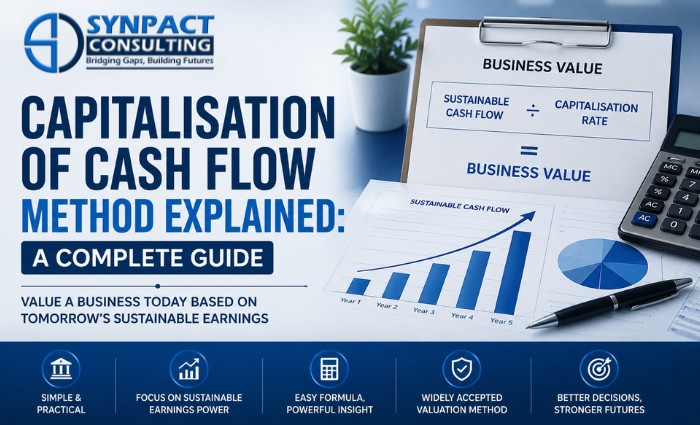
Capitalisation of Cash Flow Method Explained: A Complete Guide
Business valuation is not a one-size-fits-all process. While the Discounted Cash Flow (DCF) Method is often used for businesses experiencing changing growth rates or evolving financial performance, many mature businesses operate in a much more predictable environment. For these companies, projecting detailed cash flows over five or ten years may not always be necessary.
Instead, valuation professionals may apply the Capitalisation of Cash Flow Method, a widely accepted valuation technique within the Income Approach that estimates value based on a single representative level of sustainable future cash flow.
Rather than forecasting annual cash flows over an extended period, this method assumes that the business will continue generating relatively stable cash flows into the future. By capitalizing those expected cash flows using an appropriate capitalization rate, valuation professionals can estimate the value of the business in a simpler yet economically sound manner.
The Capitalisation of Cash Flow Method is frequently used for mature companies with consistent earnings, stable operations, and predictable long-term performance. It is commonly applied in business valuations prepared for shareholder transactions, succession planning, tax planning, financial reporting, and privately held company valuations.
In this guide, we’ll explain how the Capitalisation of Cash Flow Method works, how capitalization rates are determined, when the method is appropriate, and why professional judgment plays a critical role in producing reliable valuation conclusions.
What Is the Capitalisation of Cash Flow Method?
The Capitalisation of Cash Flow Method is an income-based valuation technique that estimates the value of a business by converting a single level of expected sustainable cash flow into value using a capitalization rate.
Unlike the Discounted Cash Flow Method, which projects multiple years of future cash flows, the Capitalisation Method assumes that future cash flows will remain relatively stable and continue indefinitely.
The concept is straightforward:
If a business is expected to generate a consistent level of cash flow each year, its value can be estimated by capitalizing that sustainable cash flow using an appropriate capitalization rate.
This approach simplifies the valuation process while still reflecting the relationship between expected future economic benefits and investment risk.
Why Stable Cash Flow Matters
The Capitalisation Method is based on the assumption that the business has reached a relatively stable stage of development.
Typical characteristics include:
- Consistent revenue
- Predictable operating margins
- Stable customer base
- Mature market position
- Moderate long-term growth
- Reliable historical performance
Because future cash flows are expected to remain relatively consistent, there is less need to prepare detailed year-by-year financial forecasts.
Capitalisation vs. Discounted Cash Flow (DCF)
Although both methods belong to the Income Approach, they are designed for different situations.
| Capitalisation of Cash Flow | Discounted Cash Flow (DCF) |
|---|---|
| Uses one representative cash flow | Projects multiple future cash flows |
| Best for mature, stable businesses | Best for businesses with changing growth |
| Simpler valuation model | More detailed financial forecasting |
| Assumes stable long-term growth | Allows varying growth rates over time |
| Less sensitive to annual forecasting assumptions | More flexible for dynamic businesses |
Rather than competing methods, they are complementary techniques selected based on the characteristics of the business being valued.
The Basic Concept Behind Capitalisation
At its core, the Capitalisation of Cash Flow Method estimates value by dividing sustainable annual cash flow by an appropriate capitalization rate.

Business Value = Sustainable Cash Flow ÷ Capitalization Rate
Conceptually, the method converts a perpetual stream of relatively stable future cash flows into a present value estimate.
The capitalization rate reflects:
- Investment risk
- Expected long-term growth
- Required investor return
- Market conditions
Higher capitalization rates generally result in lower business values, while lower capitalization rates produce higher values.
Why Investors Use the Capitalisation Method
Professional investors often use this methodology because it provides a practical way to value businesses that have already reached operational maturity.
Examples include:
- Professional service firms
- Medical practices
- Accounting firms
- Manufacturing businesses
- Distribution companies
- Established family-owned businesses
- Stable retail operations
For these businesses, future performance is often expected to resemble historical performance, making the Capitalisation Method an efficient valuation tool.
When Is the Capitalisation of Cash Flow Method Most Appropriate?
The method is generally appropriate when:
- Cash flows are stable
- Revenue growth is predictable
- Profit margins are consistent
- The business is expected to continue operating indefinitely
- Long-term growth is modest and sustainable
It is particularly useful for privately held businesses where detailed long-term forecasting may not materially improve the reliability of the valuation.
When Should This Method Be Used with Caution?
The Capitalisation Method may not be appropriate when:
- The business is experiencing rapid growth
- Earnings fluctuate significantly from year to year
- Major operational changes are expected
- Significant capital investments are planned
- The company is in an early stage of development
- Cash flows are highly uncertain
In these situations, the Discounted Cash Flow Method often provides a more representative estimate of value because it can accommodate changing financial performance over time.
Benefits of the Capitalisation Method
Some of the key advantages include:
- Simpler than multi-year DCF models
- Appropriate for stable businesses
- Requires fewer long-term forecasting assumptions
- Widely accepted by valuation professionals
- Efficient for many privately held companies
When applied to the right type of business, it provides a practical and reliable estimate of value.
Key Takeaway
The Capitalisation of Cash Flow Method is a widely accepted Income Approach valuation technique that estimates business value based on a single representative level of sustainable cash flow. It is most appropriate for mature businesses with predictable financial performance and stable long-term growth. By combining normalized cash flow with an appropriate capitalization rate, valuation professionals can estimate intrinsic business value without relying on complex multi-year financial projections.
How the Capitalisation of Cash Flow Method Works
Although the Capitalisation of Cash Flow Method appears simpler than a Discounted Cash Flow (DCF) model, developing a reliable valuation still requires careful financial analysis and professional judgment.
Rather than forecasting multiple years of future performance, valuation professionals identify a single representative level of normalized, sustainable cash flow and convert that recurring economic benefit into business value using an appropriate capitalization rate.
A typical valuation engagement follows the steps below.
Step 1: Analyze Historical Financial Performance
The process begins with a detailed review of the company’s historical financial statements.
Professionals generally analyze three to five years of financial information to understand how the business has performed over time and whether its earnings are stable enough to support the Capitalisation Method.
Key areas reviewed include:
Income Statement
Professionals evaluate:
- Revenue trends
- Gross profit
- Operating expenses
- EBITDA
- EBIT
- Net income
- Operating cash flow
The objective is to determine whether historical earnings are consistent and representative of future performance.
Balance Sheet
The balance sheet provides insight into:
- Working capital
- Debt levels
- Cash balances
- Fixed assets
- Inventory
- Accounts receivable
- Accounts payable
Although the Capitalisation Method focuses primarily on earnings, understanding the company’s financial position remains important.
Cash Flow Statement
Professionals review historical cash generation to evaluate:
- Operating cash flow
- Capital expenditure requirements
- Financing activities
- Cash conversion trends
Since the valuation is ultimately based on sustainable cash flow, historical cash generation is often more informative than accounting profit alone.
Step 2: Normalize Financial Statements
One of the most important steps in any business valuation is financial normalization.
Historical financial statements often contain items that are unlikely to continue under normal business operations. If these items are not adjusted, the valuation may overstate or understate the company’s true economic value.
Normalization removes unusual or non-recurring items to estimate the level of cash flow that a typical buyer could reasonably expect going forward.
Common normalization adjustments include:
- One-time legal expenses
- Insurance settlements
- Restructuring costs
- Extraordinary gains or losses
- Pandemic-related disruptions
- Disaster recovery expenses
- Non-operating income
- Personal expenses paid through the business
These adjustments help establish a more reliable measure of sustainable earnings.
Step 3: Adjust Owner Compensation
Many privately held businesses compensate owners differently than publicly traded companies.
Examples include:
- Above-market salaries
- Below-market salaries
- Family payroll
- Personal vehicle expenses
- Personal travel
- Home office costs
- Non-business insurance
- Discretionary bonuses
Valuation professionals adjust these items to reflect market-based compensation for someone performing a similar role.
For example:
If an owner receives an annual salary of $450,000, but the market rate for a comparable executive is $250,000, the excess compensation may be added back when estimating sustainable cash flow.
Conversely, if an owner pays themselves significantly below market rates, an adjustment may reduce normalized earnings.
These adjustments improve comparability and reflect the economics of the business rather than the personal financial decisions of the current owner.
Step 4: Determine Sustainable Cash Flow
After completing normalization adjustments, the valuation specialist estimates the company’s sustainable cash flow.
Sustainable cash flow represents the level of annual cash generation that is expected to continue under normal operating conditions.
Rather than selecting the highest historical year or simply averaging all available years, professionals consider:
- Historical trends
- Industry conditions
- Expected future performance
- Customer retention
- Cost structure
- Long-term contracts
- Economic outlook
The goal is to identify a level of cash flow that is both realistic and maintainable over the long term.
Step 5: Select the Appropriate Cash Flow Measure
Not every valuation uses the same earnings measure.
Depending on the engagement, professionals may capitalize:
- Seller’s Discretionary Earnings (SDE)
- EBITDA
- EBIT
- Free Cash Flow
- Operating Cash Flow
The selection depends on factors such as:
- Business size
- Industry
- Ownership structure
- Purpose of the valuation
- Availability of financial information
For example, small owner-managed businesses are often analyzed using Seller’s Discretionary Earnings, while larger middle-market companies are more commonly valued using EBITDA or Free Cash Flow.
Step 6: Estimate the Capitalization Rate
After determining sustainable cash flow, the next step is selecting an appropriate capitalization rate.
The capitalization rate converts one year’s expected sustainable cash flow into an estimate of business value.
Unlike arbitrary industry rules of thumb, professional capitalization rates are developed by considering:
- Business risk
- Industry outlook
- Company size
- Financial leverage
- Customer concentration
- Competitive position
- Long-term growth expectations
- Market evidence
The capitalization rate reflects the return investors require for purchasing the business.
Relationship Between the Discount Rate and Capitalization Rate
One of the most common misconceptions is that the discount rate and capitalization rate are the same.
In reality, they are closely related but serve different purposes.
A capitalization rate is generally derived from the discount rate after considering the company’s expected long-term growth.
As expected growth increases, the capitalization rate typically decreases, resulting in a higher valuation.
Conversely, higher investment risk generally increases both the discount rate and capitalization rate, reducing estimated business value.
Understanding this relationship is essential when applying the Capitalisation of Cash Flow Method.
Step 7: Convert Sustainable Cash Flow into Business Value
Once sustainable cash flow and the capitalization rate have been determined, the business value can be estimated.
The basic concept is straightforward:
- Higher sustainable cash flow generally increases value.
- Higher capitalization rates generally reduce value.
- Lower capitalization rates generally increase value.
Because relatively small changes in the capitalization rate can materially affect the valuation, selecting an appropriate rate requires significant professional judgment and market analysis.
Common Challenges
Although the Capitalisation Method is relatively simple conceptually, valuation professionals frequently encounter challenges such as:
- Inconsistent historical earnings
- Owner-specific expenses
- One-time transactions
- Changing market conditions
- Customer concentration
- Cyclical industries
- Limited financial information
Addressing these issues properly is essential to producing a credible valuation.
Why Professional Judgment Matters
No spreadsheet can automatically determine sustainable cash flow.
Experienced valuation professionals evaluate:
- Financial statement quality
- Industry dynamics
- Competitive position
- Management capability
- Long-term profitability
- Business-specific risks
These qualitative considerations influence both the normalization process and the selection of the capitalization rate.
For this reason, two analysts using the same financial statements may reasonably arrive at different—but still supportable—valuation conclusions if they make different assumptions about sustainability and risk.
Key Takeaway
The Capitalisation of Cash Flow Method depends on more than a simple calculation. Reliable valuations require careful historical analysis, thoughtful financial normalization, market-based compensation adjustments, and the selection of an appropriate capitalization rate. By identifying sustainable cash flow and applying informed professional judgment, valuation specialists can estimate business value in a manner that reflects the company’s long-term earning capacity.
Understanding the Capitalization Rate
Once sustainable cash flow has been determined, the next step is selecting an appropriate capitalization rate.
The capitalization rate is one of the most influential assumptions in the Capitalisation of Cash Flow Method because it converts a company’s expected annual cash flow into an estimate of business value.
Rather than representing a simple mathematical percentage, the capitalization rate reflects the return an investor expects after considering the risks associated with owning the business and its long-term growth prospects.
Higher-risk businesses generally require higher capitalization rates, while lower-risk businesses command lower capitalization rates.
As a result:
- Higher capitalization rate → Lower business value
- Lower capitalization rate → Higher business value
For this reason, selecting the capitalization rate requires careful analysis rather than relying on industry averages or generic valuation rules.
What Does the Capitalization Rate Represent?
The capitalization rate reflects the relationship between:
- Expected annual sustainable cash flow
- Investor’s required rate of return
- Long-term growth expectations
In simple terms, it answers the following question:
“Given the risk of this business, what annual return would a reasonable investor require?”
If investors perceive greater uncertainty, they demand higher returns.
Higher required returns lead to higher capitalization rates and lower business values.
How Is the Capitalization Rate Determined?
Professional valuation specialists do not simply select a capitalization rate from a published table.
Instead, they evaluate numerous financial and qualitative factors, including:
Business Risk
Businesses with predictable earnings typically receive lower capitalization rates.
Factors considered include:
- Revenue stability
- Profitability
- Cash flow consistency
- Customer retention
- Operating history
Industry Risk
Some industries naturally involve greater uncertainty.
For example:
Higher-risk industries may include:
- Biotechnology
- Cryptocurrency
- Early-stage technology
- Oil exploration
Lower-risk industries may include:
- Utility services
- Professional accounting firms
- Established manufacturing businesses
- Healthcare service providers
Industry characteristics influence investor expectations and, therefore, capitalization rates.
Company Size
Larger companies often receive lower capitalization rates because they generally have:
- More diversified customers
- Greater financial resources
- Broader management teams
- Better access to financing
- Lower operating risk
Smaller privately held businesses typically require higher expected returns.
Customer Concentration
Customer concentration is another important risk consideration.
Example:
Company A derives:
- 10% of revenue from its largest customer.
Company B derives:
- 65% of revenue from a single customer.
Although both companies generate identical earnings today, Company B is generally riskier because losing one customer could significantly reduce future cash flow.
As a result, Company B would likely receive a higher capitalization rate.
Competitive Position
Professionals evaluate:
- Brand recognition
- Market share
- Competitive advantages
- Switching costs
- Intellectual property
- Pricing power
Companies with durable competitive advantages generally receive stronger valuation multiples and lower capitalization rates.
Financial Strength
Financial factors also influence capitalization rates.
Examples include:
- Debt levels
- Liquidity
- Working capital
- Cash reserves
- Profit margins
- Interest coverage
Stronger financial positions generally reduce investment risk.
Relationship Between Discount Rate and Capitalization Rate
One of the most common questions business owners ask is:
“Is the capitalization rate the same as the discount rate?”
The answer is no.
Although closely related, they serve different purposes.
The discount rate reflects the total return investors require for assuming the risk of future cash flows.
The capitalization rate adjusts that required return by considering the company’s expected long-term growth.
Conceptually:
Capitalization Rate = Discount Rate − Long-Term Sustainable Growth Rate
For example:
- Discount Rate: 15%
- Expected Long-Term Growth: 4%
- Approximate Capitalization Rate: 11%
A higher expected growth rate reduces the capitalization rate, increasing the estimated business value.
Conversely, lower growth expectations increase the capitalization rate and reduce value.
Market Evidence
Although professional judgment remains essential, valuation specialists also consider external market evidence.
Examples include:
- Public company valuation multiples
- Private acquisition transactions
- Industry valuation studies
- Capital market data
- Investment banking research
- Comparable company analysis
These sources help determine whether the selected capitalization rate is reasonable under current market conditions.
Practical Example
Assume two privately owned engineering firms each generate sustainable annual cash flow of $3 million.
Company Alpha
- Diversified customer base
- Strong management team
- Stable industry
- Moderate growth
- Low debt
Estimated Capitalization Rate: 10%
Estimated Value: Approximately $30 million
Company Beta
- Heavy customer concentration
- High debt
- Cyclical industry
- Declining margins
- Limited management depth
Estimated Capitalization Rate: 16%
Estimated Value: Approximately $18.75 million
Although both companies generate identical annual cash flow, Company Beta’s higher risk results in a substantially lower valuation.
This example demonstrates why the capitalization rate is often just as important as the cash flow itself.
Common Mistakes When Selecting Capitalization Rates
Using Industry Rules of Thumb
Industry averages rarely capture the unique characteristics of an individual business.
Ignoring Growth
Long-term growth expectations directly influence capitalization rates.
Ignoring growth can significantly distort valuation.
Underestimating Risk
Customer concentration, key-person dependence, litigation, or financial leverage all increase investment risk.
These factors should be reflected in the capitalization rate.
Assuming Public Company Rates Apply to Private Businesses
Public companies benefit from greater liquidity and easier access to capital.
Private businesses generally require additional consideration for size, marketability, and ownership characteristics.
Relying Solely on Historical Performance
Past financial results provide valuable context but should not be the only basis for determining future investment risk.
Professionals also consider future industry trends, competitive dynamics, and economic conditions.
Why Professional Judgment Is Critical
The capitalization rate cannot be determined using a single formula.
Experienced valuation professionals integrate:
- Financial analysis
- Industry research
- Market evidence
- Comparable company data
- Business-specific risk assessment
- Professional judgment
This comprehensive evaluation helps ensure that the capitalization rate accurately reflects the company’s expected risk and long-term earning potential.
Key Takeaway
The capitalization rate is one of the most important assumptions in the Capitalisation of Cash Flow Method. It reflects the return investors require after considering business risk and long-term growth expectations. Small changes in the capitalization rate can have a significant impact on business value, making its selection a critical aspect of any professional valuation engagement.
Practical Example of the Capitalisation of Cash Flow Method
Understanding the theory behind the Capitalisation of Cash Flow Method is important, but seeing how it is applied in a real-world valuation provides much greater insight.
The following example illustrates how valuation professionals move from historical financial information to an estimated business value. The figures below are simplified for educational purposes, but they reflect the same methodology commonly used in professional valuation engagements.
Example Company
Assume ABC Industrial Services, Inc. is a privately owned engineering services company with a long operating history.
Company profile:
- Industry: Industrial Engineering Services
- Years in Business: 18
- Employees: 85
- Revenue: Approximately $15 million
- EBITDA Margin: Stable
- Customer Base: Diversified
- Growth Rate: Moderate
- Business Stage: Mature
The owners are considering succession planning and require an independent business valuation.
Step 1: Review Historical Performance
The valuation specialist begins by reviewing five years of financial statements.
| Year | Revenue | EBITDA |
|---|---|---|
| 2021 | $13.8M | $2.35M |
| 2022 | $14.1M | $2.42M |
| 2023 | $14.5M | $2.48M |
| 2024 | $14.8M | $2.55M |
| 2025 | $15.0M | $2.60M |
The financial results indicate:
- Stable revenue growth
- Consistent profitability
- Predictable operating margins
- Positive operating cash flow
- No significant year-to-year volatility
Based on this review, the Capitalisation of Cash Flow Method appears appropriate.
Step 2: Normalize Earnings
Next, the valuation professional identifies items that are unlikely to recur under normal operating conditions.
Reported EBITDA
$2,600,000
Normalization Adjustments
| Adjustment | Amount |
|---|---|
| Owner compensation above market | +$180,000 |
| One-time legal settlement | +$90,000 |
| Personal automobile expenses | +$35,000 |
| Non-recurring consulting fees | +$45,000 |
Total Adjustments
+$350,000
Normalized EBITDA
$2,950,000
These adjustments help estimate the earnings that a hypothetical buyer could reasonably expect after acquiring the business.
Step 3: Estimate Sustainable Cash Flow
Historical performance alone does not automatically determine future earnings.
The valuation specialist considers:
- Industry outlook
- Customer retention
- Historical performance
- Management expectations
- Existing contracts
- Competitive position
Although normalized EBITDA is $2.95 million, the specialist concludes that a sustainable annual cash flow of $2.90 million is a more reasonable estimate because of expected increases in operating costs.
This represents the company’s maintainable earning capacity.
Step 4: Select the Capitalization Rate
The next step is determining an appropriate capitalization rate.
After analyzing company-specific and market factors, the valuation specialist considers:
Positive Factors
- Long operating history
- Strong customer diversification
- Experienced management
- Stable margins
- Healthy cash flow
- Moderate debt
Risk Factors
- Competitive industry
- Moderate dependence on skilled labor
- Cyclical capital spending by customers
After considering these factors, along with market evidence and investor return expectations, the specialist concludes that a 12% capitalization rate is appropriate.
Step 5: Estimate Business Value
The sustainable cash flow is then capitalized using the selected capitalization rate.
Business Value = Sustainable Cash Flow ÷ Capitalization Rate
Using the assumptions above:
- Sustainable Cash Flow: $2.90 million
- Capitalization Rate: 12%
Estimated Enterprise Value:
≈ $24.2 million
This estimate reflects the value of the operating business before considering non-operating assets, excess cash, or debt.
Step 6: Adjust for Debt and Excess Cash
To determine the value attributable to shareholders, additional balance sheet adjustments may be required.
Assume:
- Interest-bearing debt: $4.0 million
- Excess cash: $1.5 million
Estimated Equity Value:
Enterprise Value − Debt + Excess Cash
≈ $21.7 million
This represents the estimated value available to the company’s equity owners.
Advantages of the Capitalisation of Cash Flow Method
When applied to an appropriate business, the Capitalisation Method offers several important benefits.
Simplicity
Compared with multi-year DCF models, the Capitalisation Method requires fewer assumptions and is easier to explain to business owners, investors, and other stakeholders.
Appropriate for Mature Businesses
It is particularly effective for companies with:
- Stable operations
- Predictable earnings
- Established customer relationships
- Consistent profitability
Reduced Forecasting Risk
Because the method does not require detailed year-by-year projections, it avoids some of the uncertainty associated with long-term forecasting.
Widely Accepted
The Capitalisation Method is recognized and frequently used in professional valuation engagements for privately held businesses, including those prepared for tax planning, succession planning, shareholder transactions, and strategic decision-making.
Limitations of the Capitalisation of Cash Flow Method
Despite its advantages, the method is not appropriate in every situation.
Not Suitable for High-Growth Companies
Businesses experiencing rapid expansion or significant operational changes often require more detailed forecasting than the Capitalisation Method provides.
Sensitive to the Capitalization Rate
Even small changes in the selected capitalization rate can materially affect the estimated value.
For example, increasing the capitalization rate from 12% to 13% would reduce the estimated value, while decreasing it to 11% would increase the valuation.
This sensitivity underscores the importance of selecting a well-supported rate.
Assumes Stable Future Performance
The method assumes that the business will continue generating relatively consistent cash flows.
If future performance is expected to differ significantly from historical results, the assumptions underlying the method may no longer be appropriate.
Relies on High-Quality Financial Information
Incomplete records, inconsistent accounting practices, or inaccurate normalization adjustments can reduce the reliability of the valuation.
Common Practical Mistakes
Business owners sometimes make assumptions that can lead to misleading valuation conclusions, such as:
- Using reported earnings without normalization.
- Applying industry multiples without considering company-specific risks.
- Ignoring owner compensation adjustments.
- Assuming historical performance will continue unchanged.
- Selecting an arbitrary capitalization rate.
- Failing to distinguish between enterprise value and equity value.
- Overlooking customer concentration or key-person dependence.
Avoiding these mistakes improves the credibility and usefulness of the valuation.
Why Professional Judgment Still Matters
Although the calculation itself is straightforward, the quality of the valuation depends on the assumptions behind it.
Professional valuation specialists combine:
- Financial analysis
- Industry knowledge
- Market evidence
- Risk assessment
- Professional judgment
to develop conclusions that are reasonable, supportable, and aligned with recognized valuation standards.
Key Takeaway
The Capitalisation of Cash Flow Method provides a practical and reliable way to estimate the value of mature businesses with stable earnings. By normalizing financial performance, estimating sustainable cash flow, selecting an appropriate capitalization rate, and adjusting for debt and excess cash, valuation professionals can develop a well-supported estimate of both enterprise value and equity value. The accuracy of the result, however, depends on informed judgment and careful analysis rather than the calculation alone.
When Should the Capitalisation of Cash Flow Method Be Used?
Selecting the appropriate valuation methodology is one of the most important decisions in a business valuation engagement. No single method is suitable for every company, and professional valuation specialists evaluate the company’s characteristics, financial performance, industry dynamics, and the purpose of the valuation before determining the most appropriate approach.
The Capitalisation of Cash Flow Method is particularly effective when a business has reached a mature stage of development and is expected to generate relatively stable earnings over the long term.
It is commonly used for:
- Established privately held companies
- Professional service firms
- Manufacturing businesses
- Distribution companies
- Healthcare practices
- Engineering firms
- Accounting and legal practices
- Family-owned businesses
- Succession planning
- Shareholder buyouts
- Estate and gift tax planning
- Strategic business planning
These businesses typically exhibit predictable revenue, stable profit margins, recurring customers, and moderate long-term growth, making them well suited to a capitalization-based valuation.
When Is Another Valuation Method More Appropriate?
While the Capitalisation Method is highly effective in many situations, it is not universally applicable.
Other valuation approaches may provide more reliable results depending on the circumstances.
Discounted Cash Flow (DCF)
The DCF Method is generally preferred when:
- Revenue is expected to grow significantly.
- Profit margins are changing.
- Major capital investments are planned.
- Cash flows fluctuate from year to year.
- The company is in a high-growth phase.
Unlike the Capitalisation Method, DCF allows each year’s projected cash flow to be modeled individually, making it more appropriate for businesses undergoing significant change.
Market Approach
The Market Approach is often appropriate when reliable market evidence is available.
Professionals compare the company being valued with similar businesses by analyzing:
- Public company trading multiples
- Comparable private transactions
- Industry acquisition data
This approach reflects how investors are currently pricing similar businesses in the marketplace.
Asset Approach
The Asset Approach is commonly used when:
- Asset values drive the business.
- The company is asset-intensive.
- The business is being liquidated.
- Earnings are not representative of value.
Examples include:
- Real estate holding companies
- Investment entities
- Certain capital-intensive businesses
Comparing the Three Major Business Valuation Approaches
| Income Approach (Capitalisation Method) | Income Approach (DCF) | Market Approach |
|---|---|---|
| Stable businesses | Growing or changing businesses | Businesses with reliable market comparables |
| Uses sustainable cash flow | Uses projected future cash flows | Uses market multiples |
| Moderate complexity | High complexity | Moderate complexity |
| Lower forecasting requirements | Detailed forecasting required | Depends on quality of comparable companies |
| Common for mature private companies | Common for startups and growth companies | Common for M&A and investment transactions |
Professional valuation specialists often consider more than one approach before arriving at a final valuation conclusion. Comparing results across different methodologies helps assess whether the estimated value is reasonable and well supported.
Common Misconceptions About the Capitalisation Method
“It’s just a simple formula.”
The calculation itself may be straightforward, but selecting sustainable cash flow and an appropriate capitalization rate requires significant professional judgment and financial analysis.
“Every business can be valued using this method.”
The method works best for mature businesses with stable earnings. High-growth companies or businesses with volatile cash flows often require other valuation approaches.
“Industry multiples replace the need for analysis.”
Industry averages provide useful context but should not replace company-specific analysis. Two businesses in the same industry can have very different values due to differences in risk, growth prospects, profitability, and management quality.
“Historical earnings alone determine value.”
Past performance is important, but valuation also considers future expectations, industry trends, competitive position, and business-specific risks.
Frequently Asked Questions (FAQs)
What is the Capitalisation of Cash Flow Method?
The Capitalisation of Cash Flow Method is an income-based valuation approach that estimates business value by converting a representative level of sustainable future cash flow into present value using a capitalization rate.
How is the Capitalisation Method different from DCF?
The Capitalisation Method assumes relatively stable future cash flows and uses a single representative cash flow. The DCF Method projects annual cash flows over multiple years, making it more suitable for businesses with changing growth or profitability.
Which businesses are best suited for this method?
Mature businesses with stable earnings, predictable operations, recurring customers, and moderate long-term growth are generally the best candidates.
What is a capitalization rate?
A capitalization rate reflects the return an investor requires after considering the business’s risk profile and long-term growth expectations. It is used to convert sustainable annual cash flow into an estimate of business value.
Can two valuation professionals select different capitalization rates?
Yes. While both professionals may rely on accepted valuation principles, differences in assumptions about risk, growth, and market conditions can lead to different—but still reasonable—capitalization rates.
Why are normalization adjustments important?
Normalization adjustments remove non-recurring, unusual, or owner-specific items from the financial statements so that the valuation reflects the business’s true ongoing earning capacity.
Is the Capitalisation Method accepted for professional business valuations?
Yes. When appropriate for the circumstances, it is a widely recognized valuation methodology used for privately held businesses in succession planning, shareholder transactions, tax planning, and strategic decision-making.
Does this method determine enterprise value or equity value?
The Capitalisation Method typically estimates enterprise value first. Debt, excess cash, and other non-operating assets or liabilities are then considered to arrive at equity value.
How sensitive is the valuation to the capitalization rate?
Very sensitive. Even a small change in the capitalization rate can materially increase or decrease the estimated business value, which is why careful analysis and professional judgment are essential.
Should business owners perform their own valuation?
Business owners can estimate value using publicly available information, but significant financial decisions—such as mergers, acquisitions, tax planning, shareholder disputes, or succession planning—generally benefit from an independent valuation prepared by qualified professionals.
Conclusion
The Capitalisation of Cash Flow Method remains one of the most practical and widely accepted valuation techniques for mature businesses with predictable financial performance. By focusing on sustainable cash flow rather than detailed long-term projections, it offers a streamlined yet economically sound approach to estimating business value.
However, the reliability of the result depends on far more than applying a formula. Identifying maintainable earnings, making appropriate normalization adjustments, assessing business-specific risks, and selecting a well-supported capitalization rate all require experience, market knowledge, and professional judgment.
For business owners, investors, and financial decision-makers, understanding how this method works provides valuable insight into the factors that influence value and the assumptions that underpin professional valuation conclusions.
How Synpact Consulting Can Help
At Synpact Consulting, we provide independent business valuation services that help organizations make informed financial decisions with confidence. Whether you are preparing for a merger or acquisition, succession planning, shareholder transaction, financial reporting, tax compliance, or strategic planning, our professionals apply recognized valuation methodologies—including the Capitalisation of Cash Flow Method—to deliver objective, well-supported conclusions tailored to your business.
Our valuation process combines rigorous financial analysis, industry expertise, and practical judgment to produce reports that meet the needs of business owners, investors, auditors, legal advisors, and other stakeholders.
Contact Synpact Consulting to learn how our valuation professionals can support your next business decision.
Explore More: