
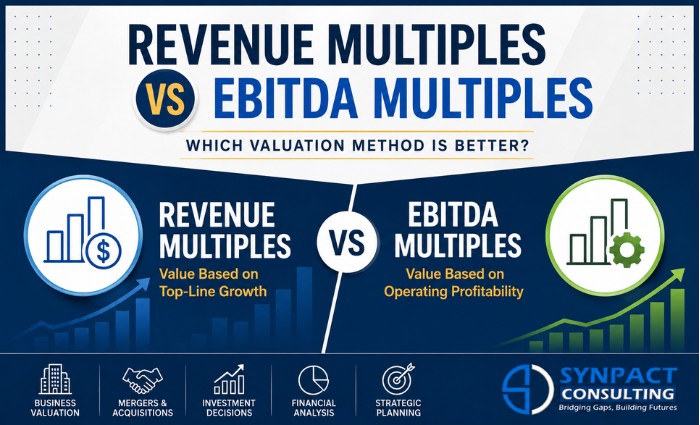
Revenue Multiples vs EBITDA Multiples: Which Valuation Method Is Better?
Business valuation is both an analytical process and a matter of professional judgment. Investors, private equity firms, business owners, investment bankers, and valuation professionals use a variety of valuation techniques to estimate what a company is worth. Among the most widely used market-based approaches are Revenue Multiples and EBITDA Multiples.
Although both methods compare a company’s financial performance with market evidence from similar businesses, they measure different aspects of value and are appropriate under different circumstances.
One of the most common questions business owners ask is:
Should my company be valued using a Revenue Multiple or an EBITDA Multiple?
The answer depends on several factors, including:
- The company’s stage of development
- Profitability
- Industry characteristics
- Growth prospects
- Cash flow generation
- Availability of comparable companies
- Purpose of the valuation
Neither valuation multiple is universally superior.
Instead, valuation professionals evaluate the specific characteristics of the business before determining which multiple—or combination of multiples—provides the most meaningful estimate of value.
What Are Valuation Multiples?
A valuation multiple compares a company’s market value with one of its financial metrics.
Rather than estimating value solely through projected future cash flows, valuation multiples use observable market evidence to determine how investors value comparable businesses.
Common valuation multiples include:
- Enterprise Value to Revenue (EV/Revenue)
- Enterprise Value to EBITDA (EV/EBITDA)
- Enterprise Value to EBIT (EV/EBIT)
- Price-to-Earnings (P/E)
- Price-to-Book (P/B)
Each multiple serves a different purpose and provides a different perspective on business value.
The two most commonly used Enterprise Value multiples are EV/Revenue and EV/EBITDA.
Why Investors Use Valuation Multiples
Market participants often prefer valuation multiples because they reflect how similar businesses are currently being valued by investors.
Rather than relying entirely on long-term forecasts, multiples provide a practical market benchmark based on observable pricing.
Valuation multiples are widely used in:
- Business valuation
- Mergers and acquisitions
- Private equity investments
- Investment banking
- Financial reporting
- Corporate finance
- Strategic planning
- Fairness opinions
When applied appropriately, market multiples provide valuable evidence that complements income-based valuation methods such as Discounted Cash Flow analysis.
What Is a Revenue Multiple?
A Revenue Multiple compares Enterprise Value with annual revenue.
It answers the question:
How much are investors willing to pay for each dollar of annual revenue generated by the business?
Revenue multiples are particularly useful when businesses:
- Generate limited profits
- Operate in high-growth industries
- Are investing heavily in expansion
- Have not yet reached stable EBITDA margins
Early-stage technology companies, SaaS businesses, biotechnology firms, and venture-backed startups are often valued using Revenue Multiples because current earnings may not fully reflect future value creation.
What Is an EBITDA Multiple?
An EBITDA Multiple compares Enterprise Value with Earnings Before Interest, Taxes, Depreciation, and Amortization.
It answers a different question:
How much are investors willing to pay for each dollar of operating earnings generated by the business?
EBITDA multiples are commonly used for mature businesses that generate stable operating profits and positive cash flow.
Unlike Revenue Multiples, EBITDA Multiples incorporate operating profitability, making them particularly useful when comparing established businesses with sustainable earnings.
Why Revenue and EBITDA Multiples Produce Different Valuations
Two companies may generate identical revenue but have very different profitability.
For example:
| Metric | Company A | Company B |
|---|---|---|
| Revenue | $100 million | $100 million |
| EBITDA Margin | 28% | 8% |
| EBITDA | $28 million | $8 million |
If both companies were valued using only Revenue Multiples, they could receive similar Enterprise Values despite generating significantly different operating earnings.
An EBITDA-based valuation, however, would recognize these profitability differences and may assign materially different values.
This example illustrates why valuation professionals carefully evaluate which multiple best reflects the economics of the subject business.
There Is No Universal “Best” Multiple
Business owners often ask whether Revenue Multiples or EBITDA Multiples are more accurate.
Professional valuation specialists generally avoid treating one method as universally superior.
Instead, they consider:
- The company’s lifecycle stage
- Whether EBITDA is positive and sustainable
- The predictability of future revenue
- The availability of comparable market data
- The purpose of the valuation
- Industry valuation practices
In many engagements, both Revenue Multiples and EBITDA Multiples are analyzed together before determining the final valuation conclusion.
How Valuation Professionals Choose Between the Two
Selecting the appropriate multiple involves far more than choosing the industry’s average valuation ratio.
Professionals analyze:
- Business model
- Growth prospects
- Profitability
- Cash flow generation
- Capital requirements
- Competitive position
- Market conditions
- Comparable companies
Only after evaluating these factors do they determine whether Revenue Multiples, EBITDA Multiples, or a combination of both provides the most reliable indication of value.
What You’ll Learn in This Guide
In the sections that follow, we’ll explain:
- How Revenue Multiples are calculated
- How EBITDA Multiples are calculated
- The advantages and limitations of each method
- When each multiple is most appropriate
- Industry-specific applications
- How investors select valuation multiples
- Practical valuation examples
- Common valuation mistakes
- Frequently asked questions
Whether you’re preparing to sell a business, evaluating an acquisition, raising capital, or seeking a better understanding of business valuation, this guide will help you understand when Revenue Multiples and EBITDA Multiples should be used—and why professional judgment remains essential in selecting the appropriate valuation approach.
Key Takeaway
Revenue Multiples and EBITDA Multiples are both important market-based valuation tools, but they serve different purposes. Revenue Multiples focus on the value investors assign to a company’s sales, while EBITDA Multiples focus on operating profitability. The most appropriate method depends on the company’s financial profile, growth stage, industry, and valuation objective. Rather than relying on a single metric, valuation professionals often evaluate both approaches to develop a balanced and well-supported valuation conclusion.
Understanding Revenue Multiples
Revenue Multiples are one of the most widely used market-based valuation methods, particularly for high-growth companies, startups, and businesses that have not yet achieved stable profitability.
Rather than valuing a company based on operating earnings, Revenue Multiples estimate value by comparing Enterprise Value with annual revenue.
This approach assumes that businesses generating similar revenue under similar market conditions may have comparable valuations after appropriate adjustments for growth, profitability, and risk.
Although Revenue Multiples should never be used in isolation, they provide valuable market evidence when earnings-based metrics such as EBITDA are not yet meaningful.
What Is a Revenue Multiple?
A Revenue Multiple measures how much investors are willing to pay for each dollar of a company’s annual revenue.
The most commonly used revenue multiple is:
Enterprise Value / Revenue (EV/Revenue)
This multiple compares the total value of the operating business with the revenue generated by that business.
Unlike Price-to-Sales ratios, EV/Revenue includes both debt and equity, making it more appropriate for comparing companies with different capital structures.
The EV/Revenue Formula
The formula is straightforward:
EV / Revenue = Enterprise Value ÷ Annual Revenue
For example:
- Enterprise Value: $180 million
- Annual Revenue: $60 million
The Revenue Multiple is:
$180 million ÷ $60 million = 3.0× Revenue
This indicates that investors are willing to pay approximately three times the company’s annual revenue.
Estimating Enterprise Value Using Revenue Multiples
Valuation professionals often reverse the formula to estimate Enterprise Value.
If comparable companies trade at an average EV/Revenue multiple of 4.5×, and the subject company generates annual revenue of $40 million, the estimated Enterprise Value would be:
Enterprise Value = Revenue × EV/Revenue Multiple
$40 million × 4.5 = $180 million
After estimating Enterprise Value, professionals adjust for debt, excess cash, preferred stock, and other balance sheet items to determine Equity Value.
Related Reading: Enterprise Value vs Equity Value: Understanding the Difference
Why Revenue Multiples Are Used
Revenue is generally one of the most stable financial metrics available.
Unlike EBITDA or Net Income, revenue is less affected by:
- Depreciation policies
- Interest expense
- Tax strategies
- Capital structure
- Temporary profitability fluctuations
This makes Revenue Multiples particularly useful when earnings do not yet reflect the company’s long-term value creation potential.
Companies That Commonly Use Revenue Multiples
Revenue Multiples are frequently applied to businesses where current profitability is not the primary driver of value.
Examples include:
- Software-as-a-Service (SaaS) companies
- Technology startups
- Artificial Intelligence companies
- Biotechnology firms
- High-growth healthcare businesses
- E-commerce platforms
- Digital marketplaces
- Subscription-based businesses
Many of these companies intentionally sacrifice short-term profitability to accelerate growth, increase market share, or develop proprietary technology.
Why Startups Often Use Revenue Multiples
Early-stage companies frequently report:
- Negative EBITDA
- Negative operating income
- Negative net income
Despite these losses, investors may still assign significant value because they expect future revenue growth and eventual profitability.
For this reason, venture capital firms often rely more heavily on Revenue Multiples than EBITDA Multiples during early funding rounds.
Revenue becomes the most meaningful indicator of commercial traction when earnings are still developing.
Enterprise Value and Revenue
Revenue Multiples use Enterprise Value rather than Equity Value.
This is because revenue is generated before considering financing costs.
Enterprise Value represents the value of the operating business available to all providers of capital, making it financially consistent with revenue.
Using Equity Value with revenue could distort comparisons between companies with different debt levels.
Illustrative Revenue Multiple Example
Assume a cloud software company reports:
| Item | Amount |
|---|---|
| Annual Revenue | $75 million |
| Selected EV/Revenue Multiple | 6.0× |
| Estimated Enterprise Value | $450 million |
If the company also has:
- Debt: $30 million
- Excess Cash: $20 million
The estimated Equity Value would be approximately:
$450 million − $30 million + $20 million = $440 million
This demonstrates how Revenue Multiples estimate Enterprise Value before arriving at shareholder value.
Advantages of Revenue Multiples
Revenue Multiples offer several important benefits.
- Useful for companies with negative EBITDA.
- Effective for early-stage and high-growth businesses.
- Less affected by accounting policies.
- Simple to calculate and communicate.
- Widely used in venture capital and technology sectors.
- Useful when profitability is temporarily depressed because of growth investments.
These advantages make Revenue Multiples particularly valuable when evaluating innovative businesses that prioritize long-term expansion over short-term earnings.
Limitations of Revenue Multiples
Despite their usefulness, Revenue Multiples also have important limitations.
Revenue alone does not indicate:
- Profitability
- Cash flow generation
- Operating efficiency
- Capital requirements
- Business risk
Two companies with identical revenue may generate dramatically different earnings and Free Cash Flow.
As a result, Revenue Multiples should be interpreted alongside other valuation metrics whenever possible.
Illustrative Comparison
| Metric | Company A | Company B |
|---|---|---|
| Revenue | $120 million | $120 million |
| EBITDA Margin | 30% | 6% |
| EBITDA | $36 million | $7.2 million |
If both companies receive identical Revenue Multiples, they may appear equally valuable despite having significantly different operating profitability.
This is one of the primary limitations of Revenue Multiples and one reason why mature businesses are often valued using EBITDA Multiples instead.
How Valuation Professionals Select Revenue Multiples
Revenue Multiples are not chosen randomly or based solely on published industry averages.
Professionals analyze numerous company-specific characteristics, including:
- Historical revenue growth
- Projected growth
- Recurring revenue percentage
- Gross margins
- Customer retention
- Market opportunity
- Competitive positioning
- Management quality
- Scalability
- Business risk
Companies demonstrating stronger growth, higher recurring revenue, and better competitive positioning generally command higher Revenue Multiples than slower-growing peers.
Industries Where Revenue Multiples Are Most Common
Revenue Multiples are especially common in industries where future growth is considered more important than current earnings.
| Industry | Primary Multiple |
|---|---|
| SaaS | EV / Revenue |
| Technology Startups | EV / Revenue |
| Artificial Intelligence | EV / Revenue |
| Biotechnology | EV / Revenue |
| FinTech | EV / Revenue |
| Subscription Businesses | EV / Revenue |
As companies mature and begin generating sustainable operating earnings, valuation often transitions toward EBITDA-based methods.
Revenue Multiples and Growth Expectations
Revenue Multiples are heavily influenced by expected future growth.
Investors may pay significantly higher multiples for companies expected to:
- Expand rapidly
- Increase market share
- Achieve operating leverage
- Improve future profitability
- Generate recurring subscription revenue
Consequently, two companies with similar current revenue can receive very different valuations depending on expected future performance.
Key Takeaway
Revenue Multiples estimate business value by comparing Enterprise Value with annual revenue. They are particularly useful for startups, high-growth businesses, and companies that have not yet achieved stable profitability. Although Revenue Multiples provide valuable market evidence, they do not directly measure operating profitability or cash flow. Professional valuation specialists therefore evaluate Revenue Multiples alongside other valuation methods to ensure that the final valuation reflects both current performance and future earning potential.
Understanding EBITDA Multiples
EBITDA Multiples are among the most widely used valuation metrics for mature businesses with established operating histories, positive earnings, and reasonably predictable cash flow.
Unlike Revenue Multiples, which focus on business scale, EBITDA Multiples reflect both revenue generation and operating profitability.
This makes them especially useful when comparing businesses that have reached a stable stage of development and can demonstrate sustainable earnings.
What Is an EBITDA Multiple?
An EBITDA Multiple compares a company’s Enterprise Value with its Earnings Before Interest, Taxes, Depreciation, and Amortization.
The most commonly used EBITDA multiple is:
Enterprise Value / EBITDA (EV/EBITDA)
It answers the following question:
How much are investors willing to pay for each dollar of operating earnings generated by the business?
Because EBITDA excludes interest, taxes, depreciation, and amortization, it allows valuation professionals to compare operating performance across companies with different financing structures and accounting policies.
The EV/EBITDA Formula
The formula is:
EV/EBITDA = Enterprise Value ÷ EBITDA
For example:
- Enterprise Value: $160 million
- EBITDA: $20 million
The EV/EBITDA multiple is:
$160 million ÷ $20 million = 8.0× EBITDA
This means investors are valuing the operating business at approximately eight times its annual EBITDA.
Estimating Enterprise Value Using EBITDA Multiples
Valuation professionals can reverse the formula to estimate Enterprise Value.
If comparable companies trade at a median EV/EBITDA multiple of 9.0× and the subject company generates normalized EBITDA of $15 million, the implied Enterprise Value would be:
Enterprise Value = EBITDA × Selected EV/EBITDA Multiple
$15 million × 9.0 = $135 million
Professionals then adjust Enterprise Value for debt, excess cash, preferred stock, minority interests, and other relevant items to estimate Equity Value.
Related Reading: Enterprise Value vs Equity Value: Understanding the Difference
Why EBITDA Multiples Are Widely Used
EBITDA Multiples are popular because EBITDA provides a practical measure of operating profitability before financing and certain accounting effects.
They help investors compare companies with different:
- Debt levels
- Tax structures
- Depreciation policies
- Amortization expenses
- Acquisition histories
This improves comparability and makes EV/EBITDA particularly useful in mergers and acquisitions, investment banking, private equity, and business valuation.
Companies Commonly Valued Using EBITDA Multiples
EBITDA Multiples are most useful for companies that generate positive and sustainable operating earnings.
Common examples include:
- Manufacturing businesses
- Distribution companies
- Healthcare service providers
- Professional service firms
- Engineering companies
- Business service providers
- Transportation businesses
- Mature software companies
- Established family-owned businesses
These businesses generally have sufficient operating history to support meaningful comparisons based on profitability.
Why Mature Businesses Often Use EBITDA Multiples
As companies mature, investors typically focus more heavily on:
- Operating profitability
- Cash flow conversion
- Margin stability
- Return on invested capital
- Debt capacity
Revenue growth remains important, but mature businesses are expected to convert revenue into sustainable earnings.
For this reason, EBITDA Multiples often provide a more economically meaningful valuation metric than Revenue Multiples for established companies.
Normalized EBITDA
Before applying an EBITDA Multiple, valuation professionals often calculate Normalized EBITDA.
Normalized EBITDA removes unusual, non-recurring, or owner-specific items that may distort the company’s sustainable operating performance.
Common adjustments may include:
- Above-market or below-market owner compensation
- One-time legal expenses
- Restructuring costs
- Acquisition-related expenses
- Insurance recoveries
- Personal expenses paid through the business
- Extraordinary gains or losses
The purpose is to estimate the EBITDA that a typical buyer could reasonably expect after acquiring the business.
Illustrative EBITDA Multiple Example
Assume a privately held manufacturing company reports:
| Item | Amount |
|---|---|
| Reported EBITDA | $11 million |
| Owner Compensation Adjustment | +$500,000 |
| One-Time Legal Expense | +$250,000 |
| Normalized EBITDA | $11.75 million |
| Selected EV/EBITDA Multiple | 8.0× |
| Estimated Enterprise Value | $94 million |
If the company has:
- Debt: $14 million
- Excess Cash: $3 million
The estimated Equity Value would be:
$94 million − $14 million + $3 million = $83 million
Advantages of EBITDA Multiples
EBITDA Multiples offer several important benefits.
- They incorporate operating profitability.
- They reduce distortions caused by financing differences.
- They are widely accepted in M&A and private equity.
- They allow comparison across companies with different tax structures.
- They are relatively easy to calculate and communicate.
- They work well for established businesses with sustainable earnings.
These advantages make EV/EBITDA one of the most frequently used market-based valuation metrics.
Limitations of EBITDA Multiples
Despite their popularity, EBITDA Multiples have several limitations.
EBITDA does not directly account for:
- Capital expenditures
- Working capital requirements
- Debt repayments
- Cash taxes
- Differences in asset intensity
Two companies with identical EBITDA may produce significantly different Free Cash Flow if one requires substantially greater investment in equipment, inventory, or receivables.
For this reason, valuation professionals analyze EBITDA alongside cash flow, capital requirements, and other financial measures.
EBITDA Is Not the Same as Cash Flow
EBITDA is often used as a proxy for operating performance, but it should not be treated as actual cash flow.
A company may report strong EBITDA while generating limited cash because of:
- High capital expenditures
- Increasing inventory
- Slow customer collections
- Large working capital requirements
- Cash tax payments
Professional investors therefore evaluate EBITDA conversion into operating cash flow and Free Cash Flow before selecting a valuation multiple.
How Valuation Professionals Select EBITDA Multiples
The selected multiple depends on the company’s financial and operational characteristics.
Professionals evaluate:
- Revenue growth
- EBITDA margin
- Cash flow quality
- Recurring revenue
- Customer concentration
- Company size
- Management quality
- Competitive position
- Capital intensity
- Industry conditions
- Market sentiment
Companies with stronger growth, margins, recurring revenue, and lower risk generally receive higher EBITDA Multiples.
Illustrative Peer Group Analysis
Assume a valuation professional identifies the following comparable companies:
| Company | Revenue Growth | EBITDA Margin | EV/EBITDA |
|---|---|---|---|
| Comparable A | 8% | 15% | 7.0× |
| Comparable B | 12% | 19% | 8.5× |
| Comparable C | 16% | 23% | 10.0× |
| Comparable D | 10% | 18% | 8.0× |
If the subject company has above-average growth and margins, the valuation professional may select a multiple near the upper end of the observed range.
If it has greater customer concentration or weaker cash conversion, a lower multiple may be more appropriate.
Industries Where EBITDA Multiples Are Common
EBITDA Multiples are commonly applied in industries where companies generate consistent and measurable operating earnings.
| Industry | Common Valuation Metric |
|---|---|
| Manufacturing | EV/EBITDA |
| Healthcare Services | EV/EBITDA |
| Professional Services | EV/EBITDA |
| Distribution | EV/EBITDA |
| Engineering Services | EV/EBITDA |
| Business Services | EV/EBITDA |
| Mature Software | EV/EBITDA and EV/Revenue |
The specific multiple selected depends on company-specific factors and current market evidence.
When EBITDA Multiples Are Most Appropriate
EBITDA Multiples are generally most appropriate when:
- The company has positive EBITDA.
- Operating earnings are sustainable.
- Comparable companies are available.
- Profitability is an important driver of value.
- The industry commonly uses EBITDA-based valuation.
- Financial information is reliable.
They may be less useful for early-stage companies, businesses with negative EBITDA, or companies whose value is driven primarily by assets or intellectual property rather than current earnings.
Key Takeaway
EBITDA Multiples estimate business value by comparing Enterprise Value with operating earnings before interest, taxes, depreciation, and amortization. They are most useful for mature businesses with positive, sustainable profitability and are widely applied in mergers and acquisitions, private equity, investment banking, and business valuation. Although EV/EBITDA provides a meaningful measure of operating value, professionals also evaluate normalization adjustments, capital expenditures, working capital, cash flow quality, and business risk before selecting an appropriate multiple.
Revenue Multiples vs EBITDA Multiples: A Side-by-Side Comparison
Revenue Multiples and EBITDA Multiples are both widely used market-based valuation tools, but they measure different aspects of business performance.
Revenue Multiples focus on business scale and sales generation, while EBITDA Multiples focus on operating profitability.
The most appropriate method depends on the company’s stage of development, profitability, industry, growth prospects, and the quality of available financial information.
Revenue Multiples vs EBITDA Multiples Comparison Table
| Revenue Multiples | EBITDA Multiples |
|---|---|
| Based on annual revenue. | Based on operating profitability. |
| Commonly expressed as EV/Revenue. | Commonly expressed as EV/EBITDA. |
| Useful for high-growth or unprofitable companies. | Useful for mature and profitable businesses. |
| Does not directly reflect profitability. | Incorporates operating margin performance. |
| Frequently used for startups and SaaS companies. | Frequently used in M&A and private equity. |
| Suitable when EBITDA is negative or unstable. | Suitable when EBITDA is positive and sustainable. |
| Highly influenced by growth expectations. | Influenced by growth, margins, and cash flow quality. |
Difference #1: Financial Metric Used
Revenue Multiples
Revenue Multiples compare Enterprise Value with annual sales.
They indicate how much investors are willing to pay for each dollar of revenue generated by the company.
This approach is most useful when profitability has not yet stabilized or when the company is deliberately reinvesting heavily in growth.
EBITDA Multiples
EBITDA Multiples compare Enterprise Value with operating earnings before interest, taxes, depreciation, and amortization.
They indicate how much investors are willing to pay for each dollar of EBITDA generated by the business.
This method provides greater insight into operating profitability and is more commonly used for established companies.
Difference #2: Profitability
The most important distinction between the two multiples is how they treat profitability.
Revenue Multiples do not directly account for operating costs or earnings.
Two companies with identical revenue may receive similar revenue-based valuations even if their EBITDA margins are significantly different.
EBITDA Multiples, however, directly incorporate profitability and therefore distinguish more clearly between efficient and inefficient businesses.
Illustrative Example
| Metric | Company A | Company B |
|---|---|---|
| Revenue | $100 million | $100 million |
| EBITDA Margin | 25% | 7% |
| EBITDA | $25 million | $7 million |
A Revenue Multiple may suggest similar values because both companies generate the same sales.
An EBITDA Multiple would likely assign a substantially higher value to Company A because it generates stronger operating earnings.
Difference #3: Business Lifecycle
Early-Stage and High-Growth Businesses
Revenue Multiples are often more appropriate when:
- The company is in an early growth stage.
- EBITDA is negative.
- Management is investing heavily in expansion.
- Current profitability does not represent long-term potential.
- Revenue growth is the primary valuation driver.
Mature and Profitable Businesses
EBITDA Multiples are generally more useful when:
- The business has a stable operating history.
- EBITDA is positive and sustainable.
- Operating margins can be compared reliably.
- Profitability is a key driver of value.
- Comparable companies report meaningful EBITDA.
Difference #4: Industry Application
Different industries rely on different valuation metrics because their economics vary.
| Industry | Commonly Used Multiple |
|---|---|
| Early-Stage SaaS | EV/Revenue |
| Artificial Intelligence | EV/Revenue |
| Biotechnology | EV/Revenue |
| FinTech Startups | EV/Revenue |
| Manufacturing | EV/EBITDA |
| Healthcare Services | EV/EBITDA |
| Professional Services | EV/EBITDA |
| Distribution | EV/EBITDA |
| Mature Software Companies | EV/Revenue and EV/EBITDA |
The preferred multiple depends on how investors typically evaluate companies within the industry and whether revenue or operating earnings provide the more meaningful indicator of value.
Difference #5: Sensitivity to Growth
Revenue Multiples are highly sensitive to expected growth.
Investors may assign premium multiples to companies with:
- Rapid revenue expansion
- Large addressable markets
- Strong customer acquisition
- High recurring revenue
- Scalable business models
EBITDA Multiples are also influenced by growth, but they place greater emphasis on whether that growth translates into sustainable profitability.
A fast-growing company with weak margins may justify a strong Revenue Multiple but a less attractive EBITDA-based valuation.
Difference #6: Cash Flow Relevance
Neither Revenue nor EBITDA is the same as Free Cash Flow.
However, EBITDA generally provides a closer indication of operating cash-generating ability than revenue.
Investors still evaluate:
- Working capital requirements
- Capital expenditures
- Cash taxes
- Debt service
- Cash conversion
A company may have strong EBITDA but limited Free Cash Flow if its operations require substantial capital investment.
Revenue Multiples provide even less direct insight into cash flow because they do not consider operating expenses.
Difference #7: Comparable Company Requirements
Both methods depend on reliable market evidence.
Revenue Multiples require comparable companies with similar:
- Growth rates
- Revenue quality
- Recurring revenue percentages
- Gross margins
- Market opportunities
EBITDA Multiples require comparables with similar:
- Operating margins
- Growth prospects
- Capital intensity
- Cash flow quality
- Business risk
Weak comparable company selection can materially distort either valuation approach.
When Revenue Multiples May Be Better
Revenue Multiples may provide a more meaningful valuation indication when:
- EBITDA is negative.
- The company is investing heavily in growth.
- Revenue is recurring and predictable.
- The business operates in a high-growth market.
- Comparable companies are commonly valued on revenue.
- Current earnings do not represent long-term profitability.
They are particularly useful for early-stage technology and subscription-based companies.
When EBITDA Multiples May Be Better
EBITDA Multiples may be more appropriate when:
- The company has positive and sustainable EBITDA.
- Profitability differs meaningfully across comparable businesses.
- Operating efficiency is a key valuation driver.
- The company operates in a mature industry.
- Buyers and investors focus on operating earnings.
- Reliable EBITDA data is available.
For many mature operating companies, EV/EBITDA provides a more economically meaningful indication of value than EV/Revenue.
Can Both Multiples Be Used Together?
Yes.
Professional valuation specialists often analyze both Revenue Multiples and EBITDA Multiples, particularly when evaluating companies transitioning from growth to profitability.
Using both approaches provides several benefits:
- It offers multiple perspectives on value.
- It highlights the effect of operating margins.
- It helps test the consistency of valuation conclusions.
- It reduces reliance on a single financial metric.
- It improves market-based valuation support.
If both methods produce reasonably consistent results, confidence in the valuation generally increases.
If they differ materially, professionals investigate whether the difference is caused by growth, margins, risk, or comparable company selection.
Practical Valuation Example
Assume a privately held technology services company reports:
- Revenue: $60 million
- EBITDA: $9 million
- EBITDA Margin: 15%
- Revenue Growth: 14%
Comparable companies suggest:
- EV/Revenue Multiple: 2.5×
- EV/EBITDA Multiple: 9.0×
| Valuation Method | Calculation | Implied Enterprise Value |
|---|---|---|
| Revenue Multiple | $60M × 2.5× | $150 million |
| EBITDA Multiple | $9M × 9.0× | $81 million |
The significant difference suggests that the selected Revenue Multiple may reflect companies with stronger margins, higher recurring revenue, or greater growth.
A valuation professional would not simply average the two values.
Instead, they would investigate:
- Whether the peer group is truly comparable
- Whether EBITDA requires normalization
- Whether current margins are temporarily depressed
- Whether future margin expansion is reasonably expected
- Whether the Revenue Multiple should be adjusted downward
Decision Framework
| Company Characteristic | More Relevant Multiple |
|---|---|
| Negative EBITDA | Revenue Multiple |
| Rapid growth | Revenue Multiple |
| High recurring revenue | Revenue Multiple |
| Stable profitability | EBITDA Multiple |
| Mature operations | EBITDA Multiple |
| Strong cash conversion | EBITDA Multiple |
| Transitioning toward profitability | Both Multiples |
Why Professional Judgment Matters
Revenue Multiples and EBITDA Multiples are not mechanical shortcuts.
Reliable application requires analysis of:
- Industry practices
- Comparable company quality
- Revenue growth
- Profitability
- Recurring revenue
- Cash flow
- Business risk
- Market conditions
The most appropriate multiple is the one that best reflects the economic characteristics of the subject company—not simply the multiple that produces the highest value.
Key Takeaway
Revenue Multiples and EBITDA Multiples evaluate business value from different perspectives. Revenue Multiples are generally more useful for early-stage, high-growth, or unprofitable companies, while EBITDA Multiples are typically more meaningful for mature businesses with stable operating earnings. Neither method is universally superior. Professional valuation specialists often evaluate both multiples, reconcile differences, and determine which approach best reflects the company’s growth, profitability, risk, and long-term earning potential.
Common Mistakes When Using Revenue and EBITDA Multiples
Revenue Multiples and EBITDA Multiples are useful valuation tools, but they can produce misleading conclusions when applied without proper analysis.
The calculations themselves are relatively simple. The real challenge lies in selecting appropriate comparable companies, normalizing financial performance, understanding industry practices, and determining which multiple best reflects the economics of the subject business.
Below are some of the most common mistakes valuation professionals seek to avoid.
Using Industry Averages Without Company-Specific Analysis
Published industry multiples can provide useful market context, but they should not automatically be applied to every company operating within that industry.
Businesses may differ significantly in:
- Growth rate
- Profitability
- Recurring revenue
- Customer concentration
- Company size
- Capital requirements
- Competitive position
- Business risk
A reliable valuation requires evaluating how the subject company compares with the businesses underlying the published multiples.
Using Revenue Multiples Without Considering Profitability
Revenue Multiples do not directly reflect operating expenses or profit margins.
Two companies with identical revenue may generate dramatically different EBITDA and Free Cash Flow.
Applying the same Revenue Multiple to both businesses may overvalue the less profitable company and undervalue the stronger performer.
Valuation professionals therefore consider gross margins, EBITDA margins, expected margin expansion, and cash flow alongside revenue-based metrics.
Using EBITDA Multiples When EBITDA Is Negative or Unstable
EV/EBITDA is generally not meaningful when EBITDA is negative.
It may also be unreliable when current EBITDA is unusually low, temporarily inflated, or highly volatile.
In these situations, professionals may consider:
- Revenue Multiples
- Discounted Cash Flow analysis
- Recent financing transactions
- Asset-based methods
- Forward EBITDA, when reliably supportable
Failing to Normalize EBITDA
Reported EBITDA may contain unusual, owner-specific, or non-recurring items that do not reflect sustainable performance.
Potential adjustments may include:
- Above-market owner compensation
- Personal expenses paid through the business
- One-time legal costs
- Restructuring expenses
- Acquisition-related costs
- Insurance recoveries
- Extraordinary gains or losses
Applying a market multiple to unadjusted EBITDA can materially distort value.
Ignoring Differences in Revenue Quality
Not all revenue has the same economic value.
Investors generally view recurring, contracted, and diversified revenue more favorably than project-based, concentrated, or unpredictable sales.
Professionals evaluate:
- Recurring revenue percentage
- Customer retention
- Contract duration
- Customer concentration
- Revenue visibility
- Pricing stability
A company with higher-quality revenue may justify a stronger Revenue Multiple than a business generating the same sales through less predictable sources.
Ignoring Capital Expenditure and Working Capital Requirements
EBITDA does not deduct capital expenditures or changes in working capital.
A company may report strong EBITDA while generating limited Free Cash Flow because it must continually invest in:
- Equipment
- Inventory
- Accounts receivable
- Technology
- Facilities
Valuation professionals therefore assess the cash conversion characteristics of the business before relying heavily on EBITDA Multiples.
Using Inappropriate Comparable Companies
The quality of a market-based valuation depends heavily on the quality of the peer group.
Potential comparables should be evaluated based on:
- Industry and subsector
- Business model
- Company size
- Growth rate
- Margins
- Geographic markets
- Customer profile
- Capital intensity
- Risk profile
Companies that share only a broad industry classification may not provide meaningful valuation evidence.
Using Outdated Market Data
Valuation multiples change as market conditions evolve.
Important factors include:
- Interest rates
- Inflation
- Economic growth
- Credit availability
- Investor sentiment
- Industry transaction activity
Using outdated multiples may produce a valuation that no longer reflects current investor expectations.
Confusing Enterprise Value with Equity Value
Both EV/Revenue and EV/EBITDA produce an indication of Enterprise Value.
To estimate Equity Value, professionals generally adjust for:
- Debt
- Preferred stock
- Minority interests
- Debt-like items
- Excess cash
- Non-operating assets
Failing to complete this bridge may cause business owners to misunderstand the value ultimately attributable to shareholders.
Related Reading: Enterprise Value vs Equity Value: Understanding the Difference
Choosing the Multiple That Produces the Highest Value
The purpose of valuation is not to select the method that produces the most favorable result.
The objective is to identify the multiple that best reflects the company’s financial profile, market position, and long-term economic characteristics.
A credible valuation should explain why a particular multiple was selected and why other methods received less weight.
Frequently Asked Questions
What is the main difference between Revenue Multiples and EBITDA Multiples?
Revenue Multiples compare Enterprise Value with annual sales, while EBITDA Multiples compare Enterprise Value with operating earnings before interest, taxes, depreciation, and amortization.
Which multiple is better for startups?
Revenue Multiples are often more useful for startups because many early-stage businesses have negative or unstable EBITDA. Revenue may provide a clearer indication of commercial traction and growth.
Which multiple is better for mature businesses?
EBITDA Multiples are generally more meaningful for mature businesses with positive and sustainable operating earnings because they incorporate profitability.
Can both multiples be used in the same valuation?
Yes. Valuation professionals frequently analyze both Revenue and EBITDA Multiples to evaluate business scale, profitability, and the consistency of market-based valuation indications.
Why do companies with the same revenue have different values?
Differences in margins, growth, recurring revenue, customer concentration, capital requirements, management quality, and business risk can result in materially different values.
Why do high-growth technology companies use Revenue Multiples?
High-growth technology companies may be reinvesting heavily in expansion and therefore report limited or negative EBITDA. Revenue Multiples allow investors to evaluate scale and growth before profitability has stabilized.
Why is Enterprise Value used in both multiples?
Revenue and EBITDA are measured before financing costs. Enterprise Value also reflects the operating business before financing structure, making the numerator and denominator financially consistent.
What is normalized EBITDA?
Normalized EBITDA adjusts reported earnings for unusual, non-recurring, discretionary, or owner-specific items to estimate sustainable operating performance.
Are higher valuation multiples always better?
Not necessarily. Higher multiples may reflect stronger growth and lower risk, but they may also indicate aggressive market pricing. The selected multiple must be supported by company-specific fundamentals.
Can Revenue Multiples overvalue a company?
Yes. Revenue Multiples may overstate value when the company has weak margins, poor cash conversion, high customer concentration, or limited prospects for achieving sustainable profitability.
Can EBITDA Multiples undervalue a growth company?
Yes. Current EBITDA may be temporarily depressed because of investments in sales, technology, or geographic expansion. In such cases, Revenue Multiples or forward earnings analysis may provide additional insight.
Should market multiples be used without a DCF valuation?
They can serve as a primary approach when high-quality market data exists, but professionals often compare the results with a Discounted Cash Flow analysis or another valuation method.
Conclusion
Revenue Multiples and EBITDA Multiples are both valuable market-based valuation tools, but they serve different purposes.
Revenue Multiples are generally more appropriate for high-growth, early-stage, or unprofitable businesses where current earnings do not fully represent future potential.
EBITDA Multiples are typically more meaningful for mature companies with positive, sustainable operating earnings and established profitability.
Neither multiple should be applied mechanically.
A reliable valuation requires careful consideration of:
- Business lifecycle
- Revenue quality
- Growth prospects
- Profitability
- Cash flow conversion
- Capital requirements
- Comparable company quality
- Industry conditions
- Business risk
In many professional engagements, both multiples are analyzed and reconciled with other valuation methods before reaching a final conclusion.
The appropriate valuation multiple is not necessarily the one that produces the highest value. It is the one that most accurately reflects the economic characteristics and future prospects of the business.
How Synpact Consulting Can Help
At Synpact Consulting, our valuation professionals help business owners, investors, CPA firms, investment banks, private equity firms, and corporate finance teams determine and apply appropriate Revenue and EBITDA Multiples.
Our valuation support includes:
- Comparable Company Analysis
- Revenue Multiple Valuation
- EV/EBITDA Analysis
- Precedent Transaction Analysis
- Normalized EBITDA Assessment
- Discounted Cash Flow Valuation
- Enterprise Value to Equity Value Reconciliation
- Mergers and Acquisitions Support
- Financial Reporting Valuation
- Independent Business Valuation
We combine current market evidence, financial analysis, and professional judgment to develop transparent and technically supported valuation conclusions tailored to the specific business and purpose of the engagement.
Contact Synpact Consulting to discuss how our valuation professionals can support your next business valuation, acquisition, financing, or strategic decision.
Related Insights:
- What Is Business Valuation and Why Does It Matter?
- How to Determine the Fair Market Value of a Business
- The Most Common Business Valuation Methods Explained
- DCF Valuation: A Practical Guide for Business Owners
- Capitalisation of Cash Flow Method Explained
- Market Approach vs Income Approach: Which Method Is Better?
- How Valuation Professionals Select Comparable Companies
- Enterprise Value vs Equity Value: Understanding the Difference